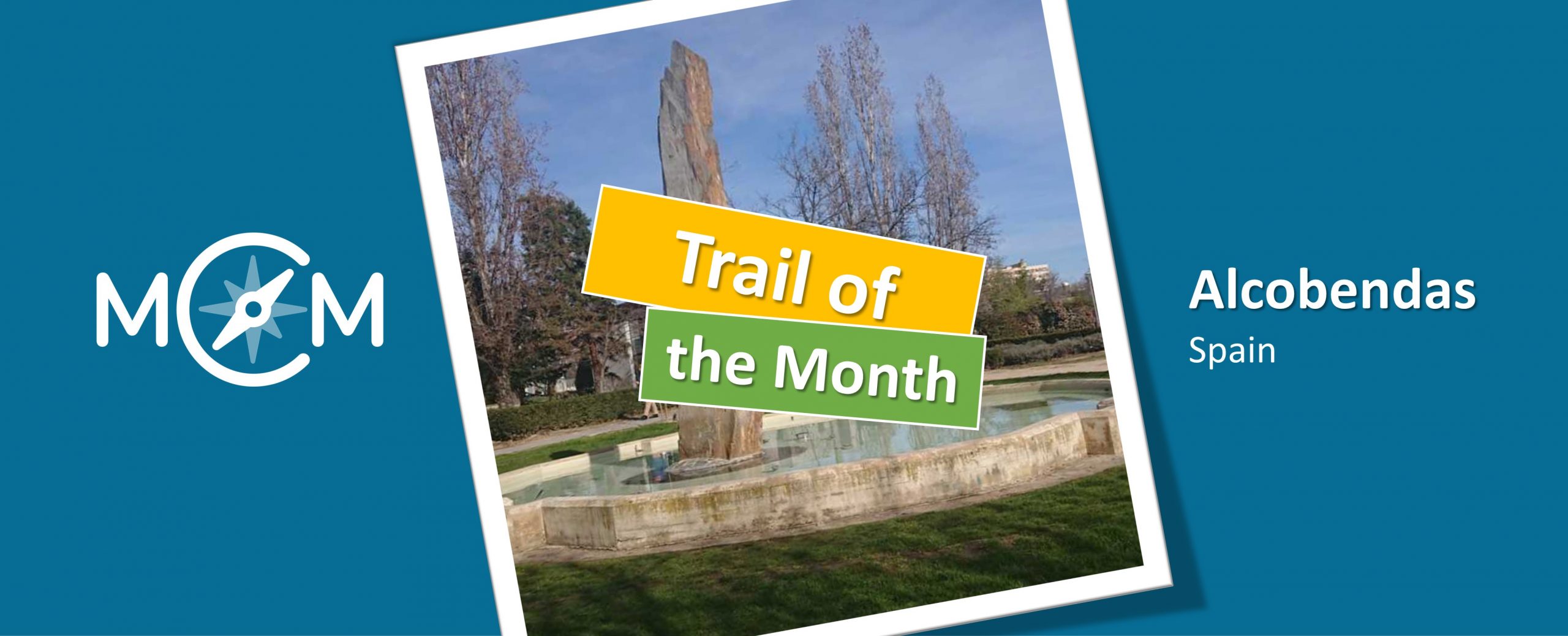
Our new Trail of the Month is located in Alcobendas, Spain. The trail in the town north of Madrid has been frequently used in teacher practice, as shown by the high number of more than 230 downloads. It was created by José Fernández de la Cigoña and Isabel Docampo for presenting MathCityMap during the Spanish mes de las matemáticas (month of mathematics; click here for the website and here for our report on the project).

In the following interview, José Fernández de la Cigoña highlights the use of the MathCityMap pirate narrative and introduces her trail Un paseo pirata matemático por el Jardín de La Vega”.

***

The following article was published in May 2021. Why we present it again?
José Fernández de la Cigoña and Isabel Docampo have since written a journal article about the trail and the MathCityMap pirate narrative, which can be accessed online here.

***

How do you get in contact with MathCityMap?

We got in touch with MathCityMap by the Spanish website Marzo, mes de las matemáticas from whom we were asked to prepare a trail to contribute to the month of mathematics. So, we looked for some information, signed up for the MathCityMap MOOC and started creating on our trail. We aim at a broad revision of learned topics, mainly geometry but also divisibility, probability or proporcionality, among others. 

Our students in school have already worked on the trail! In fact, we are a little surprised by the high number of downloads of our trail by other users.

Please describe your trail.

Our trail is placed in a park in Alcobendas, a city close to Madrid. The website Marzo, mes de las matemáticas guided us on the kind of tasks we could look for, and one great characteristic of this trail is that most of the tasks can be easily recreated in any city around the world [so-called Generic Tasks]. The special attribute of this trail lies in a story connecting all the tasks, a sort of pirate adventure based on the MathCityMap pirate narrative.

Please sketch one of your tasks. What is the mathematical question? How could you solve it?

The most inventive task in our trail is “La batalla final” (The final battle). It is located on a playground where you can find a pirate ship. The aim of the task is to find the probability of hitting the ship if you fire a cannon. So it’s about probability and geometry since you need to evaluate the ship area and the area of the playground to know the probability.

Why do you use the pirate narrative. What are its benefits?

Since we have been developed a pirate story, it seemed so natural to use the pirate narrative. In fact, this narrative inspired us to create the story.


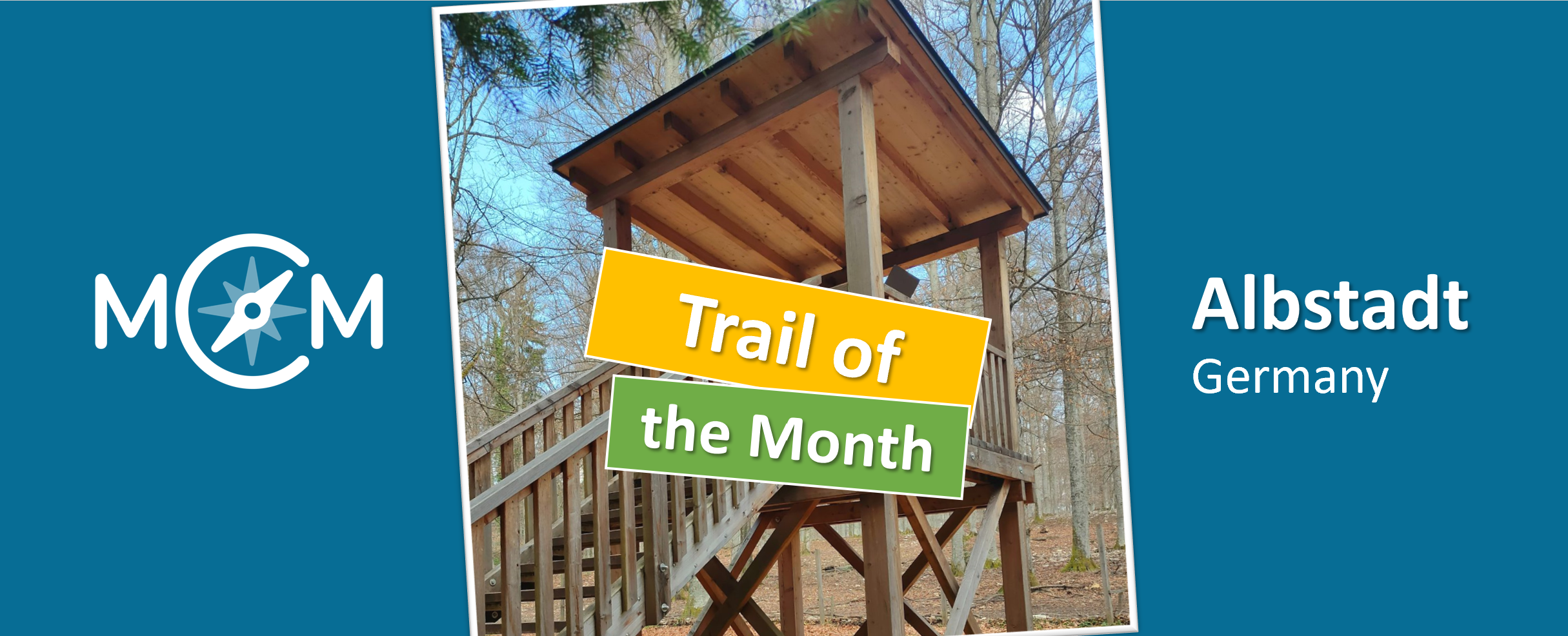
In August, the Trail of the Month comes from Albstadt, a city in the south of the German state of Baden-Württemberg. In a joint project, the Zollernalbkreis District Media Center and the Baden-Württemberg State Media Center created the “Traufgängerle Hexenküche (witch kitchen) in Albstadt” mathtrail here, which can be accessed with the MCM app under the code 459518 and is available on the MathCityMap web portal here.

The trail consists of a total of twelve tasks that are designed to cover all content-related competencies that need to be acquired in elementary school. While working on the tasks, you can experience one of the many special hiking trails around Albstadt, which gives this trail a very special atmosphere.

Silke Schick, educational associate at the State Media Center Baden-Württemberg and co-creator of the trail, gives us a short interview below about the creation of the trail and her work with MathCityMap. Enjoy reading!


How did you come across the MathCityMap project?

During a brainstorming session for the Media Competence Days of the district media centers and the Baden-Württemberg State Media Center in June of this year, we stumbled across MathCityMap and then connected it with the premium hiking trails in the city of Albstadt.
Since math teachers are on the team, the idea came up for the students to design a trail during the time of the media literacy days that would invite them outside, while also creating an area for teachers to use for long-term math field trips. In the course of this, we developed a training for teachers to introduce the portal.


Where is your trail located? What is special about your trail?

As a media center association, it is particularly important to us that the trail can be used by as many people of all ages as possible. Thus, we have chosen a trail that is located along a well-known hiking trail especially for children. This trail leads through a wooded area past a game preserve, there is a “witch’s kitchen” to discover and at the end it leads to an observation tower of a medieval castle. This trail can be used by families with children, grandparents with their grandchildren as well as school classes of elementary school or orientation school as an excursion destination and mathematical journey of discovery.


How do you use MCM and why?

The trail was a pilot project that will lead to us making similar project trails available throughout Baden-Württemberg. Starting in the upcoming 2022/2023 school year, advisors at district media centers will train local teachers on how to use MCM for their own schoolyard or city. A great option for doing math together outdoors.


Describe your favorite task on the trail. How can it be solved?

There are two favorites in the team:
In the “Albstadt Town Musicians” task, you have to find all the wooden animals in the forest, measure them and add up their height. As a team, you have to agree on where and how to measure.
The second favorite is the “Tower” station. The task is to count steps. We had three generations with us when we created it and ended up with three different solutions. The challenge was for everyone to find an optimal counting strategy on the way up and to keep it up. Fitness training was included.
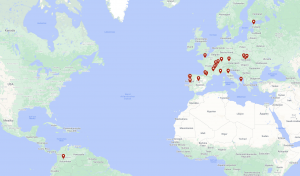


The current update extends MathCityMap with the possibility to include AR scenes as well as in the communication via the digital classroom. In addition, some bugs are fixed and the performance is significantly improved in some places.

Augmented Reality (AR) in MCM tasks


It is now possible to link MCM tasks with AR elements. Within the MASCE project, a portal specialized in the creation of AR scenes (marker or GPS-based) has been created under the name EducatAR (https://educatar.eu). After a short registration, AR scenes can be created there.

To link an MCM task with an AR scene, only the link to the AR scene has to be entered in the task form. In the MCM app, a new button now appears for tasks with AR, which takes the user directly to AR mode to view the scene.

Didactic ideas for using augmented reality will be discussed in a separate post in the near future.

Multimedia chat in the digital classroom


The chat functionality of the digital classroom has been extended in the portal to include the ability to send images and audio recordings. As part of this, the audio chat has also been extensively tested in the app and bugs have been fixed so that the functionality should now be available to all.

In addition, teachers in the digital classroom now have the option to “ping” individual groups to find out their approximate location. This feature is hidden behind a magnifying glass icon on the group tile.

Other changes:

  • The layout of tasks has been reworked with visual grouping to make it clearer.
  • The performance when loading profile data has been significantly increased.

All features will be fully available once the updated version of the MCM app has been fully rolled out.

We are very pleased to welcome the first Spanish MathCityMap partner school to our ever-growing network of partner schools! The “IES María Moliner” in the city of Segovia, north of Madrid, successfully went through the application process initiated by math teacher Sonia González Pascual.

In the following short report Sonia González Pascual describes the created trails at her school and she presents her experience with MathCityMap so far.

“At the moment we have two trails for different grade levels near our school, with
a total of 15 tasks created by myself.

These trails are designed for students ages 13 to 17. One of them “Volúmenes entorno al Acueducto”, can be used to practice calculating the Volumes of some simple three-dimensional figures to practice. In a fantastic historical setting students can calculate the volumes of stone figures they find while discovering the Roman aqueduct of Segovia: piramids, prisms, spheres, truncated cones… It is necessary to use a tape measure or something similar. Since it can often be difficult to find an exact solution, I often use the “interval” answer format.

The other trail “Frisos en pocos metros”, takes advantage of another important feature of our city: the “esgrafiado” or sgrafito. This is an architectural ornamental technique used to decorate plaster and wall coverings.
Stencils with serial geometric motifs are often used. In the trail, students have to look for plane movements in some sgraffito or window and balcony railings for example reflections or rotations. They learn about subgroups of isometry, often using the multiple choice format to enter the answers.

It is important to cross-link the knowledge that was acquired in a previous session in the classroom. Students are actually very motivated with the MCM app. The use of the cell phone, the search of the tasks via GPS and the possibility to leave the school make MathCityMap a very interesting learning environment.

I have already used our trails with MathCityMap with different students of different ages and they have rated it very positively. I have also shown the app and especially my trails to a group of math teachers. My goal is to bring this app and its possibilities to as many people as possible.”

The package with the official partner school plaque and the MCM measuring instruments is already on its way to Spain and we are very much looking forward to receiving more applications from all over the world.

All further information about the partner school program and the requirements for the application can be found in the article about the first MCM partner school as well as on the homepage of our project MaSCE³.


The last article on Generic Tasks deals with the most unusual category in the Task Wizard, GPS tasks. These tasks can be created by the wizard in a very short time and can be easily implemented on any larger area and can therefore be integrated into any trail as needed. The first article on Generic Tasks, which also tells you how to get to the Task Wizard and what Generic Tasks are, can be found here.

In the category of GPS tasks we are not bound to specific objects, which has to do with the approach of the tasks. For example, one possible task is:

“Walk a line AB which is 50 meters long.”

To create the task, you only need to define a place where the task is to be performed. The person performing the task then uses a GPS function in the app to set two points while walking that are 50 meters apart. The route can be either directional, i.e. running in a certain cardinal direction, or non-directional.


Other possible tasks are, for example, tracing a square or an isosceles triangle. In addition, as seen in the first image of this article, you can ask for points that are equidistant from two or three points previously determined in the app, such as the sculptures.

We hope that with this series of articles on Generic Tasks we were able to introduce you to our Task Wizard and its possibilities to simplify the process of creating tasks. Have fun trying it out!


Dear MathCityMap Users,

during the last years not only the MathCityMap system with its various functions has constantly developed. Our community has also continued to grow, for which we would like to thank you all very much!

In order to be able to develop interesting and customized innovations for you in the coming years, we would like to learn even more about our community. For this purpose, we have created a survey that you can access via the following link:

Click here for the survey!

We would be very pleased if you would participate in the survey and we thank you very much for your engagement with and for MathCityMap and for your feedback.

Your MathCityMap Team from Frankfurt

We are very happy to welcome again two schools in our partner school program. This time it is the “Zakladna skola Janka Matusku” from the city of Dolný Kubín in the north of Slovakia and the “Pombal Secondary School” from Pombal, a city in Portugal.

Both schools successfully completed the necessary application process. In Pombal, teachers Diana Santos, Ana Medeiros, Teresa Oliveira and Margarida Fonseca worked together on a total of three trails, each focusing on a different grade level and different content.

“The students were very enthusiastic and participative in this, and there was great feedback from the students that the knowledge they had acquired during the school year was applied in a different and more fun way” Diana Santos told us.

In Dolný Kubín, two diverse math trails were created by math teacher Klaudia Kovalcíková and tested with her students. She reports about the experience in the application process as follows:

“I have been working in education for about 3 years. In that short time, I have found that the most popular question my students ask me is, “What are we going to use this school stuff for? Where will I use this knowledge in my life?” So, instead of a humble answer, the idea of creating a math trail was born to show students how to apply math directly in the real world, in our city or in their environment. During the school year we made several trails through the town of Dolný Kubín. Dozens of photos of various objects, buildings and parks were taken and the students learned how to work in the Mathcitymap portal. They suddenly discovered that mathematics is not only a school subject, but it is in almost every object. It must be not only about its visual form, but also about its content value (for what reason was this object created, what does it symbolize, when was it built, …). We pass many memorial / information boards every day, but only now have we discovered that they not only reveal many mathematical possibilities for their use, but that thanks to them we also learn about the history of our city and its people.”

One of the students there also shared his experience with MathCityMap for us:

“Math Trails have given me more than just attending a regular class. What was the goal? We created tasks that we implemented outdoors, in a digital classroom. We learned about the town of Dolný Kubín and its history from a mathematical perspective. I would also like to thank our teacher Mrs. Kovalčíková for this opportunity.

I often go to Námestovo, but only now I found out that there is a statue of Ján Vojtaššák in front of the church (when we measured it with the other students). Until now, a meter for me was three thirty-centimeter yardsticks and a few centimeters more. Today, one meter is equal to two-thirds of a park bench, for example. I can calculate the volume of the bench, I know how many poles we need for it. I also figured out what the circumference of the fountain in our city is. Math was no longer just numbers, pencil, paper, ruler, interactive whiteboard…. We were outside touching our math problems, we measured them with a string, we looked for solutions together, etc. It was great. On the way home from school, I look around and think about what object will be our math problem next time. I’m looking forward to it.”

The package with the measuring tools and the official partner school plaque is already on its way to the schools and, as always, we are very much looking forward to receiving further applications from all over the world.

All further information about the partner school program and the prerequisites for the application can be found in the article about the first MCM partner school as well as on the homepage of our project MaSCE³.


The Trail of the Month July invites us to a mathematical walk through another European capital. This time we are in the beautiful city of Bern, Switzerland. The Trail of the Month was created by Damaris Burri as part of her master’s thesis at the PH Bern at the Institute for Secondary Level 1 and is available in the MCM app under the code 678321 and in the MathCityMap web portal here.

Running through the historic old town of Bern, the trail consists of a total of 12 tasks, some of which can be extended with sub-tasks. In terms of content, the tasks deal with topics from grades 7 to 9 (in Switzerland, the so-called third cycle), i.e. with areas and volume calculations, as well as gradients and units of measurement.

In the following interview Damaris Burri describes her experience with MathCityMap so far and gives additional background information about the trail:


How did you come across the MathCityMap project?

I came across the MathCityMap project during a mathematics didactics seminar at the PHBern. At the end of such a seminar, the lecturer introduced us in a few words to some links to websites that could be useful for teaching mathematics. One of these links led to the MathCityMap website. Looking for a topic for my master thesis, I remembered these links and explored MathCityMap and the world of mathtrails for the first time. I was thrilled and had found an exciting topic for my master thesis.


Where is your trail located? What is special about your trail?

Bern’s Old Town is a UNESCO World Heritage Site and forms the historic core of the Swiss federal city of Bern. The Mathtrail “Berner Altstadt” invites you on a mathematical tour of the city. With its total of twelve tasks, the trail leads past many sights, such as the Kindlifresserbrunnen, the Bern City Hall, the Bear Park, the Bern Cathedral and the Zytgloggen Tower. At each task, students can expect a mathematical problem based on 7th and 8th grade basic geometry knowledge, as well as background information about the object. The goal of the trail is to show the young people that mathematics can not only be done in the classroom, but that objects from everyday life are also suitable for calculating. Furthermore, the Mathtrail should be fun and a positive experience for the whole class.


How do you use MCM and why?

I developed the trail as part of my master’s thesis specifically as an extracurricular learning space for mathematics lessons in cycle 3 (secondary level 1), which can be used freely over the three school years (7th to 9th grade). In Switzerland, students in the upper grades (7th – 9th grade) are increasingly taught in mixed-level groups. My Trail takes the resulting heterogeneity into account with tiered clues and subtasks. Each task has at least two tiered hints that help the youngsters understand the task and find a possible solution path. They also point out possible stumbling blocks. In the case of tasks that exceed the subject matter of the 7th grade, the tasks were divided into several sub-tasks. These guide the young people step by step to the solution.

In order to be able to solve the tasks of the Mathtrails “Berner Altstadt”, each participating group (consisting of 3 -4 students) must be equipped with a smartphone, a set square, a double meter and a calculator.


Describe your favorite task on the trail. How can it be solved?

My favorite task is the task at the Zytglogge (time bell tower). The Zytglogge is one of the landmarks of Bern’s old town and was the first western gate before the city was expanded in the 13th and 14th centuries. The tower with its mechanical music box fascinated me already as a child. Every hour on the hour, the music box starts to play and the dancing bear train, the jester and the screaming rooster come to life.

The “Zytglogge” task refers to the doorway, where on one of the walls hang seven historical length measures that used to be used in the markets of Bern. In this task, the students have to indicate the length of the doorway to the length measure “Swiss foot”. To complete the task, learners must know and understand the principle of converting length measures. The students can determine the length of a Swiss foot both by measuring it or by observing it closely, because the length of 3/10 meter is engraved. To solve the task, they must also measure the length of the doorway and then convert the length obtained into “Swiss feet”.


A fantastic part of MathCityMap is our constantly growing international community. In this we now welcome the already fourth MCM partner school in Portugal, the “Escola EB 2,3 Dr. Pedro Barbosa” in Viano do Castelo.

The successful application process was accompanied by two pre-service math teachers, Ana Meira and Liliana Francisco, who reported on it as follows:

“Our first experience with MathCityMap was as students during our master’s program. We were so positively impressed by the app that we decided to create mobile Math Trails with our own students, two 6th grade classes. To apply the content taught in class, we created a trail about rational numbers (trail code: 099594) and another about symmetries (trail code: 145301).

Both groups reacted extremely well and enjoyed the opportunity to get outside, exploring the mathematics that surrounds them. The technology was an extra motivation, especially the gamification feature of the app and the possibility of accessing immediate feedback on their answers. The contents taught in the classroom acquired new meaning as the students could see the applicability in real context.

The package with the official partner school plaque and the MCM measuring instruments is already on its way to Portugal and we are very much looking forward to receiving more applications from all over the world.

All further information about the partner school program and the requirements for the application can be found in the article about the first MCM partner school as well as on the homepage of our project MaSCE³.