Dear MathCityMap Community,

We are delighted to welcome a new partner school, the secondary school IES Eugenio Frutos in Guareña (Spain). The math teacher Beatriz Blanco, who also initiated the application process, has sent us lots of exciting information about her city and her experiences with MathCityMap so far, which we would now like to share with you.

The town of Guareña has around 7000 inhabitants and its main economic activity is agriculture. Recently, however, an archaeological site called Turuñuelo was found, which has made the town one of the most interesting places in the region.

Beatriz Blanco and her school regularly use MathCityMap for outdoor learning in their town and the surrounding cities. Their main trail (code: 392194) is called “Una mirada matemática sobre Guareña”, which translates as “A mathematical look at Guareña”. This trail has already been used by various class levels and has been downloaded over 171 times in total.

There is also a trail in Spanish and English in a nearby town (Villanueva de la Serena), which the pupils of IES Eugenio Frutos can discover on their annual excursion to the town. The trail code in spanish is 199746.

The school was recognized for its great mathematical achievements by the regional government and several articles were subsequently written about it.

The package with the official partner school badge and the MCM measuring instruments is already on its way to Spain and we are already looking forward to receiving further applications from all over the world.

All further information on the partner school program and the requirements for the application can be found in the article on the first MCM partner school as well as on the homepage of our MaSCE³ project.

Dear MathCityMap-Community,

As we close out 2023, we would like to take a short trip through the last few months and look back on the many great events and developments that MathCityMap has had in store for us:

  • This year, the community has grown by 7,085 users and we are delighted to welcome all new members. This means that the MCM-Community now has over 25,000 users and has almost tripled in size in the last two years.
  • Furthermore, almost 25,000 new tasks have been added – more than ever before. This brings us to a total of 74,226 tasks worldwide, of which around 17,000 have been published!
  • We have also welcomed a new member to our team. Isabella Gogesch has been supporting us in the didactic support of the app since this year. She is also responsible for the content of the website and the social media pages (Instagram @mathcitymap.eu).
  • Our new Erasmus+project MATRIX (Math Trails with an Inclusive Perspective on Students Experiences) has started and we are looking forward to the new collaboration and the goals we want to achieve together over the next few years. In the future, students will also be able to create their own tasks and the app will be made more inclusive.
  • Of course, MCM was also present at international events. For example, we and our partners were able to present the system and its latest developments in Porto and Budapest. There were also numerous training courses and activities that brought MathCityMap closer to researchers, teachers and students.
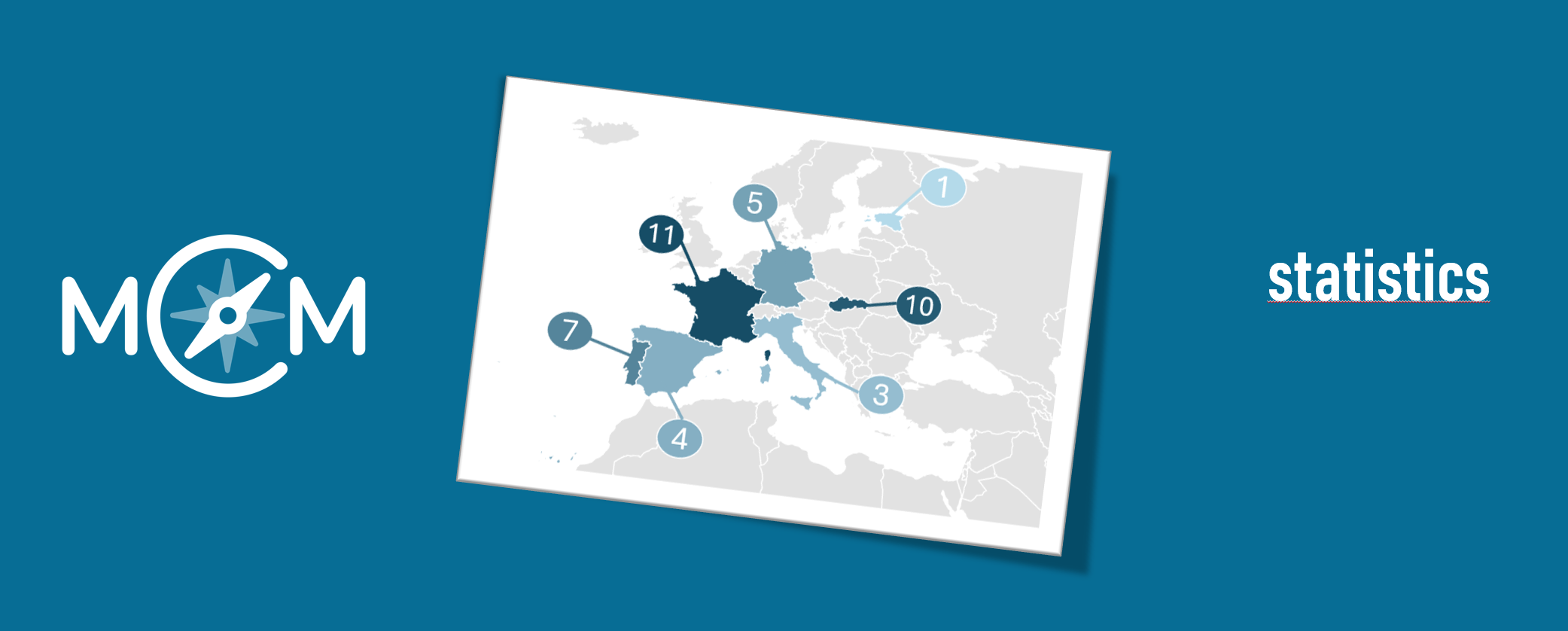
  • The partner school program launched as part of the MaSCE³-project has also been further expanded. There are now 39 official MathCityMap partner schools in a total of 9 countries that have successfully completed the application process and we are already looking forward to receiving many more applications from all over the world.

We are incredibly happy about the great developments of MathCityMap and the great cooperation with the partner schools and the community.
Thank you very much for your interest and enthusiasm to rediscover mathematics with us and to spread and share this knowledge. In this way, we can give many learners a different perspective on mathematics and change things step by step. None of this would be possible without our fantastic users, so thank you all very much!

We wish you and your families happy holidays, a Merry Christmas and a Happy New Year 2024. We look forward to discovering new and exciting challenges around the world with you and many new members in 2024.

Your MathCityMap-Team

We’re happy to welcome two new partner schools: the primary school Základná škola Kanianka in  Slovakia (Kanianka) and the secondary school Colegio María Reina Inmaculada in Spain (Santander).

Primary school teacher Daria Lubikova from Slovakia, who initiated the application process for the Základná škola Kanianka school, has already had many interesting experiences with MathCityMap at her school.

„The first point of interest is that I am a big fan of learning outdoors. Teaching outdoors is very illustrative and varied. In our facebook group of mathematics teachers we talked about various topics and one of them was MathCityMap. Then I studied alone, only with a manual. This manual is in Slovak language and is made very well. The second point of interest is digital literacy. For me it is natural. I am a teacher of computer science, but children need practical and functional skills. I found out – when students start the trails they are happy, they do mathematics and they are happy 🙂 They like to walk around the school and explore the tasks. They like working in groups. They like to use measuring tools. And they like to invent tasks for another group or for younger students. For now, only on paper, but we will see what options the future opens in MathCityMaps. We all like it – me and students, too. Thank you for all.“

These are some of the trails that Daria Lubikova has created for her students:

Trail-Code: 4712305

Trail-Code: 5617500

Trail-Code: 1317230

Finally, here are a few pictures of Daria Lubikova’s students measuring and discovering mathematics outdoors:


Teacher Cristina González Acero from the Colegio María Reina Inmaculada has also had great experiences with MathCityMap.

„The idea of using the Mathcitymaps application arose with the purpose of giving our students a chance to answer by themselves a never-ending question: What is the use of Maths in real life? Last academic year (2022/23) we created for our 2nd, 3rd and 4th Secondary School year students two Math-trails with different locations within the boundaries of our school. As a result, students could experience themselves that Maths aren’t just theoretical exercises to be solved in class. On the contrary, Maths are indeed really useful to mesure, calculate and solve problems of our daily life. Additionaly, this application let them enhance their teamwork, fostering peer collaboration and critical thinking; a truly exciting experience four our students! They are already thrilled to participate again in another activity!“

Among others, the students explored their surroundings using the trail (trail-code: 136223).

Of course, the package with the official partner school plaque and the MCM measuring instruments is already on its way to both schools and we are very much looking forward to receiving further applications from all over the world.

All further information about the partner school program and the requirements for the application can be found in the article about the first MCM partner school as well as on the homepage of our project MaSCE³.

November will be sporty with the trail of the month. The UR Sports Centre (UR Sportzentrum) mathtrail is located on the sports grounds of the University of Regensburg and was created there by several student teachers from the university.

The trail consists of a total of 10 tasks that combine the topics of sport and maths using various sports equipment and facilities. The trail is available on the web portal here and can be accessed in the app with the code 0116250.

Anna Hendlmeier, one of the students who created the trail, gives us an insight into working with MathCityMap at the University of Regensburg and the special features of this exciting mathtrail in an interview:

How did you come across the MathCityMap project?

I’m studying maths and sport to become a secondary school teacher and as part of my maths degree I chose a seminar that was about this project. As part of the seminar, we created 2 trails on the campus of the University of Regensburg, always in a group of 5 people. I found it very interesting and see it as a good opportunity to teach maths in a more practical way. The project was initiated by senior academic advisor Andreas Eberl, who is responsible for the didactics of maths at the university.

Please describe your mathtrail. What is special about the trail?

Our trail is located at the University of Regensburg’s sports centre and all the stations actually have something to do with sports facilities or equipment, which is special. Many students are more motivated because we have also created tasks that ask questions that you can ask yourself in everyday life. The trail is also located on the university campus, which can be very interesting for students as it relates to their possible future after graduating from high school.

How do you use MCM and why?

I used MCM in the course of the seminar and am very convinced of its usability and that it can be an enrichment for schools and teaching. I am therefore going to write my admission thesis on MCM and create a trail for a secondary school. With a view to my future career, I now know another way to get students excited about maths that can hardly be covered in normal lessons.

Describe your favourite task on the trail. How can it be solved?

My personal favourite task is “Game, set and match!” (Spiel, Satz und Sieg). In this task, 5 friends get together to play tennis and want to organise a tournament in which everyone plays against everyone else. They have booked the tennis courts for 90 minutes, the question now is how long a game can last so that all games are the same length. I really like this task as I think that application-based tasks are particularly important when it comes to combinatorics. This question has perhaps often been asked by someone in a different context. If you stand in front of the tennis courts, you can see that there are two tennis courts, so two games can take place at the same time. In the “everyone against everyone” mode, player A competes against players B, C, D, E: Makes four matches. Player B then has to compete against players C, D, E: Another three games. Player C against players D, E: Two more games. Player D only has to play against player E. Then everyone has played each other once and we get a total of 10 games. (4 + 3 + 2 + 1 = 10) So there are five rounds. If these game rounds are to be evenly distributed over the 90 minutes, a game round, i.e. a single game, must last 18 minutes.

Once again, there is a new MathCityMap partner school in Germany! The Dürer-Gymnasium in Nuremberg is the fourth German school to join our network and we were very pleased with the creative tasks and trails that were created for the successful application.

“At the beginning of our project seminar at Dürer-Gymnasium Nuremberg, we set ourselves the goal of becoming a MathCityMap partner school. For this purpose, a total of four trails were created in the immediate vicinity of our school. Prior to the publication of these trails, three different classes in grades 5-9 have already completed them with the help of our supervision. These students mostly enjoyed working on the tasks in class and we hope to have inspired both teachers and students at our school for MathCityMap,” wrote teachers Anne Wagner and Quang Bach Duon, who were largely in charge of their school’s application.

The different trails can be found in the web portal and in the app as follows:

Fürther Straße” with the code 0413379

Renovierung des Wiesengrunds” with the code 2313070

Reutersbrunnenstraße” with the code 1714621

Der Fürtherstr. Rundkurs” with the code 7813414

The package with the official partner school badge and the MCM measuring instruments has already been delivered and we are looking forward to receiving more applications from all over the world.

All further information on the partner school programme and the requirements for application can be found both in the article on the first MCM partner school and on the homepage of our MaSCE³ project.


The fact that creating mathtrails is sustainable is proven by the mathtrail “Berner Altstadt” (Bern Oldtown), which with 99 downloads is one of the most downloaded trails of the past weeks and thus fits perfectly into our category “Popular Mathtrails”. Already created two years ago, it has now been revived by teacher Damaris Burri, who told us in a short interview how it came about and what new activities she is planning with MathCityMap.


How did it happen that the trail was downloaded so often?

The mathtrail “Berner Altstadt” was created as part of my master thesis. In the meantime, I have been working at the school in Grindelwald for a year and since this August I have been the class teacher of the 7th class B. Last month we visited the BAM ( Career and Education Fair) in Bern, together with the parallel class and the 8th grade. As a school class, we were assigned a time slot. For us it was the afternoon. It takes 2 hours by train from Grindelwald to Bern, so we wanted to spend the whole day in Bern. This was ideal to try out my mathtrail with a class. The other two class teachers thought this was a great idea. So we visited the Mathtrail “Berner Altstadt” with 58 students.

In addition, it may well be that other schools used the BAM, which lasted a whole week, as an occasion for a trail visit.


What will you work on next with MathCityMap?

In the last two years I have not done much with MathCityMap. A little more than a year ago I revised my 1st private trail “Von Roll Areal” so that it can be published. After that there was a break until now. After the fall vacations I will start a trail for Grindelwald with the students in the gifted program. This should be for 5 – 6th grade. The children are already excited about the project.


Yesterday, MathCityMap was not to be missed at the State of Hesse’s Landesfachtag 2023 on the topics of media education and digitalization. Framed in a great program of lectures and presentations, which was organized by the Goethe University Frankfurt and the Hessian Ministry of Education, our Frankfurt MathCityMap team was on site and could, for example, inform and inspire many of the teachers about the possibilities of MathCityMap as a learning environment with a small pop-up station.

In addition, there was a comprehensive workshop on MathCityMap, in which a total of 13 teachers from primary and secondary schools participated. After a theory-based introduction by our team, the teachers went out to the university campus, where they took on the role of students and tried out a trail with the MathCityMap app.

We were very pleased about the great interest at the Landesfachtag and are already excited to see which new trail ideas will be implemented at schools in Hesse!

The trail of the month August is located in a city that is always worth a visit and now can also be rediscovered through mathematical eyes. We are talking about Venice and the mathtrail “Altstadt Venedig” (Oldtown Venice), which, as the name suggests, leads through the narrow streets and over the bridges in the old town.

The trail, which can be found on the web portal here and in the app under the code 2616643, was created by Günter Kämpfert, a math teacher from the city of Hanover in Germany, and the students in his upper secondary school class.

In a short interview, Mr. Kämpfert gives us an insight into his work with MathCityMap so far and the creation of this wonderful mathtrail.

How did you come across the MathCityMap project?

A few years ago, I came across the MathCityMap project through a didactic article in the magazine “mathematik lehren”.
After initial experiments with existing trails in Hanover, the students in my upper-level course were asked to create their own tasks.
After getting to know an existing trail in Hanover, we first tested the procedure by creating small tasks in the school and on the school grounds.

Please describe your mathtrail. What is special about the trail?

For the study trip to Venice in October 2022, the students in my upper-level course were to create their own MathCityMap tasks in the old city of Venice. To do this, they worked in small groups on tasks that they then had to present and explain in a short written paper. The existing mathtrail was created from the existing tasks of the whole course. The old town of Venice offers many historical buildings, archways and bridges, which can be discovered and viewed with mathematical eyes in a completely new – and different – way. Creating mathematical tasks should encourage people to perceive their own environment as a place where mathematics can occur.

How do you use MCM and why?

The existing app can be easily used by all students on their mobile phones. Photos that are needed for an assignment can be created directly with the cell phone and inserted into the app. Working with the app is largely intuitive. For working on assignments, we have set up a group in the app so that all students can access the assignments shared in it. In addition, this also enables everyone to support each other. For working on the tasks that are created in school, we use the helpful trail code, which also allows the tasks that have not yet been published to be used.

Describe your favorite task on the trail. How can it be solved?

The “Bridge Arch” task deals with what is probably one of the most impressive experiences of any Venice tourist walking through the old city: countless bridges and canals. The Ponte del Teatro is located in the heart of Venice, crosses the Rio San Luca and is a modern bridge in the style of ancient Venetian architecture. The context of the task (a necessary modification of the bridge arch) is fictitious, but conceivable. To solve the task, the bridge arch can be modeled in a simplified way using a quadratic function. For this purpose, suitable measured values must first be collected and the function equation of the corresponding parabola must be determined. A stretching factor may only shift the high point of the parabola so far that the slope at the edges of the arc does not exceed 45 degrees. This condition results in the stretch factor we are looking for, which can now be used to calculate the position of the new high point of the parabola. With these coordinates, the permissible elevation of the bridge arch high point can then be calculated.

The first half of 2023 was also an exciting time for all students and teachers who wanted to get to know Mathtrails in Portugal. In May and June, a total of 300 students and teachers participated in events as part of our MoMaTrE project. These events were accompanied by Professor Amélia Caldeira from the University of Porto and a special guest was certainly the Councilor for Education, Fernando Paulo, who could convince himself of the enthusiasm that mathematics can trigger outside. In the context of the events a great video was created, which we of course do not want to withhold.


Further events and trainings for MathCityMap and our partner project ASYMPTOTE are already planned for fall 2023 and spring 2024 in Portugal. These will be especially promoted by SPM (Sociedade Portuguesa de Matemática) to all schools in northern Portugal.

Not one but two new partner schools in Slovakia are introduced this week! Gymnázium Štefana Moysesa in Moldava nad Bodvou and Základná škola in Bánovce nad Bebravou both successfully applied and are now partner schools five and six in Slovakia.

Gabriela Kövesiová, a math teacher from Gymnázium Štefana Moysesa told us that: “All math teachers of this school decided to organize a mathtrail for the students of this small town in the east of Slovakia. Together they prepared two trails near the school, one for the 6th grade students and one for the 7th grade students. They also tested the trails with the students of two classes, and then these students created their own math problems in small groups. In this way, the third walk was created, with the tasks coming from the learners. Mathtrails are a great opportunity to see math in a different light. Here, many students learned how to use measuring devices and understood that math is all around us. They enjoyed working in teams and solving different problems together and understood that together they can achieve anything. We thank you for the opportunity to be part of this great project, and we wish that the network of practical mathtrails will grow with more and more high-quality routes, providing unforgettable experiences to its users.”Also the Základná škola in Bánovce nad Bebravou gave us a little insight into their application process through the teacher Marián Igaz:


Also the Základná škola in Bánovce nad Bebravou gave us a little insight into their application process through the teacher Marián Igaz:

“One of the reasons we were interested in creating Mathtrails was to take a different approach to teaching math. Tasks written in books focus to a small extent on the application of acquired mathematical knowledge in practice. We welcome the use of tablets or folding rulers in the classroom and find this very interesting and motivating for children. A few initial trails have convinced us that the children enjoy doing these tasks. We have developed our own tasks to bring more quality to math lessons and we think we have fulfilled our intention.

MathCityMap impressed us because we saw great potential in combining theoretical knowledge with everyday situations. The children have the opportunity to work in groups and compete with each other, which they find very amusing. At the same time, they have the opportunity to gain practical experience by measuring lengths in geometry. In addition to measuring, they also learn about the approximate distance between different objects. Mathtrails are very attractive to students and add variety to the teaching process.”

Of course, the package with the official partner school plaque and the MCM measuring instruments is already on its way to both schools and we are very much looking forward to receiving further applications from all over the world.

All further information about the partner school program and the requirements for the application can be found in the article about the first MCM partner school as well as on the homepage of our project MaSCE³.