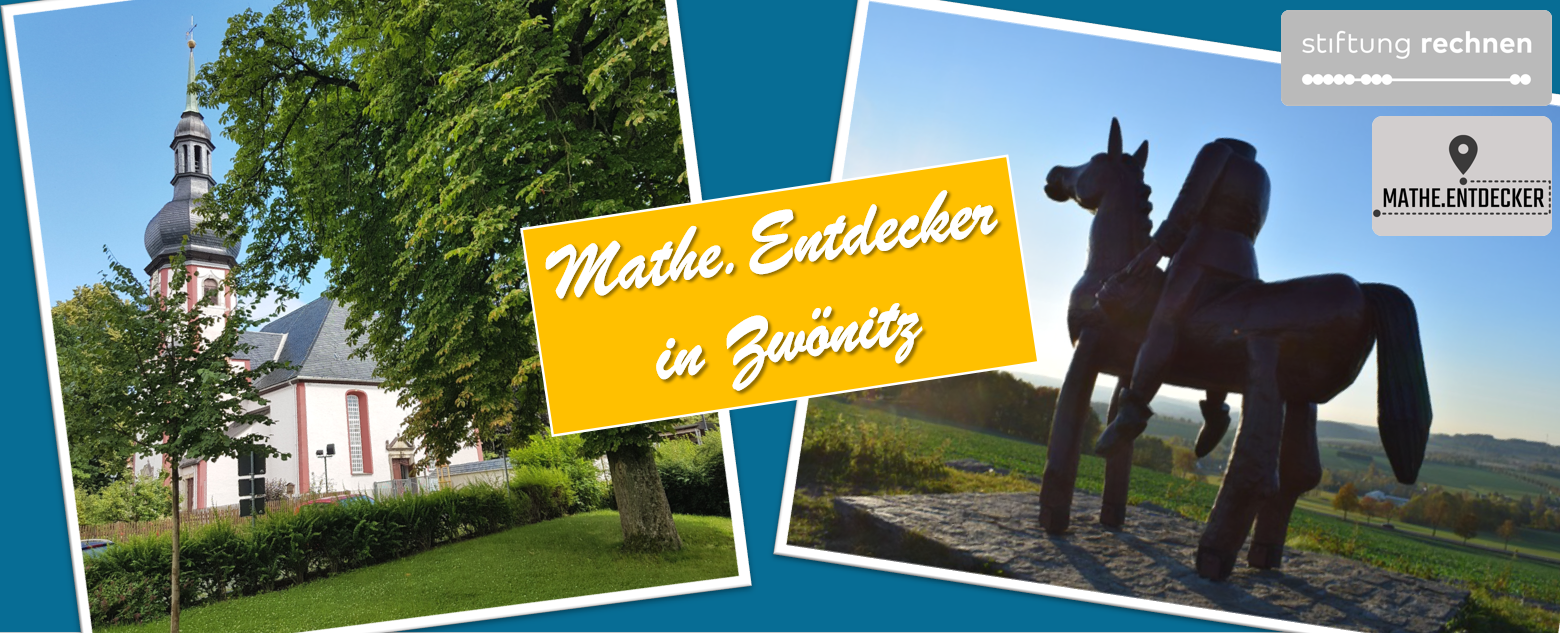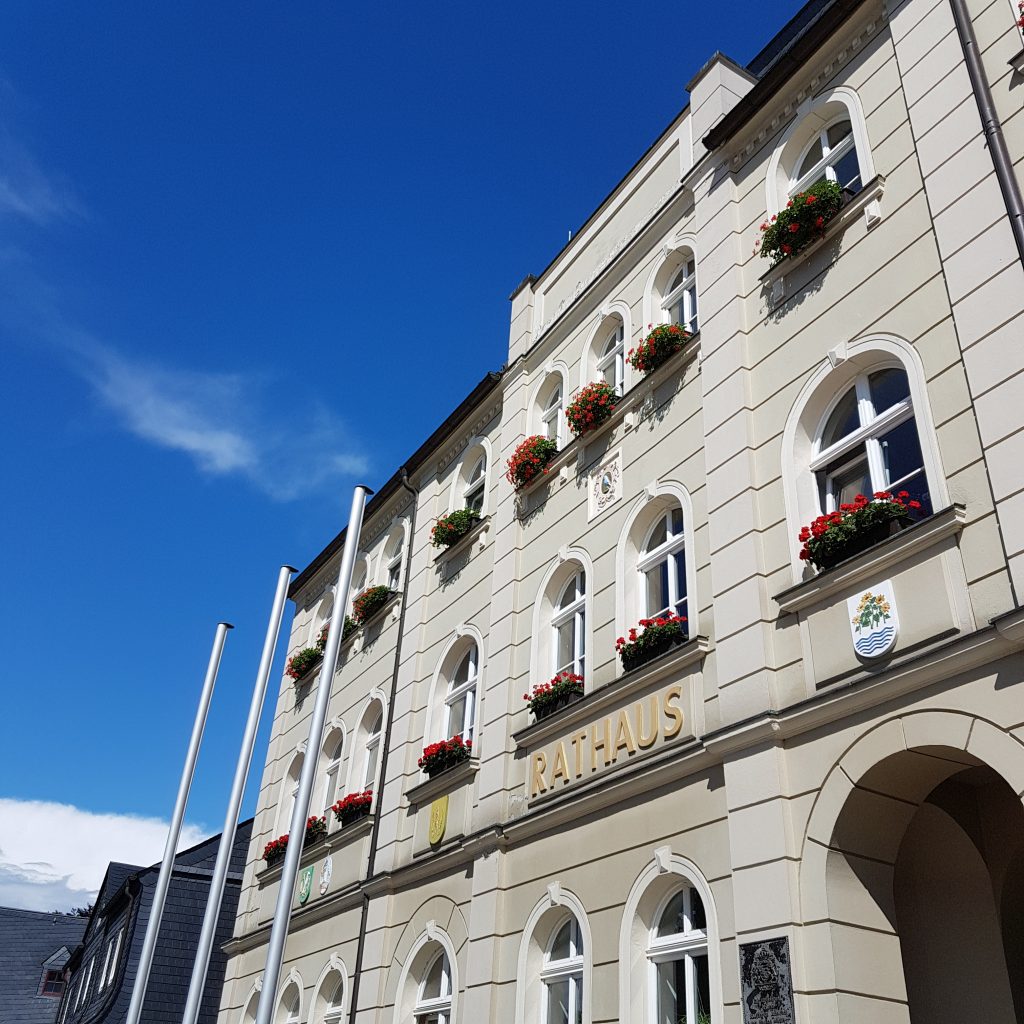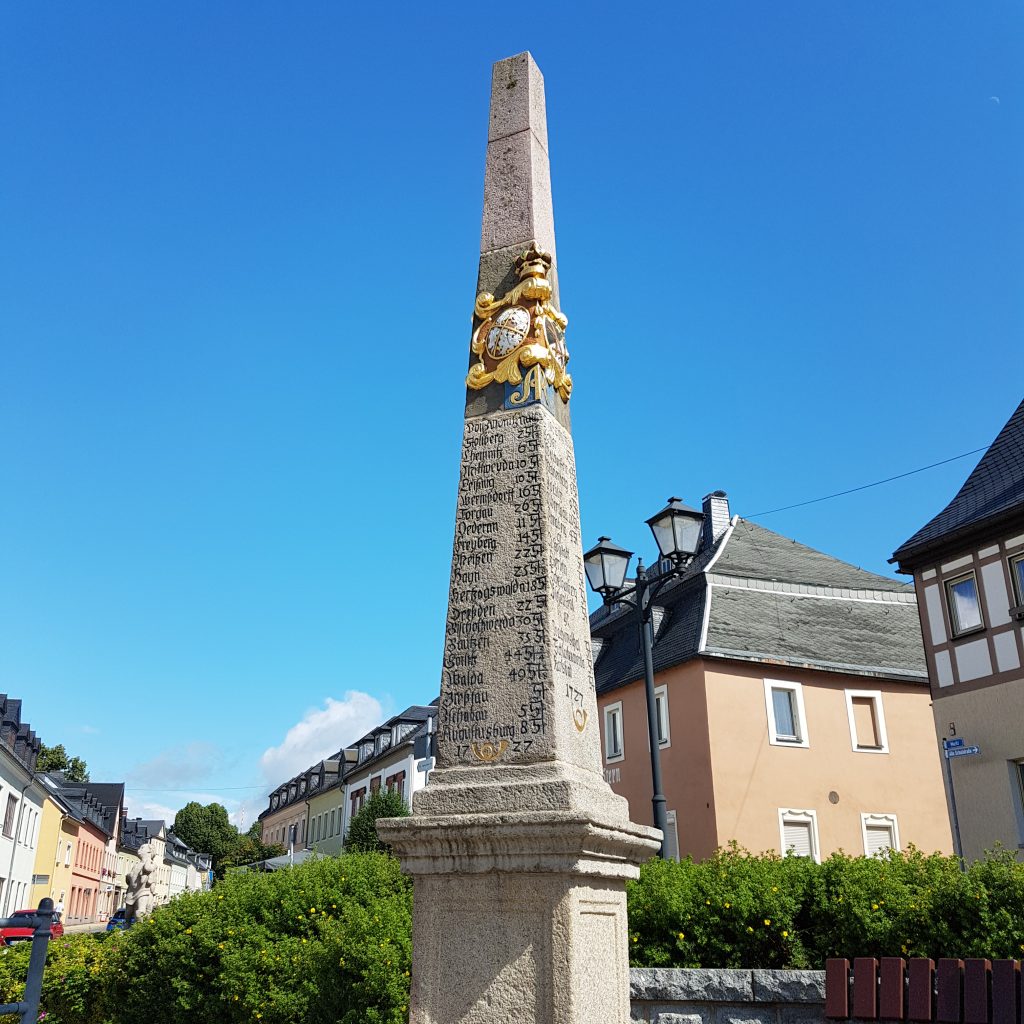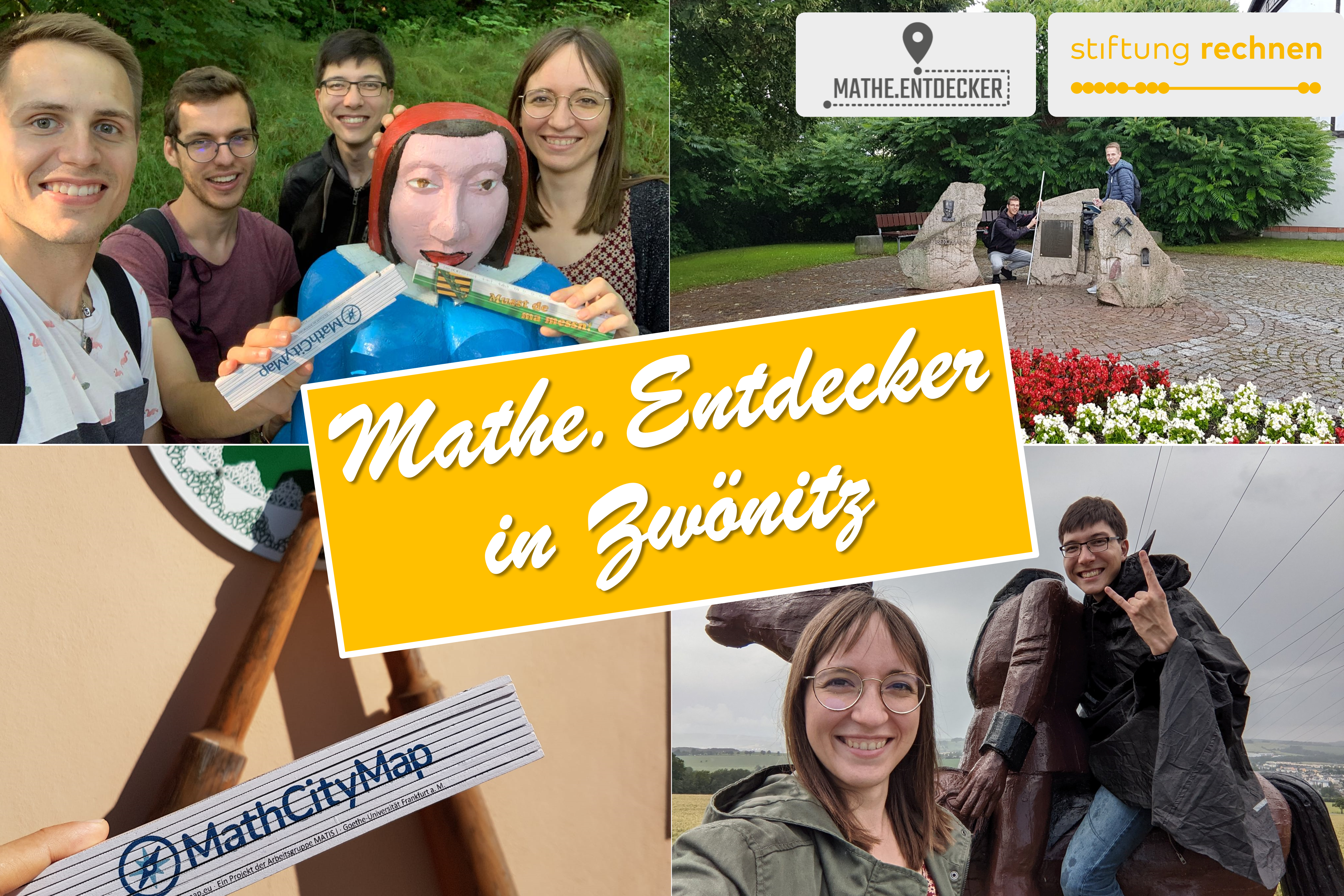
In the past months of July and August, the MathCityMap team from Frankfurt visited the German city of Zwönitz. Here our team created a total of 17 new trails, which were now officially opened and published!

With the support of Stiftung Rechnen, the town of Zwönitz and its Smart City Zwönitz project, we have created Math.Discoverer trails (Mathe.Entdecker-Pfade) for classes and families in and around the town, which is located in the middle of the Ore Mountains. On the website of Stiftung Rechnen and in a video report by erzTV, you can find more background information about the Math.Discoverer paths and the Smart City Zwönitz project.

The Mathtrails lead through different parts of the Smart City Zwönitz: the city center, past the train station and through the Austelpark, along the Sendigmühle and the Knochenstampfe. The grand opening with school classes trying out the Mathtrails took place on 12.10.2021 in the presence of the mayor of the city of Zwönitz. You can find a flyer with descriptions of the trails here.

Below we list all our created trails in Zwönitz. We wish you a lot of fun and success trying them out!


Title incl. Link

Code

Duration | Distance

Eröffnungstrail Klasse 5

[Opening Trail – Grade 5]

156358

2h 20 min | 700 m

Eröffnung Klasse 6

[Opening Trail – Grade 6]
476359

1h 40 min | 800 m

Innenstadt Familie

[City Center for families]

696049

2h 50 min | 1.300 m

Innenstadt Klasse 3/4

[City Center – Grade 3/4]

496048

2h 40 min | 1.300 m

Innenstadt Klasse 5-7

[City Center – Grade 5-7]

046050

2h 30 min | 1.400 m

Innenstadt Klasse 8-10

[City Center – Grade 8-10]

056052

2h 30 min | 1.000 m

Zwönitz für Familien 3/4

[Zwönitz for families – Grades 3/4]

255938

1h 40 min | 1.600 m

Zwönitz für Familien 5/6/7

[Zwönitz for families – Grades 5/6/7]

085939

2h 20 min | 1.600 m

Austelpark Familie

[Austelpark for families]

466044

2h 00 min | 900 m

Austelpark Klasse 3/4

[Austelpark – Grades 3/4]

292265

1h 20 min | 700 m

Austelpark 5/6/7

[Austelpark – Grades 5/6/7]

026046

2h 10 min | 800 m

Austelpark 9/10

[Austelpark – Grades 9/10]

296047

2h 00 min | 900 m

Ziegenberg Familie

[Ziegenberg for families]

786039

2h 00 min | 1.300 m

Ziegenberg Klasse 7/8

[Ziegenberg – Grades 7/8]

896038

2h 00 min | 1.400 m

Ziegenberg Klasse 9/10

[Ziegenberg – Grades 9/10]

576040

2h 00 min | 1.300 m

Knochenstampfe Familie

[Knochenstampfe for families]

136043

1h 50 min | 200 m

Knochenstampfe Klasse 5/6

[Knochenstampfe – Grades 5/6]

036042

1h 50 min | 200 m

From September 9 to October 8, we were able to collaborate with Simon Fraser University in Vancouver, Canada on a new project on outdoor mathematics and MathCityMap. Visiting the research group of Prof. Dr. Nathalie Sinclair, we dedicated ourselves to research on embodiment and gestures while walking a mathtrail: When students work on real objects, it seems natural that they interact with the object and describe mathematical concepts through gestures.


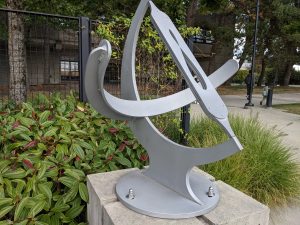
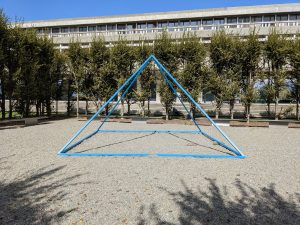
We started by looking at the SFU campus, and we didn’t have to search long for suitable tasks! Not only the pyramid seemed to be made for MCM! In the course of an advanced training with 20 teachers, the tasks could then be tested directly. Afterwards, five groups were filmed solving the tasks. In the evaluation, we will focus on when and with which function different gestures were used. We will submit these results at the next PME conference (2022 in Valencia).

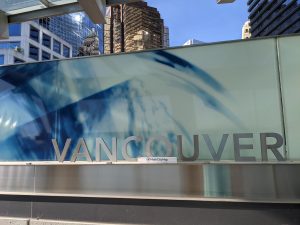
Of course, we did not miss the opportunity to create some trails in downtown Vancouver – both the Waterfront Station and the Stanley Park were ideal addresses for our first “Canadian Math Trails”.


The study and the accompanying research stay are funded by the DAAD and the BMBF within the framework of the Project-related Exchange of Persons (PPP) Canada.

The topic of the second post in our new “Behind the Scenes” category is reached by clicking on “Review” in the trail or task view in the web portal, as described in the last post. Here, users can request that their trail or task be published. But how can we the MCM team actually access the requests and according to which criteria are the requests accepted or rejected? We will answer these questions in the article below.


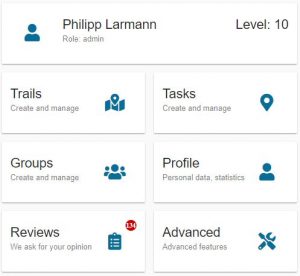
All requests for publication converge on the MathCityMap team’s side in the “Reviews” section of the web portal. This special area is only visible to reviewers. Reviews can currently only be performed by members of the MCM teams at universities around the world. In the long term, however, a review seminar is planned in which one can obtain the authorization to perform reviews of trails and tasks.
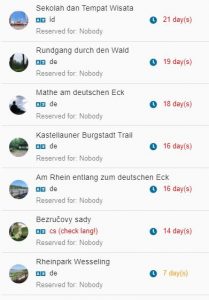
By clicking on “Reviews” we now get to an overview where all trails and tasks are listed whose review process has not yet been completed. This is either the case if the review has not been started yet or if there are still ambiguities in the tasks or trails that are being reworked by their creating users. In the image below you can see this overview for trails. It shows the title of the trail, in which language the trail was created and when the trail or task was submitted for the first time.


After selecting a trail we get to its overview where we review all tasks individually. When reviewing the tasks, we pay special attention to various criteria:

  1. Uniqueness. For each task, an image must be used to accurately identify the situation, or object, that the task is about.
  2. Presence. The task can only be solved on the spot, which means that the task data must be collected on the spot. This also means that the picture or the task text may not be sufficient to successfully complete the tasks.
  3. Activity. To solve the task an activity is necessary, i.e. you have to do something yourself (e.g. estimating, measuring or counting).
  4. Reality. The task should have an application, be realistic and not appear too artificial.
  5. Tiered aids. At least two tiered hints should be added to each task.
  6. School math and tags. The task should have a relationship to school mathematics, which are assigned to the task as keywords (tags). Similarly, the task should be assigned a grade level.
  7. Solution Formats. Each task should be based on a meaningful answer format, such as intervals for measurement tasks.
  8. Sample solution. A sample solution should be added to each task (visible to learners only after the task has been completed) to allow comparison of the learner’s own solution with the expected solution.

If all tasks meet the above criteria, there is one last criterion for the publication of the trail in addition to those already mentioned. This is especially relevant if the trail is explicitly designed for school classes.

9. Practicability. The tasks of the trail should be within an appropriate radius for the intended time of realization. Furthermore, it makes sense if the tasks are arranged in such a way that they form a circular trail with the start and finish as close to each other as possible.

However, we would like to show you in the next article of our category “Behind the Scenes” what exactly happens from the application to the publication and how this looks in the portal on the MCM teams side with an example task.


The online portal “FREE APPS FOR ME” regularly presents and reviews apps that are publicly available and free of charge. In one of its latest articles, the portal’s team presents the MathCityMap App and reports on their impressions of using the app.


Here, the portal focuses mainly on the technical features and user-friendliness of the app, but also refers to the idea of making the relevance of mathematics visible and comprehensible on real objects in the environment.


You can find the full article here. Enjoy reading!

Dear users,

we have already presented several MCM@home learning paths for distance learning within the MathCityMap app. In our new collection we have added some new learning paths.

All your learners have to do is to enter the code in the free and GPDR-compliant MathCityMap app. Ready to start!

We hope you enjoy working through them!


LanguageGradeTitelCode
English7[MCM@home] Pribina Square Nitra052591
9Erasmus Days 2020 I273177
9Erasmus Days 2020 II583178
9MCM@Home: Semarang232525
10[MCM@home] Berlin052524
Spanish8Actividades en casa062651
8El patio de mi casa es particular…472991
8MathCity@Home 2º ESO562551
9Campo de fútbol del Racing de Santander782526
9Ruta PI de la FESPM044282
10Matemáticas en el baloncesto382998
10Noche Europea de los Investigadores-Noviembre 2020893300
Italian8Matematica a tutto tondo per IDM 2021 – scuola secondaria di I grado044258
11Matematica a tutto tondo per IDM 2021 – scuola secondaria di II grado184244
Portuguese8MCM@Home: PT-Porto [7/8]692543
9MCM@Home: PT-Porto [9]062544
9MCM_PI_Guimaraes @ home384252
12MCM@Home: PT-Guimarães022552
Slovak5[MCM@home]Dubovce2164107
5[MCM@home]Kombinatorika okolo prezidentského paláca v Bratislave342691
6[MCM@home] Dvory nad Žitavou292584
7[MCM@home] Pribinovo námestie Nitra142598
7[MCM@home]Holíčsky zámok392602
7[MCM@home]Senica172870
8[MCM@home]Dubovce342540
8[MCM@home]U včelárov363332
8[MCM@home]Veľké Borové393526
8Vratna@Home562529
9[MCM@home] Detské ihrisko Nové Zámky383533
9[MCM@home] Objemy a povrchy v lesoparku Žilina152588
9[MCM@home]Skalica692760
9[MCM@home]Stromy okolo rieky Nitra174015
10[MCM@home]πNitra084229
Indonesian9MCM@home: Matematika di Sekitar Kita684255
German3Mathe-Adler Knobelaufgaben072592
3Mathe-Adler Rätselspaß282593
3Mathe-Adler: Folgen und Reihen012519
3Mathe-Adler: Kombinatorik262518
3Mathe-Adler: Zahlenrätsel192515
3Rechentricks für die Mathe-Adler073299
4Mathe-Adler: Neue Matherätsel284659
4MathCityMap@home Fortbildung – Grundschule353578
6Mathe-Adler: Knobeln für Fortgeschrittene054098
6Mathe-Adler: 24 knifflige Rätsel564802
6Rechnen mit Dezimalzahlen392881
8MCM indoors: Mathematik-Wettbewerb 1183150
8MCM indoors: Mathematik-Wettbewerb 2073244
8MCM@Home: Lineare Funktionen012514
8Umgang mit Termen063152
9MCM@Home: Quadratische Funktionen682517
9Jahresrückblick Klasse 9792904
9MCM@Home LemaS Fortbildung Bremen344106
9iM INTernet: Fortbildung zu MCM@home154204
9MCM@home-Fortbildung783277
9ZAA HS Pflichtteil 2019354115
9ZAA HS Wahlteil 2018014129
10ZAA HS Wahlteil 2019144260
10Mathematik ist überall! Trail zum IDM 2021134205
10MCM@Home: Ffm a. M.692521
10Daten und Statistik282769
10ZAA RS Pflichtteil 2012464997
10ZAA RS Pflichtteil 2013894693
10ZAA RS Pflichtteil 2019164132
10ZAA RS Wahlteil 2018124130
10ZAA RS Wahlteil 2019174133


Did you also create a MCM@home learning path and would like to share it with other users? Great!

Then please write an email with…

  • the name of your MCM@home trail,
  • the related code,
  • the grade level,
  • and the language of the digital learning path

to barlovits[at]math.uni-frankfurt.de.

We would be very happy to add your contribution to the list as well!

On May 30, our great MathCityMap MOOC within the Erasmus+ project MaSCE³ ended. In this article we present experiences of teachers from all over the world.


Experiences with MathCityMap:

In the following statements, the teachers participating in the MOOC review on the course and their made experiences with doing mathematics outdoors with their classes.

Edinéia Zarpelon (Brazil, Upper secondary level):
I proposed the trail to my high school students and a couple of friends, math professors at the university. Unfortunately, due to the pandemic, only a few student volunteers walked the trail. Still, it was a very worthwhile experience and their feedback was very positive and encouraging. I am determined to continue using MCM in my classes.

Monika Haupenthal (Germany, Upper secondary level):
Repeating old things, gaining new knowledge and having fun – all this combines outdoor learning. This is what the students in my Q11 course experienced on the trail.
Slogan: Be ready, be careful, be correct, calculate, check, correct. The slogan is derived from the first letters of the stations.

Margherita Motteran (Italia, Secondary level):
We had fun trying to solve problems in reality mathematically. In order to determine the dimensions of real objects, students used different strategies that they developed themselves. This activity stimulated their imagination and increased their math skills. We plan to use MCM often in the future.

More statements of participating teachers from all over the world can be found here.

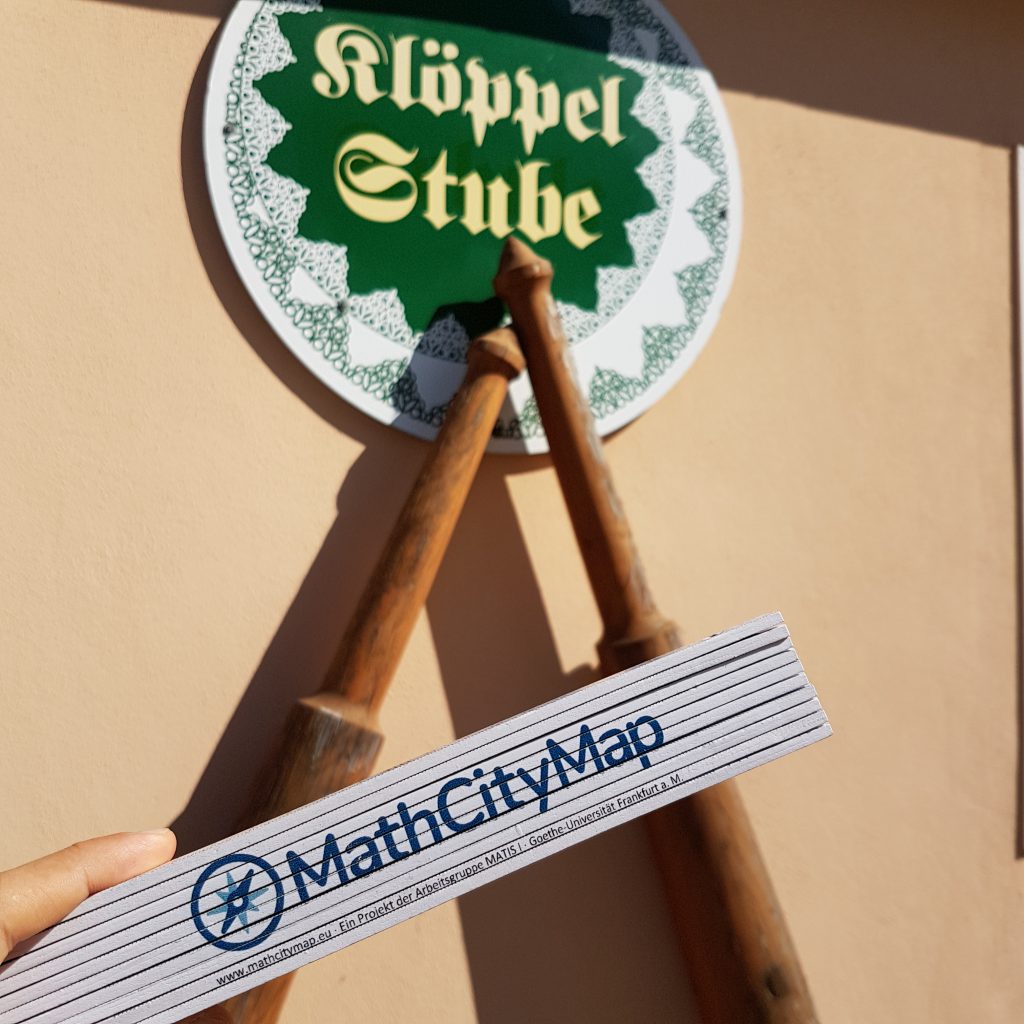
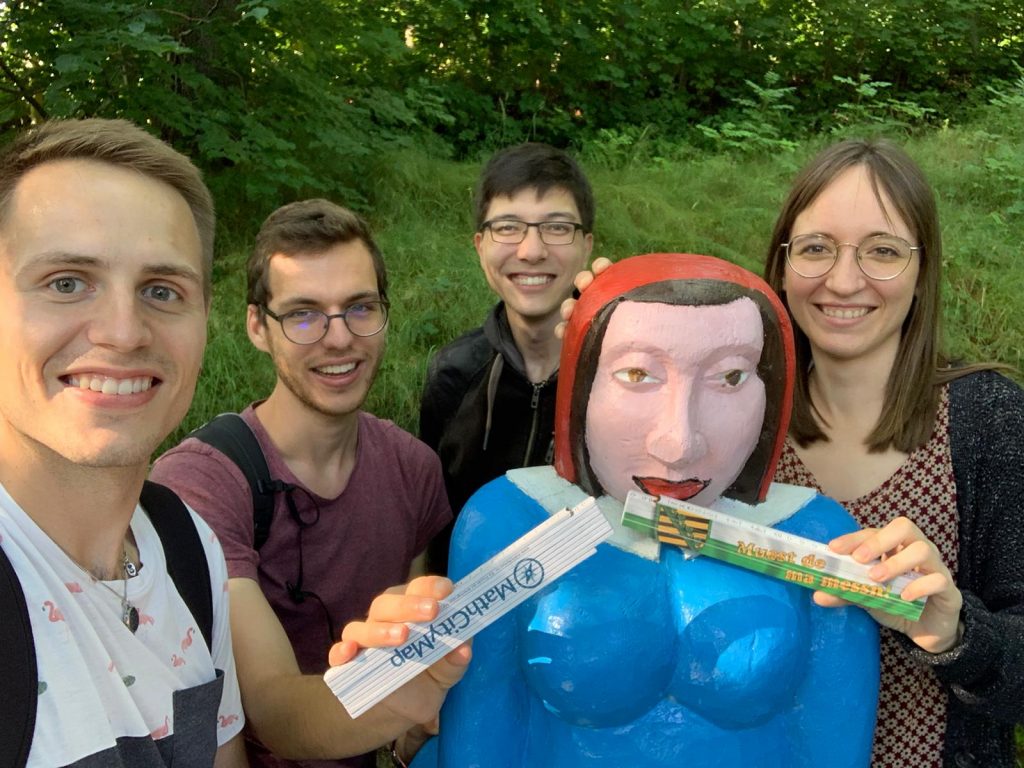
The MathCityMap team visited the beautiful Zwönitz in the Ore Mountains last week. There, Simone, Philipp, Ken and Simon looked out for numerous exciting tasks.

As part of the Mathe.Entdecker project of Stiftung Rechnen, a variety of interesting and challenging math trails for all grades are being created in Zwönitz.

Here is already a small foretaste of the content of the tasks:

  • Do you know the legend of the headless horseman?
  • Do you know what ‘Klöppeln’ is?
  • Or when the coal mine in Zwönitz was closed down?

We are already looking forward to the opening of the Mathtrails in Zwönitz!

Four classes at the Kleist School Eschborn (near Frankfurt) took part in our MathCityMap study over the past three weeks. In the process, the eighth graders were able to rediscover their own schoolyard:

Equipped with folding rules, measuring tapes and, of course, the MathCityMap app, the learners each worked on two math trails on the topic of linear functions in groups of three. Among other things, they determined the slope of the skateboard ramp or the function term of the handrail.

Student Alea Henrich (G8b) summarizes her experience with MathCityMap as follows: “Personally, I really enjoyed the project! It was great to learn mathematics in a new way. Of course, the app can’t replace a classroom, but I think it’s great as a supplement to normal lessons. In addition, I see the app as helpful and more memorable, because you have your tasks as a real building, bench, square, etc. in front of you and can then check your solutions on your smartphone and get tips directly if necessary.”

Alea also offers a tip for the summer vacations: “If you want to, try the free app MathCityMap during your vacations – not only for the repetition of what you learned this year or last year, but also get to know places in your environment with a math trail.”


You can read Alea Henrich’s complete report here on the website of the Heinrich-von-Kleist-Schule Eschborn.

Two students of the Master degree course in Mathematics and Sciences Education of Instituto Politécnico de Viana do Castelo, Antony Lopes and Liliana Francisco, respectively under the supervision of Ana Barbosa and Isabel Vale, have focused their thesis in the use of MathCityMap.

The work developed by Antony Lopes aimed to understand the way 6th grade students apply Geometry concepts in a math trail using MathCityMap. Although it was not possible to collect data with students due to COVID-19, the published report grounds and explains all the methodological options and also presents all the data collection techniques, including the procedures that led to the trail submission in MCM. The author also presents a theoretical discussion of the expectations concerning the results. The report can be found here.

The work of Liliana Francisco is still under development and aims to understand how 6th grade students solve tasks, within the scope of isometries, designed to be applied outside the classroom through a math trail with MathCityMap. This study is being conducted with 23 students and data is being collected, resorting to observation, documents (task solutions), questionnaires, interviews and photographs. The report will be published soon.

A master thesis on MathCityMap and its novelties

At the Department of Mathematics and Computer Science of the University of Catania, the student of the Master degree course in Mathematics Emanuele Amico, under the supervision of Professor Eugenia Taranto, is working on his Master thesis. This is an experimental thesis whose aim is to analyse the impact of using MathCityMap on students’ learning in terms of problem solving and problem posing skills. The teaching experiment, which took place in May 2021, involved a grade 9 class at the Liceo Scientifico “A. Volta” in Caltanissetta (Sicily). Due to the emergency situation caused by the pandemic, the experimentation took place in indoor mode, using the MCM@home and Digital Classroom functionalities.

For more details, read the full report (in Italian) here.