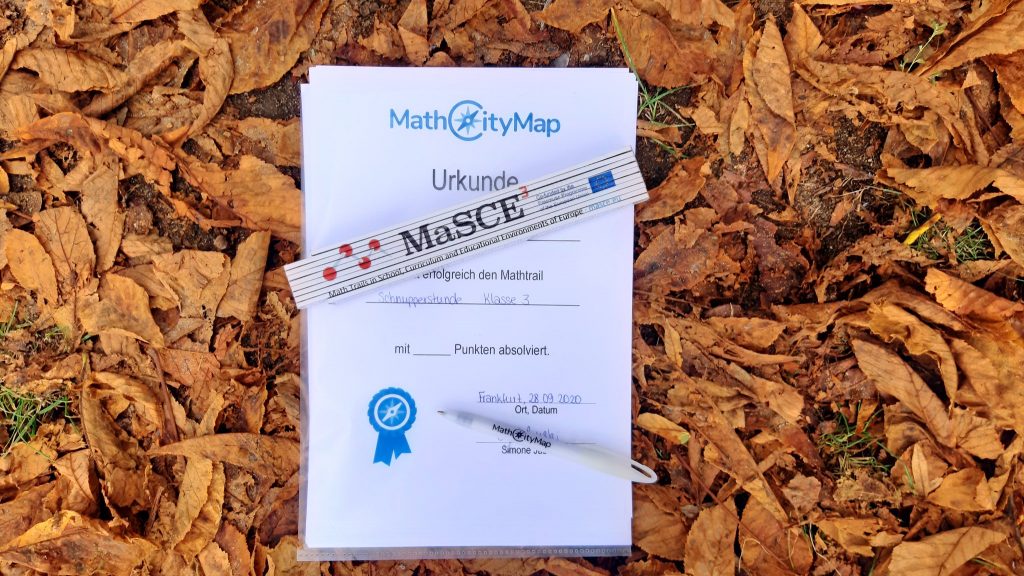
The Junge Mathe-Adler [engl.: Young Math Eagles] fly again! Our mathematical scholarship for gifted students from Frankfurt and the surrounding area under the lead of Simone Jablonski, Melanie Schubert and Steffen Burk started the new season with a highlight: Working on a math trail with MathCityMap!

Our new third graders as well as the students of the sixth grade worked on the tasks alongside their parents with great commitment and solved many a tricky mathematical problem. Here you can find the completed trails:

We are already looking forward to the upcoming sessions of the Mathe-Adler, which will be digitally completed in MCM@home format due to the current situations. Have fun & success!

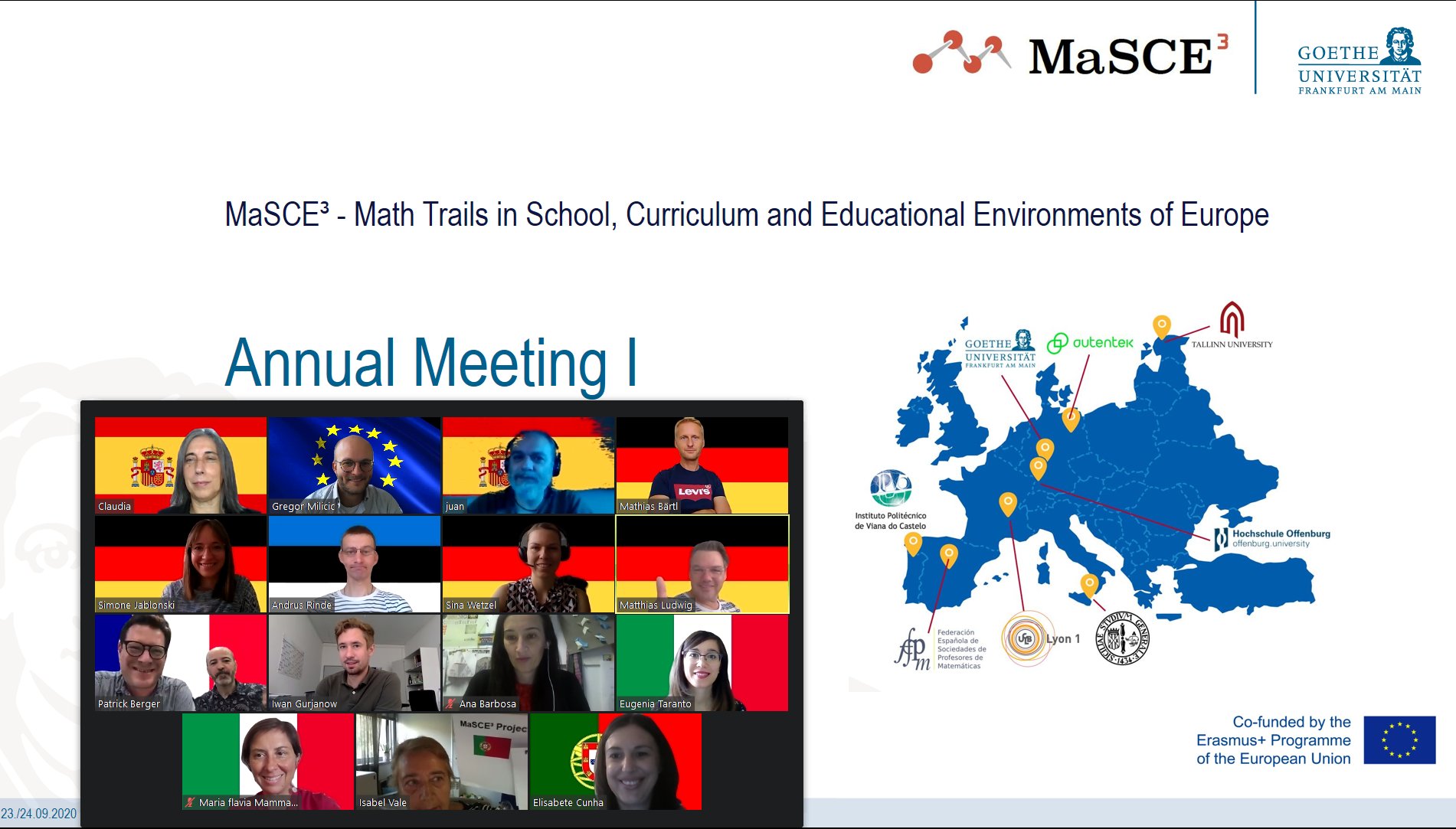
MaSCE³ [Math Trails in School, Curriculum and Educational Environments of Europe] is a program funded by Ersamus+ which aims at the further development of MathCityMap. This year’s meeting with our project partners from France, Spain, Italy, Portugal and Estonia as well as from Germany had to take place online due to the current situation.

Nevertheless, we can look back on two very intensive and successful working days: During the project meeting new task formats, the embedding of augmented reality elements into our system and the development of theme-based trails were reflected and discussed.

We thank all partners for this great meeting!

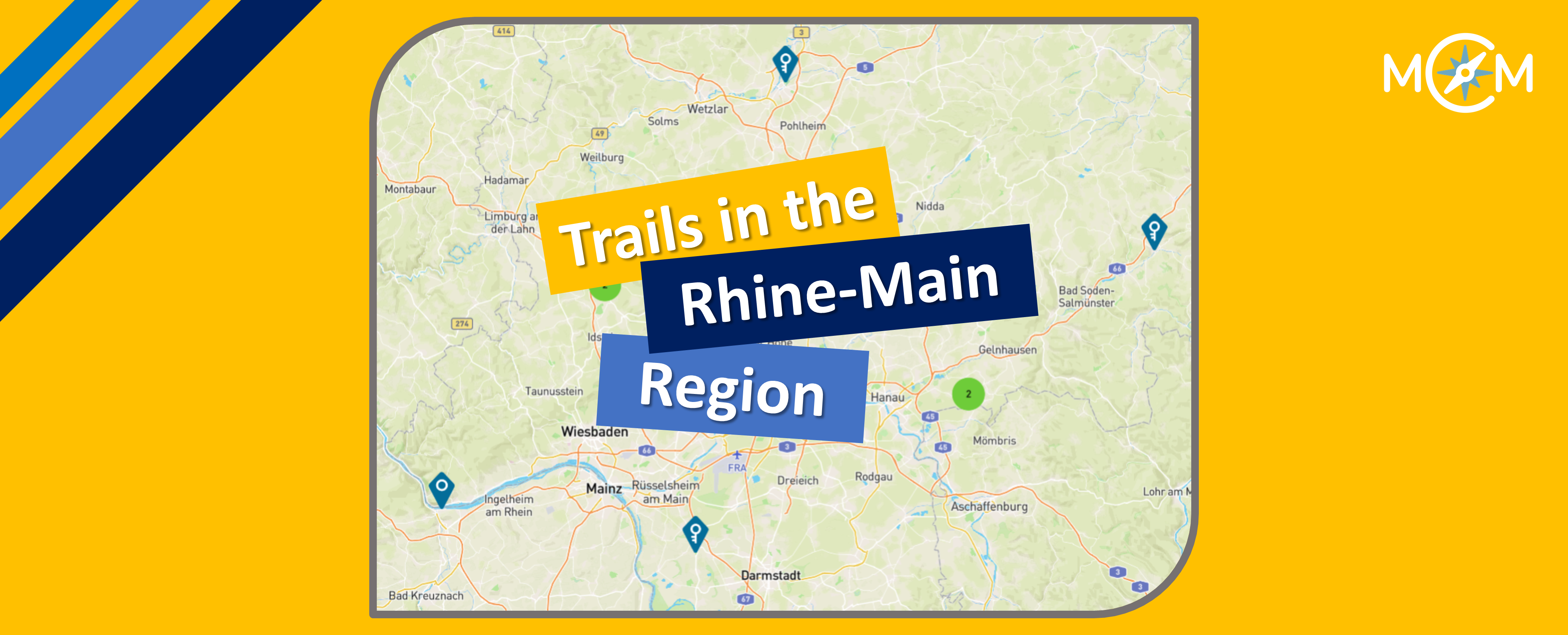
The next trail in our section “Tested Trails in the Rhine-Main-Area” leads us to Gießen. There our student Iqra Shah has created the math trail “The World of Geometry”. The trail was created during our award-winning math trail seminar at the Goethe University Frankfurt. All trails have been tested by students on site and have also passed our expert review. Recently, in this section we presented the trail “Die Fasanerie in Groß-Gerau” by Martin Pusch.

Information about the trail:
Name: The World of Geometry
Code: 122924
Place: 65929 Frankfurt-Höchst
Grade : 9
Topic: Geometry (volume and area calculation)

Geometric objects surround us in our environment in all possible forms and almost everywhere, be it at school, in the city, in nature or on the playground. The children should be able to recognize them here and analyze their function and meaning. The aim of the trail is to show the children that they are surrounded by mathematics, especially geometry. As they walk the trail, they will perceive other objects in the park in addition to the geometric objects that appear in the tasks. With the help of geometry, the children should learn how to think and work mathematically. They develop strategies to solve problems. In doing so, they develop their problem-solving skills. They analyze real situations and translate them into mathematical language.

Example task: Gymnastics bar

In this task, the children have to calculate the percentage difference between the two surfaces under the gymnastic bar. This task combines two contents from the curriculum. Here the geometry is interlocked with the percentage calculation. This should show the children that mathematical content is not a separate drawer. The pupils measure and calculate on site. They are active and work in a team.

At MEDA 2020 (Mathematics Education in the Digital Age) the MathCityMap system was presented today in two presentations:

Ana Barbosa and Isabel Vale, partners in our Erasmus+ project MaSCE³, presented a study on the attitudes of primary school teachers towards digital media, more specifically towards teaching with MathCityMap. The corresponding contribution was published in the MEDA Proceedings (pp. 135-142).

In his presentation, Simon Barlovits, an employee of the Frankfurt MathCityMap system, explained the use of topic-based MathCitMap math trails. In the article (together with Moritz Baumann-Wehner and Matthias Ludwig) a guideline for the creation of theme-based trails is also presented. The article can be found in the MEDA-Proceedings on pages 143-150.

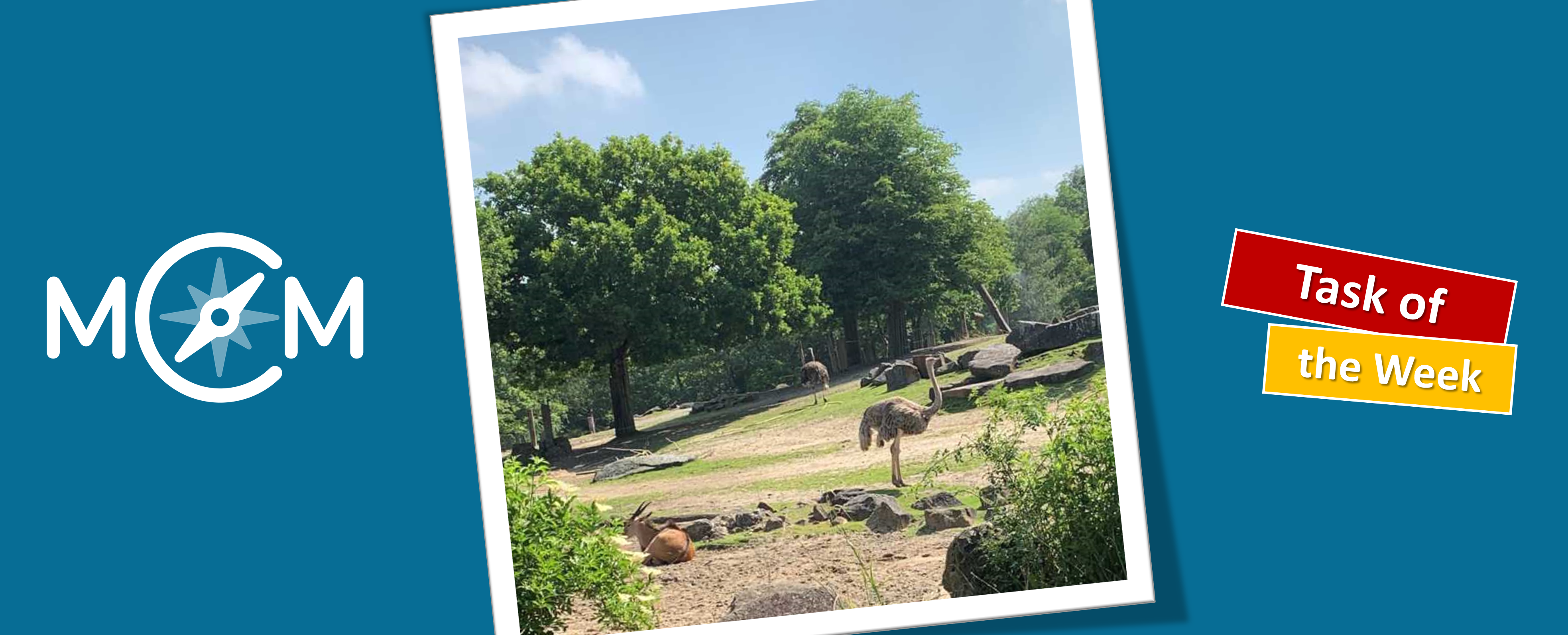
In Münster we find our new task of the week. Here the research assistant of the University of Münster Lea Schreiber has created some math problems in the zoo (trail code: 012859). Here we present the task “Ei ei Käptn”.

How did you get in contact with MathCityMap?

I work as a research assistant at the WWU Münster and came across the project at a conference. Since then I have been working with the app from time to time and create trails for my group of giftet students “Kleine Mathe-Asse” (see below for a project description). Additionally I participated in a workshop in Münster by the MathCityMap educators Matthias Ludwig and Iwan Gurjanow. I can well imagine using the app later in my math classes.

Describe your task. How can it be solved?

The task was created as part of an “excursion trail”, because the math students could not go on an excursion this year due to the Corona pandemic. Accordingly, I thought it would be a nice idea if the children could have the opportunity to do a little rally through the zoo on their own with the help of MCM. First of all, they have to find the information board about the African red-necked ostriches on which the information necessary to solve the actual task is written. This consists of finding out how many ostrich eggs are needed to bake a gigantic amount of pudding slices, if the remaining eggs could still be bought in the supermarket. Once the children have found out that 1 ostrich egg replaces about 25 chicken eggs, they can use the information from the recipe for the task (343 eggs) to determine how many ostrich eggs or normal eggs they need for baking. That would be 13 ostrich eggs (13 x 25 = 325 hen eggs) and 18 hen eggs. Since the children may also consider using only ostrich eggs and thus no supermarket eggs, a solution interval was given where the solution numbers 13 and 14 are correct.

What didactic goals do you pursue with this task?

For the solution of the task, different competences are required from the children/”Kleine Mathe-Asse”. On the one hand, they have to filter out the relevant information on the information board and from the task. In both cases, significantly more information is given than is actually necessary. Once they have done this, they have to come up with a solution strategy to get the number of ostrich eggs (e.g. by trying and approaching the 343 eggs). For this they need knowledge of division or multiplication and addition or subtraction. A mathematical sensitivity and the ability to structure on the pattern level are also helpful in order to quickly arrive at a solution or to think of a solution approach/strategy with meaningful number spaces. Less able-bodied children also have the chance to solve the task successfully by gradually extrapolating the 25 series up to 325 or 350. This takes a little more time, but ultimately gets them to the goal.

Information on the promotion of gifted children in Münster & Frankfurt:

Click here for the project “Mathe für kleine Asse” in cooperation with Lea Schreiber at the University of Münster. The Goethe University Frankfurt also offers a mathematical program for gifted students which is leaded by Simone Jablonski: “Die jungen Mathe-Adler Frankfurt”.

Today’s trail in the category “Tested Trails in the Rhine-Main-Area” – the trail “Fasanerie in Groß-Gerau” – was created by our student Martin Pusch in Groß-Gerau. It was created during our math trail seminar at the Goethe University Frankfurt. All trails were tested by students and also passed our expert review. Recently we presented the trail “Ortsmitte Somborn” by Johanna Lomax & Emily Schön in this section.

Information about the trail:
Name: Fasanerie in Groß-Gerau
Code: 262896
Place: Groß-Gerau
Grade: 10
Topic: Repetition of intermediate level mathematics

In the math trail of the Fasanerie (a park) there are many illustrative objects and places, which were used for playful application for mathematics-related tasks. Many contents of the middle school mathematics are repeated. Topics like triangle and angle calculation, reconstruction of square functions, volume calculation of different bodies, linear functions, area and perimeter calculations of different figures, scales and unit calculation are repeated in this trail.

It takes about two and a half hours to walk and to work on the trail, and about 700 meters are covered on foot.

Example task: The great spotted woodpecker

The model of a great spotted woodpecker shows him on a scale of 5:1. How big would the great spotted woodpecker be in reality? Enter the result in cm and with one decimal place.

Further information:

Already in our article “Testing of Math Trails in Bingen & Groß-Gerau” the seminar leaders Iwan Gurjanow and Simon Barlovits reported about trying out the trail in Groß-Gerau.

Our new trail in the category “Tested Trails in the Rhine-Main-Area” is located in the idyllic village Somborn. Here our student teachers Johanna Lomax & Emily Schön have created the math trail “Ortsmitte Somborn”. The trail was created as part of our award-winning Mathtrail seminar at the Goethe University in Frankfurt. All trails were tested by students on site and also passed our expert review. Most recently, in our section “Tested Paths in the Rhine-Main Area” we presented the trail “Experience Mathematics at the Swan Lake” by Aline Schreiner.

Information about the trail:
Name: Ortmitte Somborn
Code: 092910
Place: Freigericht
Grade: 7 / 8
Topics: Algebra, Geometry, Stochastics

The math trail “Ortsmitte Somborn” is located within walking distance of the Kopernikusschule. It consists of 12 tasks, which are arranged on a circular route around the town hall forecourt.

Through the tasks, the students discover that our immediate surroundings offer many exciting mathematical tasks. How many liters of water gush out of the fountain, in how many combinations can you walk up the stairs to the town hall, and how many dividers does the maximum parking time at the Norma parking lot have?

The MathCityMap app navigates the students to the individual tasks and guides them through the tasks with step-by-step assistance. A didactically well thought-out mix of simple and challenging tasks ensures that there is something for everyone and that no one loses motivation!

Example task: You have the plan!

How many kilometers is the Fatima Chapel in the north of Horbach from your current location? This is about the distance in the real world, not on the map! Give the result rounded to one decimal place in km.

The task “Trapézio” [engl.: “Trapezoid”] by Isabel Figueiredo, who was one of our partner in the MoMaTrE project from 2017-2020, is chosen to be our new Task of the Week. The task is located in the north of the Portuguese city of Porto.

How do you use MathCityMap? Please describe our European project here in a few sentences.

MathCityMap is a project of the working group MATIS I of Goethe University Frankfurt. It is co-funded by the Erasmus+ project MoMaTrE [Mobile Math Trails in Europe]. Currently, seven institutions from five countries are participating in this project that englobe a web portal and the MCM app. Unfortunately, the MoMaTrE project ended after three years at August 31th.  

MathCityMap combines the well-known math trail idea with the current technological possibilities of mobile devices. I use MathCityMap for the dissemination and popularization of mathematics, to attract more students to continue their scientific and technological studies.

With the MathCityMap-Project we like to motivate students to solve real world tasks by using expedient mathematical modelling ideas outside the classroom in order to discover the environment that surrounds them from a mathematical perspective. Mathematics should be discovered and experienced and must be done on the spot.

Please describe your task. Where is it placed? What is the mathematical question? How could you solve it?

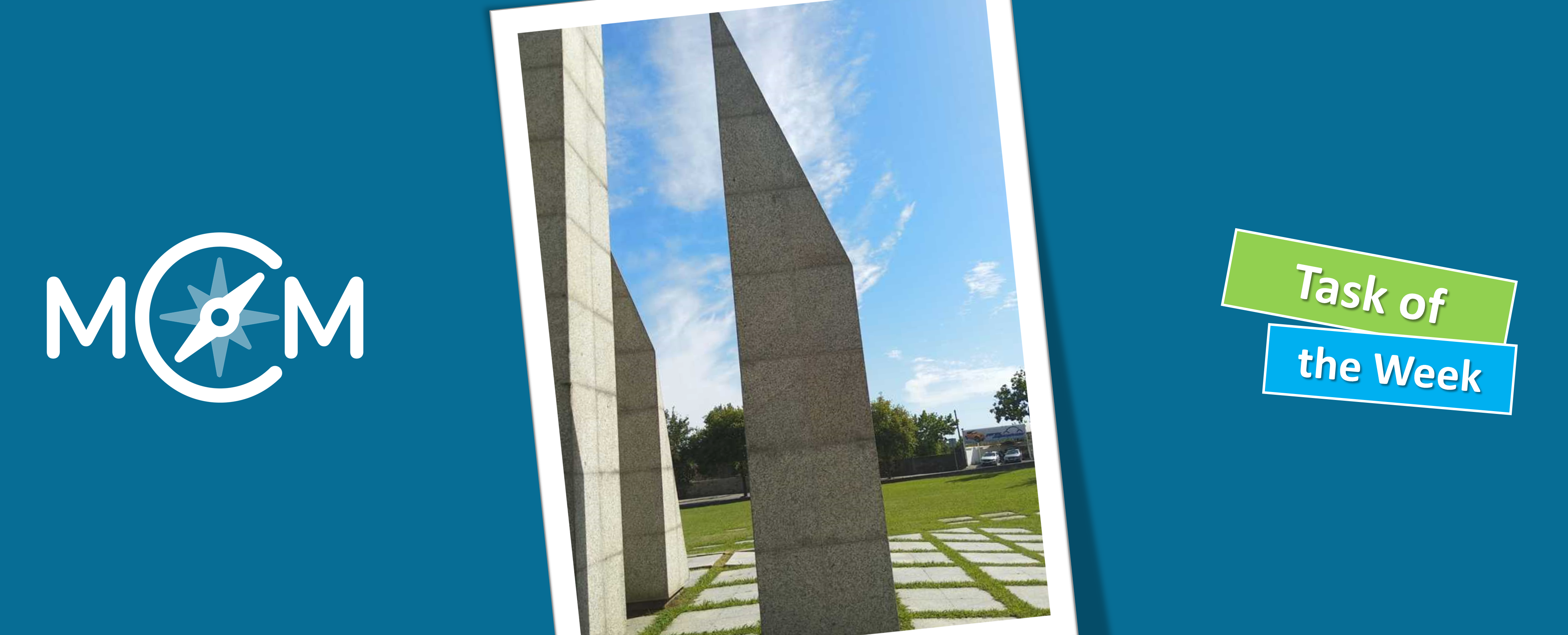
This task is placed in Maia, a Portuguese municipality in the district of Porto. In one of the entrances of this city there is a Monument located in the Jardim das Pirâmides. We ask for the area, in m², of the lateral surface that can be seen in the picture.

As the necessary data could not easily measured, the idea is to use a non-standard surface unit. The formula for the trapezoid area must be used, but the measurements to be used are determined by the rectangular plates that make up the structure. Students measure one of the plates and count the number of slabs on the trapezoid.

Which didactic aims do you want to stimulate through this task?

The task has as main objective to be able to apply the teaching content in the classroom to real objects and, thus, deepen the knowledge.
The advantage of this is that it is clear that prior knowledge is necessary to be able to see everyday life from a mathematical perspective by training an eye for simple geometric figures in architecture. Another advantage is to lead students to find a different way to solve problems and don´t give up in face of obstacles.

Do you have any other commentary on MathCityMap?

MCM project integrates advanced digital technology with the math trails concept to illustrate the use of a technologically supported outdoor trail to enhance the teaching and learning of outdoor mathematics.

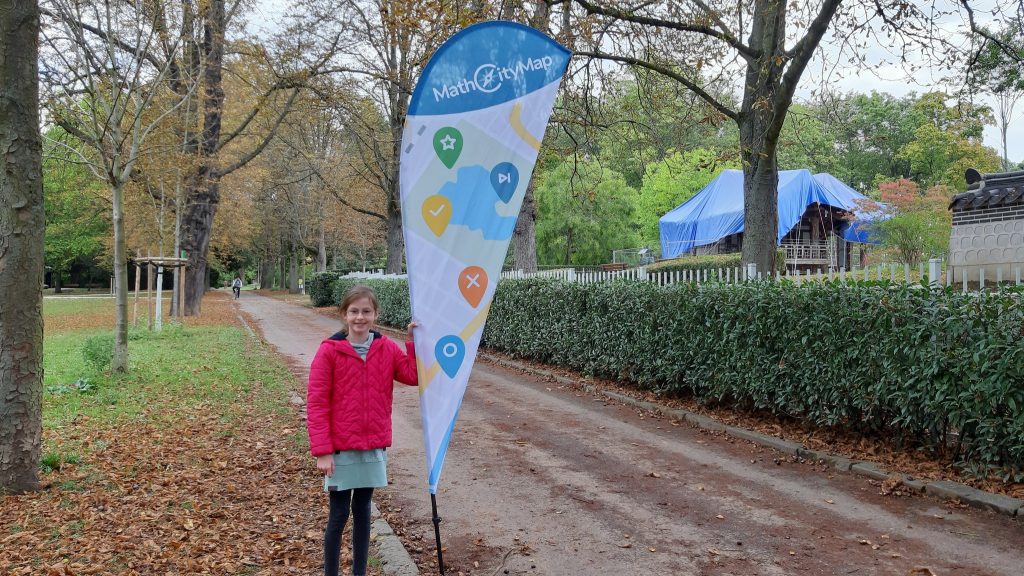
The next trail in our section “Tested Trails in the Rhine-Main-Area” is located in Gießen. There our student Aline Schreiner has created the mathtrail “Experience mathematics at the swan lake”. The trail was created during our math trail seminar at the Goethe University Frankfurt. All trails were tested by students on site and also passed our expert review. Recently, we presented the trail “Mathe-Kings & Mathe-Queens” by Jolanta Zdyb in our section.

Information about the Trail:
Name: Experience mathematics at the Swan Lake
Code: 152919
Place: Gießen
Grade: 6
Topics: Angles, Fractions, Area, Volume
Duration: approx. 3h

Unfortunately, mathematics is often perceived by students as a pointless game with numbers and letters. With the help of the first math trail in Giessen, “Experiencing Mathematics at the Swan Pond”, which is located in Giessen’s largest green area, the aim is to show the pupils that mathematics can be fun and that their lives are made easier by using mathematics. 

Due to its quiet location, the teachers can let their students work in small groups on the respective tasks at different objects without hesitation. The Trail is recommended for the end of grade 6 or the beginning of grade 7, as it is designed to repeat the topics from school year 5 and 6.

Examplifying task: Treasure chest


The treasure chest should be filled with dry sand. 1 liter of sand weighs 1.8 kg. How many kg of sand fit into the treasure chest? Neglect the woods in the box and round to whole kg.

In Frankfurt’s Martin Luther King Park, our student Jolanta Zdyb created the maths trail “Math Kings & Math Queens”. The trail was created as part of our Mathtrail seminar at the Goethe University Frankfurt, which was awarded by the Stifterverband for excellent teaching. All trails were tested by students on site and also passed our expert review. Most recently, we presented the “Einstein Trail” by Daniel Tiedke in our section “Tested Trails in the Rhine-Main Area”.

Information about the trail:
Name: Math Kings & Math Queens
Code: 692949
Place: Martin-Luther-King-Park, Frankfurt
Grade: 5th grade
Topic: Introduction to the 5th grade


Welcome to the Ernst-Reuter-School! You are really lucky that your new school is located at the great Martin-Luther-King-Park. There is not only a lot of nature and fun, but also a lot of math to discover. So grab a measuring tape and start doing mathematics!

The Trail “Math Kings & Math Queens” is located in the Martin-Luther-King-Park, right in front of the entrance of the Ernst-Reuter-School. It is specially designed for the newly enrolled fifth graders to get to know the surroundings of their new school and to develop a joy for mathematics in everyday life. In the park, they can move around unsupervised and solve the tasks in a concentrated manner.

Example task: Giant slide

How long is the slide in total? Enter your result in km.
In this task the children have to measure the length of the slide. This is not so easy, because it is quite long! Another difficulty is to convert the result into km. Fortunately, there are hints in the app that will certainly help.