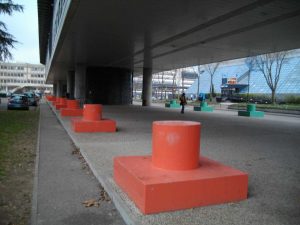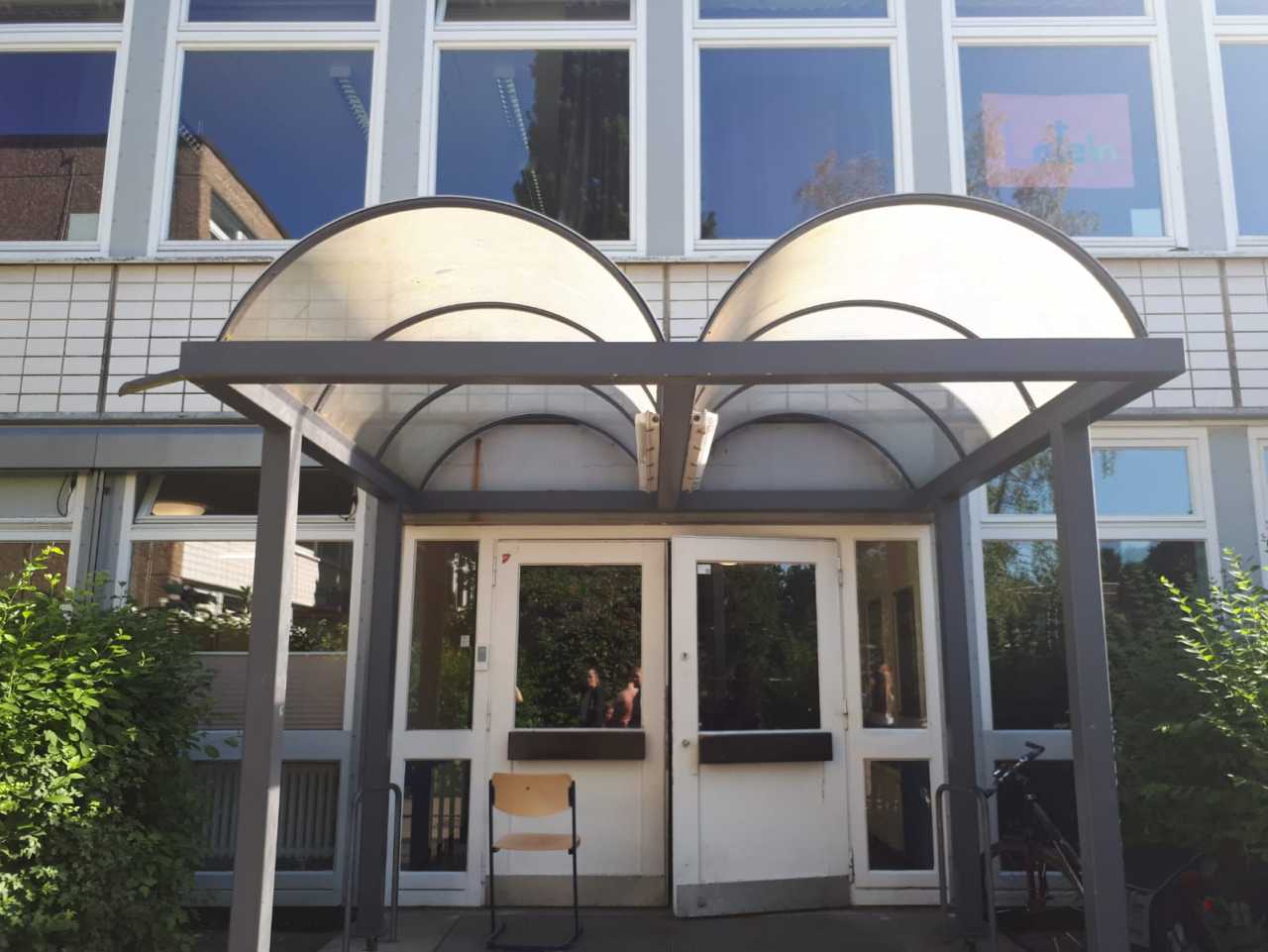
The classical geometric bodies and figures can be found numerously in the environment. However, real objects deviate from the ideal body and require modeling skills. In addition, composite bodies are not uncommon as in our current “Task of the Week”, which was created by Bente Sokoll, a student at the Johannes-Brahms-Gymnasium in Hamburg.


Task: Volume under the roof (Task number: 4194)

Calculate the volume under the roof (if the sides were closed). Give the result in m³.

To calculate the volume, the body is split into a cuboid and two semi (idealized) cylinders. For the cuboid, length, width and height must be measured and multiplied. For the cylinder, one needs the diameter (or the radius) and the height of the cylinder, which corresponds to the width of the cuboid. The necessary formulas give the sum of the individual volumes.

The task is also a nice example of how MathCityMap students can become authors themselves. In this case, students were asked to create assignments for younger grades. We are looking forward to the usage of the tasks!
In a further article on our category Generic Tasks, we want to present you determinations of volume and mass. The focus will be on the bodies Cuboid and Cylinder. Further bodies will follow in future articles. We start with these forms as they occur in the environment very often and can be realised very quickly with our Task Wizard.

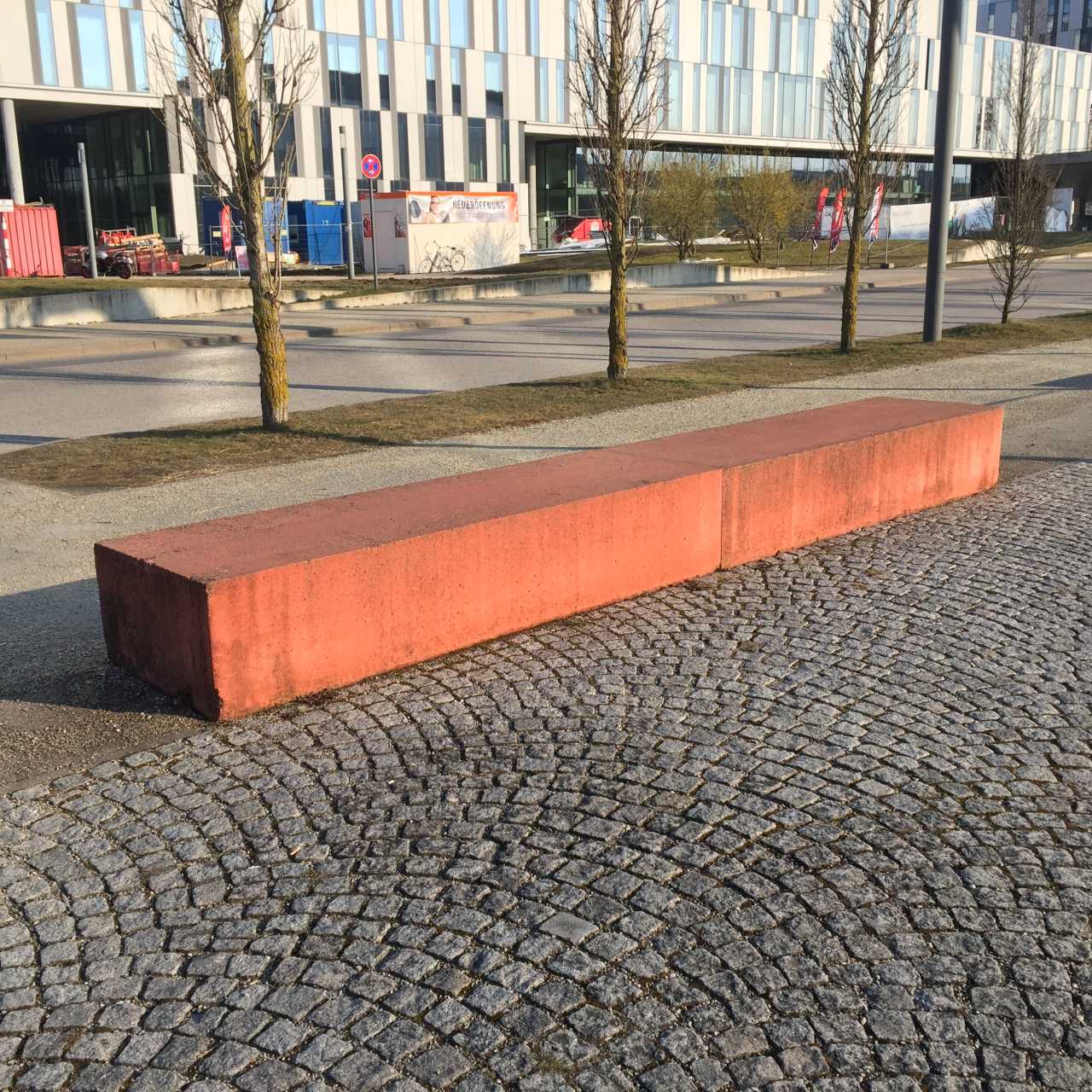
Objects that can be described with help of cuboids are for example concrete blocks or stones. Here, the difficulty varies according the unevennesses of the object, which can be balanced through averadged values. With benches, the difficulty can be increased as well, as they have to be described through different cuboids.

Cylinders are very suitbale to determine the volume of a tree trunk. Furthermore, many fountains are circular and therefore a good basis for calcualtions with the cylinder.


Especially with stones and tree trunks, the question of the object’s weight seems adequate through a given density. The mathematical background, as well as popular densities can be found in the following document Generic Tasks Volume 1.

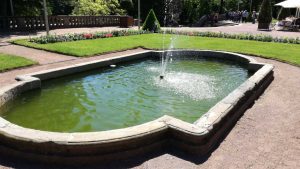
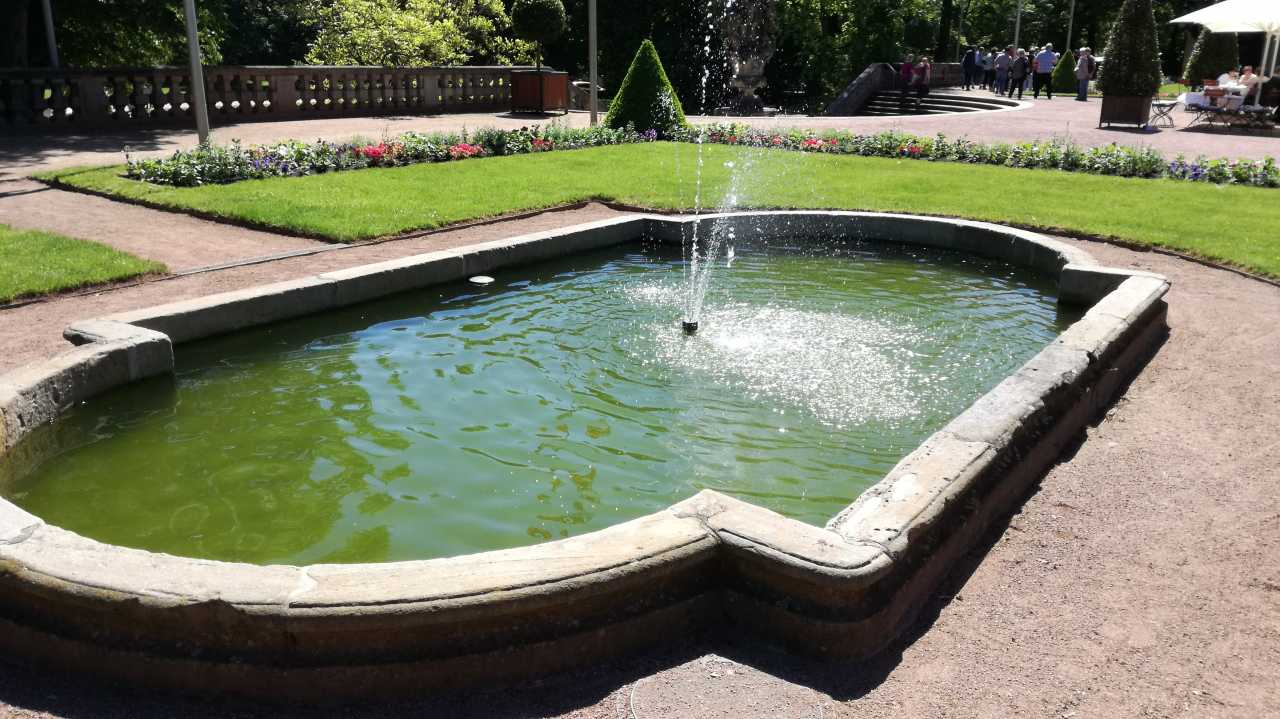
A popular MathCityMap task is concerned with the volume of fountains and how many liters of water are contained. The question can be used for a wide range of geometric themes, depending on the shape of the selected fountain (rectangular, circular, …). The Task of the Week is a particular challenge because the fountain has to be modeled with help of different geometric bodies.


Task: Water in the Fountain (task number: 1420)

How many liters of water are in the illustrated fountain?


The illustrated fountain can be modeled using a cuboid and a cylinder (divided into two parts). If this has been recognized, the necessary quantities must be collected and the individual volumes calculated. Finally, the conversion in liters is required. The task with cylinders can be used from class 9 onwards; simpler fountain shapes are already possible from class 6 onwards.

Depending on the structure of the well, the collection of the data can be a challenge and the students have to become creative. For example, the circumference of a circle can be helpful for the determination of the diameter. Not at least through such considerations, a flexible handling of mathematical formulas and correlations is promoted.

The determination of the weight of an object has often been part of a Task of the Week. However, today’s task is a particular challenge because the object consists of different materials with different densities.


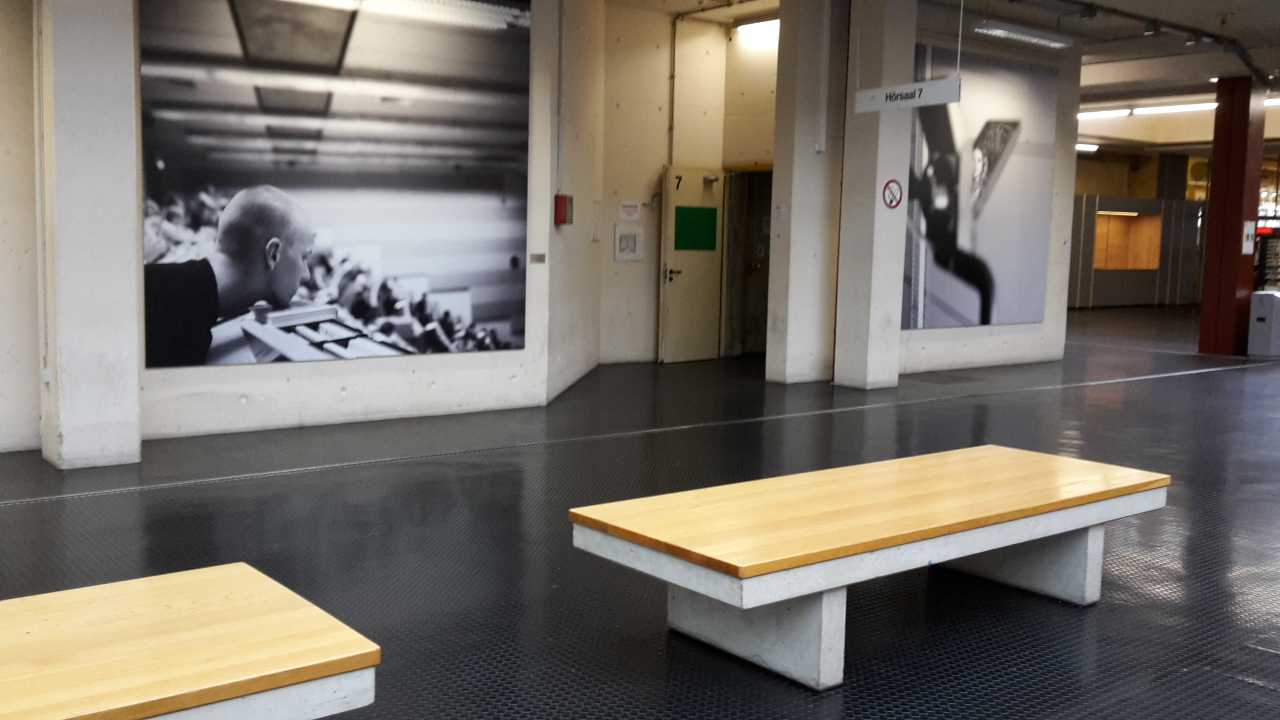
Task: Bench (task number: 1803)

There are benches in front of the H7. How much does a bench seat weigh when the wood weighs 690 kg per m³ and the concrete weighs 2400 kg per m³? Give the result in kg.


The best way to solve this problem is by dividing the bench into three parts: the two concrete feet, the concrete seat and the wooden seat. A cuboid can be used as a model for all parts. Then the students take the necessary measurements and calculate the weight of concrete and wood first separately. The total weight of the bench is then calculated by addition.

The task requires knowledge about the cuboid as well as its volume. In addition, the concept of density should be known to the pupils. Within solving this task, this can be sharpened. The task is recommended from class 7.

The current “Task of the Week” from the trail “La Doua” in Lyon, France, shows that the MathCityMap project is already implemented internationally. Originally, the task is in French and will be translated for the Analysis.


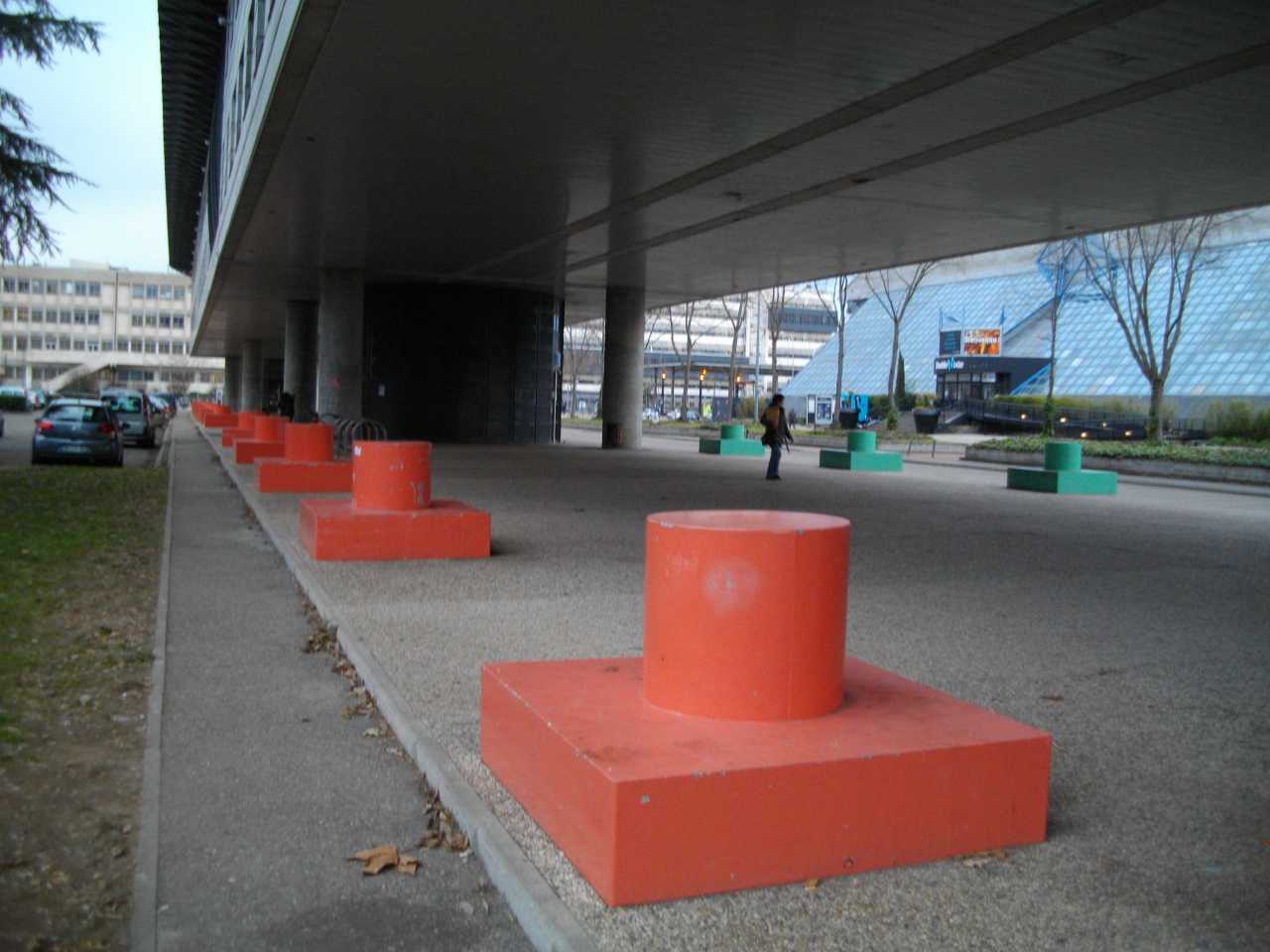
Task: Weight of the Quai 43 (Task Number: 855)

The building “Quai 43” has the shape of an ocean liner, which is built on ten concrete columns. Determine the weight of the building in tons (reinforced concrete weights 2.5t/m³).


To approximate the weight, it is necessary to calculate the volumes of the individual walls and floor slabs. To do so, the length and width of the building are determined through measuring. Afterwards, the area and the perimeter of the building (idealized as a rectangle) can be calculated. The building includes two floors and therefore the area can be counted three times. To determine the volume of the walls and floor slabs, it is further necessary to determine the height of the building and the thickness of a wall/floor slab. Afterwards, the students can calculate the different volumes through the formula of a cuboid. With help of a multiplication with the density, the approximate weight of the building can be found.

This task is a geometric and architectural problem which includes measuring of lengths as well as determining of field volumes. Especially modelling is in the center as the form of the building is approximated to a cuboid. Afterwards, the students have to consider which walls and floor slabs are relevant for the building’s weight. The task can be used from grade 7, especially in the context of cuboids and compound fields.

This task is only one of many examples which show that the MathCityMap project is an international project which stands out due to its universal use at several locations.