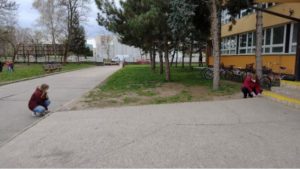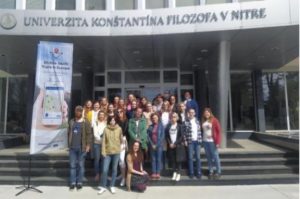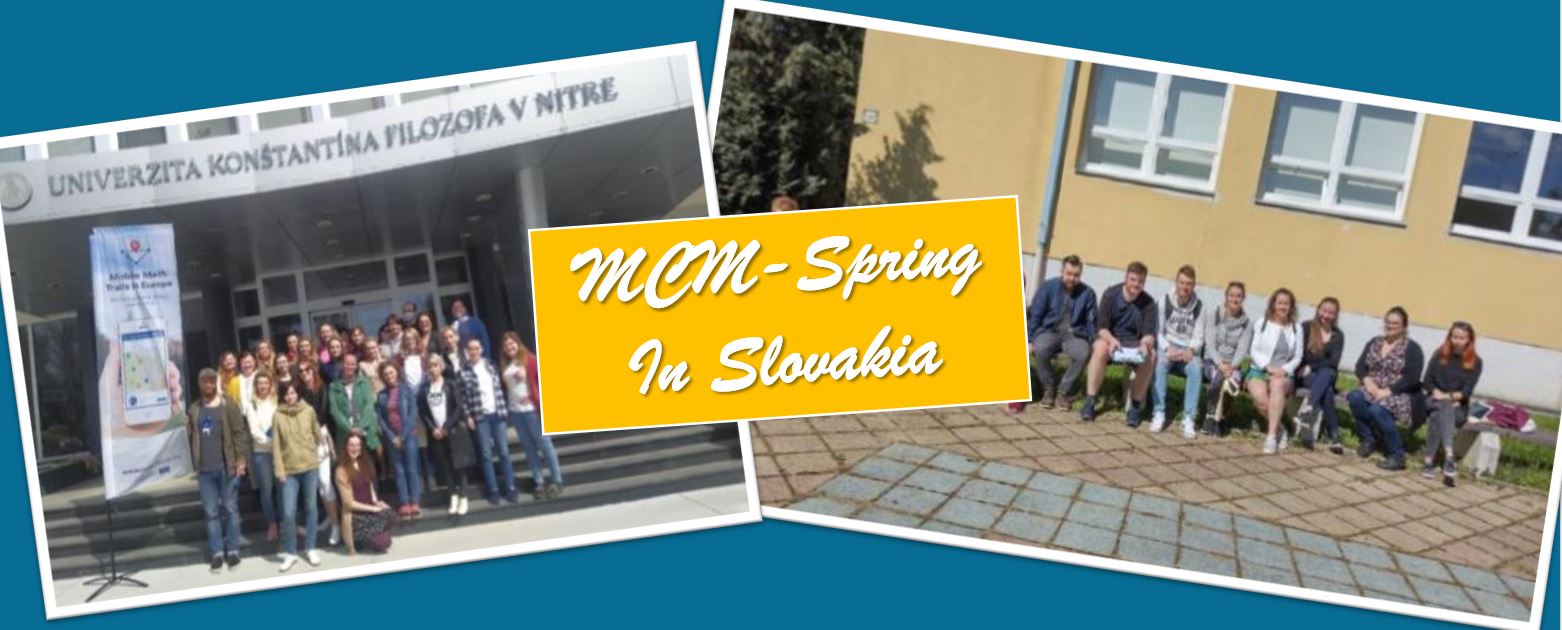
At the beginning of April, a MathCityMap advanced training course was held in Ober-Ramstadt as part of a project day for the more than 30 students of the advanced mathematics courses at the Georg-Christoph Lichtenbergschool.

The students first learned how to use MCM and then developed creative MCM tasks on the school campus for the lower and middle school. In total, the math teachers can now draw on about 50 new tasks and develop trails for their classes.

An overview of the different tasks created by the students* can be found in the trails sorted by grade level with codes 489376 for 5th/6th grade, 569374 for 7th/8th grade, and 199375 for 9th/10th grade.

The students were happy that they could create math tasks for current and future students in the spirit of sustainability. This project day showed that students can also create meaningful MCM tasks for the school community.

The project day was led by our team members Melanie Schubert and Rebecca Stäter and was carried out at the direct request of the Georg-Christoph Lichtenbergschool Ober-Ramstadt, whose teachers had already attended a MathCityMap training course in advance. If you would like to learn more about MathCityMap in the context of a teacher or student training, perhaps even directly at your school, please contact us at any time at info@mathcitymap.eu .

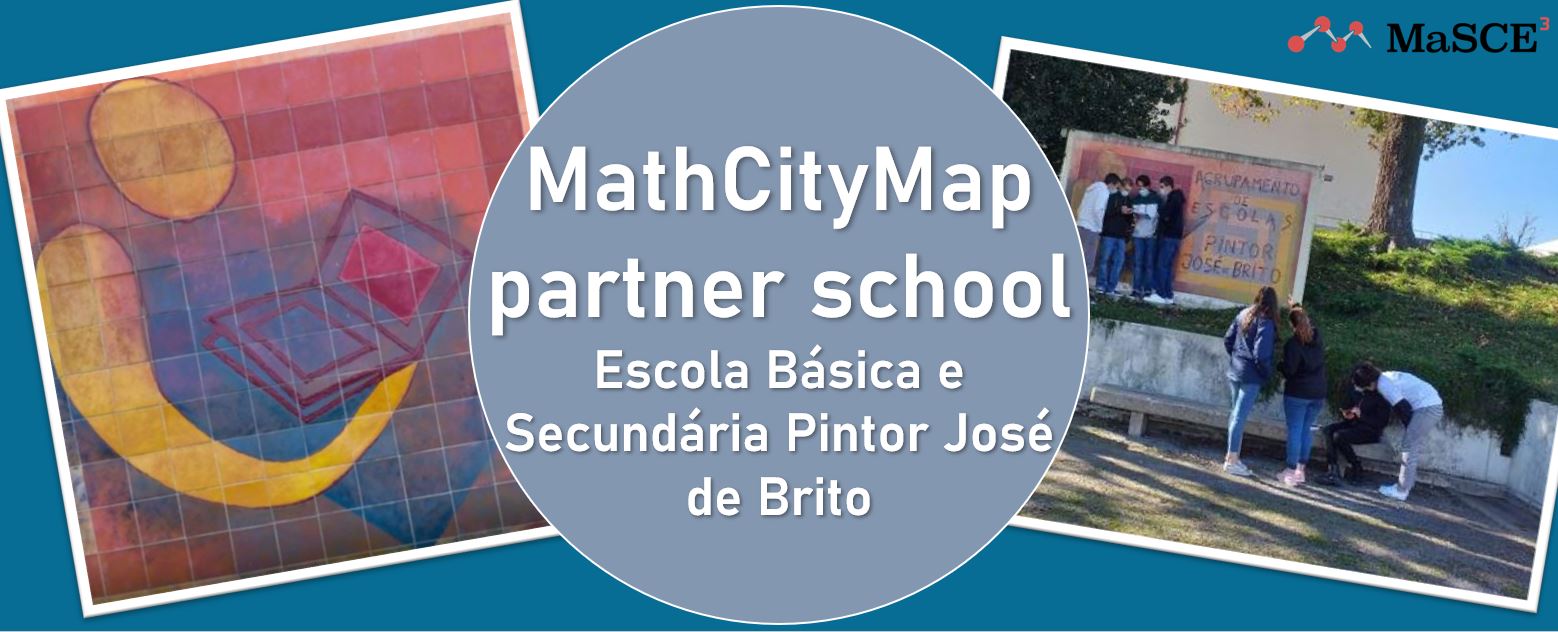
Three is a charm! We are very happy to welcome the third Portuguese school in our partner school program. The “Escola Básica e Secundária Pintor José de Brito” has also successfully completed the application process and is now the fourth official MCM partner school.

Two dedicated math teachers from the school created and tested the three math trails required for the application here, and also wrote a short report on their experience with MCM so far, which you can read later in this article.

Again, the package with the measuring instruments and the official partner school plaque is on its way to the school and we are already very much looking forward to receiving more applications from all over the world.

All further information about the partner school program and the prerequisites for the application can be found in the article about the first MCM partner school as well as on the homepage of our project MaSCE³.


Two teachers (of Mathematics and Mathematics/ICT) working at Escola Básica e Secundária Pintor José de Brito (Viana do Castelo, Portugal), built and applied in partnership three trails; two of these were intended for 12th grade students, and the remaining one for 7th grade students. One of the 12th grade tracks was applied using the digital classroom. Two more trails are currently being prepared, one for 9th grade students and the other for 10th grade students, with a total of 27 tasks published on the school grounds.

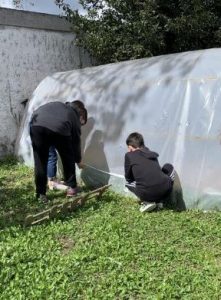
The trail tasks were solved in groups of three/four students, who worked collaboratively, using the MathCityMap application on smartphones.

By applying these mathematical trails on the school grounds, we involve all students in active learning, working on the physical, cognitive and collaborative aspects. The different groups used creativity and different forms of mathematical representations in solving the tasks.


We provide students with a different learning experience from the usual one, in which assessment, reflection, critical mobilization of information with a view to solving tasks and strengthening selfesteem and wellbeing were present.

Students, who are usually less participative in the classroom, were involved in solving the tasks, collaborating with not only group colleagues but also 12th grade students who get involved in the tasks according to the way they perceive their importance for results in national exams.

They all claimed it to be an interesting activity, allowing them to experience mathematics in a different way. As for the fact that the trails allow gamification, the students got engaged with commitment in order to achieve maximum scores.

It is usual for students to question about the importance of mathematics and how it applies to real life. The execution of the mathematical trails on the school grounds allowed them to see the application of different mathematical concepts and procedures in the world around them.


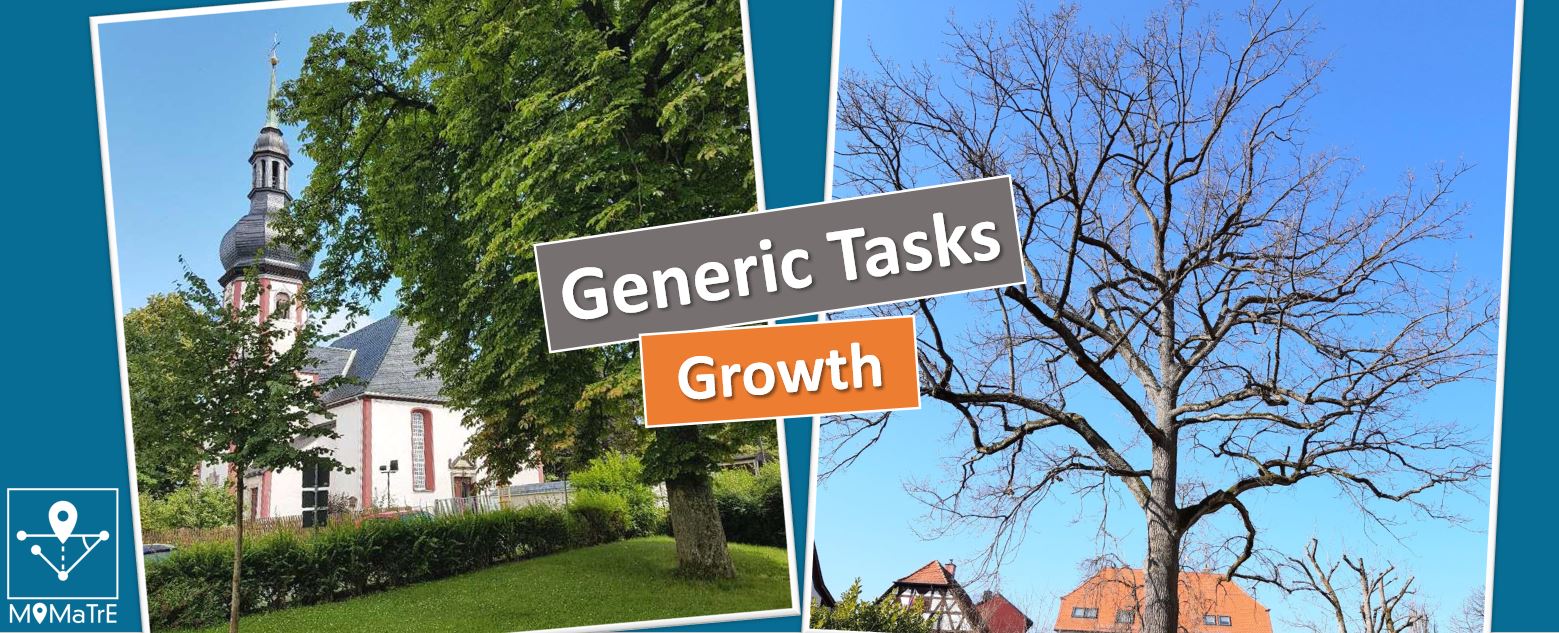
This Generic Tasks article is about the wizard task from the “Growth” topic. As always with our Generic Tasks, the tasks can be created in no time with the help of the task wizard, and this time you can find the corresponding objects everywhere in your environment with even greater certainty than usual. The first article on Generic Tasks, which also tells you how to get to the Task Wizard and what Generic Tasks are, can be found here.

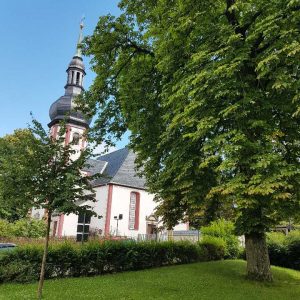
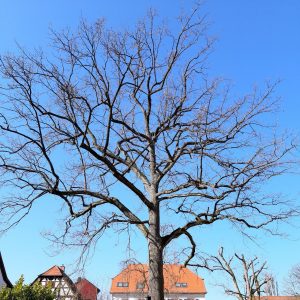
The objects we are looking at in this article on growth are, of course, trees. Whether in the countryside or in the city, the next MCM task is never far away. The task that is stored in the task wizard is:

“Determine the age of this tree. A tree with a diameter of approximately 40cm (measured in 130cm height) is about 72 years old. One can assume that the diameter grows proportionally. Give the result in years.”

To create the task, we need the circumference of the tree at a height of approx. 130 cm and the type of tree, i.e. whether it is an oak, a maple or a sycamore, since different trees naturally grow at different rates. The task can then be solved via the fact that the growth takes place almost linearly, so we can determine the growth of the tree per year via proportionality.


The next article on the issue of Generic Taks will deal with the topic of velocities, for which we will take a closer look at the escalator. Until then, have fun and save time when creating MCM tasks with the Task Wizard!


Dear MathCityMap users,

there is currently a problem with the Android 11 version of the MathCityMap app. Fortunately, our IT team has already been able to identify and fix the cause of the problem. An update can now be installed in the Google Play Store, which makes the app run smoothly again.

We apologize for any inconvenience this disruption may have caused. Please feel free to write to us at info@mathcitymap.eu if we can assist you with any technical difficulties.

Your MCM Team

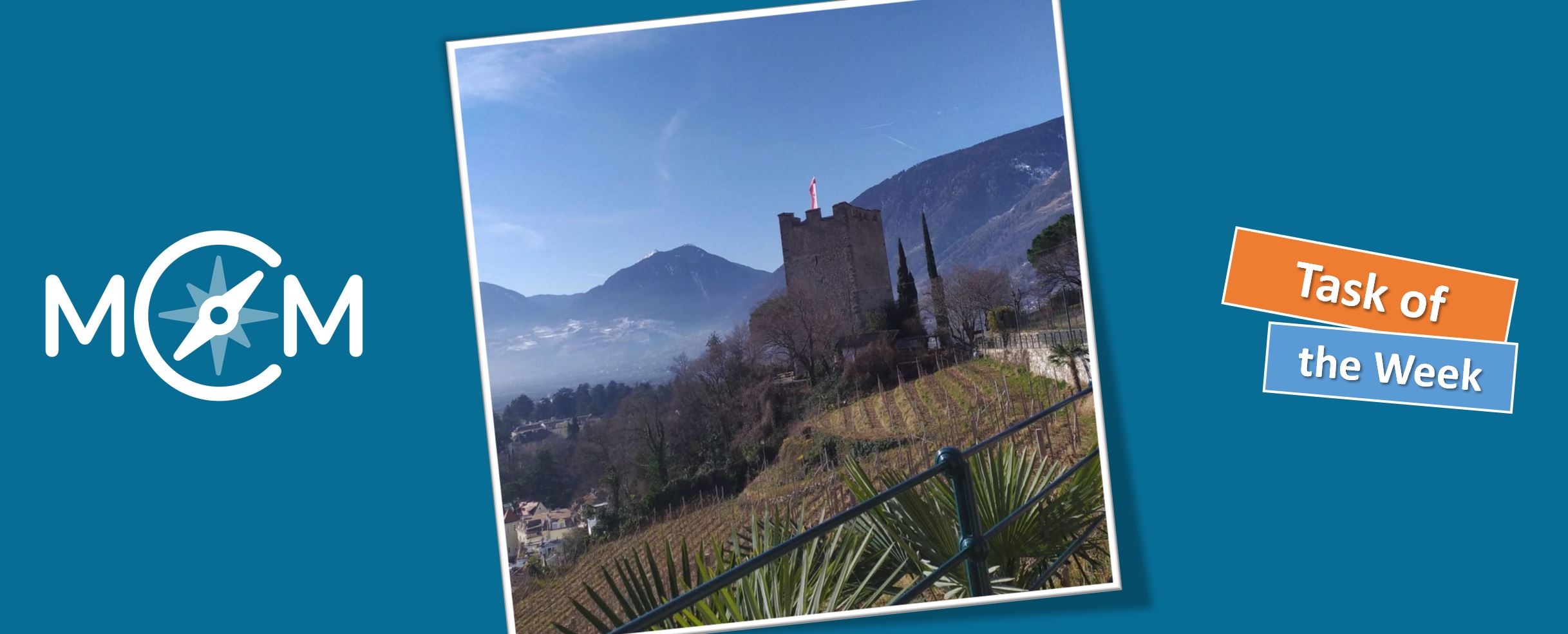
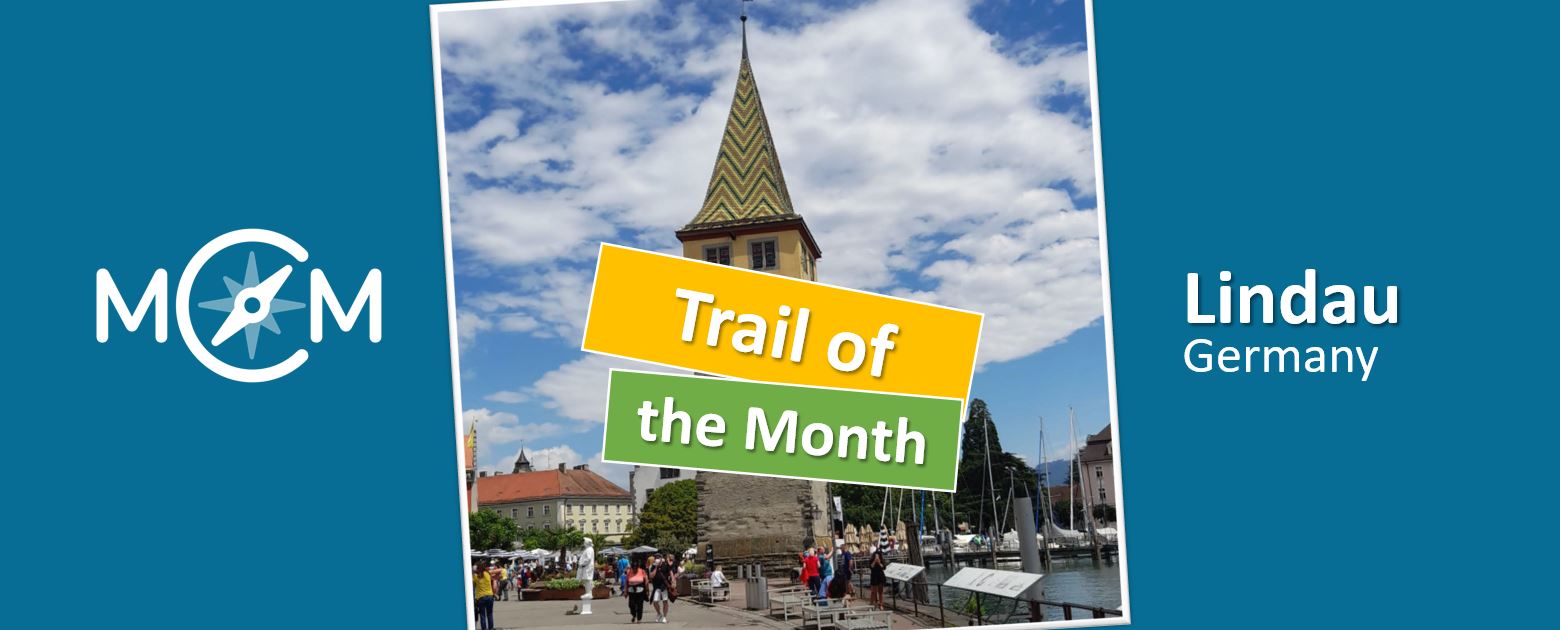
The Trail of the Month for April was created at a picturesque location on Lake Constance, on the island of the city of Lindau in Bavaria. Together with his P-Seminar, a special type of course in the Bavarian gymnasiale Oberstufe, teacher Jan Neuendorf created the “Lindau Island Mathtrail” (Lindauer Insel Mathtrail), which is available in the MCM app under the code 376526 and in the MathCityMap web portal here.

Along the harbor and through lindau’s old town, the trail winds its way across the entire island and integrates various sights of the city, making it very interesting not only mathematically, but also architecturally and historically. The trail contains a total of ten tasks that focus in particular on the content of the eighth and ninth grades.


An interview about the background of the trail is given by Jan Neuendorf in the following interview:


How did you come across the MathCityMap project?

I first heard about the project from colleagues who had spoken about it in various training courses. Afterwards, I found out more about the MathCityMap project on the Internet. This gave me the idea to offer a P-seminar in mathematics, which had the goal to develop a Math-Trail on the island of Lindau and to make it accessible to interested people via the MathCityMap-App. The P-Seminar is a special feature of the gymnasiale Oberstufe in Bavaria. It supports students in their study and career orientation and focuses on the planning and implementation of a subject-related project.


Where is your trail located? What is special about your trail?

The trail is located on the island of Lindau in Lake Constance. With its historic old town, narrow streets, medieval buildings and picturesque harbor with lighthouse, lion and mountain view, the island provides a unique backdrop for the elaborate math trail. Therefore, it was also an exciting challenge to discover and develop suitable mathematical tasks on objects on the island. Thus, the trail combines sightseeing with math activities, which is an exciting combination.


How do you use MCM and why?

So far, MCM has served as a guiding idea for the P-Seminar in mathematics. The goal of the participating students was to plan and implement a math trail on the island of Lindau. In the future, the trail will be used in grades 9 and 10 as a subject outside the classroom or as part of our project week. It is certainly also desirable that other schools in the Lindau area will use the trail for classroom excursions and class action days.


Describe your favorite task on the trail. How can it be solved?

My favorite task of the trail is the task to the Mangturm (Mangtower) at the Lindau harbor. On the one hand, the task is to be solved directly at the harbor in the heart of Lindau, which gives the task an exposed place within the trail. On the other hand, it is a suitable task from the field of geometry, in which mathematics is applied in practice and in which geometry as the science of measurement can be understood in its most original form.
The task is solved with the ray theorem. The fascinating thing is that this theorem can be used to determine lengths that are difficult or impossible to measure.
If you form the 2m long meter stick into an isosceles, right-angled triangle and place it on the harbor railing in such a way that you can aim at the top of the tower via the tip of the leg of the meter stick that is far from your eye, you are not far from the solution. After you have measured the horizontal distance of your location to the Mangturm with the help of the railing elements, you add the height of the railing to this quantity and thus obtain the height of the tower.


Nach zwei Jahren voller Onlinemeetings konnte sich das Team des aktuellen MathCityMap EU-Projektes MaSCE3 (“Math Trails in School, Curriculum and Educational Environments of Europe”) endlich wieder persönlich Treffen und die Aktivitäten für das Abschlussjahr des Projektes planen. Ausgerichtet wurde das Meeting von den Projektpartnern der Universität Claude Bernard in Lyon, Christian Mercat und Patrick Berger, die für einen gelungenen Austausch und eine strukturierte Organisation sorgten.

Im Rahmen des MaSCE3 Projektes wurden schon fantastische Neuerungen für MathCityMap realisiert. Zum Beispiel wurden unter anderem neue Antwortformate, wie der Vektor, der Lückentext oder die Informationsstation eingeführt. Weiterhin wurde die Möglichkeit implementiert sogenannte Subtasks, also Unteraufgaben, zu bestehende Aufgaben hinzuzufügen. Außerdem wurde durch das Projekt, dass schon jetzt viel genutzte und effektive “Digitale Klassenzimmer” mit seinen mannigfaltigen Einsatzmöglichkeiten entwickelt. Über die vielen weiteren Projektergebnisse kann man sich natürlich auf der Website des Projektes informieren.

Wir sind sehr gespannt, welche weiteren Entwicklungen durch MaSCE3 in diesem Jahr auf MathCityMap zukommen, über die wir natürlich auch auf unserer Website informieren werden!

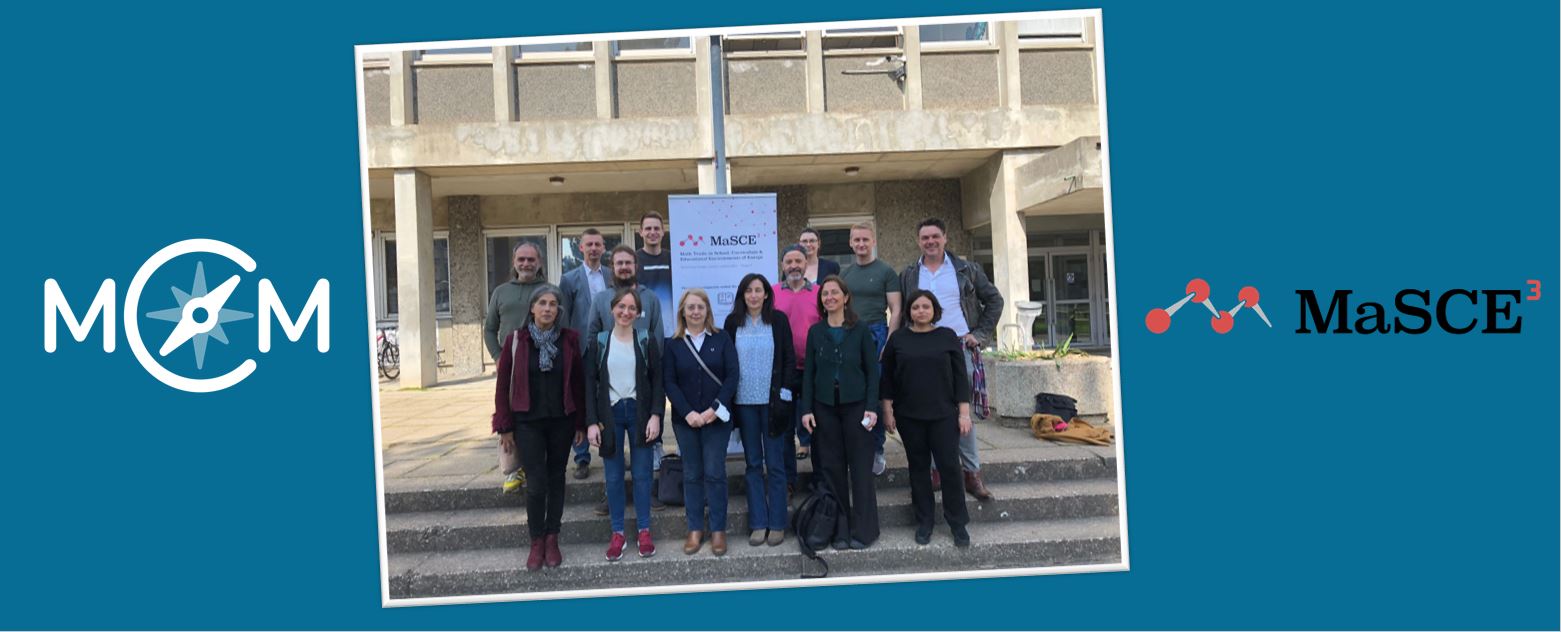
After two years of online meetings, the team of the current MathCityMap EU project MaSCE3 (“Math Trails in School, Curriculum and Educational Environments of Europe”) could finally meet again in person and plan the activities for the final year of the project. The meeting was hosted by the project partners of the University Claude Bernard in Lyon, Christian Mercat and Patrick Berger, who ensured a successful exchange and a structured organization.

Within the MaSCE3 project, fantastic innovations for MathCityMap have already been realized. For example, new answer formats such as the vector, the cloze or the information station have been introduced. Furthermore, the possibility of adding so-called subtasks to existing tasks has been implemented. Furthermore, the project developed the already widely used and effective “Digital Classroom” with its manifold application possibilities. Of course, you can read about the many other project results on the project’s website.

We are very excited to see what other developments MaSCE3 will bring to MathCityMap this year, which we will of course inform you about on our website!

In this article we present a very interesting development in Ober-Ramstadt, a city in the south of the German state of Hesse. There, Daniel Reckhard, a student teacher at the Georg-Christoph-Lichtenberg-Schule, has developed a special kind of math trail with MathCityMap. The aim of the so-called mathematical culture trail is to combine the culture of the city with interesting and creative mathematical discovery opportunities and thus to gain a new perspective on mathematics. Further information about the trail can be found on the website of the city of Ober-Ramstadt and an interview about the background of the mathematical culture trail with the creator can be read below.


How did the idea for combining the topics of mathematics and culture come to life?

Mathematics is one thing above all: an art. Very eloquently and with the necessary leisure Paul Lockhart describes this in “A Mathematician’s Lament: How School Cheats Us Out of Our Most Fascinating and Imaginative Art Form”. An abridged version is freely available as a PDF on the Internet and is absolutely worth reading.

Math as art is meant to be very inclusive, that math is so amazingly suited to describing our universe is one aspect of it. My favorite subjects are the STEM sciences and within mathematics my favorite is statistics. In statistics, too, you are not at home until you have filled its concepts with experience and thus brought them to life, whereupon you can create. So also in statistics aesthetics in the literal sense (aisthesis as “sensual cognition”) is central.

The typical school mathematics could hardly be more opposite. I am forced to cram through a crowded curriculum, necessarily superficial and hasty. I have to drill students on exam math and fill them with mindless arithmetic, dry formulas, and meaningless concepts. So my pubescent students came back to class from distance learning and already the “mathematics competition” of the state of Hesse loomed on the horizon, a de facto comparative test in which an immense range of topics is asked. And this (thoroughly international) rigidity of the curriculum is commonly thought to be the true face of mathematics. No wonder, there is no time for real understanding.

The central reason for the connection, then, is as a resolute antithesis of instruction characterized by control. A second reason is that mathematics is in any case inseparable from our culture as a part of it. For example, I had attended the lecture “Mathematics in Context” by Prof. Burkhard Kümmerer and had enjoyed studying the genesis of mathematics.


Why did you choose MathCityMap to implement the idea?

The idea came from the supervisor of my educational thesis, Steffen Burk. I had the idea of laying a geocache, and he thought there was something better because it was tailored to schools. My second subject is computer science, I like to work my way into new techniques. And here I also found it exciting to see how I can implement my ideas in a very closed learning environment. For example, how do I represent imagination, how do I enable mathematics to unfold?

Because the core principle behind MathCityMap is the same as with the Skinner Box: learners interact with a machine, but outside, i.e. on real objects. And of course, Prof. Ludwig does not intend MathCityMap to replace teaching, but recommends it for certain scenarios, especially as a deepening of the application of already learned concepts. So a real encounter of the learners with something fundamentally new was a challenge. I hope that I succeeded well. In any case, my students had a lot of fun, as did my colleagues who had previously tested the trail.

What I and the students really liked was going out into the world. It naturally led to cooperation with the city administration and to opening up the trail to the general public. That’s another aspect of cultural school: connecting the school community with the communities that surround it. That also enlivens the math. What I also really liked is that the user-friendliness allows students to create tasks. This allows them to be immediately creative.

For example, I could also imagine implementing open-ended task formats: for example, “How should (mathematical object) be designed?” The students use the funnel principle to make assumptions or choose suitable real objects, and their closed MathCityMap task thus represents a solution to the open task.


What is there to discover and learn on the trail?

The goal of this trail is to show the cultural and aesthetic side of mathematics, its diversity, hidden patterns, symmetries, but also how mathematical cultural techniques shape our world. Compared to other trails, the tasks are deliberately kept quite easy. After testing, I have adapted the tasks and aids so that many students can solve the tasks well. As with the Computer Science Beaver, the trail is intended to enable students to gain a positive experience with mathematics without a great deal of prior knowledge, which creates a desire for more.

At my favorite station, students discover what numbers (for example, their favorite number) really look like because, for example, “4” or “four” are just names for a number, they are not the number itself. I implemented this via a geogebra activity. At another station, they learn why scaffolds always contain triangles, as they recreate them and thus “grasp” math in the literal sense. The material for this is on file at the school. Those outside the school can borrow the material from the town hall with a deposit of 10€.

At yet another station, they stretch a twelve-knot cord and have to understand how many stone slabs are spanned, thus discovering the decomposition principle and thus the decisive basic idea for the area of any polygon. One station (appropriately enough, the library) activates the imagination and asks what would be created if one were to think of the mirrored object in addition to the given object (a decorative window).

And quite incidentally, something about cultural history is told, for example, why a stream leads to a mill wheel. I found it impressive to calculate with which enormous force this wheel is turned. Finally, the students are taken to hidden cultural sites, for example, our small town has its own museum, which many people are not aware of.


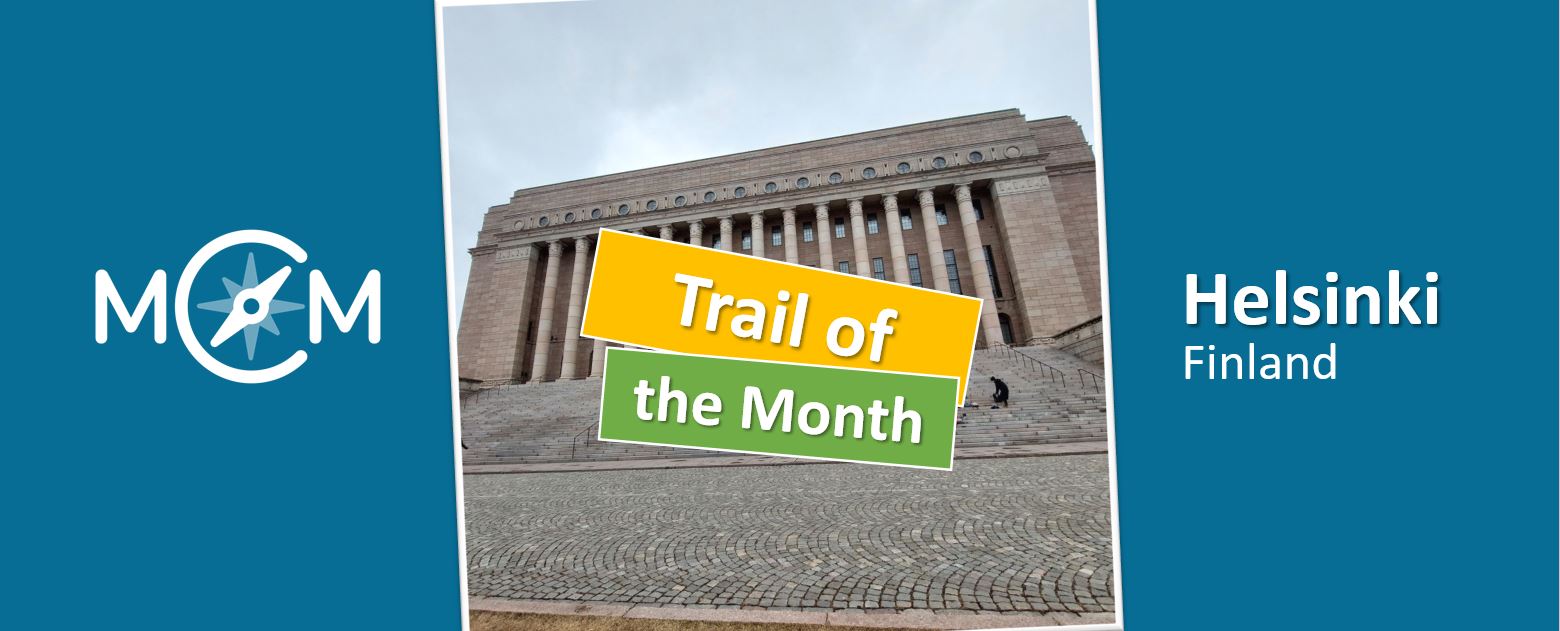
The term mathematical walk could hardly be more apt than for the trail of the month March. This one comes from the largest city in Switzerland, Zurich. Here, Roland Wiss, a member of the school management and executive board of LIPSCHULE Zurich, has created the trail “Counting, measuring, calculating and estimating between Sechseläutenplatz and the city border” (Zählen, Messen, Berechnen und Schätzen zwischen Sechseläutenplatz und der Stadtgrenze), which can be accessed in the MCM app under the code 257781 and is available on the MathCityMap web portal here.

The trail stretches over a total length of 2.8 km and, as the title suggests, leads from the centrally located Sechsläuteplatz along a walking path alongside Lake Zurich to the city border. A total of twelve interesting mathematical tasks with a wide variety of content can be found along the route, which not only offers a chance to marvel at the beautiful nature surrounding the city of Zurich. What most of them have in common, however, is that there seems to be too little data to solve them.

Roland Wiss explains among other things the concept of the trail in more detail in the following interview:


How did you come across the MathCityMap project?

I am always interested in different ways to show my students the beauty and excitement of mathematics. This includes mathematical problems from everyday life and especially outside the classroom. For this reason, I regularly search the internet for exciting math projects. In doing so, I came across the MathCityMap project, which immediately appealed to me.


Where is your trail located? What is special about your trail?

I walk every morning in Zurich from Stadelhofen station to Lipschule and since I am a big fan of Fermi questions, I had the idea to design this trail along my way to work. I call a Fermi question an estimation about a problem, where the students seem to have no or insufficiently accurate data at a first superficial glance. However, when their explorer and detective eyes are awakened, students notice that they can decompose the question into several sub-problems for which they can find exact or approximate solutions. Combining and completing the partial results, they arrive at an overall result that is very close to the actual value. My students like to deal with Fermi questions and they learn a lot. So it was obvious for me to create a trail on the topic “Counting, Measuring, Calculating and Estimating”. Since the Lipschule is a comprehensive school with different age groups, I wanted to create a trail that contains tasks for many age groups. In addition, there is the wonderful location at the lake and the possibility to extend the trail to a day trip with (at least in summer) a swim in Lake Zurich.


How do you use MCM and why?

We regularly have a mathematics project week. One workshop of this week is called “Mathematics outside” and has the following content: “Mathematics is everywhere. We explore the surroundings from Sechseläutenplatz to Lipschule with a mathematical eye”. The MathCityMap app is perfect for this. I especially like the fact that the students are outside thanks to the app and solve many tasks in teamwork. They are also actively involved and have to solve the tasks and problems using appropriate tools. The students learn not only mathematics, but also teamwork and the use of clever solution and organization strategies.


Describe your favorite task on the trail. How can it be solved?

My favorite task is called “Area of a hexagon” because it can be solved in different ways and by different ages. On the one hand, the older students can use the area formula for the hexagon 3*√3*s*s/2 and count the paving stones along the sides to determine the number. On the other side, there are hexagons of equal area in the square, which are filled with paving stones. Younger students, who do not yet know the area formula, can determine the number in a clever way by counting and estimating. Since the hexagons filled with pavers all have similar patterns, the students can also think about the method the paving contractor used to lay out the pavers. It is therefore a place and a task that can stimulate a variety of thinking processes.

After almost two years, the time has finally come. A new Mathtrail takes the title of the most downloaded trail in the world! The previous record holder, the trail MCM@home (Ffm a. M.) by Matthias Ludwig with 477 app downloads, has now been replaced by a great trail from Jakarta in Indonesia.

The trail Banteng Berhitung was created by Yunas Chandra and has already been downloaded 569 times in the MCM app since its release on 09.12.2021.

Congratulations to the new record holder and we are curious when we will set a new record.

A short interview with the creator of the Mathtrail follows now in this article. Have fun reading!


How did you come across the MathCityMap project?

To be honest, I never guessed that my Mathtrail will be downloaded that many times. It’s a pleasure for me. This Mathtrail probably is the output from “Bimtek Penguatan Keterampilan Numerasi Guru Dikdas melalui Math City Map” which was held by Ministry of Education. It was a teacher training at which all the participants had to go outdoors to create a task and trail and “Banteng Berhitung” is my trail which consist of tasks of myself and other participants. So, I thought this reward must be declared for all the participants in that “Bimtek” especially who made the tasks that I used in my trail.


Please describe your Mathtrail.

“Lapangan Banteng“ is a historic square located in a historic area formerly known as Weltevreden. Formerly students could learn history and enjoy the beauty of “Lapangan Banteng” and now they can also learn about numeracy. Students can apply their math knowledge in real life so they can maintain and improve their numeracy skill.

How do you use MCM and why?

I really love to use this app, it can help us as teachers to make more interesting learning settings included in an outdoor activity. So far, students rarely use their math skills in their life problems. With MathCityMap they can learn how to apply them and they deepen their knowledge about math.


Describe your favorite task of the trail. How can it be solved and what can students learn from it?

“The City of Collaboration” is my favourite task. It needs numeracy skill to solve this, because if students don’t have it they will never get the answer. Its very simple to answer but people can easily type in the wrong answer too. They have to determine the area to be installed ceramics in and then divided it by the size of ceramics that is supposed to be use.