Task of the Week: Volume of the Bulwark

Katalin Retterath is a mathematics teacher and consultant for teaching development in the German fedaral state Rhineland-Palatinate. In the following interview, she introduces us to a task that was created during an teacher training on outdoor mathematics teaching. The task: Bulwark – Volume: Task: “Go to the interior of the bulwark. Calculate the volume of […]

Task of the Week

Katalin Retterath is a mathematics teacher and consultant for teaching development in the German fedaral state Rhineland-Palatinate. In the following interview, she introduces us to a task that was created during an teacher training on outdoor mathematics teaching.


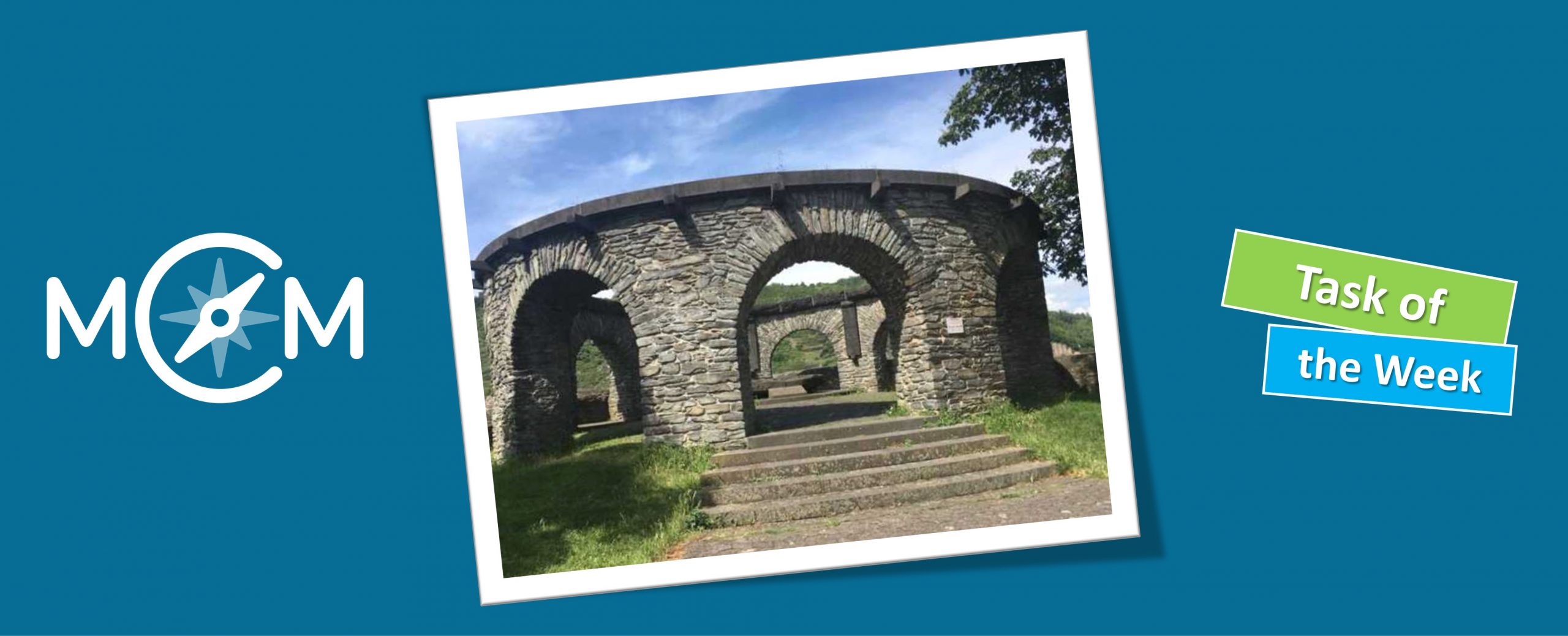
The task: Bulwark – Volume:

Task: “Go to the interior of the bulwark. Calculate the volume of the interior in m³ up to the capstones. Assume that the floor is level.”

The goal here is to calculate the volume of a cylinder, which the bulwark encloses with a circular base.

You describe in the category “About the object” that the task was created during an teacher training. How do you use MCM and why?

I am a consultant for instructional development at the pedagogical state institute in Rhineland-Palatinate, Germany. I don’t remember how I got to know MCM, probably at a conference. I have known MCM from the beginning and use it in my classes 1-2 times a year during virus-free times.

At the pedagogical state institute we offer advanced trainings also for the use of media in mathematics lessons, here MCM is a topic again and again. One of the most successful advanced trainings is “Outdoor Mathematics” – a two-day event, which we have offered so far alternately in Speyer, Bad Kreuznach and Andernach. The task “Bulwark – Volume” was created by a group of participants in Andernach – I just created it in the MCM system.

How do you plan to use MathCItyMap in the future? What ideas do you have for using MCM in math classes?

It’s a very great tool! I look forward to using it again. We consultants have also used MathCityMap in another way, including outdoor math: we created a series of surveying tasks around Speyer Cathedral (code: 031829) and entered them into MCM.

With the help of MCM we have been able to create very appealing booklets for the participants of the advanced training [also MathCityMap offers the possibility to download a trail guide as a companion booklet to the trail; editor]. These booklets help document the work so that the field trip can be better integrated into the classroom: In addition to entering results in the app, the notebooks are used anyway / in parallel. I would try it out like this in a 10th grade or high school class – if times allow and I have a suitable class.
Task of the Week: Climbing Net

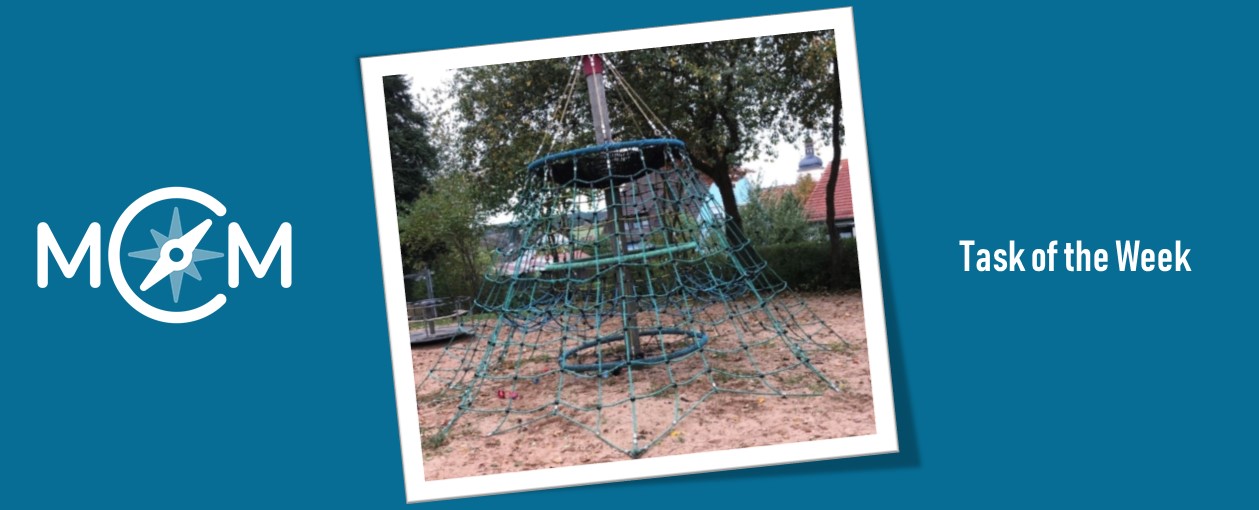
Henrik Müller, a grade 12 student, created some MathCityMap tasks in Geiselwind, Germany. One of them – the task “Kletternetz” [eng. “climbing net”] – is our new task of the week How did you get to know the MathCityMap idea? I am a grade 12 student at a German Gymnasium. There I participated at the […]

Henrik Müller, a grade 12 student, created some MathCityMap tasks in Geiselwind, Germany. One of them – the task “Kletternetz” [eng. “climbing net”] – is our new task of the week

How did you get to know the MathCityMap idea?

I am a grade 12 student at a German Gymnasium. There I participated at the seminar “mathematics in sports and gaming”, where the MathCityMap idea was presented. As part of my seminar paper, I created one trail consisting of five tasks in the German town Geiselwind. Additionally, I examined the aspects of mathematical modelling in school.

Please describe this task type. How the age of the tree could be ascertained?

The task is about the climbing net, which exhibits some complex geometric structures und solids. Especially, the regular base, circles, one pyramid and one cylinder attract attention. We can model the hole solid as one pyramid with a base in shape of an octagon, which is penetrated by a cylinder. By using the formula for the volume of solids and by applying the theorem of Pythagoras the task can be solved.

What are the results of your analysis of school-based modelling?

In my seminar paper, I compared the usage of realistic and traditional tasks. Therefore, one group worked on conventional tasks in the classroom, while another group handled my created MathCityMap tasks. Both groups consisted out of eight students of the 11th grade. The results of my experiment indicate that solving a MathCityMap tasks leads to an increase of modelling competencies as well as to an improved visual thinking. In my opinion, the project could get a fixed part of modelling pedagogy for the reason that using MathCityMap conduce the mathematical understanding of students.

Task of the Week: Lateral Area of the Pillar

As part of the MEDA conference in Copenhagen from 05.-07.09.2018, Joerg Zender und Simone Jablonski presented the MathCityMap system and the review process. During this, various tasks in Copenhagen’s city center were created. Task: Lateral Area of the Pillar (Aufgabennummer: 4666) What is the lateral area of the red part of the pillar? Give the results […]

As part of the MEDA conference in Copenhagen from 05.-07.09.2018, Joerg Zender und Simone Jablonski presented the MathCityMap system and the review process. During this, various tasks in Copenhagen’s city center were created.


Task: Lateral Area of the Pillar (Aufgabennummer: 4666)

What is the lateral area of the red part of the pillar? Give the results in m².


One of these tasks is about the statue at the city center and the red area. For this, the statue has to be modelled as a cylinder. With help of the measuring tape, the circumference can easily be determined and out of this the radius. The height can be calculated by means of the regular stones.

All in all, Copenhagen was a great success for MCM!

Task of the Week: Columns in the Parc

This week, Carmen Monzo, teacher in Spain gives us an inside into her task “Colums in the Parc”. It is created in a parc in Albacete, which ” is full of mathematical elements,  though people are not aware of them until they are in math-vision mode.” Task: Columns in the Parc (Task Number: 3981) Calculate […]

Task of the Week

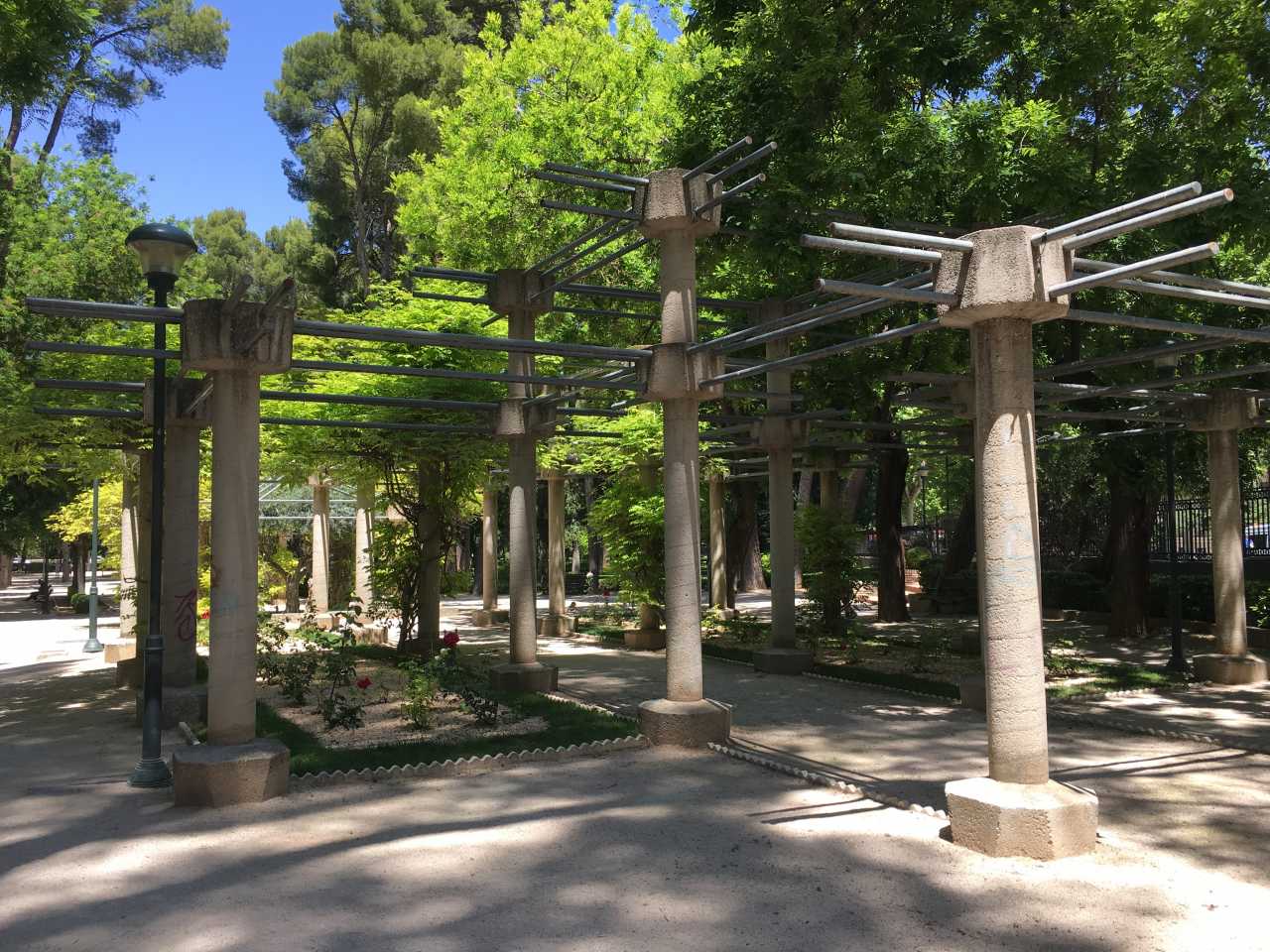
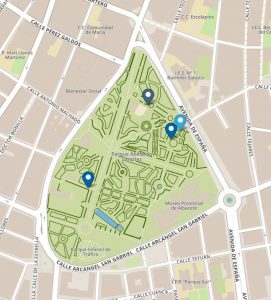
This week, Carmen Monzo, teacher in Spain gives us an inside into her task “Colums in the Parc”. It is created in a parc in Albacete, which ” is full of mathematical elements,  though people are not aware of them until they are in math-vision mode.”


Task: Columns in the Parc (Task Number: 3981)

Calculate the lateral surface (in m²) of one of the columns of this structure.


“I especially love this structure.  Parallel and perpendicular lines can be easily identified, as well as a set of columns (cylinders) whose lateral surface can be easily calculated by using a folding ruler or a measuring tape, and a calculator to introduce the data and the formula. The height of the cylinder is easy to get, but to calculate the radius of the base as accurate as posible, students first have to measure the circumference and then divide by 2*pi.

As this structure has a dozen columns, the activity can be done by around 20 students, comparing their results and thinking about the importance of the accuracy when measuring. To solve this task, students should have previously studied 2D and 3D shapes, the concept of the lateral surface and some formula to calculate it.

As a secondary mathematics teacher, I think that our students need to handle things, measure, count, touch, feel, use their senses… MathCityMap provides the motivation students and teachers need to do those things with the help of the mobilephone technology.”

Task of the Week: Roof

The classical geometric bodies and figures can be found numerously in the environment. However, real objects deviate from the ideal body and require modeling skills. In addition, composite bodies are not uncommon as in our current “Task of the Week”, which was created by Bente Sokoll, a student at the Johannes-Brahms-Gymnasium in Hamburg. Task: Volume […]

Task of the Week

The classical geometric bodies and figures can be found numerously in the environment. However, real objects deviate from the ideal body and require modeling skills. In addition, composite bodies are not uncommon as in our current “Task of the Week”, which was created by Bente Sokoll, a student at the Johannes-Brahms-Gymnasium in Hamburg.


Task: Volume under the roof (Task number: 4194)

Calculate the volume under the roof (if the sides were closed). Give the result in m³.


To calculate the volume, the body is split into a cuboid and two semi (idealized) cylinders. For the cuboid, length, width and height must be measured and multiplied. For the cylinder, one needs the diameter (or the radius) and the height of the cylinder, which corresponds to the width of the cuboid. The necessary formulas give the sum of the individual volumes.

The task is also a nice example of how MathCityMap students can become authors themselves. In this case, students were asked to create assignments for younger grades. We are looking forward to the usage of the tasks!

Generic Tasks: Volume I

In a further article on our category Generic Tasks, we want to present you determinations of volume and mass. The focus will be on the bodies Cuboid and Cylinder. Further bodies will follow in future articles. We start with these forms as they occur in the environment very often and can be realised very quickly […]

Task of the Week

In a further article on our category Generic Tasks, we want to present you determinations of volume and mass. The focus will be on the bodies Cuboid and Cylinder. Further bodies will follow in future articles. We start with these forms as they occur in the environment very often and can be realised very quickly with our Task Wizard.

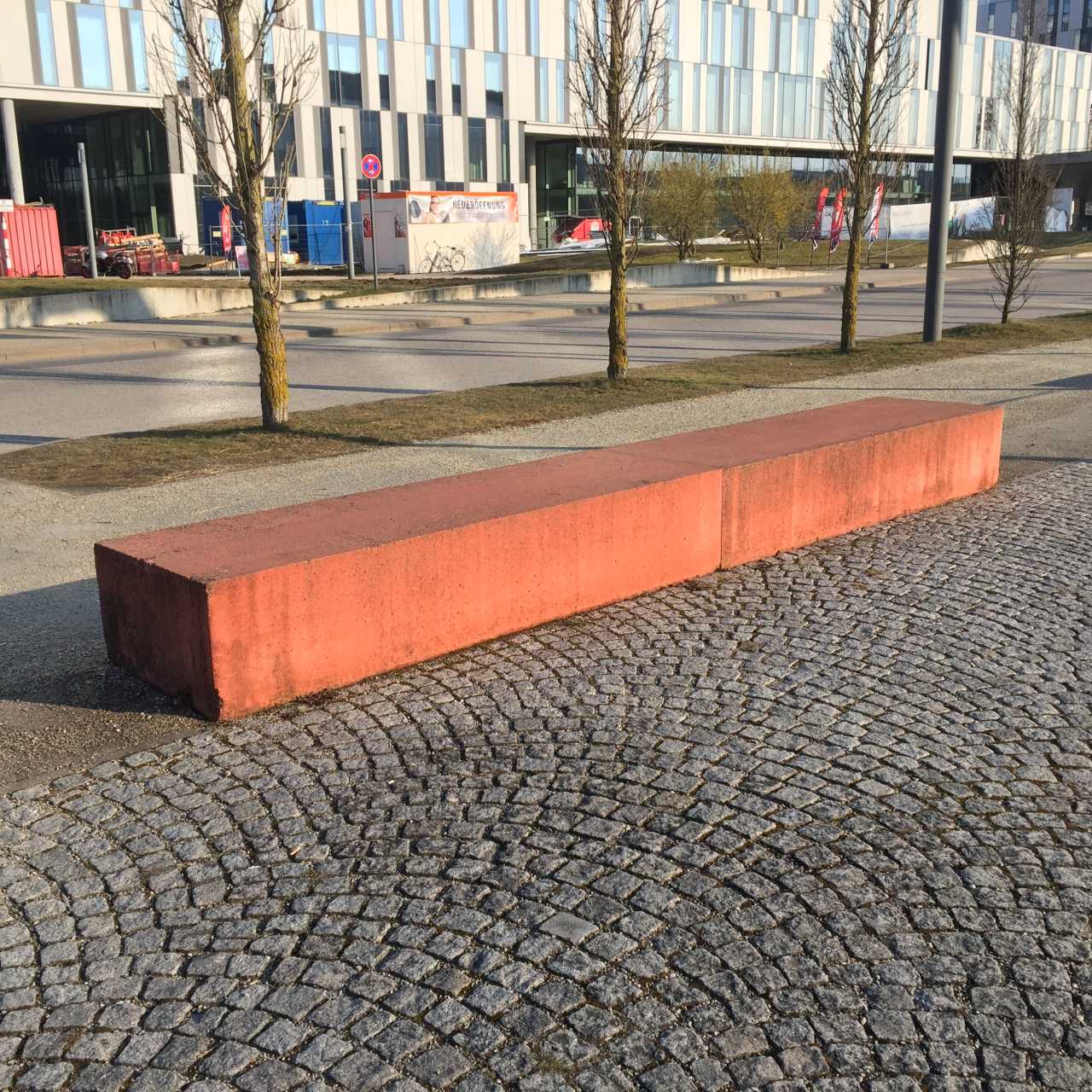
Objects that can be described with help of cuboids are for example concrete blocks or stones. Here, the difficulty varies according the unevennesses of the object, which can be balanced through averadged values. With benches, the difficulty can be increased as well, as they have to be described through different cuboids.

Cylinders are very suitbale to determine the volume of a tree trunk. Furthermore, many fountains are circular and therefore a good basis for calcualtions with the cylinder.


Especially with stones and tree trunks, the question of the object’s weight seems adequate through a given density. The mathematical background, as well as popular densities can be found in the following document Generic Tasks Volume 1.

Task of the Week: Arched Greenhouse

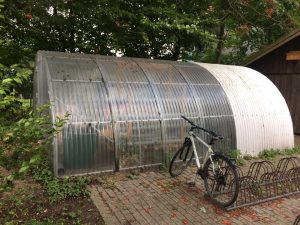
As a task creator for MathCityMap, it is important to look at the environment through “mathematical glasses”. Thus, buildings become cuboids, lawns become polygons or – as in the current task of the week – greenhouses become half cylinders. Task: Arched greenhouse (task number: 1950) Calculate the material requirement for plastic for the greenhouse. Give […]

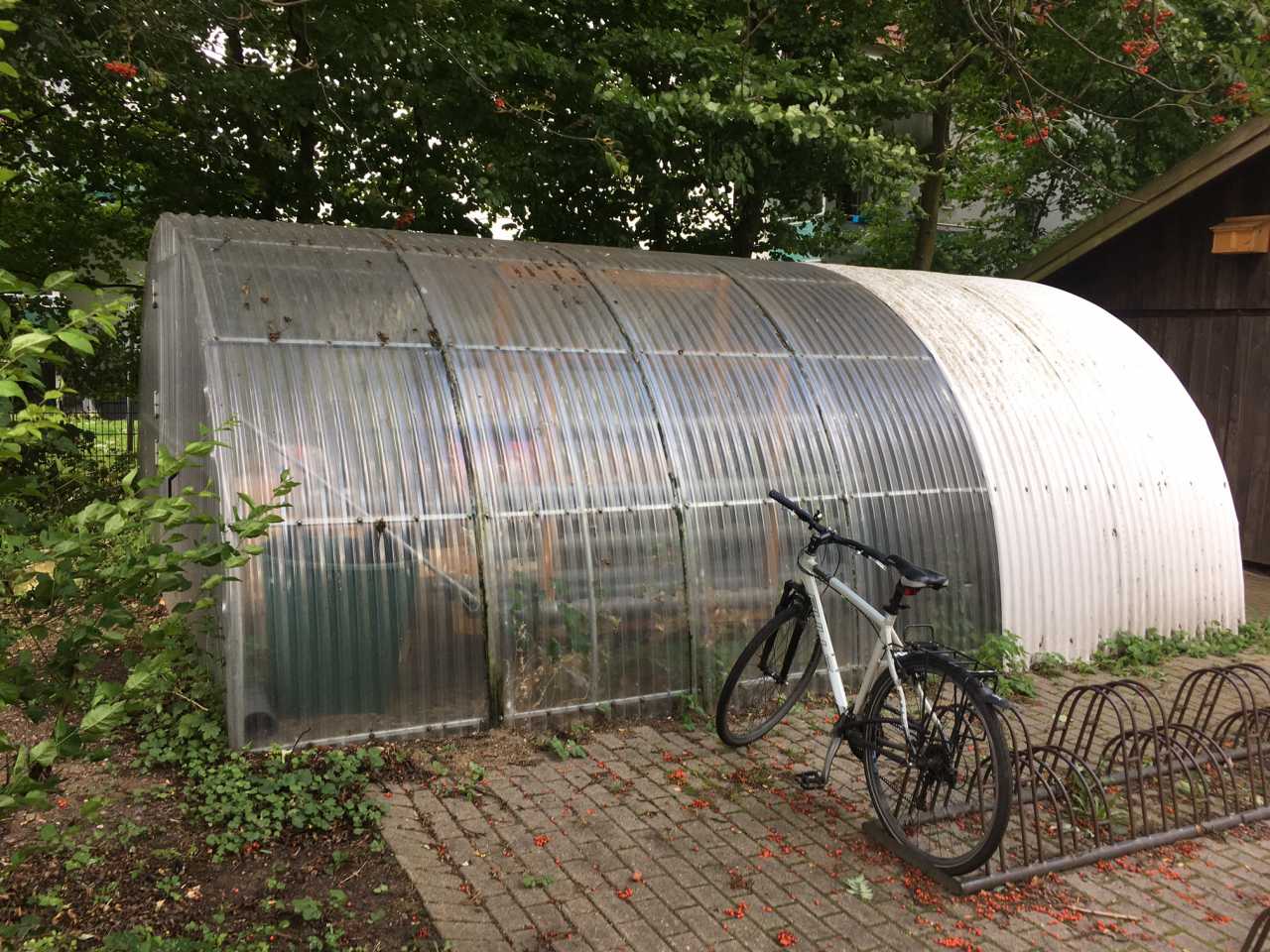
As a task creator for MathCityMap, it is important to look at the environment through “mathematical glasses”. Thus, buildings become cuboids, lawns become polygons or – as in the current task of the week – greenhouses become half cylinders.


Task: Arched greenhouse (task number: 1950)

Calculate the material requirement for plastic for the greenhouse. Give the result in m².


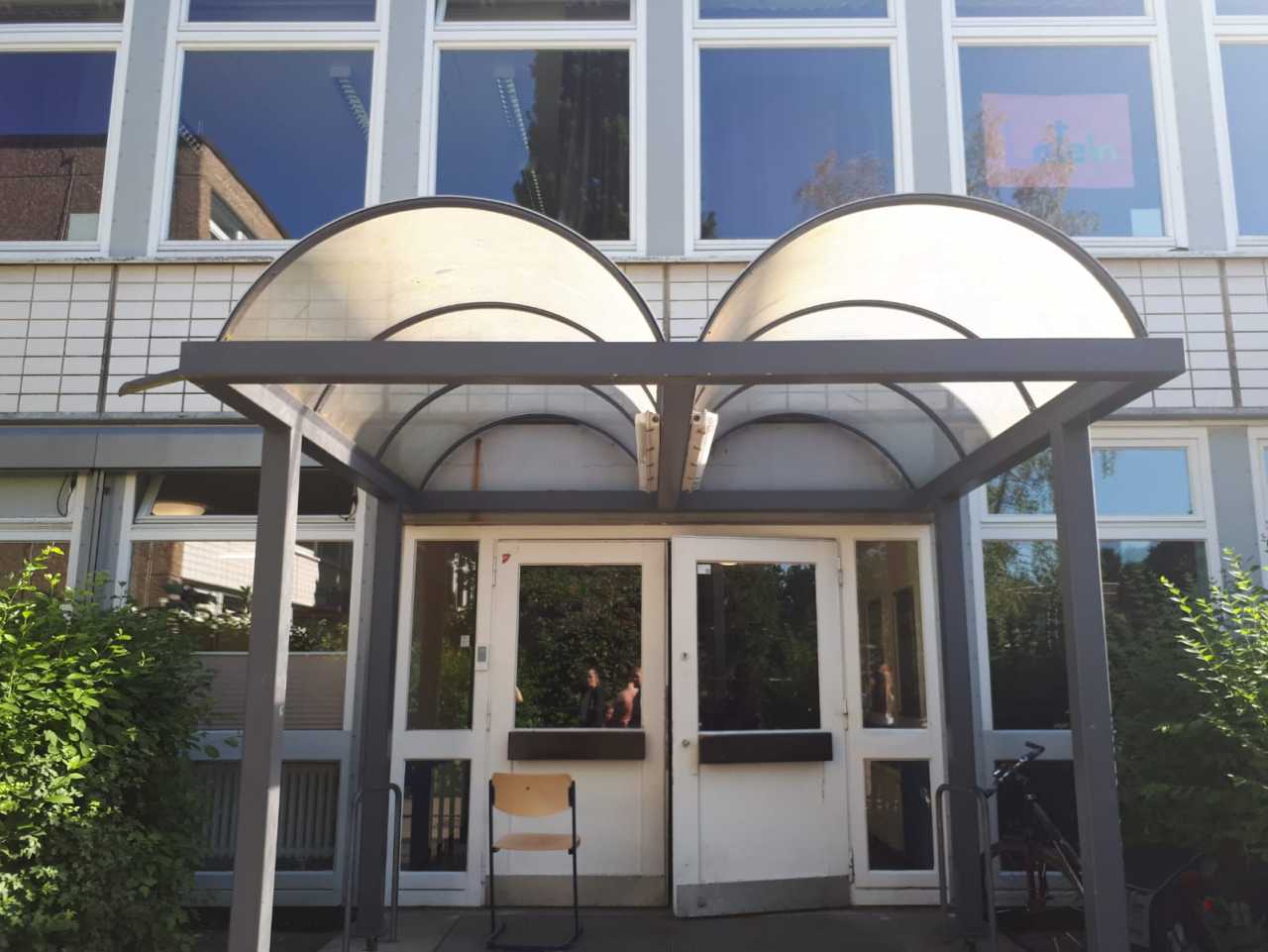
When solving the task, students’ mathematical view is also taught. This involves the recognition of the object as a lying half cylinder. Once this has been achieved, radius, the circumference of the semicircle and height must be measured, so that the material consumption can be calculated. This corresponds to the surface of the half cylinder, which can be determined by means of formulas for the area of ​​a circle and the surface of a cylinder.

Task of the Week: Lamp

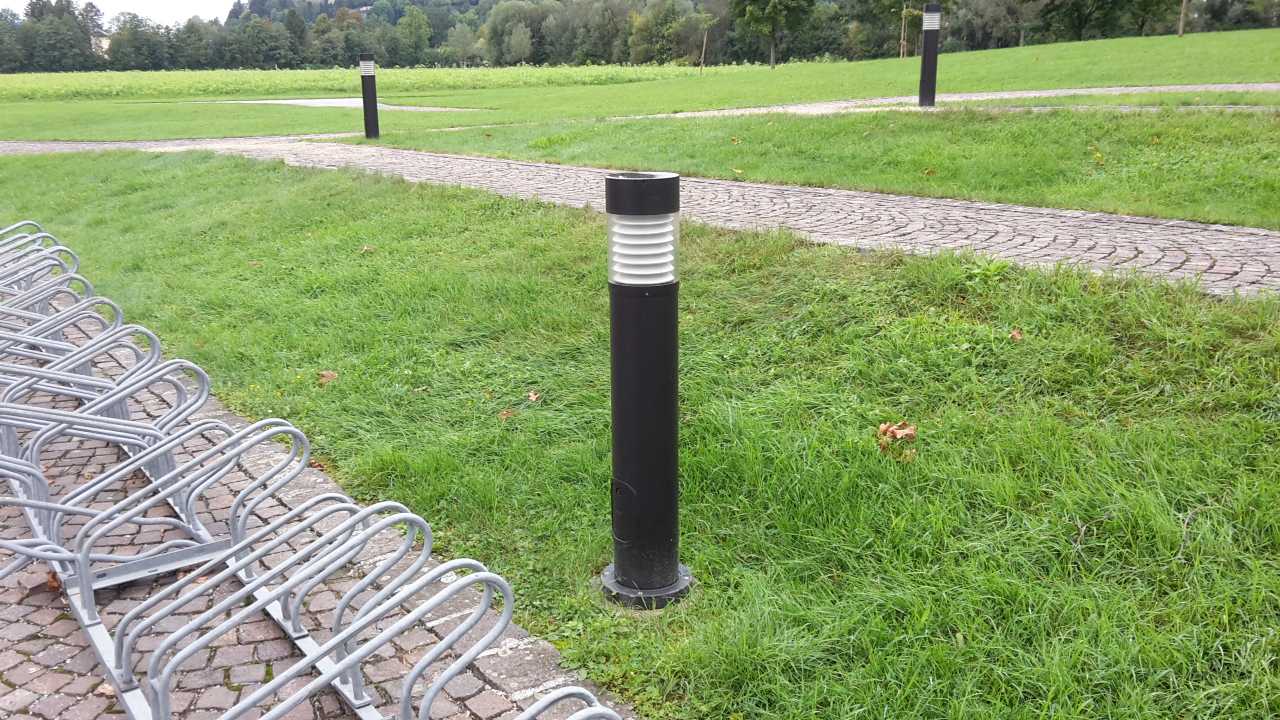
With two trails in Salzburg, we can now welcome Austria as the 9th country with a MCM Trail. The current task of the week presents a task in the field of the surface of a cylinder. It is located in the trail at the natural sciences faculty of the Paris-Lodron University in Salzburg. Task: Lamp […]

With two trails in Salzburg, we can now welcome Austria as the 9th country with a MCM Trail. The current task of the week presents a task in the field of the surface of a cylinder. It is located in the trail at the natural sciences faculty of the Paris-Lodron University in Salzburg.


Task: Lamp (task number: 1908)

How large is the black painted surface of a lamp without the base plate? Give the result in m². Round to two decimal places.


The pupils first recognize the lamp as cylindrical and then determine the black surfaces. For this, it is necessary to divide the lamp into two cylinders. For the upper small cylinder, the shell surface as well as the cover are calculated, for the lower cylinder only the shell surface. Height and radius need to be measured. Subsequently, the individual surfaces are added and the total painted surface area is obtained.

The task can be assigned to the subject area of ​​geometry and, in particular, geometrical bodies (cylinders) and can be used from class 9 onwards.

Task of the Week: Water in the Fountain

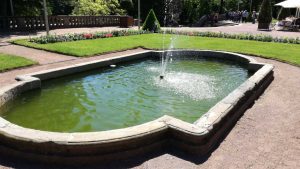
A popular MathCityMap task is concerned with the volume of fountains and how many liters of water are contained. The question can be used for a wide range of geometric themes, depending on the shape of the selected fountain (rectangular, circular, …). The Task of the Week is a particular challenge because the fountain has […]

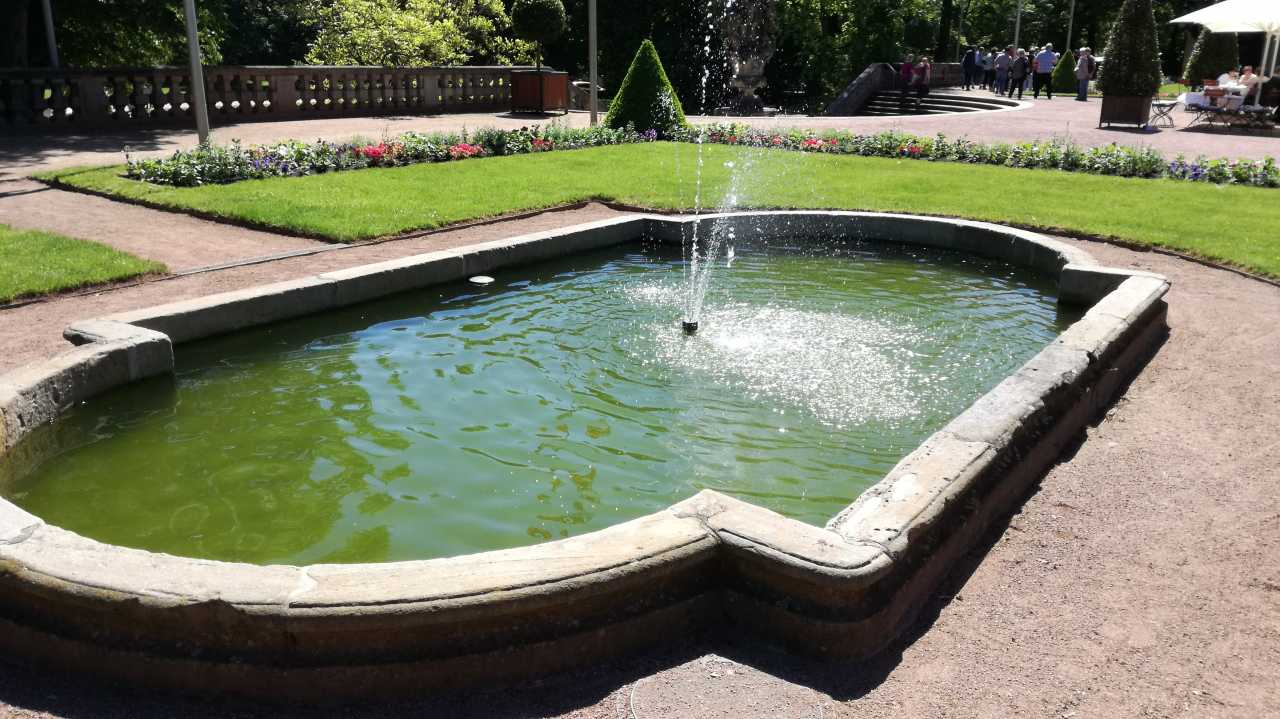
A popular MathCityMap task is concerned with the volume of fountains and how many liters of water are contained. The question can be used for a wide range of geometric themes, depending on the shape of the selected fountain (rectangular, circular, …). The Task of the Week is a particular challenge because the fountain has to be modeled with help of different geometric bodies.


Task: Water in the Fountain (task number: 1420)

How many liters of water are in the illustrated fountain?


The illustrated fountain can be modeled using a cuboid and a cylinder (divided into two parts). If this has been recognized, the necessary quantities must be collected and the individual volumes calculated. Finally, the conversion in liters is required. The task with cylinders can be used from class 9 onwards; simpler fountain shapes are already possible from class 6 onwards.

Depending on the structure of the well, the collection of the data can be a challenge and the students have to become creative. For example, the circumference of a circle can be helpful for the determination of the diameter. Not at least through such considerations, a flexible handling of mathematical formulas and correlations is promoted.

Task of the Week: Shaft Cover

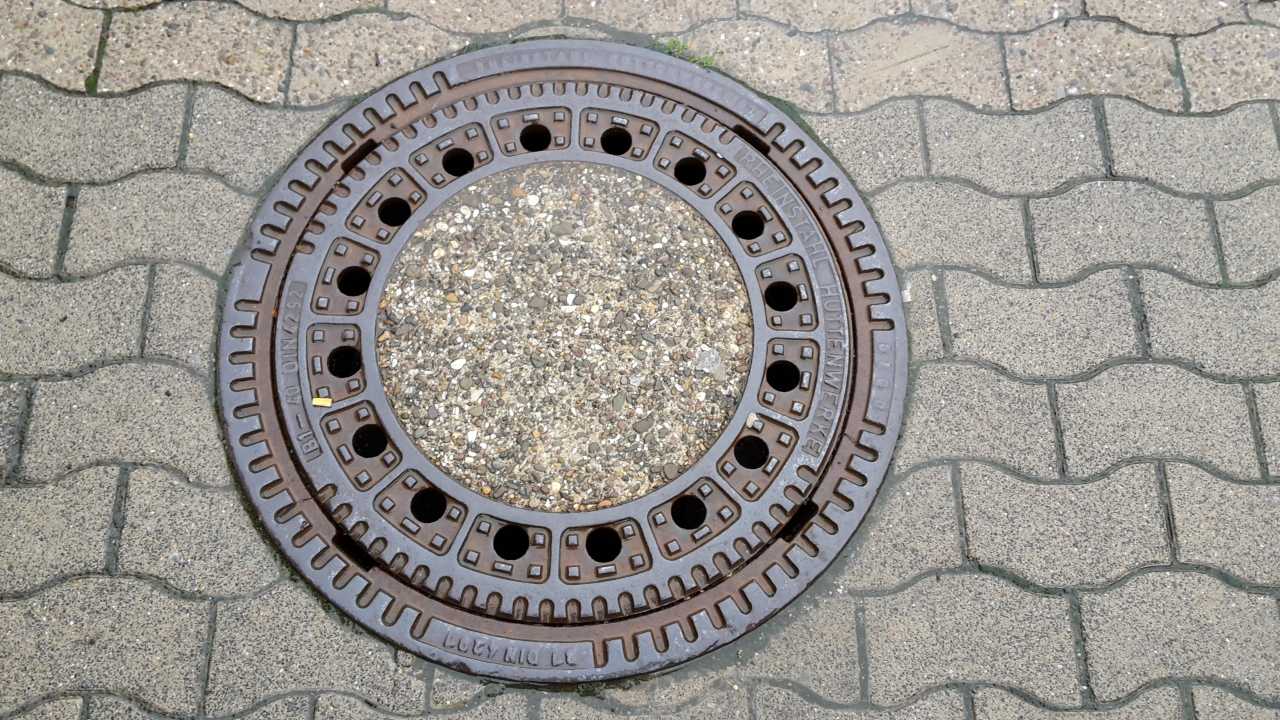
The current Task of the Week is about an everyday object, which is suitable for various tasks around the circle and can be used due to its frequent occurrence in almost every trail. More specifically, it is about the shaft cover of a canal and its dimensions and weight. Task: Shaft Cover (task number: 1804) […]

The current Task of the Week is about an everyday object, which is suitable for various tasks around the circle and can be used due to its frequent occurrence in almost every trail. More specifically, it is about the shaft cover of a canal and its dimensions and weight.


Task: Shaft Cover (task number: 1804)

In the center of the shaft cover, concrete is given. 12 liters of concrete are used per lid. What is the height of the concrete cylinder? Give the result rounded to one decimal place in cm.


To solve the problem, it is first necessary to recognize that the volume of the center of the shaft cover is given. In addition, the shaft cover has to be recognized as a cylinder apart from minor inaccuracies. Using the formula for the volume of a cylinder and the measured radius, the students can identify the required height. In general, the modeling competence and handling of mathematical objects in reality is trained. In addition, the flexible handling of formulas and the choice of suitable units play an important role in order to solve the problem. The problem can be grouped into the complex circle and cylinder and thus plays a role in geometric questions. The task can be used from class 9 onwards.