Today’s Task of the Week will be presented in an interview with Virginia Alberti, who uses and supports MathCityMap in Italy. We say thank you for the interview and the numerous Italian tasks!


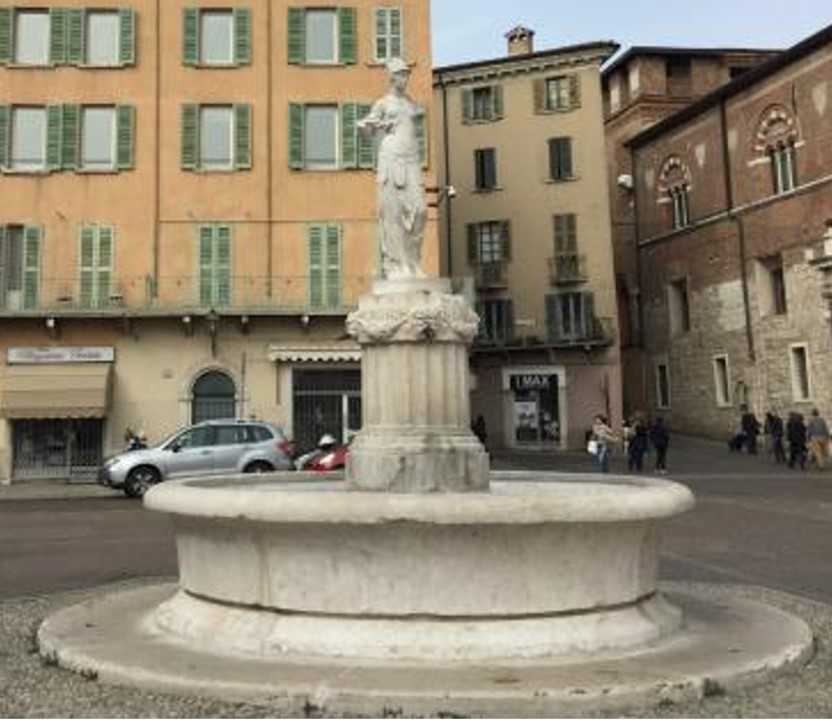
Task: Capacità per la fontana della Minerva – Capacity of the Minerva fountain (Task number: 2452)

How many liters fit into the Minerva fountain?
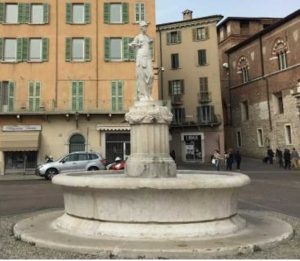

This task concerns the calculation of the capacity of a fountain tub placed in a square of my city center. To answer the question of the activity, the students have to model the fountain basin and calculate the volume.

At a first sight, the calculation could be trivial, but in reality, it requires observation, analysis and skill in the choice of the model to be applied with certain conditions and approximations related to:

  • the particularity of the shape of the tub (2 cone trunks),
  • the presence of a base in the center that supports the statue,
  • the choices on measurement methods not taken for granted.

I have thought, designed, and created this task to propose it in a collaborative learning mode for a small group, and I identified myself with the actions that my students could use their knowledge to estimate the capacity.

I found it intriguing that in the group the students could:

  • talk about math for creating the model,
  • activate and compare the skills for solving a real problem,
  • choose a shared solution strategy with different measurement opportunities,
  • make conjectures and then have different ways to verify them without finding ideas in the network.

I think MathCityMap is a tool that allows:

  • supporting the pursuit of mathematical and digital skills as well,
  • facilitating a conscious and educational use of mobile devices and recovering some skills and practices of use that millenials mature in informal learning,
  • supporting what is defined as laboratory teaching,
  • facilitating an active role of the student by stimulating creativity in the approach to the resolution strategy with respect to the questions of the task,
  • opening up the possibility of other methods of teaching approach such as the flipped lesson or PBL.

Furthermore, I think MathCityMap for teachers is:

  • a challenge to innovation towards an educational proposal that facilitates the social and collaborative learning of mathematics;
  • a reactivation of a new project towards those that are the learning requests of the 21st century (I am thinking of the STEM field);
  • an activation to a role of less transmissive teacher, but more as tutor, from facilitator, …
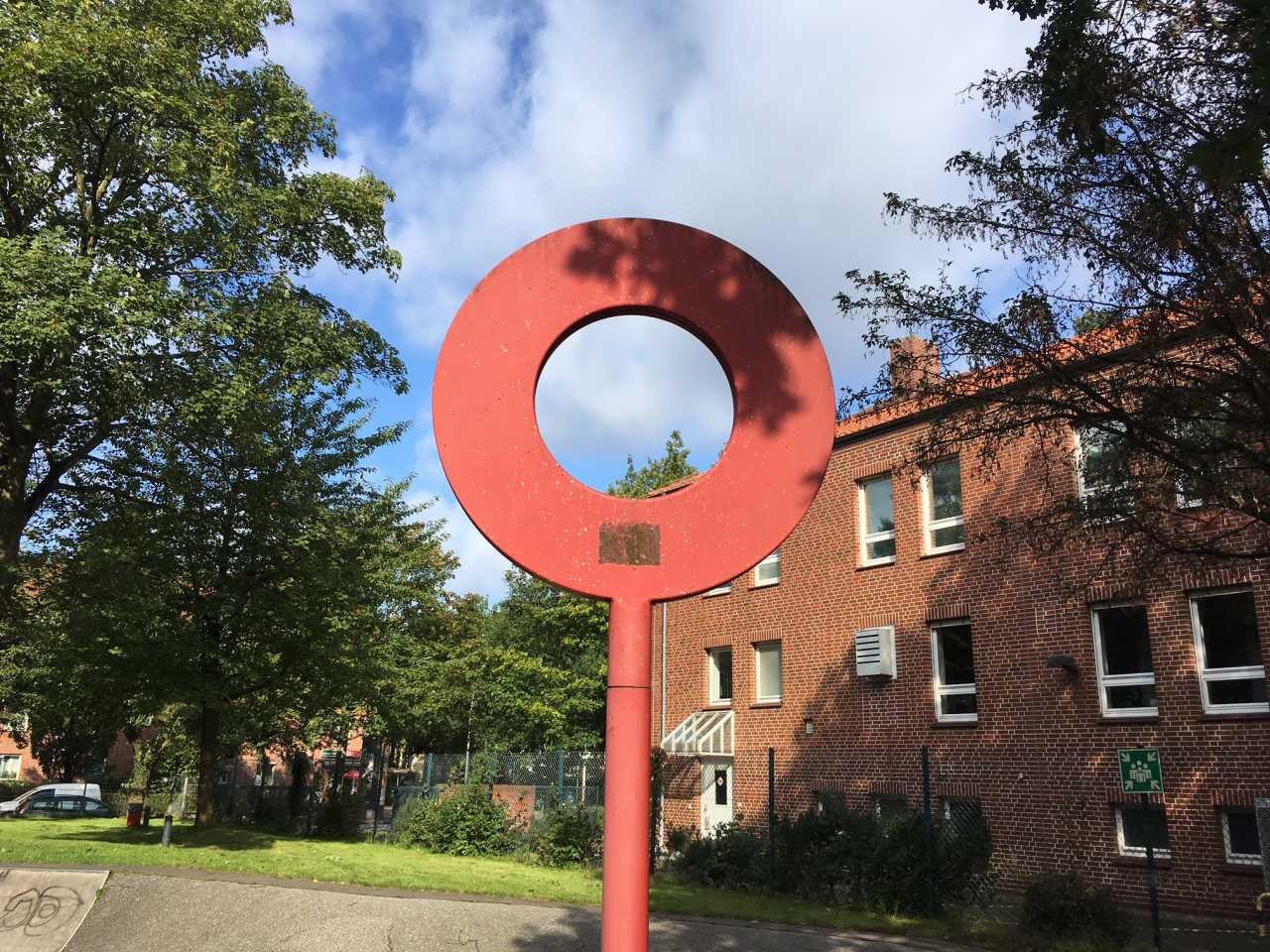
 

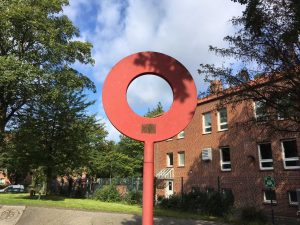
Today’s Task of the Week focuses on the circular ring. The idea behind is to determine the desired surface area by the difference of two surfaces, which can be calculated easily.


Task: Ciruclar Ring (Task number: 1943)

Calculate the area of ​​the circular ring. Give the result in cm².


The area of the circular ring can be calculated by determining the radius of the entire circle, as well as the radius of the small “missing” circle. In this case, the easiest way is to measure the diameters of both circles. Then one calculates the wanted area either with the formula of the area of the circular ring, or one calculates the area of ​​the entire circle and deducts the small circular gap. In both cases, the wanted area results.

A similar task can be created by means of traffic signs, e.g. the passage prohibited sign and the question of the proportion of red color. In both cases, the circle plays a thematic main role, so that the topic can be used from class 9 onwards.

Determine quantities and numbers – an issue that is already relevant at primary level. For getting started in determining numbers, one should use regularly arranged objects like windows on a (high-rise) building, paving stones on a sideway or stones at a wall.     

Determine the number of windows on the house

When determining windows on houses, in many cases you can count the number of windows per row and the number of rows and get the result by multiplication. It is important to make clear whether you ask for windows or window panes, and whether all the windows of the building are relevant or, for example, only windows on the southern front.     

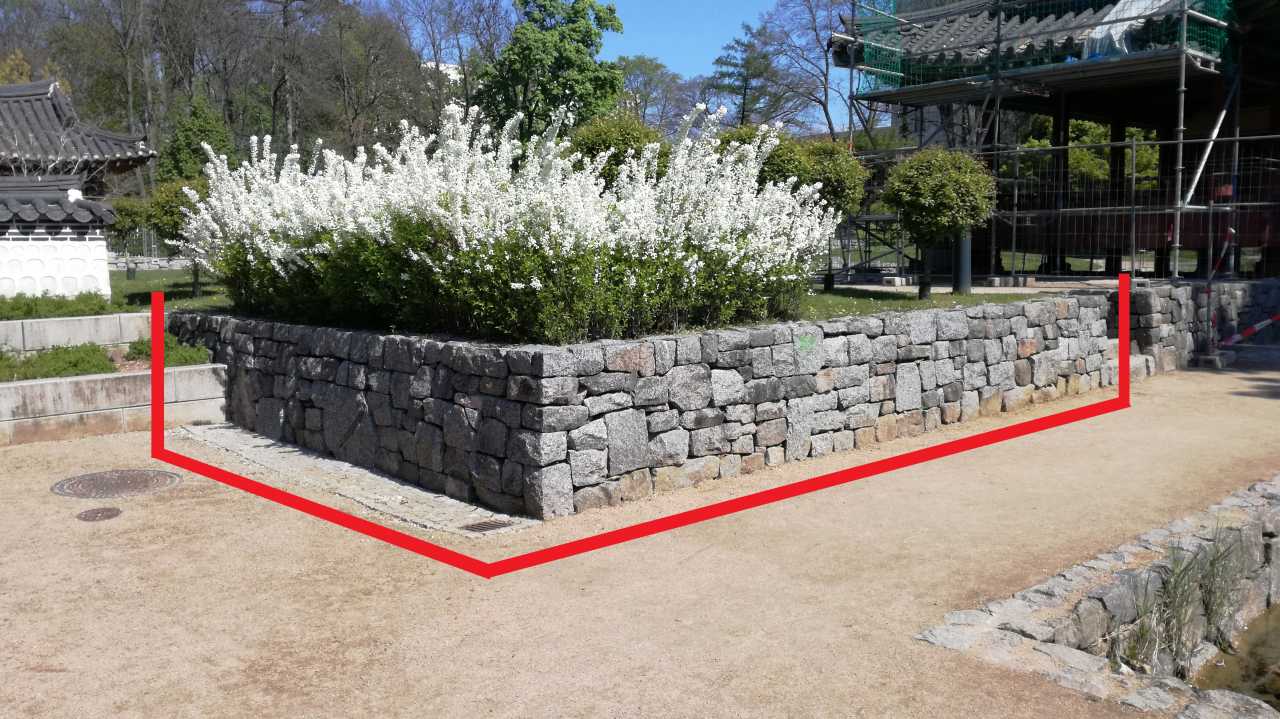
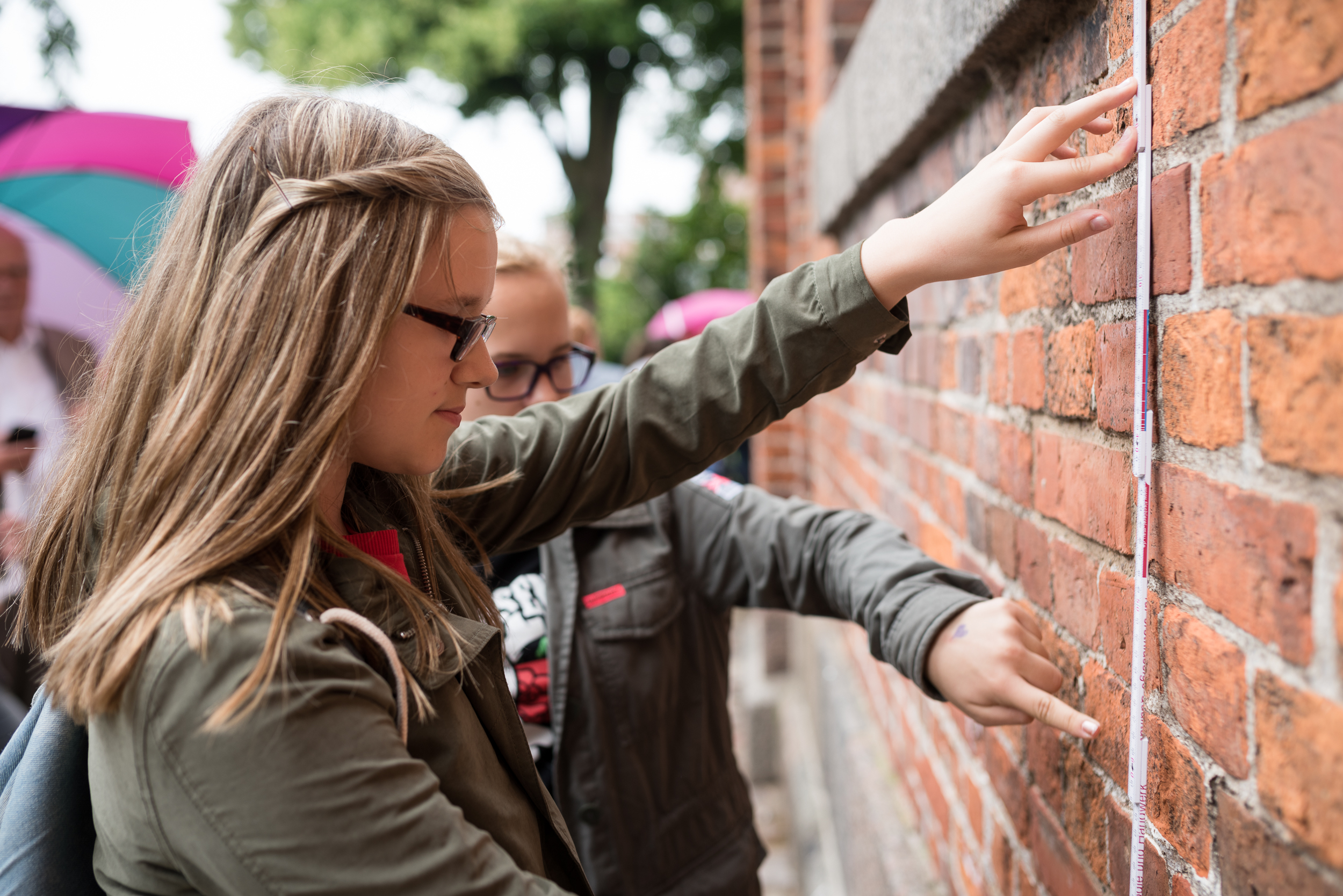
Determine number of bricks

For walls and rectangular pavings there are several possibilities:    

1. One determines the number n of the stones per 1m² and projects that to the total area A.     

2. The length and height of the wall are determined in “stone units” and one counts the number of stones in length l and in width b.     

Circular arranged stones with a gap

The level of difficulty increases when deviating from rectangular areas and e.g. asking for circular arranged stones. In addition, it can be difficult to determine the number of objects in which the regularity is interrupted in some places and one is forced to choose special solution methods.

You will find a detailed overview of our generic tasks on Determining quantities in the deposited PDF document.

Also this week, we would like to introduce you to a task with help of an interview with the task author, Johannes Schürmann. We would like to thank him for creating the task and his time to answer our interview questions.


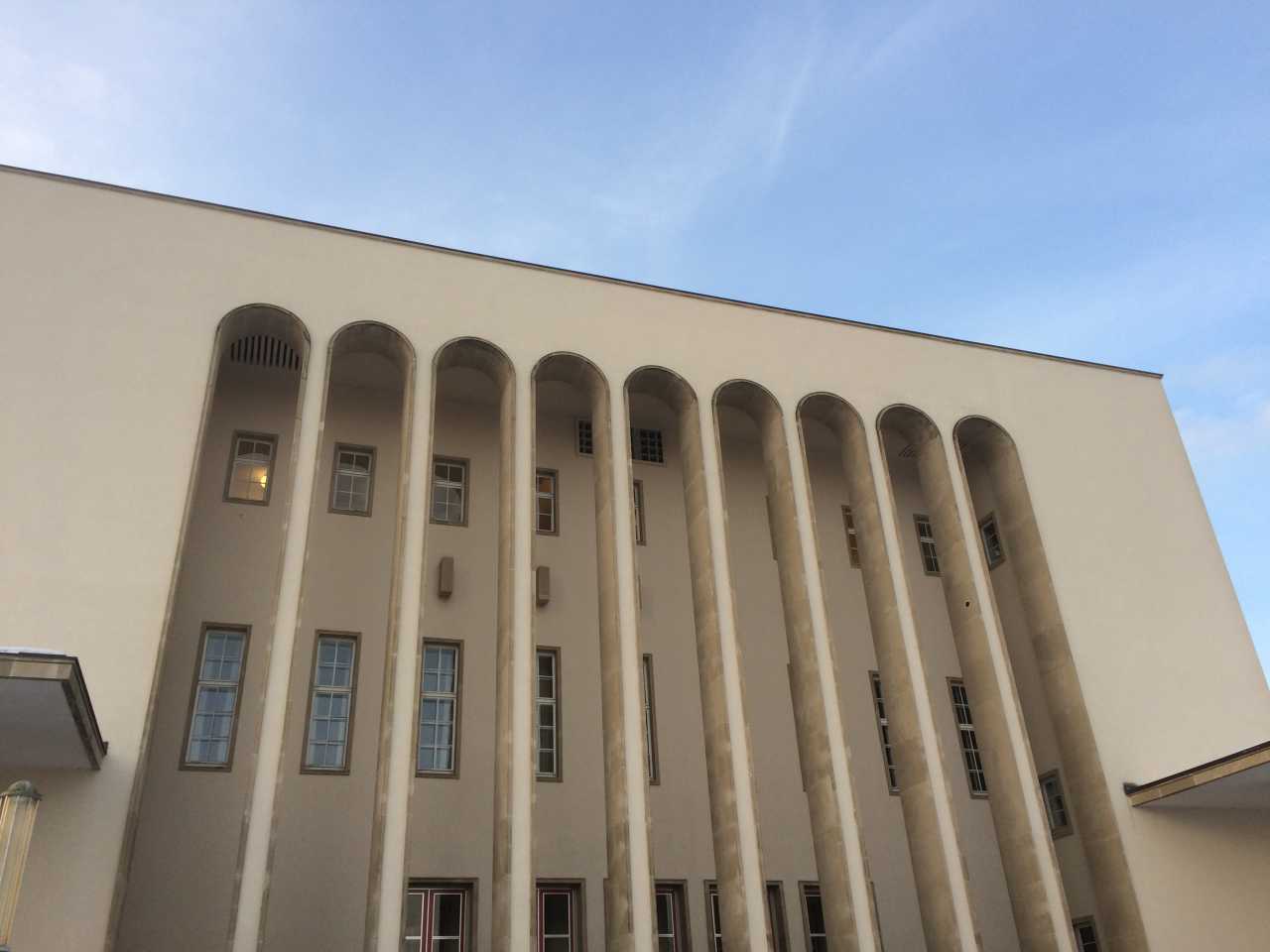
Task: Height of the Building (task number: 2339)

Determine the height of the Oetker hall! Give the result in meters.


How did you come up with the idea to create this task for MathCityMap? How did you find out about MathCityMap?

In my studies, I became aware of MCM through a seminar I attended. The lecturer, Prof. Dr. Rudolf vom Hofe, told us about the project and so the idea to write a final thesis about the topic was born. As a result, Joerg Zender was invited to Bielefeld University for a lecture and I was able to create a mathtrail with Joerg at the university. When creating the trail and in conversation with Joerg, the idea of ​​using MCM or digital media in teaching was strengthened. Thus, a school near the Bielefeld city center agreed on participating in a study and I was able to create a mathtrail adapted to the class content. So it turned out that I created the task.

Which competencies and topics play a role in solving the task?

The current topic which was taught in class were the intercept theorems. Accordingly, this should also be used in the task. However, the task is not so easy to solve with the intercept theorems, because of the local condition that the height differences are not easy to measure. Therefore, a second approach is given on the measurement and counting of the facade panels of the inner arches. Both approaches come up with a similar result. Space and form are the priority content with the skills problem solving, mathematical modeling as well as formal-technical work.

Have you tested the task with students or received any other feedback on the task?

I tested the task for my survey of the thesis with students, or rather, let the whole trail run by the students. The specification while running was that the students should work on certain tasks. In the evaluation of the individual groups of students, it turned out that not all had decided for this task. Reasons for this would be purely speculative.

Our Task of the Week was created by Vanessa Präg, student at Goethe University Frankfurt, as part of a mathematics didactic course. In a short interview, she will tell us about her experiences.


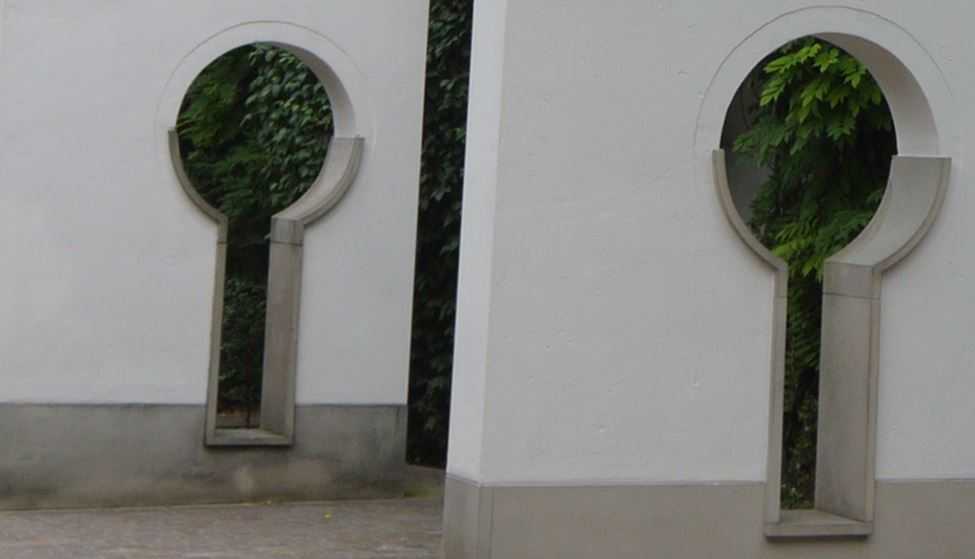
Task: Giant keyhole (Task number: 2550)

The city wants to close the keyholes. For this, the holes are filled with concrete up to the respective edges. How much does the concrete weigh in a keyhole when the density of the concrete is 2.1g/cm³? First estimate and then calculate the weight of the concrete in kg.


How did you come up with the idea to create this task for MathCityMap? How did you get to know MathCityMap?     

My lecturer, Mr. Zender, made me aware of MathCityMap. As part of a course, we as prospective teachers talked about what modeling in mathematics education means. For clarification, he let us run a small trail from MathCityMap and solve it, as well as create 2 tasks in MCM. I’ve been an avid geocacher for years and think it’s a good idea to set tasks which can be solved with mathematics at different places. If I have more time, I will certainly create more tasks.    

The task itself came to me as I walked through our city looking for unusual objects for MCM. The keyhole immediately jumped in my eye.

Which competencies and topics play a role in solving the task?

In this task, I see the competences “problem solving”, “modeling” and “working with mathematics symbols and techniques”. Communicating is also part of the task since on the one hand, the information from the task must be understood and implemented correctly, and on the other hand, the students should communicate with each other their solution proposals. Correct measurement of lengths, as well as the knowledge of the body and its volume play an important role. What surprised me was how heavy concrete is in a comparatively small volume. Therefore, I thought it would be interesting for the students, if they can assess the weight reasonably well.

In addition to a variety of geometric issues, combinatorial and stochastic problems also play an important role in MathCityMap. Today, we would like to introduce you to the most common generic tasks concerning combinatorics and probability. Two combinatorial questions that can be created quickly and easily with the Task Wizard are tasks asking for combination options of stairs and bike stands.

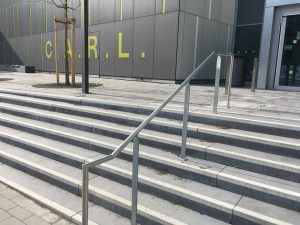
In how many ways can you climb the stairs by taking one or two steps?

There are various possibilities for solving the problem. On the one hand, it is possible to systematically record different combinations of 1 and 2 steps. In doing so, the students can use the stairs directly and conclude which combinations are possible. In another consideration, the fact that the last step comprises either one step or two steps is used. Leaving this last step, the number of possibilities for a staircase with n steps can be determined using the possibilities for n-1 and n-2 steps. This reasoning leads to the Fibonacci numbers, a recursive sequence in which a number results from the addition of its two predecessors.

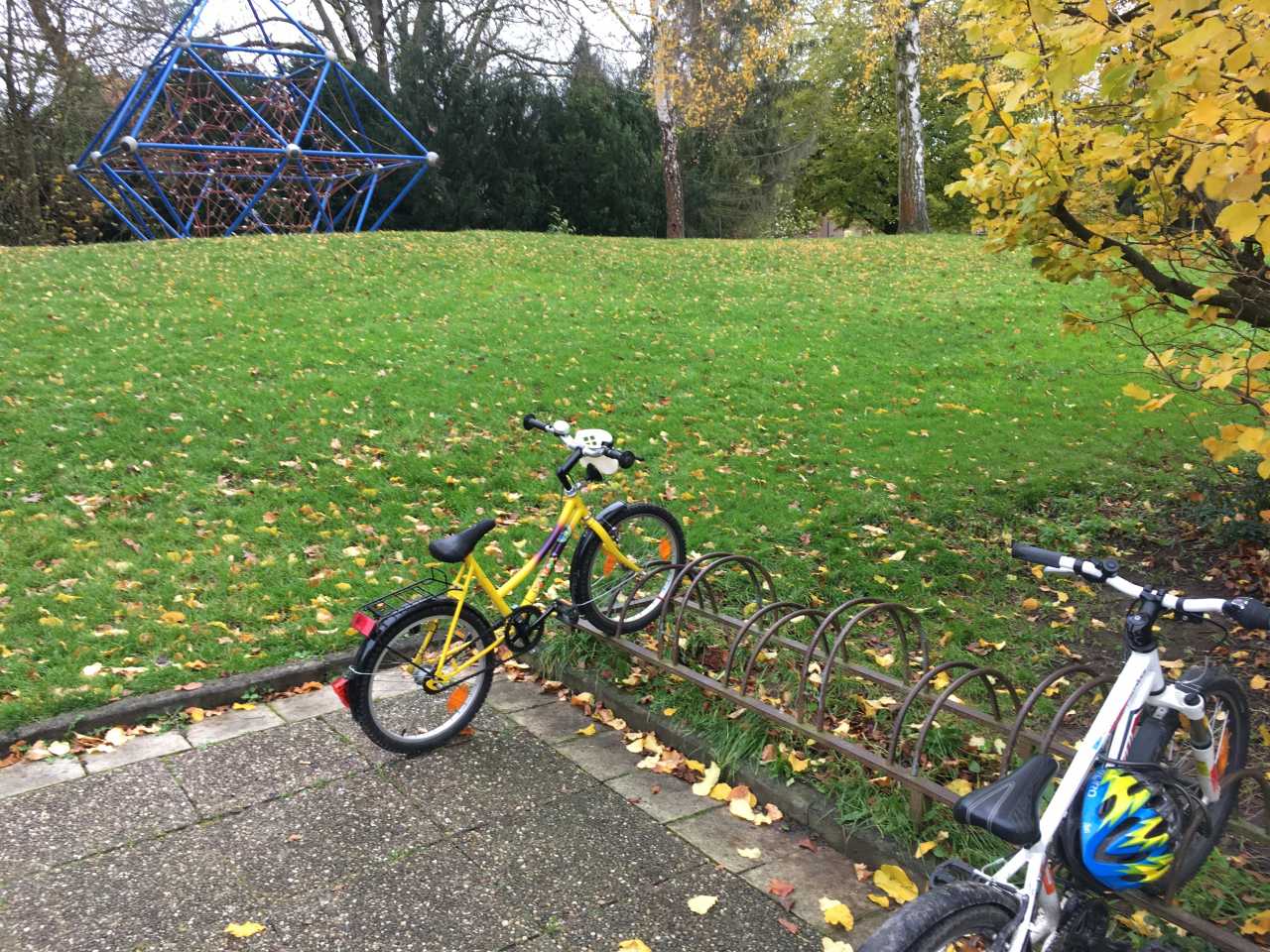
How many possibilities do you have to lock k bikes?

In this task, it is necessary to determine the number of possibilities to lock k bicycles at n spaces. For the first bike, there exist n possibilities to lock it. As this space is full afterwards, the number of possibilities to lock the second bike is n-1. Analogous, the possibilities for bike k is n-(k+1). This combinatorial problem is a situation where repetition is not allowed and order matters. With help of the possibilities’ product, one can calculate the total number of possibilities.

It is important to formulate the tasks precisely and to make clear which object or which part of the object is concerned (for example, in the case of a very long staircase, the lowest part). The activity of the task solver initially refers to the counting of the stairs or parking spaces of the bicycles. Therefore, when photographing, it should be noted that this number can not already be taken from the photo.

Further, probabilities can be realized by MCM, for example, the question for the probability of arriving at a traffic light during a green phase or to wait at a bus stop less than 5 minutes for the next bus. Both types of tasks focus on the Laplace probability (favorable events divided by all possible events).

We have compiled both emphases for you in the following document with detailed mathematical background and hints.

Icon

Combinatorics and Probability 758.34 KB 101 downloads

...

Although the focus of many MCM tasks is on lower secondary maths, some upper secondary level tasks can also be realised. So our current Task of the Week, which was created in the context of a teacher training at the commercial schools Hanau.


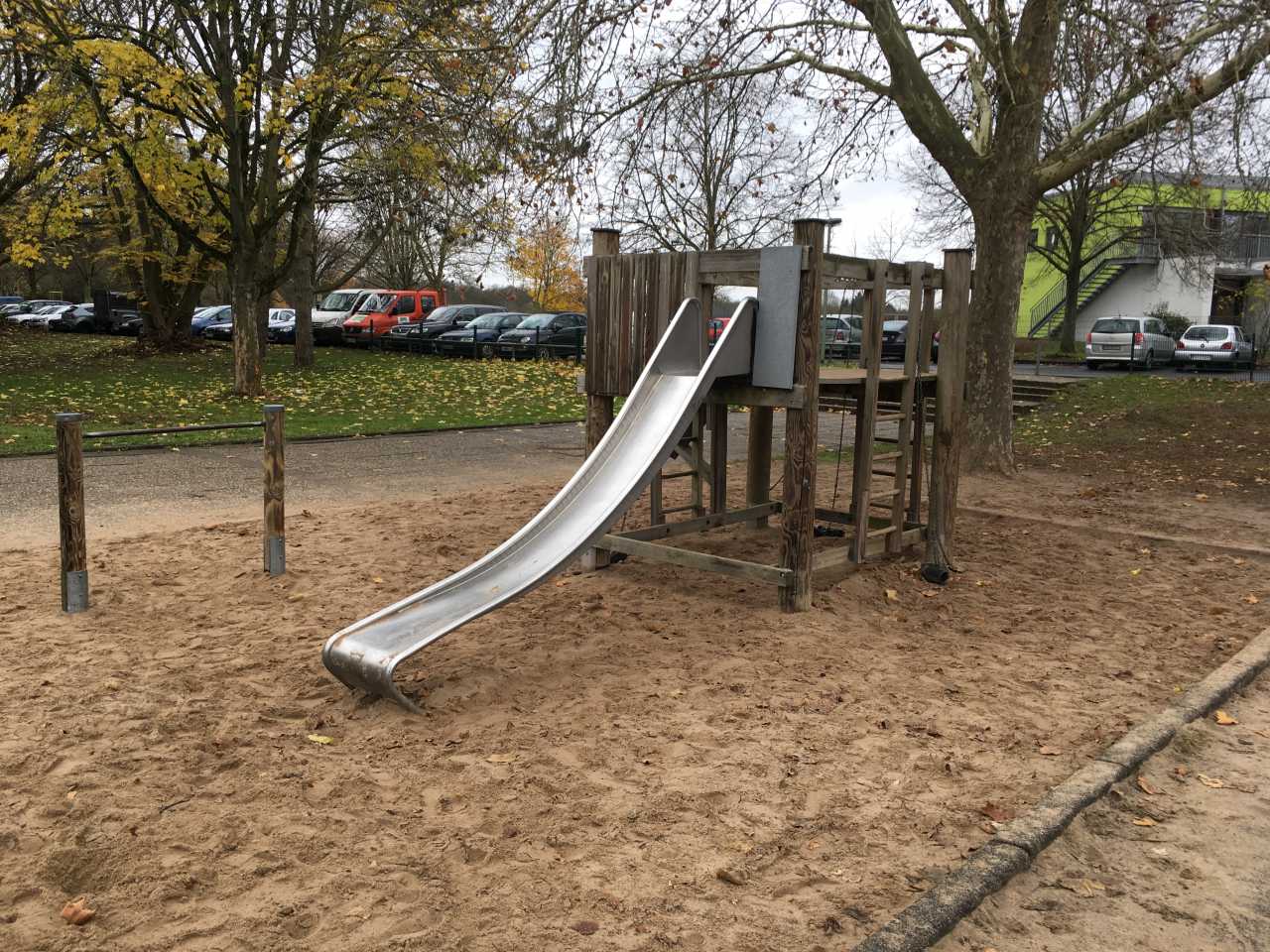
Task: Parabolic Slide (task number: 2241)

The shape of the slide is the part of a parabola. Determine the compression factor. 1m equals 1 unit of length. You can assume that the slide is almost horizontal at the end.


The slide is approximated according to the task with the help of the equation f (x) = ax² of a parabola. To solve the task, the students first have to transfer the situation to a suitable coordinate system. Since only the compression factor is asked, it is not necessary to specify this in the task. It makes sense to set the coordinate system so that the origin lies at the lower end of the parabola, but leaves out the horizontal end. Through such a choice, it is sufficient to determine another point on the slide, so the change in the x- and y-coordinate. By inserting this into the equation, the compression factor a results.

At the beginning of the year, MCM was successfully presented in Mumbai. Of course, in this context the first Indian Math Trail was created, from which our current task of the week originates.


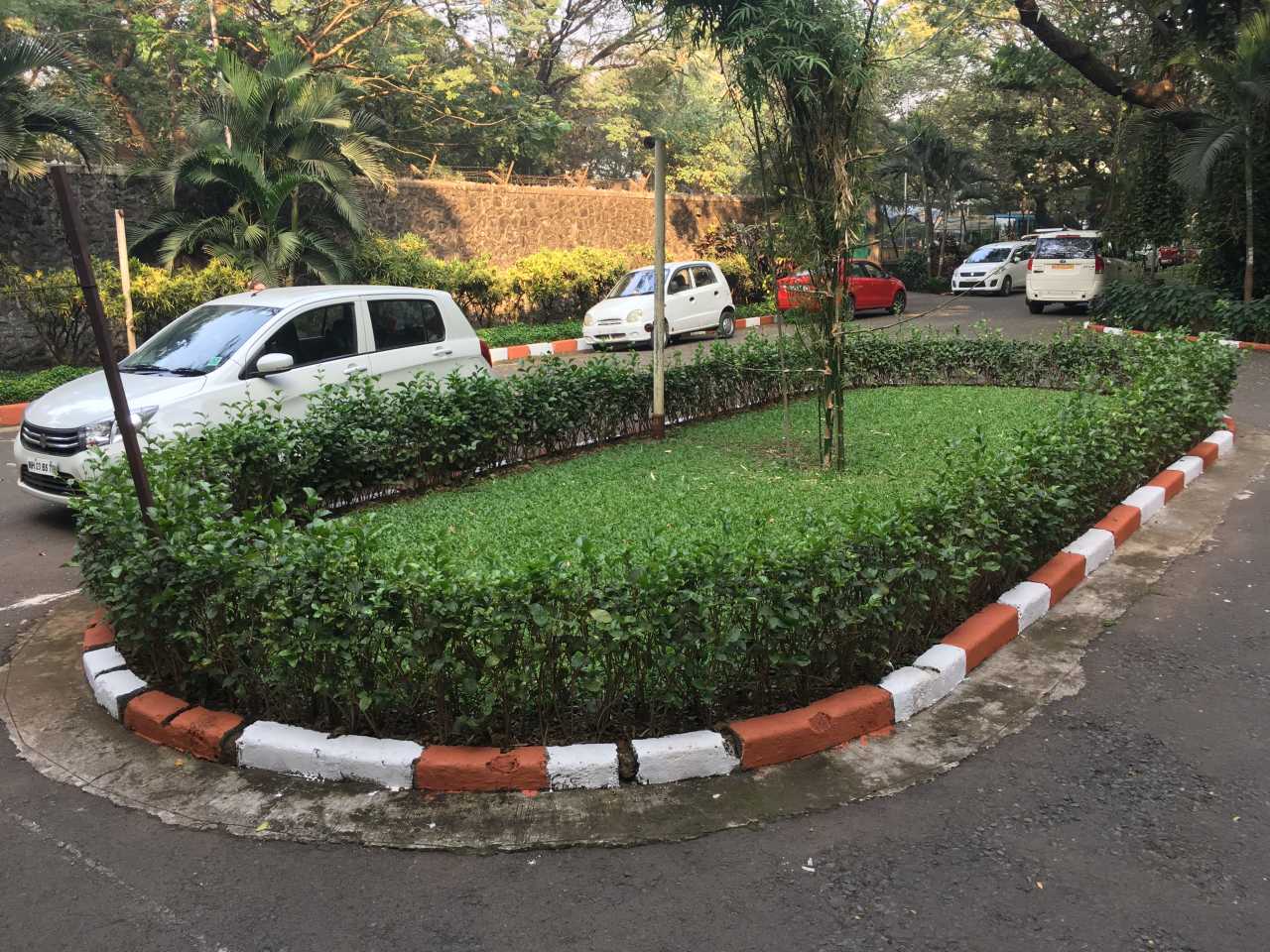
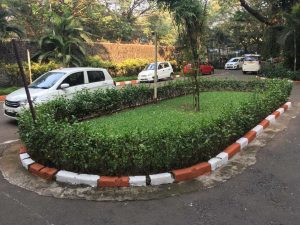
Task: Grass Field (Task number: 2459)

Calculate the area of the grass field. Give the result in m²!


First, a mathematical model has to be found that represents the area most accurately. This is best done by dividing the total area into several individual areas. The obvious choice is the division into two halfcircles and a rectangle. For this, the rectangular side lengths and the circle’s radius must be measured, the areas calculated and all partial areas added.

The task belongs to the topic of compound surfaces, whereby calculations on the circle must already be known in order to solve the task as exactly as possible. In the German school system, it would therefore be solvable from class 8.

Our first focus on generic tasks, meaning tasks that can be created in any location with similar objects, is on the subject of slopes. This topic has relevance for math lessons in different grades up to the upper secondary level.

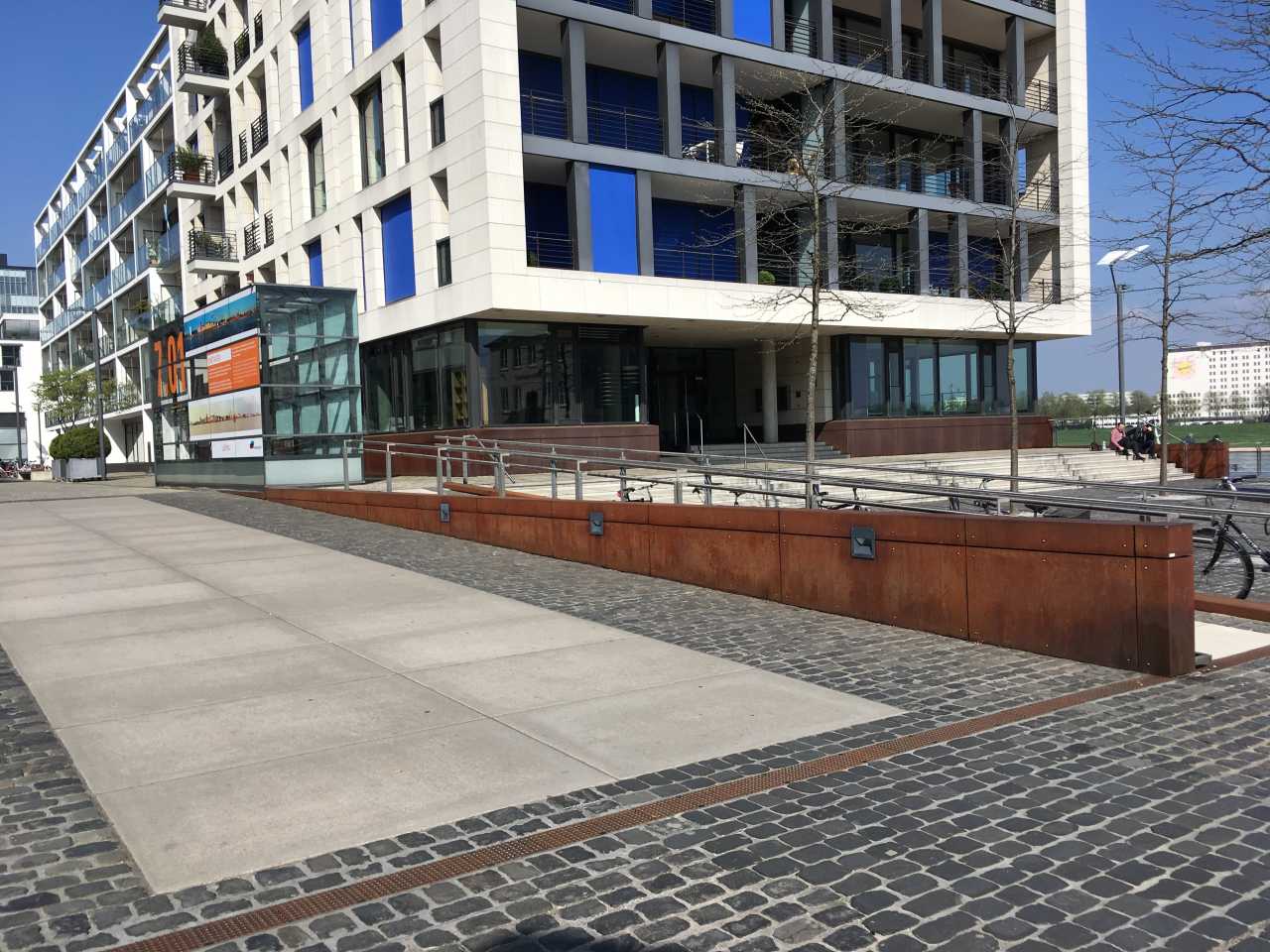
In particular, the slope of a straight line or linear function makes it possible to determine the slope of various objects, such as ramps or handrails, with mathematics from lower secondary school. The result can be expressed either in percent or in degrees, including trigonometric relationships.

The mathematical basis is the definition of the slope as a quotient of vertical and horizontal difference, or in practical terms: the use of a gradient triangle. This can e.g. be implemented on ramps, especially if the horizontal length is easy to measure:  

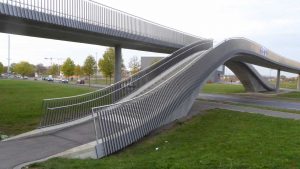
Example of a ramp where both, horizontal and vertical changes are easy to detect.

More difficult is the calculation of the slope of handrails, where one should use a water level for the difference in horizontal and vertical change:

Example of a handrail, where the result without a level can be inaccurate.

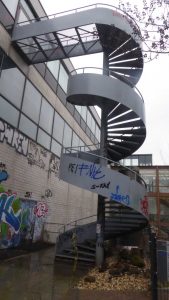
Even more complex is the slope on the railing of a spiral staircase or on objects that do not rise linearly:  

The spiral staircase takes the topic of slopes to a more complex level and requires imagination and transfer knowledge.
For non-linearly rising objects, one may ask for the maximum slope or the slope at a particular point, e.g. as a preparation for the concept of tangent.

Attached you will find our extensive collection of frequently occurring generic tasks on the subject of slopes, the mathematical background as well as hints, compiled by Matthias Ludwig: 

Icon

Slope 373.45 KB 59 downloads

...

By the way: With our Task Wizard you can create the tasks for ramps and handrails with just a few clicks and transfer them to suitable objects in your area!

MathCityMap stands for outdoor mathematics, authentic tasks, physical activity, new technologies and teamwork. And we assert: The combination of these aspects works (almost) everywhere and just like magic …

… because in every city there are stairs, buildings, parking lots, ramps, signs and many other recurring objects where you can  do math actively. These objects offer the chance to easily and quickly transfer existing tasks to other locations. We call these tasks generic tasks. The idea behind is thus a finished question in which only the object is exchanged and the measuring values ​​are collected.

Very frequent generic tasks can already be created using the Task Wizard. This makes it possible to create complete tasks with just a few clicks, because sample solution and hints are generated automatically and inserted by the wizard.

In the following months, we will present a variety of topics from our catalog, which can be realized through generic tasks, e.g. slope, determine and estimate numbers, combinatorics and probability, speed, areas, volume and weight. It is an open and always growing fund. We are therefore pleased about your ideas for generic tasks!