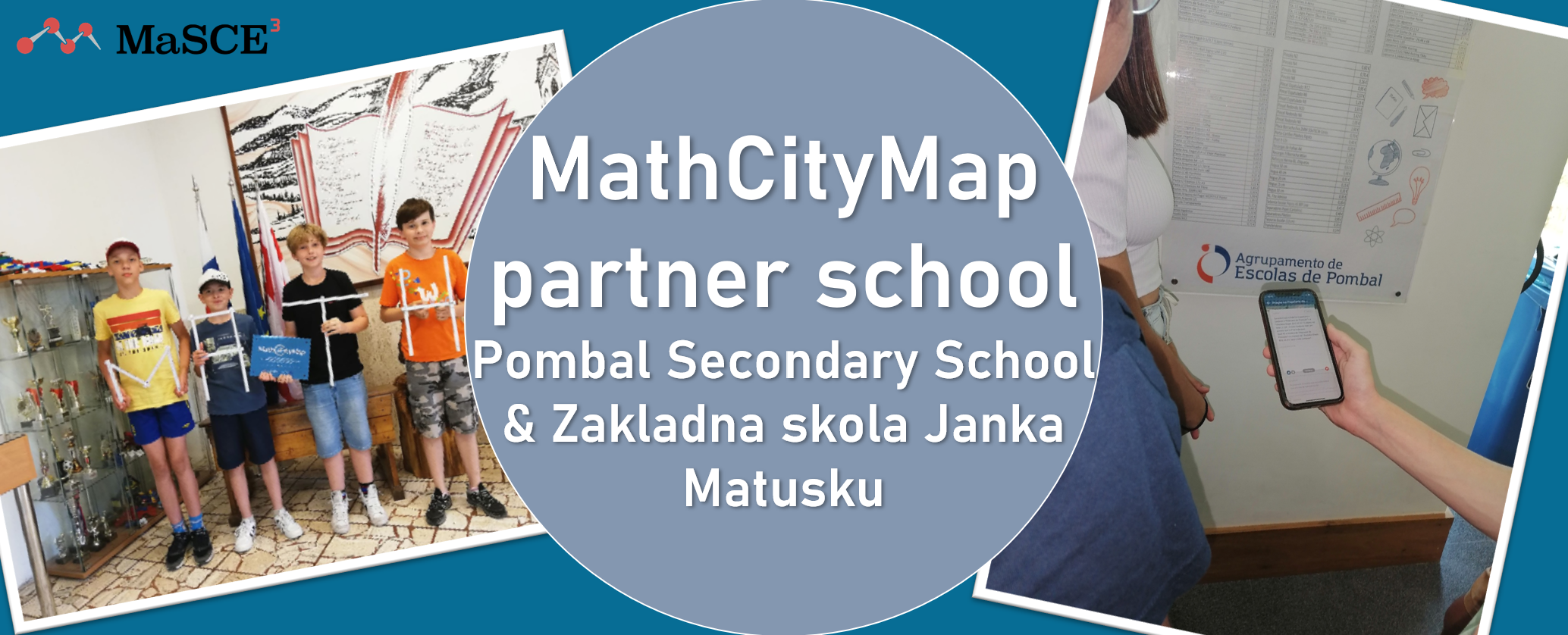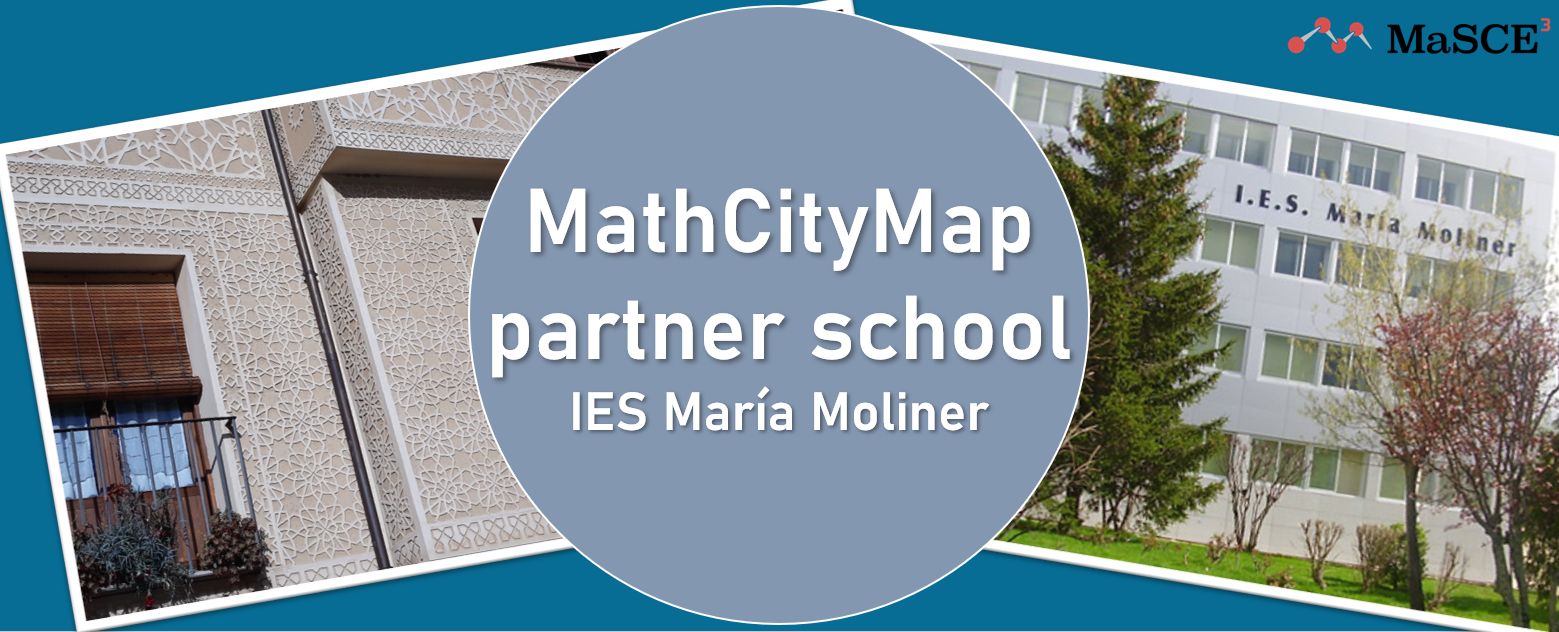
We are very happy to welcome again two schools in our partner school program. This time it is the “Zakladna skola Janka Matusku” from the city of Dolný Kubín in the north of Slovakia and the “Pombal Secondary School” from Pombal, a city in Portugal.

Both schools successfully completed the necessary application process. In Pombal, teachers Diana Santos, Ana Medeiros, Teresa Oliveira and Margarida Fonseca worked together on a total of three trails, each focusing on a different grade level and different content.

“The students were very enthusiastic and participative in this, and there was great feedback from the students that the knowledge they had acquired during the school year was applied in a different and more fun way” Diana Santos told us.

In Dolný Kubín, two diverse math trails were created by math teacher Klaudia Kovalcíková and tested with her students. She reports about the experience in the application process as follows:

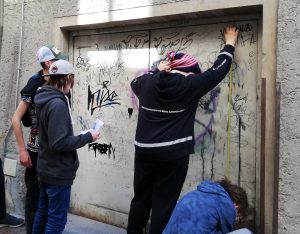
“I have been working in education for about 3 years. In that short time, I have found that the most popular question my students ask me is, “What are we going to use this school stuff for? Where will I use this knowledge in my life?” So, instead of a humble answer, the idea of creating a math trail was born to show students how to apply math directly in the real world, in our city or in their environment. During the school year we made several trails through the town of Dolný Kubín. Dozens of photos of various objects, buildings and parks were taken and the students learned how to work in the Mathcitymap portal. They suddenly discovered that mathematics is not only a school subject, but it is in almost every object. It must be not only about its visual form, but also about its content value (for what reason was this object created, what does it symbolize, when was it built, …). We pass many memorial / information boards every day, but only now have we discovered that they not only reveal many mathematical possibilities for their use, but that thanks to them we also learn about the history of our city and its people.”

One of the students there also shared his experience with MathCityMap for us:

“Math Trails have given me more than just attending a regular class. What was the goal? We created tasks that we implemented outdoors, in a digital classroom. We learned about the town of Dolný Kubín and its history from a mathematical perspective. I would also like to thank our teacher Mrs. Kovalčíková for this opportunity.

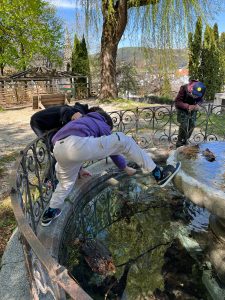
I often go to Námestovo, but only now I found out that there is a statue of Ján Vojtaššák in front of the church (when we measured it with the other students). Until now, a meter for me was three thirty-centimeter yardsticks and a few centimeters more. Today, one meter is equal to two-thirds of a park bench, for example. I can calculate the volume of the bench, I know how many poles we need for it. I also figured out what the circumference of the fountain in our city is. Math was no longer just numbers, pencil, paper, ruler, interactive whiteboard…. We were outside touching our math problems, we measured them with a string, we looked for solutions together, etc. It was great. On the way home from school, I look around and think about what object will be our math problem next time. I’m looking forward to it.”

The package with the measuring tools and the official partner school plaque is already on its way to the schools and, as always, we are very much looking forward to receiving further applications from all over the world.

All further information about the partner school program and the prerequisites for the application can be found in the article about the first MCM partner school as well as on the homepage of our project MaSCE³.
 

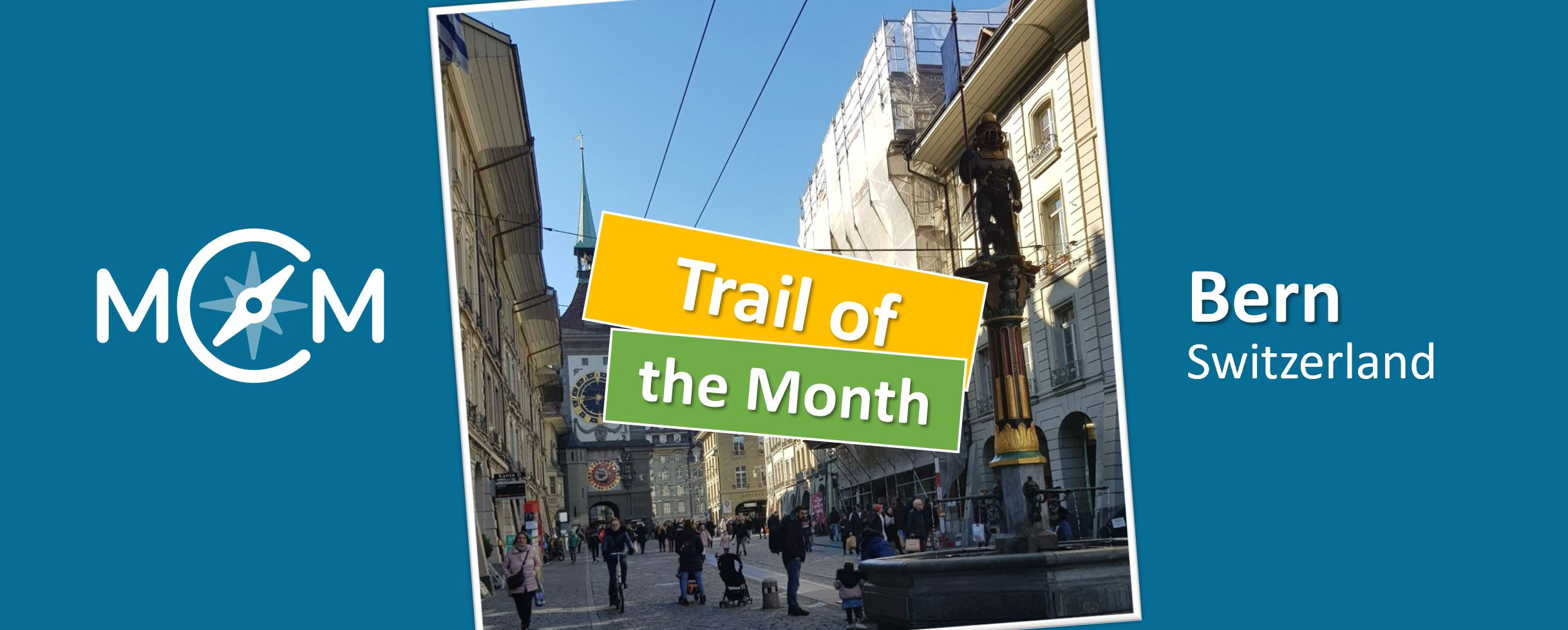
The Trail of the Month July invites us to a mathematical walk through another European capital. This time we are in the beautiful city of Bern, Switzerland. The Trail of the Month was created by Damaris Burri as part of her master’s thesis at the PH Bern at the Institute for Secondary Level 1 and is available in the MCM app under the code 678321 and in the MathCityMap web portal here.

Running through the historic old town of Bern, the trail consists of a total of 12 tasks, some of which can be extended with sub-tasks. In terms of content, the tasks deal with topics from grades 7 to 9 (in Switzerland, the so-called third cycle), i.e. with areas and volume calculations, as well as gradients and units of measurement.

In the following interview Damaris Burri describes her experience with MathCityMap so far and gives additional background information about the trail:


How did you come across the MathCityMap project?

I came across the MathCityMap project during a mathematics didactics seminar at the PHBern. At the end of such a seminar, the lecturer introduced us in a few words to some links to websites that could be useful for teaching mathematics. One of these links led to the MathCityMap website. Looking for a topic for my master thesis, I remembered these links and explored MathCityMap and the world of mathtrails for the first time. I was thrilled and had found an exciting topic for my master thesis.


Where is your trail located? What is special about your trail?

Bern’s Old Town is a UNESCO World Heritage Site and forms the historic core of the Swiss federal city of Bern. The Mathtrail “Berner Altstadt” invites you on a mathematical tour of the city. With its total of twelve tasks, the trail leads past many sights, such as the Kindlifresserbrunnen, the Bern City Hall, the Bear Park, the Bern Cathedral and the Zytgloggen Tower. At each task, students can expect a mathematical problem based on 7th and 8th grade basic geometry knowledge, as well as background information about the object. The goal of the trail is to show the young people that mathematics can not only be done in the classroom, but that objects from everyday life are also suitable for calculating. Furthermore, the Mathtrail should be fun and a positive experience for the whole class.


How do you use MCM and why?

I developed the trail as part of my master’s thesis specifically as an extracurricular learning space for mathematics lessons in cycle 3 (secondary level 1), which can be used freely over the three school years (7th to 9th grade). In Switzerland, students in the upper grades (7th – 9th grade) are increasingly taught in mixed-level groups. My Trail takes the resulting heterogeneity into account with tiered clues and subtasks. Each task has at least two tiered hints that help the youngsters understand the task and find a possible solution path. They also point out possible stumbling blocks. In the case of tasks that exceed the subject matter of the 7th grade, the tasks were divided into several sub-tasks. These guide the young people step by step to the solution.

In order to be able to solve the tasks of the Mathtrails “Berner Altstadt”, each participating group (consisting of 3 -4 students) must be equipped with a smartphone, a set square, a double meter and a calculator.


Describe your favorite task on the trail. How can it be solved?

My favorite task is the task at the Zytglogge (time bell tower). The Zytglogge is one of the landmarks of Bern’s old town and was the first western gate before the city was expanded in the 13th and 14th centuries. The tower with its mechanical music box fascinated me already as a child. Every hour on the hour, the music box starts to play and the dancing bear train, the jester and the screaming rooster come to life.

The “Zytglogge” task refers to the doorway, where on one of the walls hang seven historical length measures that used to be used in the markets of Bern. In this task, the students have to indicate the length of the doorway to the length measure “Swiss foot”. To complete the task, learners must know and understand the principle of converting length measures. The students can determine the length of a Swiss foot both by measuring it or by observing it closely, because the length of 3/10 meter is engraved. To solve the task, they must also measure the length of the doorway and then convert the length obtained into “Swiss feet”.


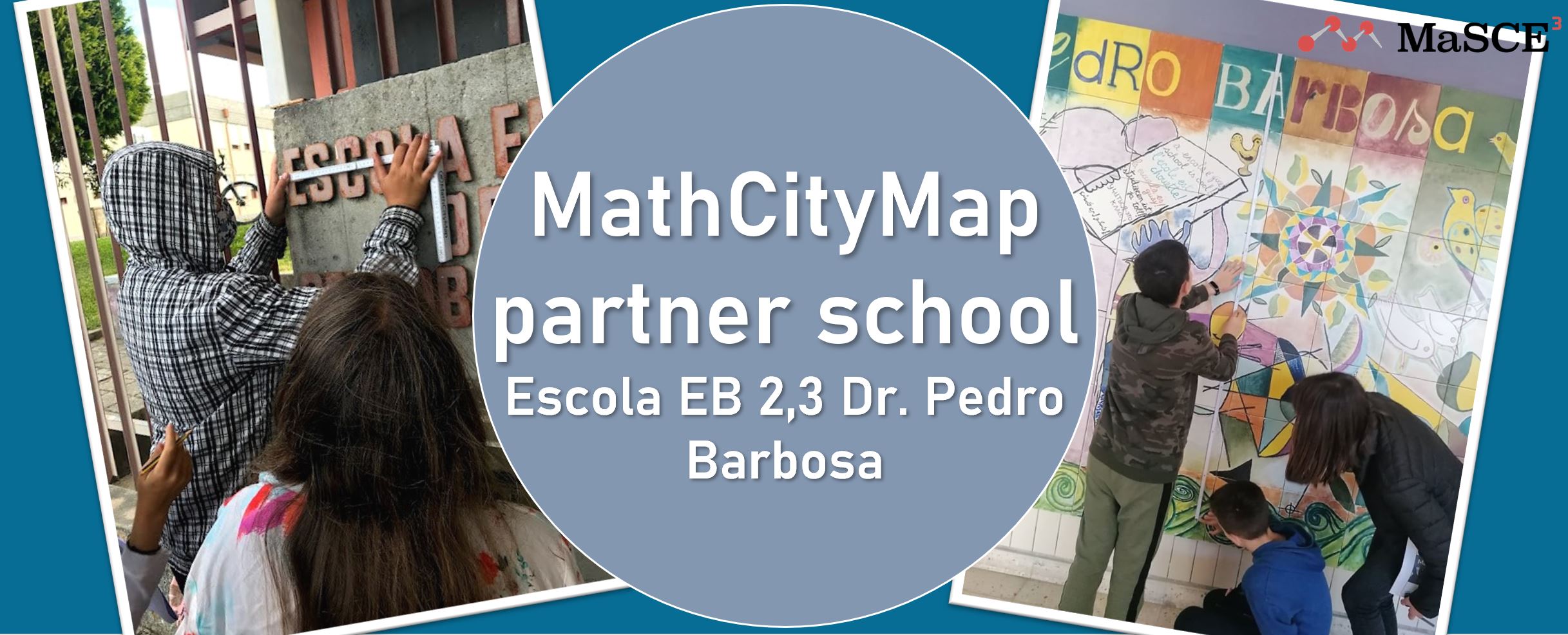
A fantastic part of MathCityMap is our constantly growing international community. In this we now welcome the already fourth MCM partner school in Portugal, the “Escola EB 2,3 Dr. Pedro Barbosa” in Viano do Castelo.

The successful application process was accompanied by two pre-service math teachers, Ana Meira and Liliana Francisco, who reported on it as follows:

“Our first experience with MathCityMap was as students during our master’s program. We were so positively impressed by the app that we decided to create mobile Math Trails with our own students, two 6th grade classes. To apply the content taught in class, we created a trail about rational numbers (trail code: 099594) and another about symmetries (trail code: 145301).

Both groups reacted extremely well and enjoyed the opportunity to get outside, exploring the mathematics that surrounds them. The technology was an extra motivation, especially the gamification feature of the app and the possibility of accessing immediate feedback on their answers. The contents taught in the classroom acquired new meaning as the students could see the applicability in real context.

The package with the official partner school plaque and the MCM measuring instruments is already on its way to Portugal and we are very much looking forward to receiving more applications from all over the world.

All further information about the partner school program and the requirements for the application can be found in the article about the first MCM partner school as well as on the homepage of our project MaSCE³.
 

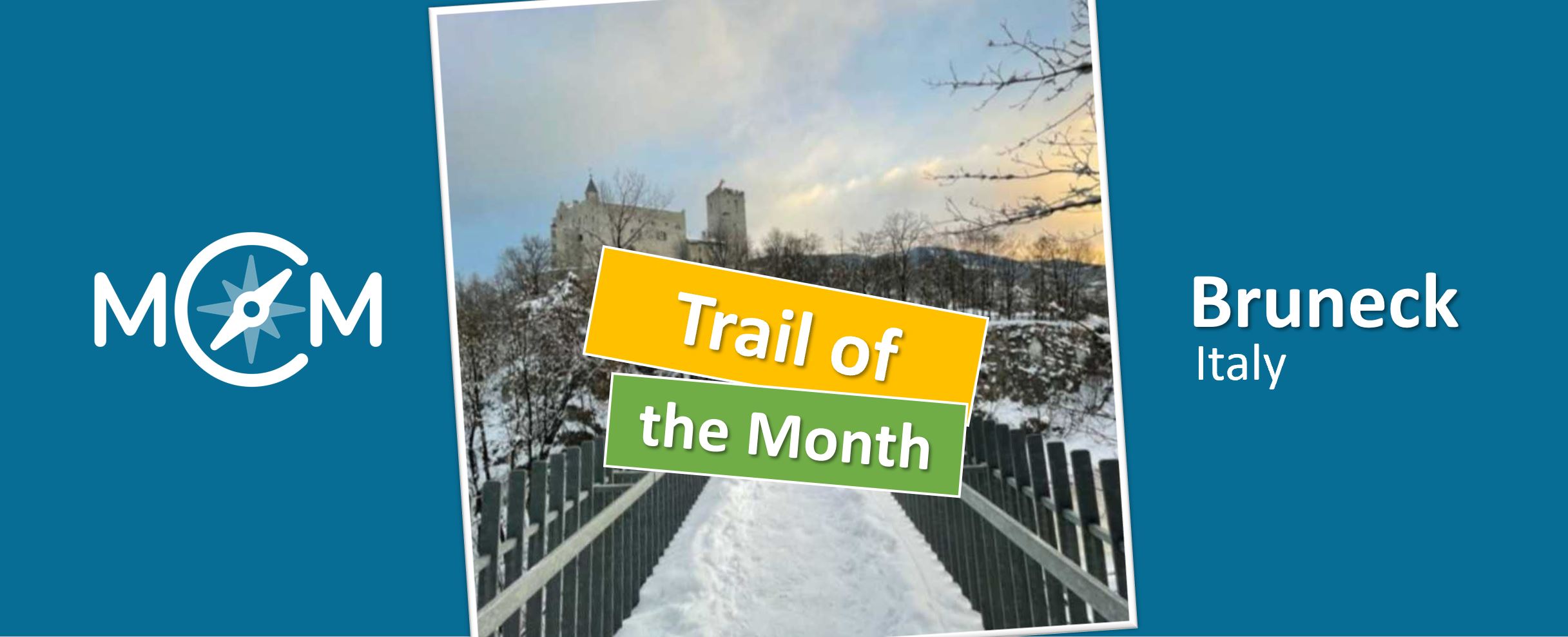
The Trail of the Month of June comes from the small medieval town of Bruneck in the region of South Tyrol in northern Italy. Here, Melanie Forer and her third-grade students created the trail “Bruneck einmal anders” (Brunico a little different), which can be accessed with the MCM app under the code 353905 and is available on the MathCityMap web portal here.

The trail consists of a total of six tasks that mostly revolve around the topics of areas and volume calculation of basic and composite objects and areas. In addition, of course, you have the pleasure of getting to know Bruneck from a completely different perspective, while at the same time visiting sights such as the castle of Bruneck.


An interview about the creation of the trail and her experiences with MathCityMap is given by Melanie Forer below:


How did you come across the MathCityMap project?

I got to know MathCityMap in the context of the further training ” Mathematical Trails” of the Pedagogical Department in South Tyrol. Using the example of the project “matematica in città” in Bolzano, we interested teachers were invited to observe the environment with a mathematical eye and then familiarize ourselves with the app MathCityMap. The possibility to formulate and solve mathematical questions at extracurricular learning sites appealed to me very much, so I also brought this idea to my class, where it immediately received a lot of approval.


Where is your trail located? What is special about your trail?

The small medieval town of Bruneck in South Tyrol, Italy impresses with its castle and the famous town alley. In 1741, the Ursuline Order settled in Brunico and in the following years the Ursuline Sisters built a church, convent, boarding school and school. Pupils of this equated secondary school have created the mathtrail “Bruneck einmal anders”, which is described as follows:

Starting from the school entrance at the Ursuline Church, the route goes through the eponymous Ursuline Gate via the historic Stadtgasse up to the Upper Town. From there it continues up to Bruneck Castle and across the suspension bridge to Hermann-Staudacher-Platz. Afterwards the trail goes back to the Schlossberg, down to the Rainkirche and over the trench to the Hintergasse. With the trail it is possible to get a new perspective on the sights of Bruneck by putting otherwise inconspicuous, everyday, geometric figures and bodies in the center of attention.


How do you use MCM and why?

I use MathCityMap to offer very practical, modern mathematics lessons that are close to the students’ lives. Through new digital media, such as MathCityMap, the student world can become a place of learning and a new approach to mathematics can be created. The mathematical perspective no longer remains only in the classroom, but is increasingly applied in the playground, on the way to school or in leisure time.

This school year, I will again be working with a small group of students to collect new tasks and take on the mathematical challenge.


Describe your favorite task on the trail. How can it be solved?

My favorite task is the “bridge at the castle”. With a bit of a thrill, but of course with maximum safety, you can enjoy a wonderful view of Bruneck Castle. The task is to measure the area of the fence and calculate the cost of redesigning it. The special thing here is the varied approach to determining the length, with measuring and counting with meter tape folding rule or other aids such as thread, step length, etc.. To be able to solve the task, basic knowledge of calculating the area of rectangles and an understanding of direct proportionality is needed.


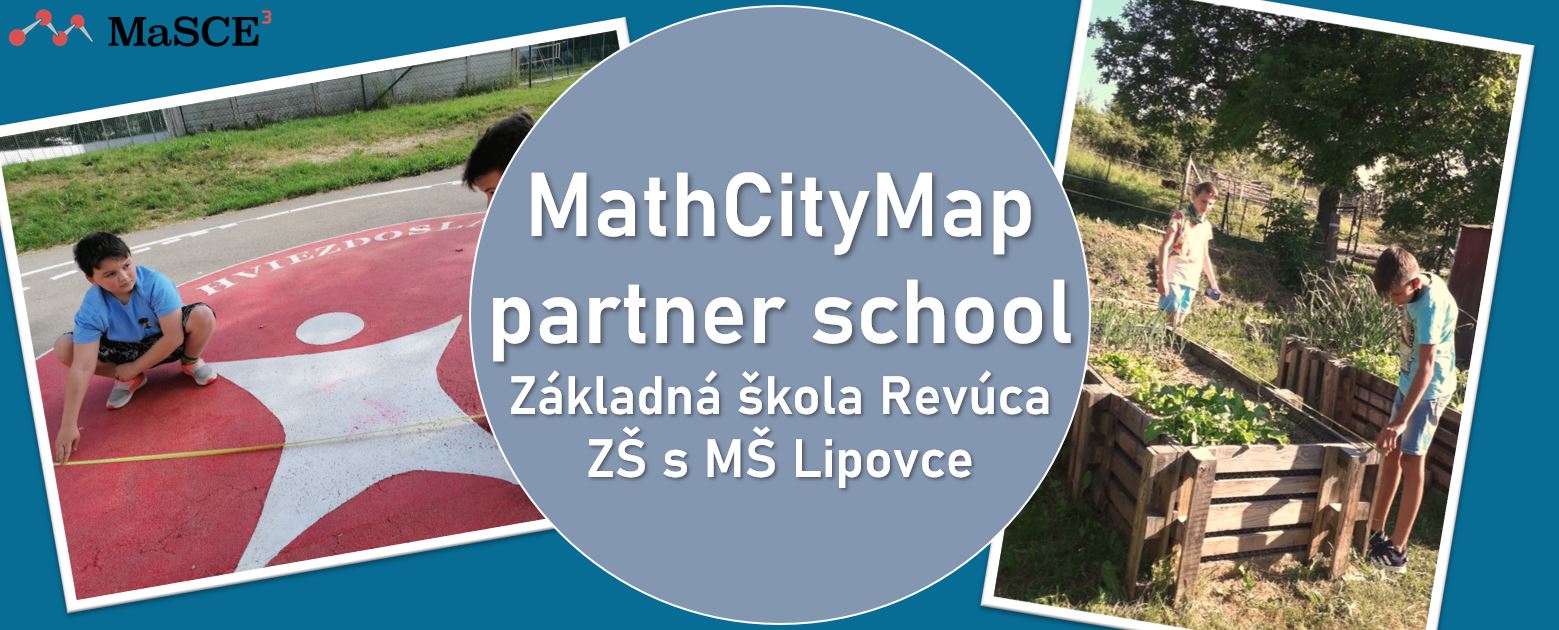
Also from Slovakia the first schools are joining the partner school program of MathCityMap. We are very happy to welcome “ZŠ s MŠ Lipovce” and “Základná škola Revúca” as the new and fifth / sixth partner school, which successfully passed the application process.

The process at ZŠ s MŠ Lipovce was initiated by Sylvia Smolková, a dedicated mathematics teacher at the school, which has a kindergarten, primary and secondary school.
Four trails were created for grades 5 (075303), 7 (025383), 8 (675400) and 9 (565437), which lead the school’s students across Lipovce and let them discover the community in a new way. Trying out the trails with the classes was a lot of fun for all involved and especially the experience of doing mathematics outside was a great motivational factor, as Sylvia Smolková told us.

At Základná škola in Revúca, the application was submitted by Michaela Štefko, who described her experience with MCM as follows:

“I work at the primary school in Hviezdoslavova street in Revúca. Our students are always open-minded to new and interesting forms of learning. As soon as we came across the application and the portal Mathcitymap, we immediately decided to use it in our lessons. So far, we have created two trails in the area of our school for the 5th and 6th grade. We are currently working on another one for the 7th grade. My colleague and I have recently started to design a mathematical walk in our town. We would like to present the monuments and significant places in our district town. Our students have already passed both routes, they were all excited, they formed groups very quickly and worked nicely on every single task. They even suggested that they take part in creating other tasks. We want to improve students´ reading comprehension, teamwork and also communication skills. Additionally, we see a great benefit in the fact that students, whose favourite school subject is not mathematics, took part in solving mathematical problems.”

The packages with the measuring tools and the official partner school plaque are already on their way to the schools and, as always, we are very much looking forward to receiving further applications from all over the world.

All further information about the partner school program and the prerequisites for the application can be found in the article about the first MCM partner school as well as on the homepage of our project MaSCE³.
 

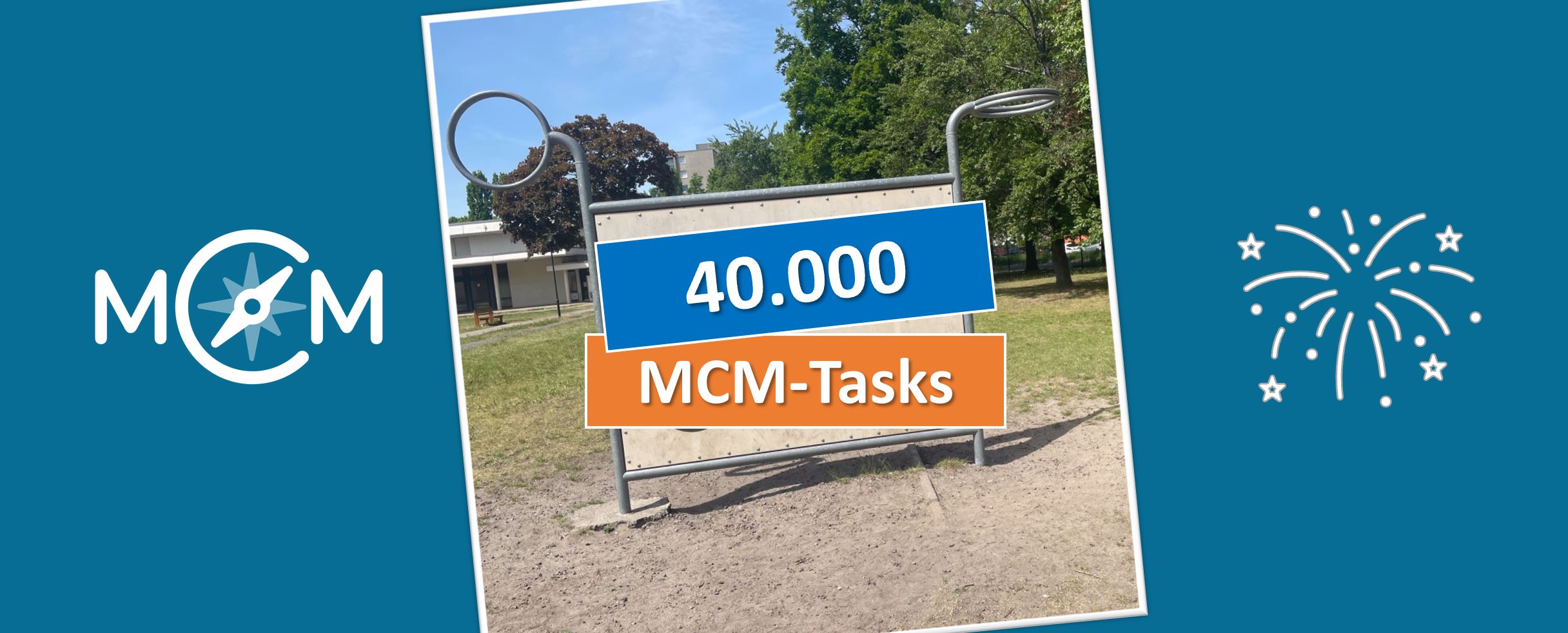
Not even half a year has passed since we cracked the mark of 30,000 tasks in the MathCityMap system. Today, we are more than happy to announce the achievement of the next milestone. We are celebrating over 40,000 tasks in the web portal! Our users were also very active in the first half of 2022, and today we have exactly 41,356 tasks in the portal.

Our anniversary task, which cracked the 40,000 mark, was created by Tobi Walter-Born in Berlin and asks for the area of the front of a goal wall. Click here to go to the task.

We look forward to many more MathCityMap tasks and we are excited to see when we will reach the next mark of 50,000 tasks!

Spring with warmer temperatures and sunshine has reached many parts of Europe. So it’s high time again to do mathematics outside and explore your surroundings with mathematical eyes. The steadily growing MCM community in Slovakia took this thought to heart in April and carried out a wide range of activities, which we would like to report on in more detail below.

It started on April 6, when the Student scientific conference, a joint scientific event of the Faculty of natural sciences and informatics (FNSaI) of the Constantine the Philosopher University (CPU) in Nitra, Slovakia and the Faculty of natural sciences of the Matej Bel University in Banská Bystrica, Slovakia, took place. The graduated student Silvia Haringová won the section Professional didactics II with the paper: The importance of including math trails in teaching.

Veronika Bočková and Silvia Haringová, graduates of the Mathematics Department of the FNSaI CPU in Nitra, visited the lower secondary school in Nové Zámky on April 8, where they prepared a math trail for grade 5 students together with math teacher Elena Závodská. An open lesson for primary and lower secondary math teachers will also be held there, where all fifth graders will complete the trail.


On April 12, Silvia Haringová and Janka Medová went to Nemšová, where primary and lower secondary math teachers were trained in designing and implementing lessons with MathCityMap.

On April 14, a training workshop on MathCityMap paths for primary, secondary and university teachers was held at the Faculty of Science and Informatics in Nitra. Thirty teachers registered for the event. In the first block, teachers received the basic information about MathCityMap and became students again for a while when they tried a math trail themselves. In the second block, the teachers learned how to create the trails in the MathCityMap portal.

The EME 2022 conference – New challenges in mathematics education in primary school – was held in Liberec, Czech Republic on 21-23 April. At the conference, PhD students Silvia Haringová and Veronika Bočková presented the paper: Mathematical trails as a tool to stimulate teacher cooperation. They also created a trail on the campus of the Technical University for pre-service teachers and conference participants to experience.

At the end of the month, on April 26, a group of student teachers from the Physics Department of the University of Pilzen visited the University in Nitra. In the atrium of the Faculty of Science and Informatics and in the center of Nitra, they were introduced to the MCM system and were also able to try out a Mathtrail.

The coming months will also be interesting in Slovakia. The design and implementation of trails in the town of Bánovce nad Bebravou is already planned for May and mathtrails will also be created in Poland. In addition, the University in Nitra is working with mathematics teachers as part of the national project KEGA Cooperation, a project for the professional development of mathematics teachers, and aims to use Mathtrails and MathCityMap specifically for this purpose.

In the beautiful South Tyrolean city of Merano, teacher Michael Perkmann recently created the task “Height of the Powder Tower in Merano”, which we would like to present to you today as the task of the week. The goal of the task is to determine the height of the old powder tower.  Michael Perkmann reports about his task and the use of MathCityMap in the classroom in the following.


How did you come across the MathCityMap project? How do you use MCM?

I first heard about MathCityMap about 3 to 4 years ago at a teacher training course in South Tyrol. At that time we did the first Mathtrails in groups and tried to create our own tasks.

Since there are hardly any tasks and trails in South Tyrol and especially in Merano at the moment, I have always planned to create my own math parkour with my students one day.

I created this task for the Powder Tower together with my students from the Business School in Merano as part of an interdisciplinary project to get to know the MathCityMap platform better.
The goal is that the students themselves will soon create several tasks in the vicinity of Merano.

Together we will try to enter the tasks into the portal and then create a trail.


What can the learners gain by working on the tasks?

I think that working on tasks requires many competences of the students, especially modeling, creating text tasks, applying mathematical representations, creativity in solving mathematical problems.

This is often neglected in frontal teaching. MathCityMap is therefore a great addition to the lessons and the work outside the class motivates and makes fun for the students.

Through the Trail of the Month of May, we get to know a European capital from a slightly different angle. We’re talking about Finland’s largest city, Helsinki, where Nina Salminen, a local mathematics, chemistry and physics teacher, created the Helsinki Tour trail, which is available in the MCM app by using the code 129638 and on the MathCityMap web portal here.

On this extensive mathematical walking trail we get to know the city and its sights in connection with six mathematical tasks based on intermediate level topics. Starting at the Sibelius Monument, the trail covers a total distance of 2.9 km, passing the Olympic Stadium, the Parliament Building and the famous Temppeliaukio Church, which was carved directly into a rock.

In a short interview Nina Salminen tells us how she got to know MathCityMap and gives us some background information about her trail:


How did you come across the MathCityMap project?

My Italian colleague Giovanna Zito from Brindisi asked me to join an Erasmus+ project, where a MathCityMap trail is being planned with students in each of the five countries participating in the project. I found out about the MathCityMap project and made one trail with my students near our school, Munkkiniemi School. This spring we went further and planned two trails in the center of Helsinki.


Please describe your Mathtrail.

Along the trail you will see points of interest in Helsinki and at the same time solve short math problems. For each task, you will get to know one of Helsinki’s attractions. Thus, the route also serves as a tourist tour in our capital. Math problems are suitable not only for students but also for anyone who wants to recall the basics of mathematics or enjoy problem solving.


How do you use MCM and why?

MCM trail brings good variation for math lessons. A trip outside breaks up the monotony of the school day. Showing math in different contexts is also a good way to reach students who, for one reason or another, don’t like math and don’t think they’re good at it.

We can also get around the trails on theme days or when there are foreign guests at our school. The trail makes it easy to introduce our hometown. The Finnish mobility of the Erasmus+ project will take place in May and all 50 students from five different countries will take the MCM trail.


Describe your favorite task of the trail. How can it be solved and what can students learn from it?

My students have come up with ideas for the tasks and were so excited about planning them that I consider everyone a favorite. The tasks differ from each other and many of them require knowledge of geometry. In addition to connect math with real life, students get to know their hometown. They also learn to work together as a group when solving tasks and navigating from one task to another.