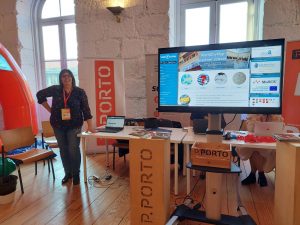
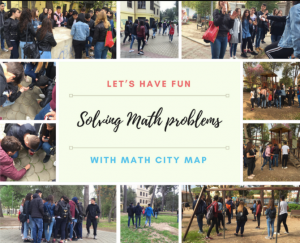
On November 10 and 11, the 5th edition of the “Tomorrow Summit” took place in Porto. It was an event on technology and innovation organized by the Academic Federation of Porto. This year, the program was planned in special connection with the European Year of Youth.  The aim of this event was to lead the discussion for “Tomorrow”. At the Tomorrow Summit, participants found a wide range of innovation, research and technology that attracted many visitors. 

The MathCityMap and ASYMPTOTE projects were represented at this event to display innovative ideas for teaching mathematics and mathematics education in general. 

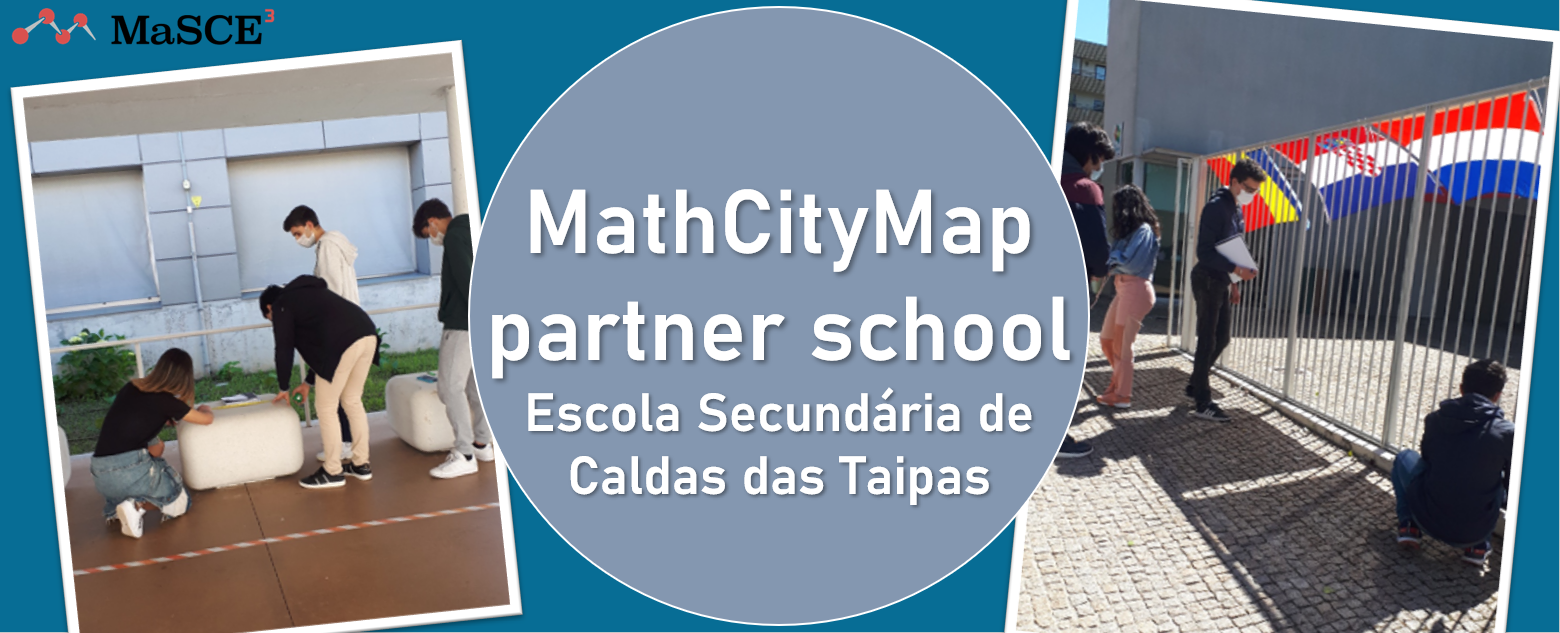
We are very pleased to welcome the sixth Portuguese partner school, Escola Secundária de Caldas das Taipas, to our partner school network. A report about the work with MathCityMap so far and the further plans and application possibilities of Mathtrails was written by the math teacher Arminda Machado, who initiated the application process:

“At ESCT (Secondary School of Caldas das Taipas), the MathCityMap application was used to create Mathtrails, an activity that contributed to the valorization of information and communication technologies and to the development of specific skills in mathematics among the students, namely logical thinking and problem solving.

This school year, the students at our school integrated the Erasmus+ project Maths&Art with the International Mathematics Day, which is celebrated on March 14. As part of this, a great challenge was launched for all ESCT math students, which consisted of forming teams of three members representing each class to participate in a Mathtrail with MathCityMap, put together by themselves and implemented on the school campus. The students accepted this invitation with enthusiasm and the initiative, in which the entire educational community participated, was a success.

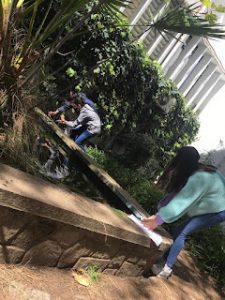
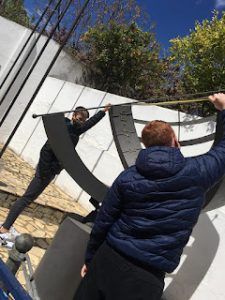
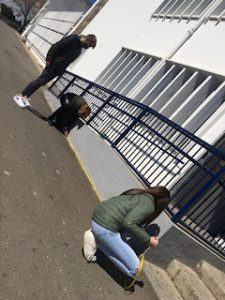
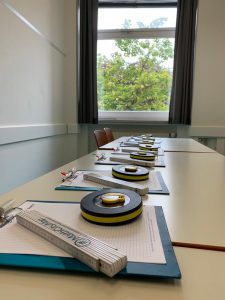
The courses were conducted outside the classroom and in a real-world context, focusing on hands-on and experimental work, which increased the students’ motivation to learn. Students walked in small groups and in constant collaboration along trails guided by the MathCityMap application previously installed on their mobile devices, solving a series of mathematical problems related to objects or constructions present in the outdoor areas of the school. In this way, they mobilized the fundamental knowledge acquired in class. In certain situations, students used measuring tools such as the tape measure and protractor to address the practical side of the subject and the importance of its application in everyday life. The fact that students have the opportunity to develop various skills such as independence, critical thinking, creativity, collaboration, and communication while completing these tasks makes the use of this tool even more important. After completing the Mathtrails, students could analyze and discuss the solutions and results of each task in class with the math teacher. This type of activity adds a new dynamic to the classroom that is very attractive to students and promotes educational success.

For the next school year, a math trail is planned in the city of Guimarães, connected with mathematical problems related to monuments of the historical center, to be carried out by students of partner schools from Spain, Finland, Italy and Turkey during the student exchange planned in ESCT in the framework of the Erasmus+ project Maths&Art. In addition to broadening knowledge in the field of mathematics and information and communication technologies, this trail aims to develop intercultural and language skills.”

The package with the official partner school plaque and the MCM measuring tools is already on its way to Portugal and we are very much looking forward to receiving further applications from all over the world.

All further information about the partner school program and the requirements for the application can be found in the article about the first MCM partner school as well as on the homepage of our project MaSCE³.

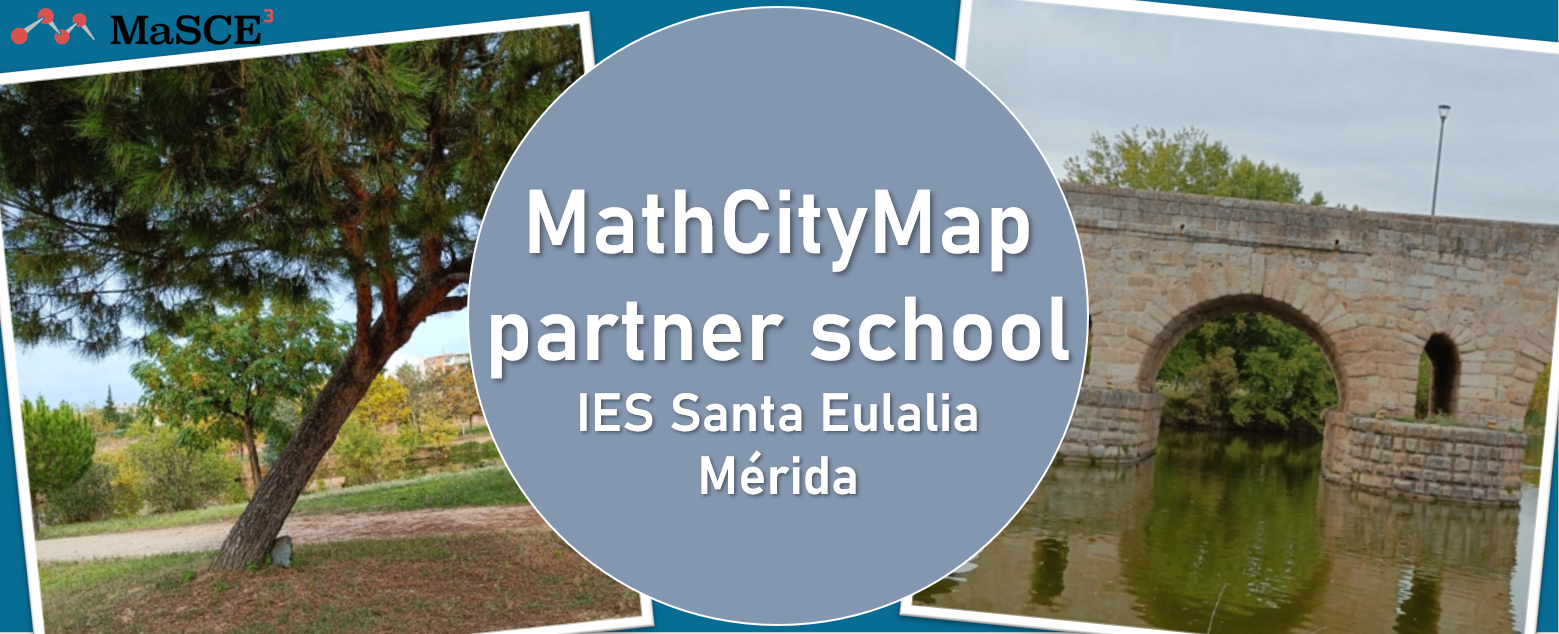
In Spain, too, there are more and more official MathCityMap partner schools. The fourth Spanish school that has successfully applied to the partner school program is IES Santa Eulalia, in the city of Mérida. As part of the application, which was initiated by math teacher María Bravo Conde, a total of three math trails were created and tested with students from the school.

Regarding the motivation to integrate MathCityMap into the teaching, the school’s team wrote as follows:

“Using MathCityMap allows us to bring math closer to a real and everyday environment, and our students have to work together in groups, make independent and critical decisions, take initiative, and evaluate different options to find solutions.”


The first trail is located directly at the school, the second trail is located on an island in the Guadiana River, which flows through Mérida, and the third trail is located in a park that the students of the school can easily reach by bus.

The trails are available under the following names and codes in the MathCityMap system:

  1. Ruta matemática por el IES Santa Eulalia (079113)
  2. La isla de Mérida (256425)
  3. El parque de las Siete Sillas (786348)

The package with the official partner school plaque and the MCM measuring instruments is already on its way to Spain and we are very much looking forward to receiving further applications from all over the world.

All further information about the partner school program and the requirements for the application can be found in the article about the first MCM partner school as well as on the homepage of our project MaSCE³.


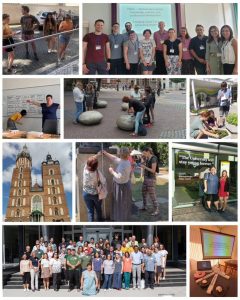
In the summer of 2022, several events, such as conferences and so-called summer schools for young scientists, took place all over Europe on the topics of development of mathematics education and research in the field of mathematics education. Several of them were attended by the staff of the Department of Mathematics of the Faculty of Mathematics of the University of Constantine the Philosopher in Nitra, as well as by teachers and students of various disciplines of the University of Constantine the Philosopher in Nitra. The aim of the visit was, among other things, to make MathCityMap better known in Europe and to present the latest findings on the use of MathCityMap in the classroom.

In the following report, Janka Medová, Veronika Bočková, Soňa Čeretková and Silvia Haringová present the activities of the Slovak MathCityMap Summer:

The first of the summer schools, Socio-scientific Issues in Mathematics and Science Initial Teachers Education: Join a unique intercultural experience preparing you for the future classroom! was held on 15-24 June 2022 at the Faculty of Education, Charles University in Prague, Czech Republic. Soňa Čeretková prepared and facilitated a workshop including MathCityMap trails named Preparation of teaching with the use of innovative teaching methods and outdoor teaching with the support of digital technologies. The summer school was organised within the Erasmus+ ENSITE project (https://icse.eu/ensite/), as was the summer school Dealing with environmental issues in science education – Deepening future science and maths teachers’ learning by teaching. A two-day workshop on MCM trails as a tool for developing awareness of environmental issues was prepared in Varna by Janka Medová and Veronika Bočková. The summer school took place in Varna, Bulgaria, 31 July-11 August 2022 and was organised by the Institute of Mathematics and Computer Science of the Bulgarian Academy of Sciences.
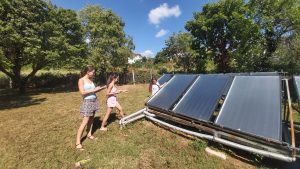
 

At the summer school for graduate students and early career researchers Intensive training school in qualitative research design and research methods in mathematics education supported by European Society for Research in Mathematics Education (ERME), held in Nitra on 29 June – 1 July Silvia Haringová referred about her work with teacher in co-designing and teaching the MCM trails.

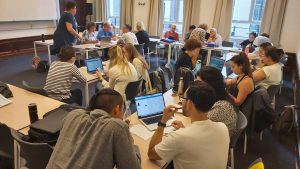
During the two-day Summer School of Didactics of Mathematics, which took place on 6-7 July 2022 at the Pavol Jozef Šafárik University in Košice, Slovakia, primary and secondary school teachers solved a mathematical trail using the MathCityMap application in the city centre. The seminar led by Silvia Haringova continued after solving all the tasks in the premises of the university. During the seminar, participants learned how to create a trail on the portal and received manuals for creating math trails in MathCityMap.

A workshop on MCM trails was conducted by Janka Medová and Veronika Bočková in the centre of Utrecht, the Netherlands, as part of Utrecht Summer School: Mathematics Education held on 15-25 August 2022. The implementation of the summer school was also supported by the ICSE Academy project, in which researchers from several departments of Constantine the Philosopher University in Nitra collaborate with the Freudenthal Institute of the University of Utrecht to design and implement professional development programmes for teachers of mathematics, science and engineering (STEM) with a European dimension.


Janka Medová went also to Usti nad Labem in the Czech Republic, where she attended an event called the Summer School of Didactics of Science STEM Subjects, consisting of several accredited programmes for teachers of mathematics and science. As a lecturer, she collaborated in the implementation of the programme Didactic Principles in STEM subjects with colleagues from the J.E. Purkyně University, Ústí nad Labem and Charles University in Prague. The proposed professional development programme included MCM trails and is based on a joint book of 16 authors, didacticians of various subjects, entitled Didactic principles in science education: methodological guide for teachers of biology, chemistry, physics, geography, informatics, mathematics and lecturers of environmental education. The book was officially invited on Thursday, 18 August 2022, with the participation of the Dean of the Faculty of Science of UJEP and the Faculty of Education of Charles University.

From 22 to 26 August 2022, the prestigious summer school for doctoral students and young researchers called YESS (YERME Summer School) organized with the support of ERME at Johannes Kepler University in Linz, Austria, was attended by a doctoral student of the Department of Mathematics, a student of the study programme Theory of Mathematics Education, Mgr. Silvia Haringová. In TWG 1: Mathematics teacher expertise, practice, and professional development, led by Alf Coles from the University of Bristol (UK), she presented partial results and proposed methodology of her PhD thesis on Collaboration as a means of professional growth of mathematics teachers where she collaborates with mathematics teachers in development of MCM trails.
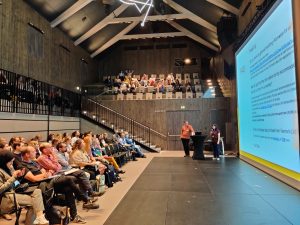


In the last days before the start of the lecture period, 7-9 September 2022, the Faculty of Natural Sciences and Informatics of the Constantine the Philosopher University in Nitra, Slovakia hosted the thirteenth ERME Topic Conference 13 (ETC13) entitled MEDA 3 Mathematics Education in the Digital Age. The MEDA3 conference follows the MEDA conferences organized at the Department of Mathematical Sciences, University of Copenhagen, Denmark in 2018 and Linz School of Education, Johannes Kepler University, Austria in 2020. During the conference Silvia Haringova presented a contribution Identification of domains of mathematics teachers’ knowledge addressed in reflection on technology-supported mathematical trails, co-authored with Janka Medova. The presented model of PD for mathematics teachers and the MCM trails evoked rich discussion.

A week later, on 13-16 September 2022, Janka Medova presented another contribution of the team Haringova-Medova, titled Factors affecting collaboration in designing and enacting MathCityMap trails by in-service teachers at the conference TiMER Trends in Mathematics Education Research held in Krakow, Poland. Event was supported by European Society for Research in Mathematics Education (ERME) within the call Initiatives for Supporting Emerging Communities for Mathematics Education Research in Eastern Europe.

And, since the school year in Slovakia has already started, we are again visiting the schools where we develop and enact the new MCM trails in collaboration with mathematics teachers.


In the summer semester of 2022, Dr. Susanne Podoworny offered a seminar on MathCityMap for master students of elementary school teaching at the University of Paderborn. We would like to present a report about the implementation of this great seminar idea in this article.

The goal of the seminar was to create and implement a mathematical trail using the MCM app with elementary school children on a suitable theoretical basis.

In the area around Paderborn, two elementary schools could be won over, which agreed to carry out a mathematical trail with five first and two second classes later on.

After a few sessions in which the students explored theoretical backgrounds on learning in out-of-school places, learning with digital media, and of course MathCityMap, four student groups formed to create four mathematical walking paths with MCM. The students found it particularly challenging to create appropriate tasks for the still very young target group. One student wrote in this regard “It’s very difficult to formulate tasks for first grade when the kids can barely read.”

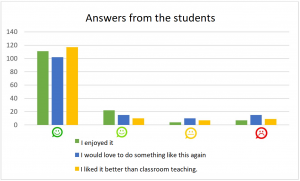
The implementation then took place in a double lesson at each of the two elementary schools. The trails were designed along the schoolyards and often referred to the playground equipment. Overall, the student teachers reported that the students involved, as well as the teachers, greatly appreciated this different mathematics lesson. A questionnaire was distributed to the students by the students and 145 children completed it. Some results can be seen in the following diagram.


As a hint from the implementation, the recommendation to integrate a read-aloud function into the MathCityMap app arose, which we gladly take up for the further development of our system.

The seminar was well attended with 24 students. On the one hand, the students appreciated the freedom offered by the seminar design and, on the other hand, the real-life work with elementary school children, which gave everyone a lot of pleasure. Due to the positive response from the students, this seminar will be offered again in the winter semester.


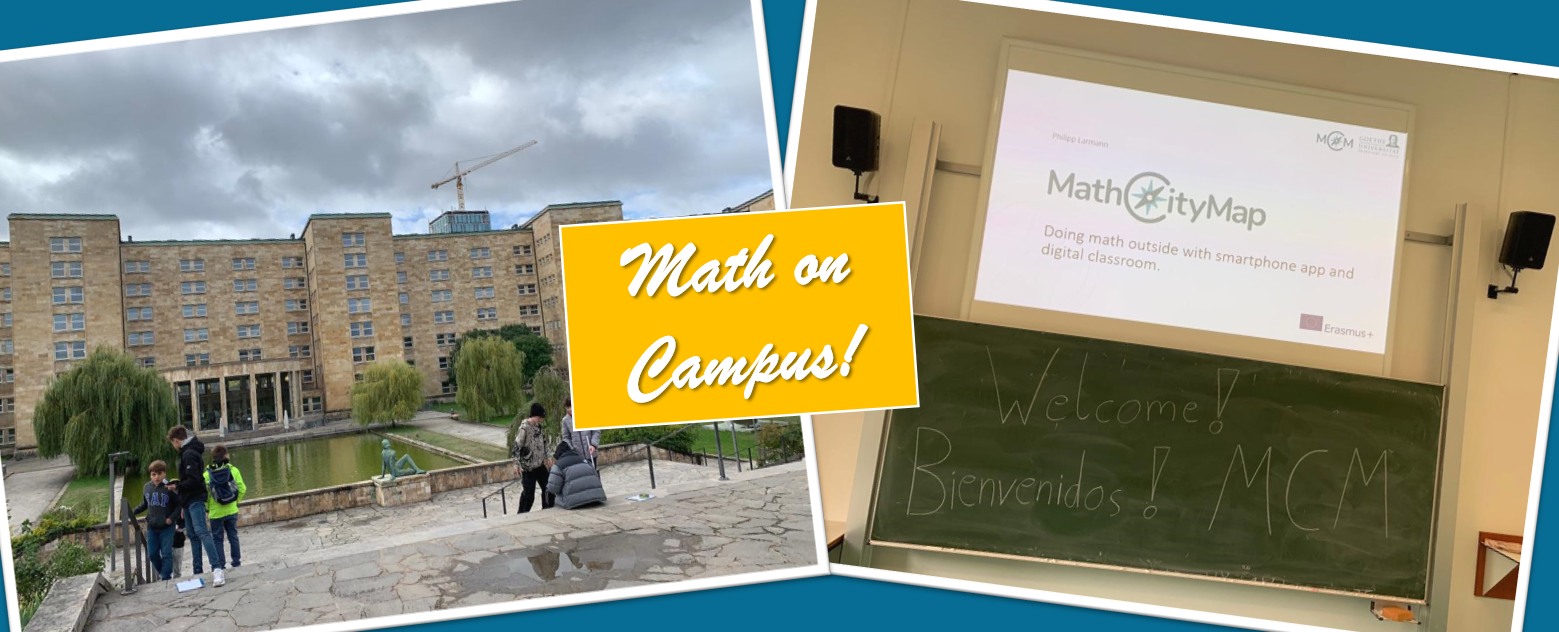
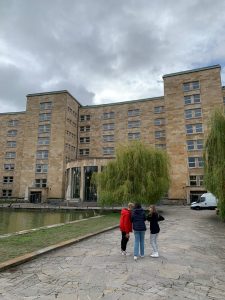
Even in autumn, there are still plenty of opportunities to experience mathematics outdoors! Following this motto, an exchange school program of the Heinrich-Heine-Schule in Dreiech visited the MathCityMap team Frankfurt on the campus of the Goethe University. The group consisting of 18 Spanish students and 13 German students as well as two Spanish and two German teachers had the opportunity to get to know the idea and the functionality of MathCityMap in a short presentation and afterwards to try out a math trail directly on the campus.


The special feature of the trail was that it consisted of tasks in German, English and Spanish, which made cooperation between the students of the partner schools indispensable.

The MathCityMap team in Frankfurt was very happy about this visit on campus and is always available for inquiries for small trips into the world of mathtrails with MathCityMap at our address info@mathcitymap.eu!

Also in Italy, the partner school network is constantly growing and we are happy to welcome the “IISS Ettore Majorana” from the city of Brindisi as a new MathCityMap partner school. The application process was initiated by the local math teacher Giovanna Zito, who has already been using MathCityMap in class since 2019.

In addition to her work as a teacher, Giovanna Zito also coordinates the Erasmus+ project “Maths and Art”, in the context of which two of the three trails required for the application were also created in the vicinity of the school. She reports about this as follows:

“The project “Math and Art” is carried out together with schools from Finland, Spain, Portugal, Italy and Turkey and is based on three different activities in each partner school.
The most important of the three activities is the creation of at least one MathTrail with MathCityMap in each country. Mixed groups of students from the different partner schools test the trails and give feedback on their experience with MathCityMap. The created trails and the measuring materials, which are needed to solve the tasks, are also made available to the local tourist offices. This way, visitors of the different cities of the partner schools can get to know the respective place in a new way.


The Erasmus project is focused on mathematics and art. For this reason, two of the trails created consider two different historical periods: Ancient Rome and the Middle Ages. In the tasks of the trails some interesting facts and curiosities about mathematics, history and art have been deposited. Thus, the different objects are contextualized mathematically as well as artistically and historically.”

The created trails can be found under the following names and codes in the MathCityMap web portal:

  1. Passeggiando per i parchi (03636)
  2. Brindisi nell’Antica Roma (0311262)
  3. Brindisi medioevale (0511256)   

The trails cover a wide range of topics, including geometry, functions and statistics. Furthermore, there will be translations of the trails into English, so that access to the trails is easily possible.

If you and your school would like to become part of the MathCityMap network, you can find all further information about the partner school program and the requirements for the application in the article about the first MCM partner school as well as on the homepage of our project MaSCE³.

We are very pleased that the Nábrežná 95 elementary school in the Slovakian city of Nové Zámky has successfully applied to become a MathCityMap partner school, making it the 37th partner school in total and the fourth partner school in Slovakia. The MathCityMap community in Slovakia is also growing steadily, which can be seen in the graphic that shows all current partner schools worldwide.


Aneta Vadkerti, a math teacher at Nábrežná 95 Elementary School who initiated the successful application process, has already been able to implement six Mathtrails in the school’s surroundings and reports on her first experience with MathCityMap as follows:

“I have been using the MCM portal and also the mobile application for over 2 years. I have completed 2 online trainings – Mobile Math Trails in Europe (MoMaTre) and also task design for Math Trails. My students love these math walks and I am very happy when I see their satisfaction and smiles while completing the trails. I am currently planning a project day called –Math is Everywhere– to be held at our school on September 28. All 9th grade students will participate, and my main goal is to increase motivation for math as a subject.”

The package with the official partner school plaque and MCM measuring instruments is already on its way to Nové Zámky and we are very much looking forward to receiving more applications from all over the world.

All further information about the partner school program and the requirements for the application can be found in the article about the first MCM partner school as well as on the homepage of our project MaSCE³.


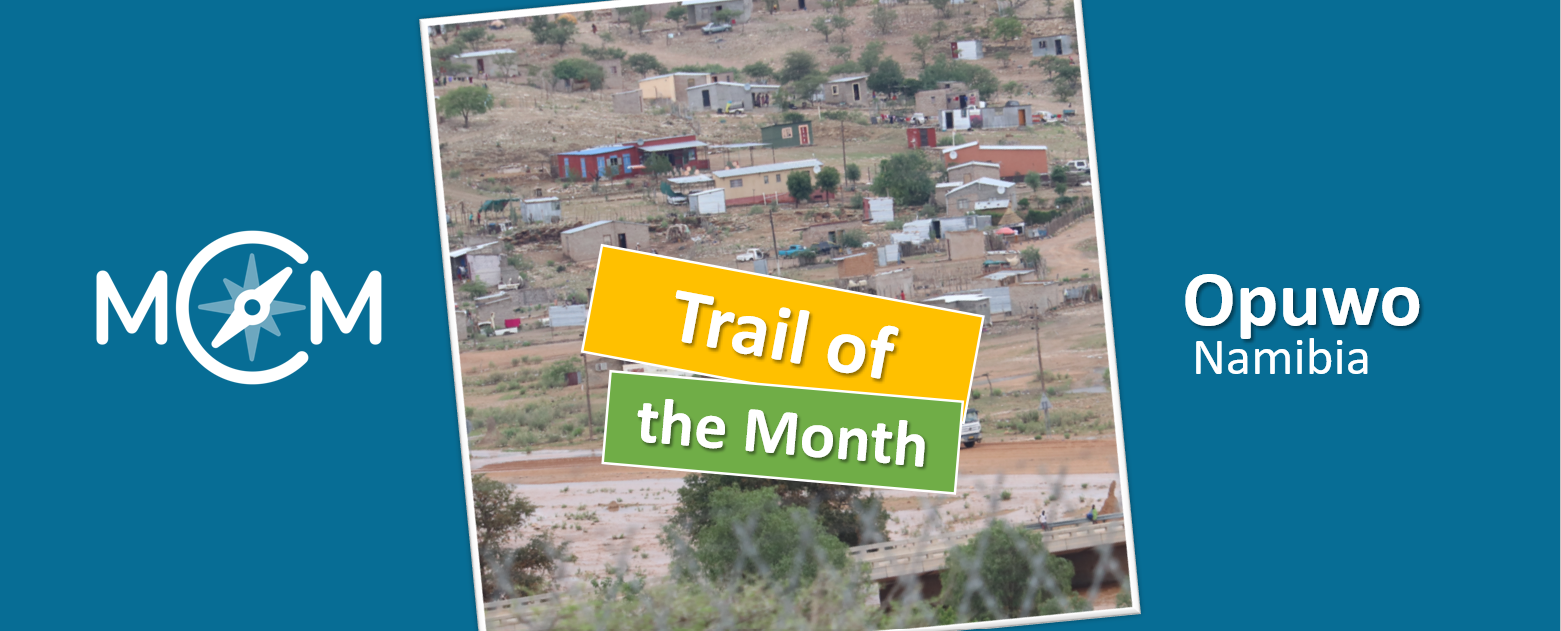
October’s Mathtrail of the Month is located in the Slovakian town of Nové Zámky and lives up to its name “Learn Something New”. It was created by math teacher Aneta Vadkerti as part of the application process for Nábrežná 95 Elementary School to become a MathCityMap partner school. The trail is available in the MCM app under the code 342253 and on the MathCityMap web portal here.

The trail consists of a total of seven tasks, which are designed in such a way that interesting objects in the cityscape are viewed and discovered from a new, mathematical perspective. The mathematical content is wide-ranging and extends from geometric modeling to Roman numerals.

Aneta Vadkerti gives us a short interview below about the creation of the trail and her work with MathCityMap. Enjoy reading!


How did you come across the MathCityMap project?

I came across MathCityMap by accident, actually by a stroke of luck. A sister of my colleague works at the Department of Mathematics at the University of Constantine the Philosopher in Nitra. She told me that they were looking for enthusiastic math teachers who were willing to try and learn something new, able to communicate in English, create some math tasks and try them outdoors, and apply for a teacher training in Granada. The in-service training was only held online due to the pandemic, however, I was able to learn how to work with the MathCityMap portal there. I then attended two more online teacher training courses – Mobile Math Trails in Europe (MoMaTre) and Task Design for Mathtrails – and started using MathCityMap and teaching with MCM.


Where is your trail located? What is special about your trail?

The trail is located in the center of the city and is therefore accessible to anyone who likes math and solving problems. It was designed especially for ninth graders, to review what they have learned so far.


How do you use MCM and why?

I use MathCityMap to increase motivation for learning math and to relieve the boredom that classroom instruction sometimes struggles with.

My main goal is to connect mathematics with real life situations. I want to show my students that mathematics is really everywhere and that it is really useful and almost necessary to learn it. I want to take away the fear of mathematics. I have always wanted to show my students the beauty of mathematics.

The best thing is to see that the students really have fun while learning. They work in groups, help each other, communicate, compete, sometimes argue, but most of all they have a good feeling when they have solved a task correctly. Every time I do a trail outside with my students, there is a lot of laughter and they are happy. Seeing them happy makes me happy too, so I love MCM and conducting lessons with MathCityMap.


Describe your favorite task on the trail. How can it be solved?

My favorite task is “Famous landmarks”. It is a simple but very interesting task that teaches us a lot about the history of Nové Zámky.


The German partner school community is also growing and so we are very pleased to introduce the second MathCityMap partner school in Germany today! The “Friedrich Gymnasium Freiburg” has successfully completed the application process and can now look forward to receiving the official partner school plaque and the package with measuring instruments, which is already on its way to the school.

Working with MathCityMap, 10 trails have already been created at and around the school, partly by the school’s students and partly by teachers.


In a report created for the Friedrich Gymnasium school website, Dr. Patrick Bronner, a math teacher at the school, wrote in an initial conclusion:

“Despite the tight project timeframe shortly before the summer vacations (July 2022), numerous partner groups of class 9a achieved excellent results. What motivated the students in the MathCityMap project was above all the everyday context, the intensive use of digital media, and the expansion and constant change of the learning space from the classroom to the city center. The experiences during the four-week project period in the school practice are now reflected with the MathCityMap team, the created material is improved and published in didactic journals.”

If you also want to apply with your school as a MathCityMap partner school, you can find all further information about the partner school program and the requirements for the application both in the article about the first MCM partner school and on the homepage of our project MaSCE³.