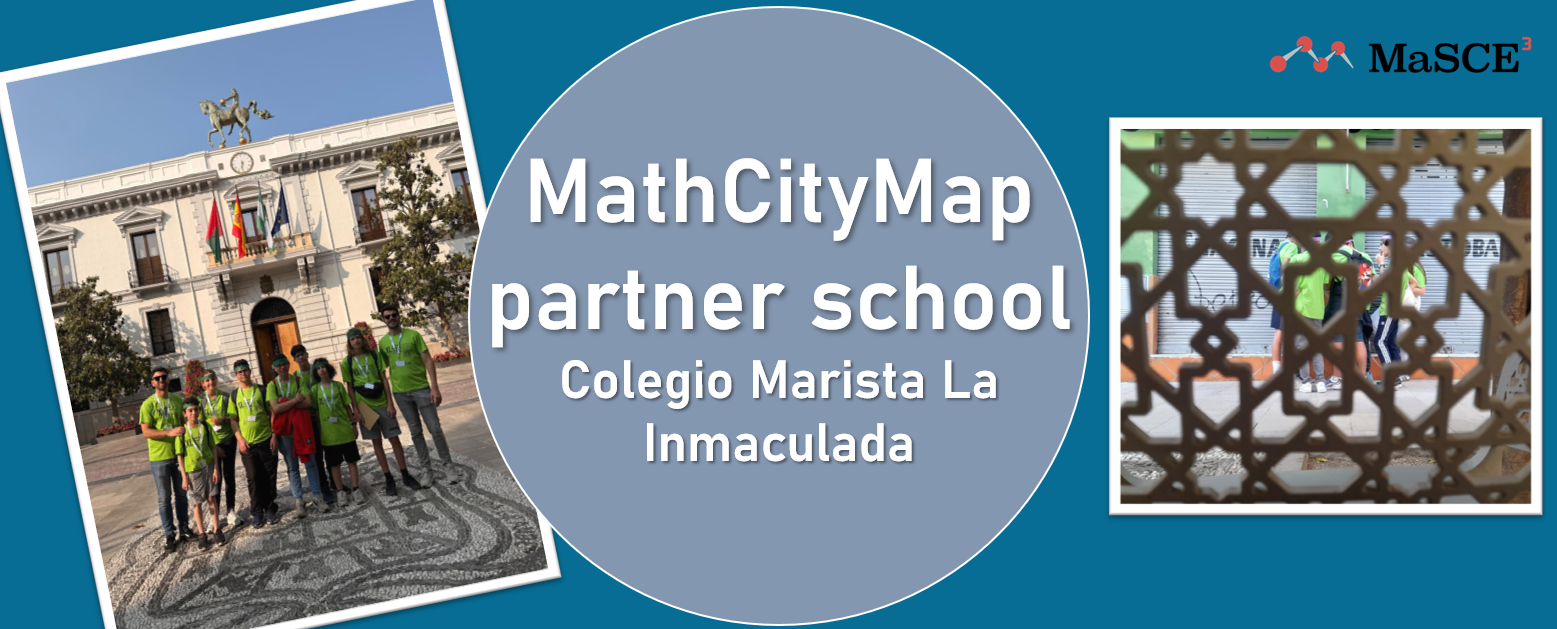
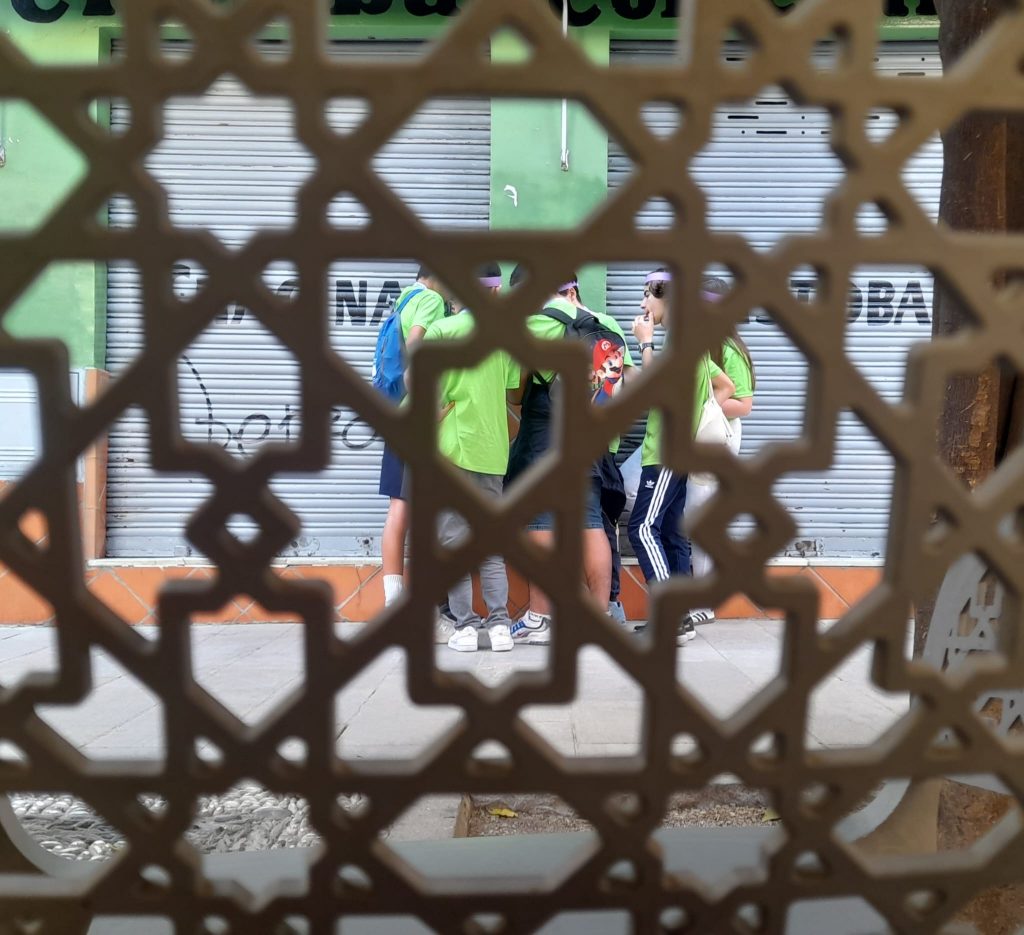
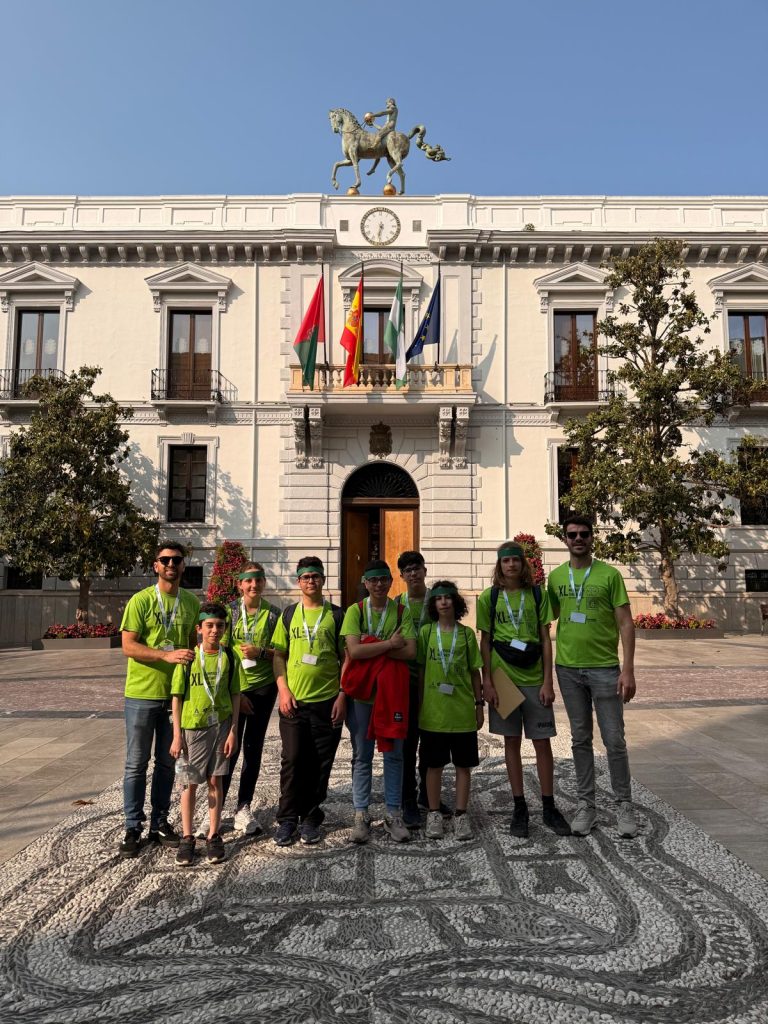
We are proud to welcome Colegio Marista La Inmaculada as an official MathCityMap Partner School! Though new as an official partner, the school has been working with MathCityMap since 2022. The mathematics teacher Daniel Partal García and his colleagues have created multiple math trails, some of which have been downloaded over 100 times:
Thales-30-03-2023 (Trail code: 2313973) – This trail was already subject of an earlier article due to its popularity.
These trails are used both in daily math lessons and for city-wide challenges, bringing together students from various schools in Granada. The central location of the school allows learners to connect mathematics with urban heritage, exploring the city’s historic buildings and landmarks through meaningful, outdoor mathematical activities.
We look forward to more exciting trails and great new ideas.
The package with the official partner school badge and the MCM measuring instruments has already been delivered and we are looking forward to receiving more applications from all over the world.
All further information on the partner school programme and the requirements for application can be found both in the article on the first MCM partner school and on the homepage of our MaSCE³ project.
The application deadline for the first international MathCityMap meeting for students and teachers in Seville is approaching fast! Until July 31, 2025, you can submit a creative video to secure one of the spots for the event taking place from May 4 to 9, 2026.
We are looking for short, creative videos that showcase a MathTrail created by your students. The top five entries will win a trip to Seville – including interactive MathTrails, hands-on workshops, and exciting opportunities to connect with international participants around the theme of outdoor mathematics.
To participate, your school must already be a MathCityMap partner school – or become one by July 31. All information about the partner school program and how to apply can be found on our project website and in the article about the first MCM partner school.
The winning teams (consisting of up to 2 teachers and 6 students each) will enjoy a fully covered program: accommodation and meals will be provided, and 90% of travel costs (up to €350 per person) will be reimbursed – not to mention plenty of math, fun, and international exchange.
Send your video to info@mathcitymap.eu – we look forward to your creative contributions!
We are thrilled to celebrate an exciting milestone: MathCityMap has officially welcomed its 50,000th registered user! Meet Marvin Ahmed, a 19-year-old student at the Technical University Braunschweig, who is studying Mathematics and Biology with the goal of becoming a teacher. In this article, Marvin shares his journey with MathCityMap, his experiences, and what excites him most about using the platform.
Marvin came across MathCityMap through a university seminar titled “Didaktik der Geometrie” (Didactics of Geometry). During the seminar, the MCM project was introduced as a tool for making mathematics more tangible and engaging for students. “MCM was presented to us as a way to make math more accessible and tangible for students, enabling them to get in touch with math in another, more fun way!” What made the introduction especially memorable for Marvin was the hands-on demonstration by our team member Simon Barlovits, who guided students through the platform and answered questions live.
As part of the seminar, Marvin and his group—proudly named “Sons of Pythagoras”—were tasked with creating their own math trails. They quickly learned how challenging it can be to design problems that are not only solvable and accurate but also clearly understandable for all students. “For me, the hardest part was: How do you formulate a task so understandably that everyone can actually grasp what they are supposed to do, and you don’t make it too easy?” This hands-on process gave Marvin a new appreciation for the intricacies of task design—a skill that will serve him well in his future teaching career.
Marvin’s debut task on MathCityMap, titled “So viele Möglichkeiten!”, taught him valuable lessons about real-world variability and precision in task creation. “I didn’t formulate the task well enough, so many things could have been misinterpreted…” Despite the challenges, Marvin was proud of the outcome and grateful for what he learned.
He sees great potential in using MCM in his future lessons: “I really like MCM and will definitely use it in my lessons later on. I think it can make the teaching of some topics in math, like the calculation of volumes, much more interesting and fun!”
We’re honored to welcome Marvin as our 50,000th user and are excited to see how he — and thousands of other teachers, students and math enthusiasts — will continue to use MathCityMap to bring mathematics to life. To Marvin: thank you for being part of our community. And to all our users — here’s to the next 50,000!
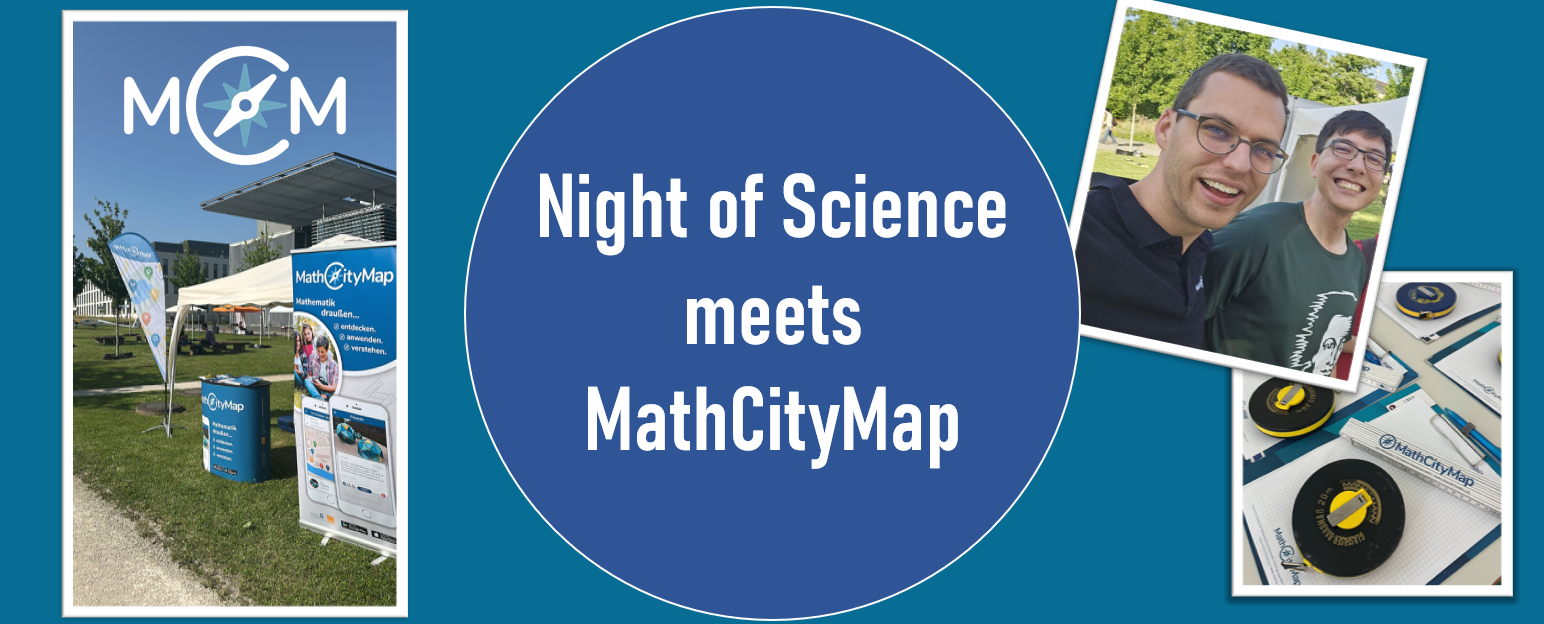
On Friday, June 13, 2025, Frankfurt’s Riedberg Campus once again became a hotspot for science: the Night of Science opened its doors from 5 p.m. until late into the night – and our MathCityMap team was right in the middle of it all with an interactive stand.
Our outdoor location offered the best conditions for our special hands-on offer: the “Night of Science 25” trail. Equipped with measuring materials, a clipboard and the MathCityMap app, many curious guests embarked on a mathematical discovery tour of the campus. The aim was to solve up to 12 tasks – and to look at everyday places such as stairs, benches or building facades through a mathematical lens.
We were delighted with the consistently positive feedback we received – both from those interested in mathematics and from guests who would not describe themselves as fans of maths.
We would like to thank all visitors for the exciting conversations, the interest and the great interaction. Special thanks also go to the Night of Science organization team for making this unique event possible.
See you next year – we are already looking forward to the Night of Science 2026!
We are pleased to include a new school in our partner school program: the EB/JI do Fanqueiro School, a primary school from Loures in Portugal!
The teachers Maria de Fátima Barros Ferreira and Lídia Albuquerque have created two trails und have tested them with their students. These trails can be found with the following codes:
EB/JI do Fanqueiro 3 – Code 2627281 This trail consists of seven tasks and was tried out by 25 students of the third grade.
EB/JI do Fanqueiro 4 – Code 5625904 Further 25 students from the fourth grade have tested this trail consisting of ten tasks.
“The students truly enjoyed the experience! Their favourite task involved taking measurements and calculating area. They were highly motivated and even asked to do more activities like these! We strongly recommend using the MathCityMap app as a way to make lessons more dynamic, interactive, and different from the traditional classroom routine. We will definitely continue to use it!”
We look forward to more exciting trails and great new ideas.
The package with the official partner school badge and the MCM measuring instruments has already been delivered and we are looking forward to receiving more applications from all over the world.
All further information on the partner school programme and the requirements for application can be found both in the article on the first MCM partner school and on the homepage of our MaSCE³ project.
Over the past few months, our MathCityMap team has visited several schools to present the new Student-Account feature through workshops and introductory sessions. After exciting visits to Eberbach, Herten, and Dublin, we had the pleasure of welcoming a group from the Johanna-Tesch-Schule in Frankfurt this May – and we’re happy to give you a closer look at how such a workshop day unfolds.
Together with 18 students and their teacher Nazanin Roushanaei, we spent a full day exploring the idea of “experiencing mathematics outdoors.”
To start the day, we introduced the core concept of MathCityMap and gave an overview of the system. The students then had the chance to get hands-on right away: Equipped with measuring tools and their smartphones, they completed a pre-designed MathTrail and discovered how mathematics can be made visible and applicable in the real world.
Afterwards, we changed perspective and presented the digital classroom from the teacher’s point of view. Then it was time for the students to become creators themselves: Working in small groups, they searched for suitable objects to develop their own tasks, carried out measurements, and prepared everything for digital input.
Following a well-deserved lunch break, the tasks were entered into the system. Together, we compiled the newly created tasks into a trail – which, of course, was tested right away. The day concluded with a feedback session in which students shared their thoughts on each other’s tasks and reflected on the overall workshop experience.
We sincerely thank the group for their enthusiasm and are thrilled about a successful day full of mathematical discovery!
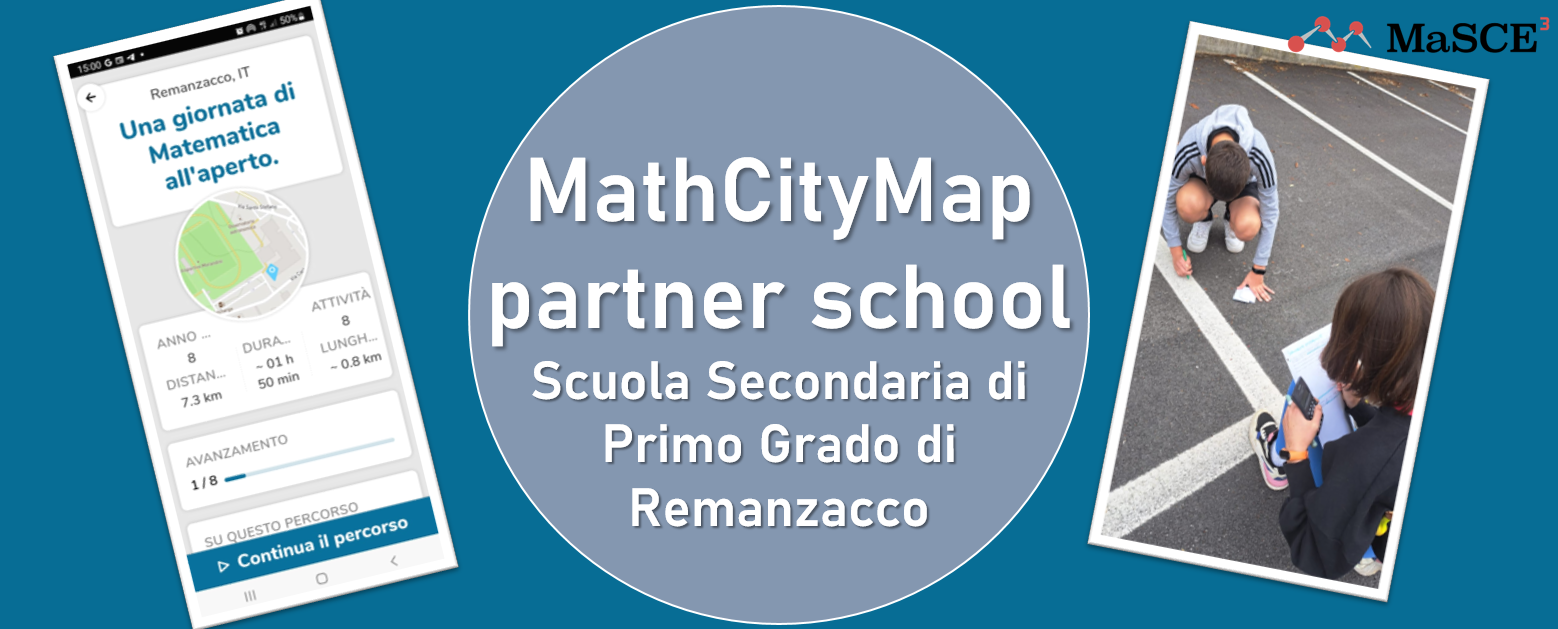
We are happy to announce a new MathCityMap partner school: The Scuola Secondaria di Primo Grado di Remanzacco, part of the Istituto Comprensivo Tina Modotti di Premariacco, Moimacco e Remanzaccoin Italy!
The teacher Irene Salomé Franco Fernandez reports of the positive experiences she and her colleagues have made with MathCityMap:
“Students were enthusiastic, and the outdoor setting helped them connect mathematical concepts to their everyday environment. Teachers reported improved motivation and participation, especially among students who usually struggle with traditional classroom settings. The tasks encouraged teamwork, critical thinking, and a more joyful approach to learning math.”
They have created two public trails suitable for lower secondary school students:
Matematica a Remanzacco! – Code: 2722855 (7 tasks) A day of outdoor mathematics in the town of Remanzacco.
Una giornata di Matematica all’aperto – Code: 1714046 (8 tasks) A math trail designed to engage students in real-world problem solving through outdoor activities.
We look forward to more exciting trails and great new ideas.
The package with the official partner school badge and the MCM measuring instruments has already been delivered and we are looking forward to receiving more applications from all over the world.
All further information on the partner school programme and the requirements for application can be found both in the article on the first MCM partner school and on the homepage of our MaSCE³ project.
From May 7th to 9th, a three-day training course on MathCityMap took place at the Academy for Teacher Training and Personnel Management (ALP) in Dillingen. Twenty-three highly motivated teachers from all over Bavaria came together to explore and practically test the potential of out-of-school learning with digital media, alongside part of our team.
Day 1: Theory Meets Practice
The opening day was dedicated to laying the theoretical foundation: What opportunities does learning outside the classroom offer? How can mathematical modeling succeed in outdoor settings? In presentations and discussions, the MathCityMap concept was introduced — based on current scientific research. Additionally, participants experienced a MathTrail from the learners’ perspective: Equipped with smartphones and the MCM app, they set out on a mathematical walk through the surrounding area.
Day 2: Task Development & Feedback Culture
The second day focused on the question: What makes a good MCM task? Quality criteria for suitable tasks were presented, and existing examples were analyzed. Afterwards, the group headed outdoors: The teachers searched for appropriate locations and developed their own task ideas. A particularly valuable element was the subsequent peer review: Participants gave each other constructive feedback on their tasks — a key component of professional development. The day concluded with insights into the creation of a MathTrail and the use of the digital classroom.
Day 3: Student Accounts & New Features
The final day of training focused on working with the new student-accounts, which we introduced in an article last week. The teachers tested how to create and edit tasks in the student area of the platform and tried out the new review feature, which is still in the testing phase.During a final feedback session, our team received valuable input on the three days of collaboration and the new MCM features
We received a lot of positive feedback and are already looking forward to future training sessions!
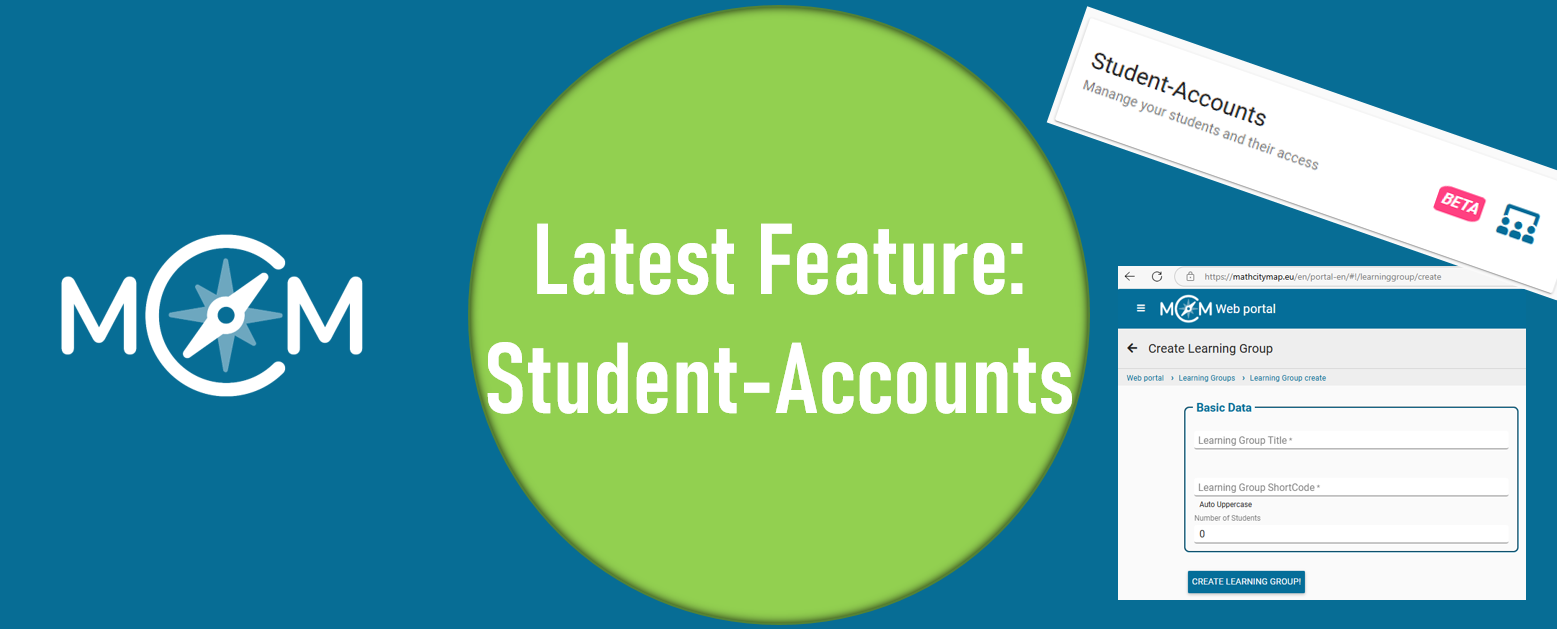
We are excited to introduce one of the latest features on MathCityMap:Student-Accounts. With this function, students are actively involved in the process of creating mathematical tasks – they become authors themselves.
How does it work? Teachers create a learning group on the MathCityMap web portal and specify the number of participating students. Immediately afterward, usernames and passwords are automatically generated and can then be distributed to the students. Using these credentials, students can easily log into the portal – there’s no need to create their own account.
Another advantage: Teachers always maintain an overview. Not only can they view all the tasks created by the group, but they can also compile a shared trail for the entire class. This makes collaborative and creative work with digital media easy to integrate into the classroom.
Tested and further developed The student-accounts have been thoroughly tested – both through close collaboration with our partner schools and workshop days with our team. Valuable feedback from both teachers and students has been directly incorporated into the ongoing development of the feature.
Our MathCityMap team has already visited several schools to present the new feature live during workshops and to try it out together with students. In February, we were guests at the Hohenstaufen-Gymnasium in Eberbach, in March at the Martin-Luther-Schule in Herten and in Dublin at the Lycée Français International Samuel Beckett. A closer look at how such workshop days are structured will follow in a separate article – you can already find some first impressions on our Instagram account.
Positive feedback from schools The response to the new feature has been consistently positive – from both teachers and students. The intuitive handling, the simple assignment of accounts, and the ability to independently create tasks are perceived as particularly helpful and motivating.
Have you already tried out the student-accounts or are planning to use them in your lessons? We would love to hear about your experiences, feedback, and suggestions – feel free to write to us!
Today, May 12, 2025, we are celebrating the seventh International Women in Mathematics Day. This day serves to highlight and recognize women in a subject that they have played a key role in shaping over the centuries – often without being named or recognized. This is because many important female mathematicians worked under difficult conditions: For a long time, women were denied access to education and a scientific career was not envisaged. Nevertheless, numerous women have asserted themselves, researched, taught and enriched the mathematical world with their findings. One of these women is the Iranian mathematician Maryam Mirzakhani, who was born on May 12, 1977, thus establishing the date of this day. In 2014, she was the first woman ever to receive the Fields Medal – one of the highest honors in mathematics.
To mark this special day, we not only want to commemorate the achievements of some women, but also show how their topics can be experienced in a very concrete, contemporary and admittedly much simplified way in mathematics lessons or in everyday life – with MathCityMap.
Hanna Neumann (1914-1971), for example, conducted research in the field of group theory and combinatorics. Her first publication dealt with selection rules in chess competitions. Under the tag “Combinatorics” you will find numerous tasks on mathematical arrangement and selection. If you would like to work on a task about chess, you can work on the task “Walking on the Chessboard” (3432743).
Sophie Germain (1776-1831) is also one of the pioneers in her field. She worked intensively on Fermat’s last theorem and became famous for the so-called Sophie Germain primes. Despite the social obstacles of her time, she made a significant contribution to number theory. If you would like to explore this topic in a fun way, MathCityMap offers tasks such as “Prime Numbers Street Saint Antoine” (2317764), which deal with prime numbers and offer a simple and practical approach to abstract theory.
Another impressive personality is Katherine Johnson (1918-2020), whose mathematical calculations contributed significantly to the successful implementation of NASA missions during Project Mercury. MathCityMap can be used to tackle real-life physical challenges, for example by calculating speed, as in the task “Speed of the escalator” (835048).
The International Women in Mathematics Day is an invitation to discover. Let’s keep part of the mathematical heritage of these great women alive together – outside, digitally and together with the MathCityMap community.