Task of the Week: Town Hall

Our current task of the week leads us to Switzerland. Noah Gass, student of primary education, created the MathCityMap task “Rathaus” (engl. “town hall”) in Liestal near Graz. He answered us some questions about the MathCityMap app. How did you get in contact with the MathCityMap app? I am a student for primary education at […]

Our current task of the week leads us to Switzerland. Noah Gass, student of primary education, created the MathCityMap task “Rathaus” (engl. “town hall”) in Liestal near Graz. He answered us some questions about the MathCityMap app.

How did you get in contact with the MathCityMap app?

I am a student for primary education at the Pädagogische Hochschule Nordwestschweiz in Basel. I take part in a didactics seminar about teaching mathematics using digital media for which I created a MathCityMap mathtrail.

Please describe your task. How could students solve the task.

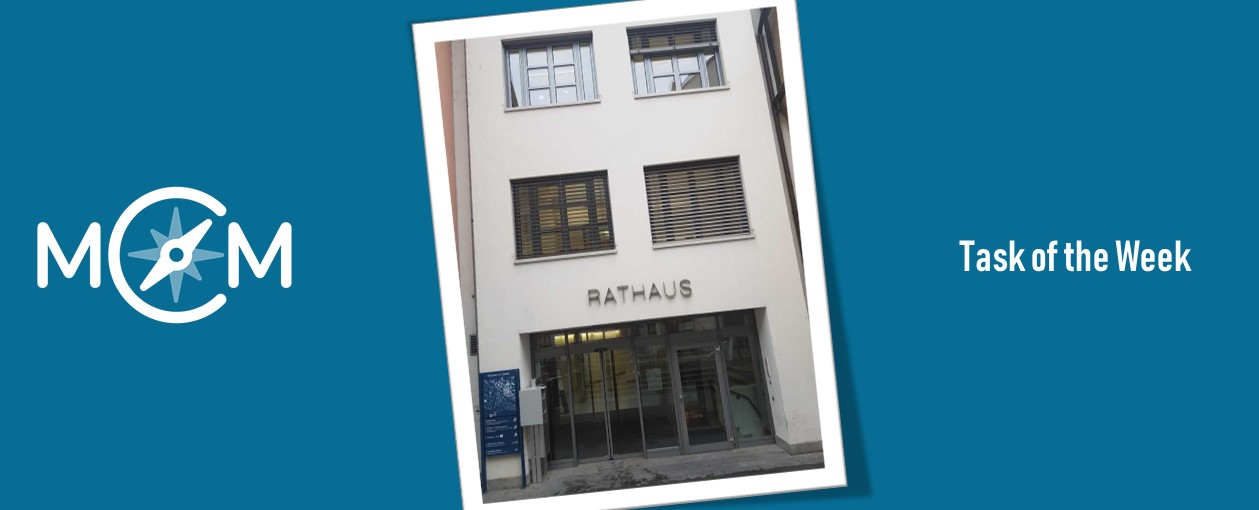
To answer the task, students have to find out how many hours the town hall is opened per week. Except for two days, the opening hours differ from day to day. For example, on one day the town is closed during a lunch break, on others it is opened continuously. First, the students have to calculate the daily opening hours. Then, they can figure out how long the town hall is opened weekly by adding those daily opening hours.

Which didactic aims are stimulated through your task?

To answer the questions, the students have to calculate with full and half hours – they need decimal numbers. Another difficulty is that the time is given in a scale of 24 units. However, speaking about time differs from the “written” digital time – to calculate the opening hours from half past 7 a.m. to 2 p.m. the students have to find out the time period between 7:30 and 14:00 o’clock.
Task of the Week: Benches out of Wooden Slats

Our current task of the week leads us to the Austrian state Steiermark. In Graz, Rosina Haider and Ursula Skrabitz created many interesting MathCityMap tasks. Professor Haider answered some questions about the MathCityMap app. How did you get in contact with the MathCityMap app? During the conference “Forschen. Lernen. Lehren an öffentlichen Orten” in Münster, […]

Task of the Week

Our current task of the week leads us to the Austrian state Steiermark. In Graz, Rosina Haider and Ursula Skrabitz created many interesting MathCityMap tasks. Professor Haider answered some questions about the MathCityMap app.

How did you get in contact with the MathCityMap app?

During the conference “Forschen. Lernen. Lehren an öffentlichen Orten” in Münster, Germany, I tested the MathCityMap app. Back in Graz, I was able to arouse my colleague’s interest in the app.

How do you use the MathCityMap app?

We use MCM in the context of our teaching at Kirchliche Pädagogische Hochschule Graz. The students of primary teacher training get the possibility to work on a trail. Afterwards, they have to create their own MCM task – at best their own trails – in small groups. The tasks are used in the math class of a primary school which is associated to our university.

Please describe your task. How could students solve the task.

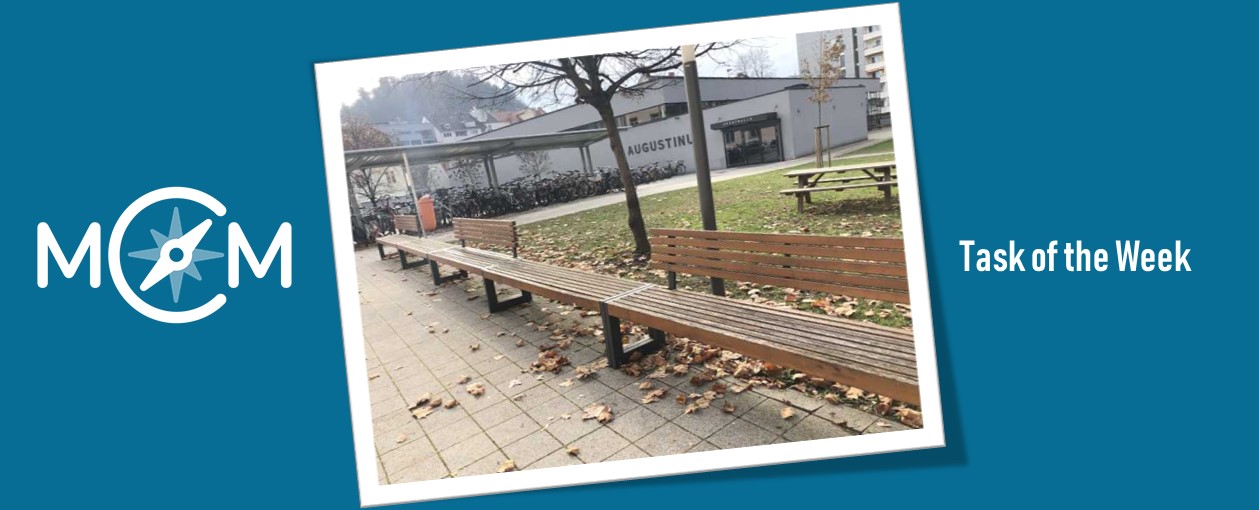
The question of the task „Parkbänke aus Holzlatten“ (engl. „benches out of wooden slats“) is how long a single wooden slat would be, if the wooden slats of six benches were placed one after another. To answer the question, the kids have to count the number of benches as well as the number of wooden slats one bench consists of. Of course, they have to measure how long one of the slats is. Finally, the students should analyse the fictive length of the single wooden slat.

Which didactic aims are stimulated through your task?

The students

  • … find out the number of the installed wooden slats on an individual path.
  • … are able to add and multiplicate mentally or in writing within the range up to 1000
  • … can deal with the unit meter and
  • … are able to get on with their solving process on their own or by using the given hints.

Do you have any other commentary on MathCityMap?

We are enthusiastic about the MathCityMap app and are going to create some more interesting MCM trails.

Task of the Week: Age of the Tree

“How old is this tree?” is the question of our current Task of the Week, which is located in Karlsruhe, Germany. Matthias Ludwig, the head of the MathCityMap team at Goethe University Frankfurt, gave us an interview about this task type. Please describe this task type. How the age of the tree could be ascertained? […]

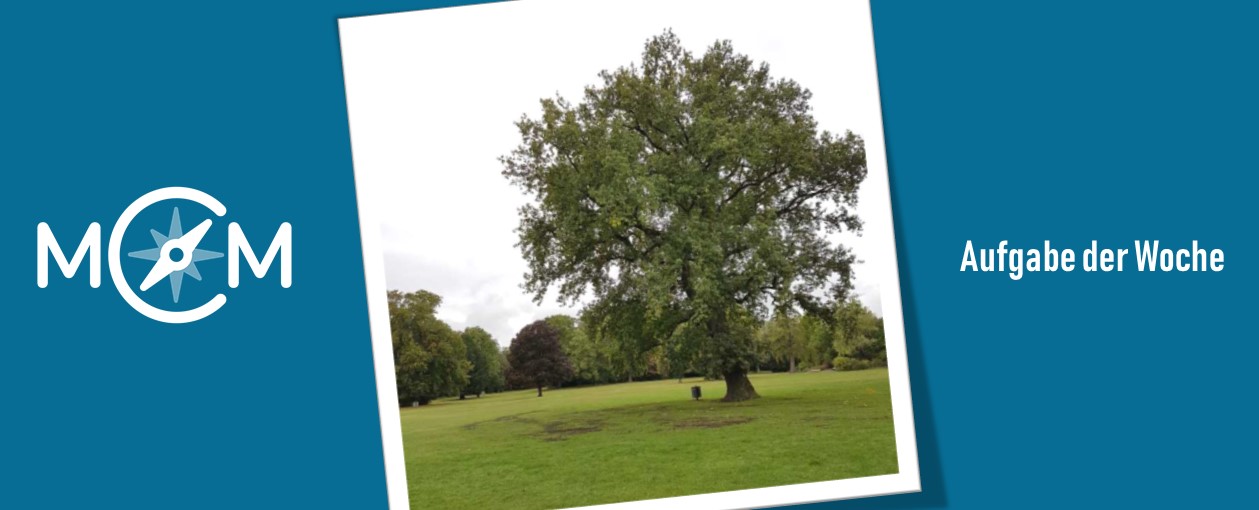
“How old is this tree?” is the question of our current Task of the Week, which is located in Karlsruhe, Germany. Matthias Ludwig, the head of the MathCityMap team at Goethe University Frankfurt, gave us an interview about this task type.

Please describe this task type. How the age of the tree could be ascertained?

The task type “Age of the Tree” connects the learning of mathematics with non-mathematical knowledge or more specifically with information about trees: What does an oak, a beech or a lime tree looks like? How fast the tree species grows? Lots of further botanic questions could be examined subsequent to this task.

The classic solution process is to measure the circumference of the tree trunk at first, followed by the calculation of its diameter. However, students can also solve this task, if they don´t know the formula for the circumference yet. They can ascertain the diameter of the tree by measuring the distance between two parallel lines, which are both tangent to the trunk. If the students determined the diameter on one way or the other, they can approximate the age of the tree for example by using the rule of three.

The task “Age of the Tree” became a part of our task wizard a few weeks ago. The wizard provides all users prepared MathCityMap tasks, which can be created only by adding the measured data and a photo of the object – the sample solution and the hints emerge as if by magic.

Which didactic aims do you want to encourage through this task type?

In my opinion teachers and students should discover tasks, which exalt their mathematical imagination. For the reason that outdoor learning is highly useful, MathCityMap is one of many interesting ideas for the further development of modern math class.

Task of the Week: So many stairs!

Our new Task of the Week is located in the United States. On the campus of the University of California Santa Cruz the PhD student for mathematics education Julianne Foxworthy created the task “So many stairs!”. She gave us an interview about this task and her usage of MathCityMap. How did you get in contact […]

Our new Task of the Week is located in the United States. On the campus of the University of California Santa Cruz the PhD student for mathematics education Julianne Foxworthy created the task “So many stairs!”. She gave us an interview about this task and her usage of MathCityMap.

How did you get in contact with MathCityMap? How do you use MCM?

I discovered the app when I met Iwan Gurjanow [MCM team of the Goethe University Frankfurt] at PME in Sweden last year. I used to teach math to 10-13 year-olds, and I used math trails with them (low-tech version!) and they loved them.

I created the “MBAMP Math Trail“ that this task is a part of for a professional development program for teachers of young students (6-9 year-olds). The teachers were all very interested in using math trails with their students. In the future, I’m planning on creating a series of math trails for various ages at our town’s famous beach boardwalk, so look out for that one!

Please describe your task. How could it be solved?

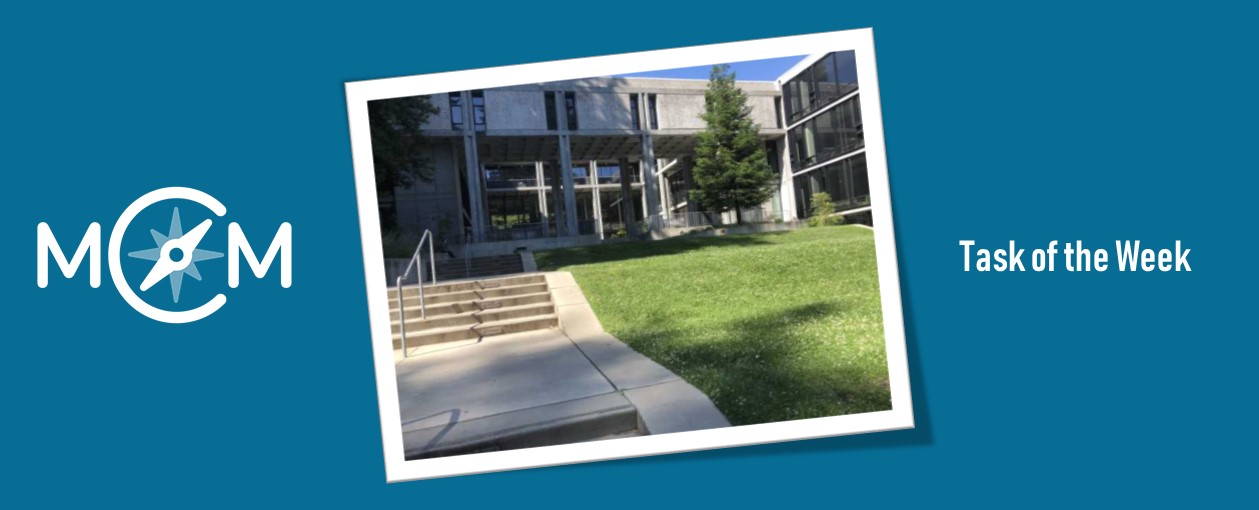
“So many stairs!” is a very simple task aimed at very young children. The question is, how many steps will you climb altogether, if you and two friends decide to race up the stairs all the way to the door of the library.

The problem solver needs to count all the stairs leading to the library and then, and this will be the tricky part for the youngsters, determine how many stairs will be walked by themselves and their friends.

The teachers who tried the task gave me very helpful feedback about being very clear with my language. The word “step” could be a stair (that’s what I intended) or it could mean a step taken by a person. The second meaning could result in a different answer (e.g., what if a person took the stairs two at a time?).

Task of the Week: Ramp Acess

Todays´ task of the week is located in Portugal, where our MoMaTrE partner Amélia Caldeira created the task “Rampa de Acesso” (engl. Acess Ramp). She answered us some questions about her task and the MathCityMap project. How do you use MathCityMap? I use MathCityMap to motivate students to learn mathematics. I want students to be […]

Todays´ task of the week is located in Portugal, where our MoMaTrE partner Amélia Caldeira created the task “Rampa de Acesso” (engl. Acess Ramp). She answered us some questions about her task and the MathCityMap project.

How do you use MathCityMap?

I use MathCityMap to motivate students to learn mathematics. I want students to be happy to learn and apply mathematics. Through the usage of MathCityMap they can model shapes in the environment. At the same time, I reveal to their teachers a successful recipe for teaching math: technology and outdoor.

Please describe your task and the procedure of solution. What is the underlying problem of your task?

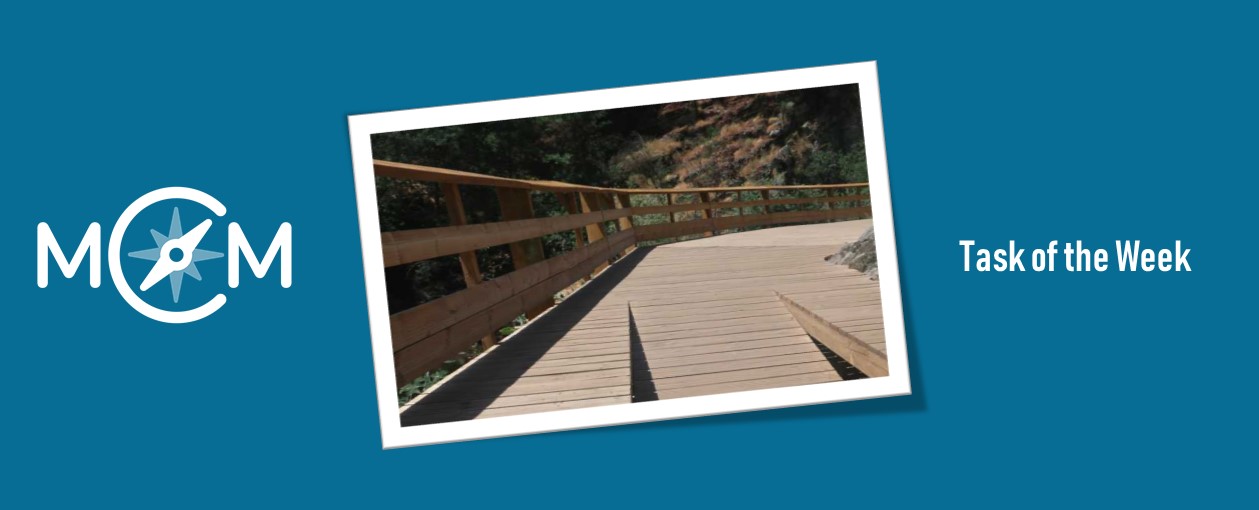
The question of my task “Rampa de Acesso” is, whether the ramp can be comfortably used by a wheelchair person or not. A ramp is rated as wheelchair-assessable, if its slope don`t exceed 6%. The aim of the task is to determine an approximate value for the ramp slope in percentage.

Therefore, the students have to model the ramp (gradient triangle). The slope of the ramp can be calculated as as a ratio between the length and the height of the ramp.

Good to know: MathCityMap provides a wizard task for calculation the slope of a ramp in percent or degree. Wizard tasks are prepared tasks, which can be created only by adding the measured data and a photo of the object.

Task of the Week: Cobblestones

Task of the Week: Cobblestones This week our Task of the Week is located in Estonia. In the city of Tartu the German mathematics teacher Sascha Abraham created the task “Cobblestones”. In the following he describes his task and the Erasmus project “Making Technology Meaningful Through Digital Pedagogy”, for which he developed this interesting task. […]

Task of the Week: Cobblestones

This week our Task of the Week is located in Estonia. In the city of Tartu the German mathematics teacher Sascha Abraham created the task “Cobblestones”. In the following he describes his task and the Erasmus project “Making Technology Meaningful Through Digital Pedagogy”, for which he developed this interesting task.

How you get to know the MathCityMap project?

In march I participated in a workshop of MathCityMap. Unfortunately, I didn´t have enough time last school year to work with MCM in math class, but I am going to use the app in this school year. I want to use the tool in two ways. Firstly, I create trails to repeat the educational content before an exam or to illustrate the mathematical content. Secondly, I want that older students create MathCityMap tasks for younger students.

Please describe your task. Why did you create it? How could it be solved?

I created a mathtail and this task within the frame of the Erasmus project “Making Technology Meaningful Through Digital Pedagogy” in order to present MathCityMap to other teachers. The Erasmus project works on the question, how “new technologies” (e.g. electronical devices like tables or smartphones and available software) could benefit mathematical education. In my opinion, MathCityMap enables students to experience mathematical problems in the “real world outside the class room”.

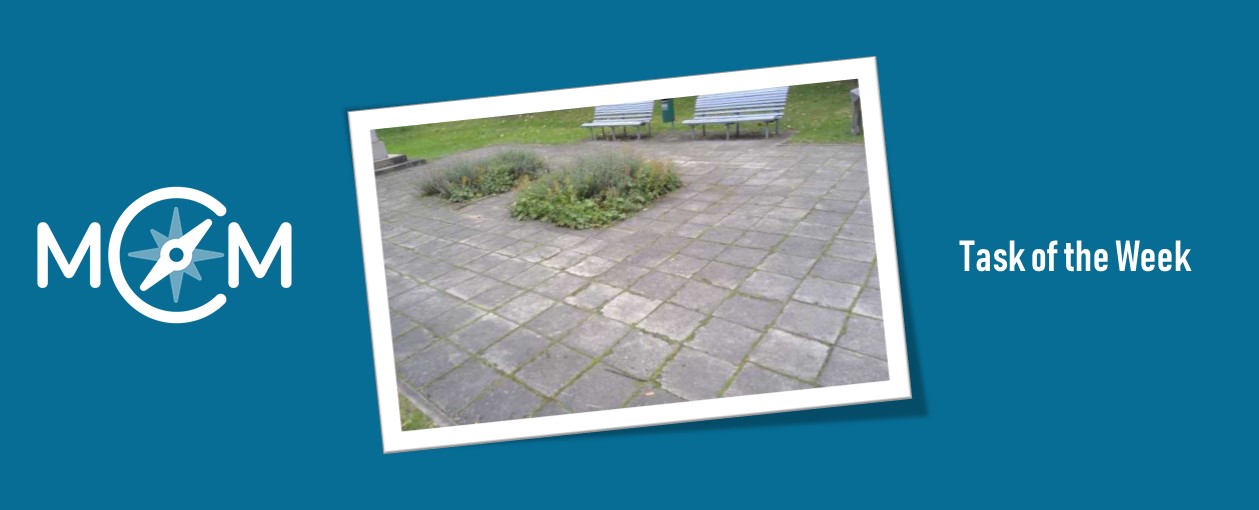
The task cobblestone is an example for a counting task (How many cobblestones are placed in this area?). The task can be solved by calculating how many squared cobblestones at the rectangular area. However, there are two planted areas, wherefore students have to subtract the missing cobblestones. Lastly the students have to add the number of cobblestones, which are placed around the benches. The aim of the task is that students learn to observe their environment carefully in order to solve mathematical problems.

Why do you use wizard tasks?

Wizard tasks are mathematical standard problems, which can be identified nearly anywhere. Through the usage of the MathCityMap wizard users can created a small set of tasks very rapidly. In addition, wizard tasks demonstrate new users different possibilities for interesting mathematical problems.


Task of the Week: Flower Frame

Todays´ task of the week was created in Druskininkai, Lithuania, by our MoMaTrE project partner Sona Ceretkova. The aim of the task is to explore a flower frame and to calculate the missing percentage of the frame. Sona Ceretkova gave us an interview about this interesting task. What´s the topic of the task? The frame […]

Task of the Week

Todays´ task of the week was created in Druskininkai, Lithuania, by our MoMaTrE project partner Sona Ceretkova. The aim of the task is to explore a flower frame and to calculate the missing percentage of the frame. Sona Ceretkova gave us an interview about this interesting task.

What´s the topic of the task?

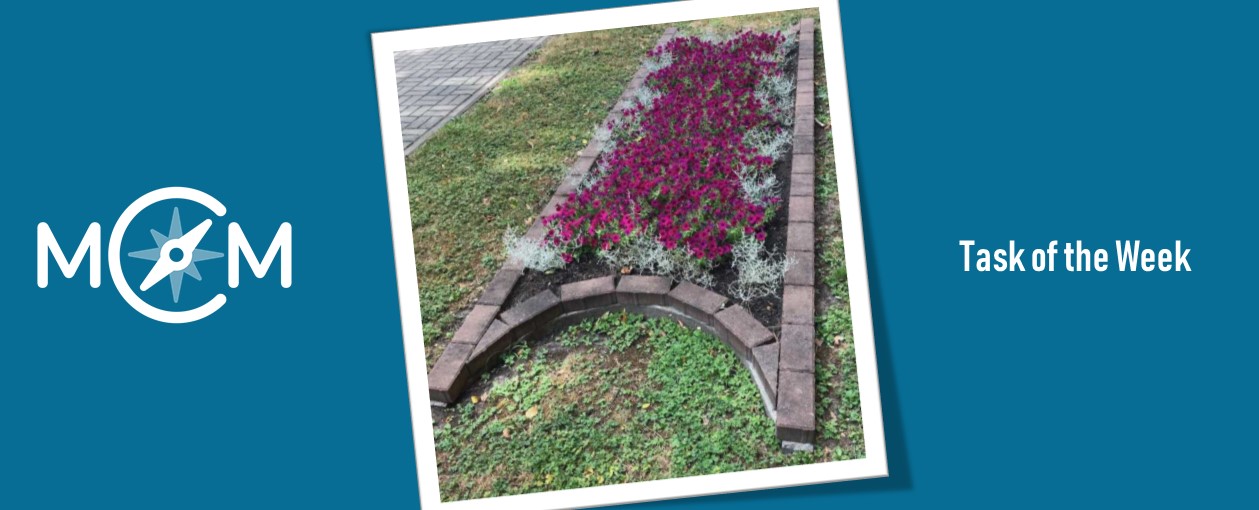
The frame for the task is situated in Lithuania, spa town Druskininkai, which is flowers paradise itself. It is quite common gardening practice to frame a piece of lawn by stones or bricks and plant some nice composition of flowers inside the area of the frame. The flower frame chosen for the task is an interesting geometrical shape. rectangle with shorten sides cut.

Several mathematics calculations can be presented of the flower frame:

  1. Calculate the inner area of the complete frame (without cuts).
  2. Calculate the area of cut parts.
  3. Calculate the difference between the area of the whole frame and cut parts.
  4. Calculate the ratio of whole frame and cut parts.
  5. Calculate the ratio of the cut frame and cut parts.
  6. Calculate the missing percentage of the whole frame.
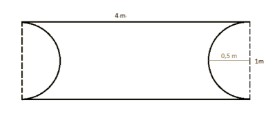
    This is the given task in Druskininkai.

How could you solve this problem?

The original frame has “mathematically friendly” measures with a length of 4 metres and a width of 1 meter. The cut parts are two identical semi-discs, which create one whole disc (in calculation). This information is given by a hint. The geometrical situation of the task is quite simple (see figure).

Another hint declares that the area of the whole rectangle is 100%. This hint is an important note for correct calculation of the percentages. Since the exact percentage calculation gives 19,625%, rounding of this number was other mathematical skill required by solvers.

The multiple choice is the most suitable alternative as the answer. It´s an interesting game to ask solvers about their estimation of the tasks` solution. The 20% (one fifth) is a quite large number, quite large part, which is cut of the whole area of the flower frame. It is not so obvious when observing and measuring the real object.

What´s the didactic aim of the task?

We want to stimulate the following didactics aims through the task.

  1. Measure precisely.
  2. Imagine, draw or describe an ideal geometrical situation: rectangle, semi-circle (semi-disc).
  3. Calculate areas of two basic geometric shapes: rectangle and circle (disc).
  4. Use units in correct way; square meters are recommended.
  5. Calculate number of percentages when knowing the base and the percentage part.
  6. Interdisciplinary approach: ecology & botany

Task of the Week: The weight of DCU

This week our presented task is located in Ireland. At the campus of the Dublin City University (DCU) our MoMaTrE partner Christian Mercat created the task “The weight of DCU” and gave us an interview about this task and the value of using the MathCityMap app. What´s the topic of the task? On the campus […]

Task of the Week

This week our presented task is located in Ireland. At the campus of the Dublin City University (DCU) our MoMaTrE partner Christian Mercat created the task “The weight of DCU” and gave us an interview about this task and the value of using the MathCityMap app.

What´s the topic of the task?

On the campus you can find a huge DCU solid rock sign. I really wondered how much that could weight! So I investigated and figured out that one could estimate the surface of the letters and the depth of the sculpture.

How could you solve this problem?

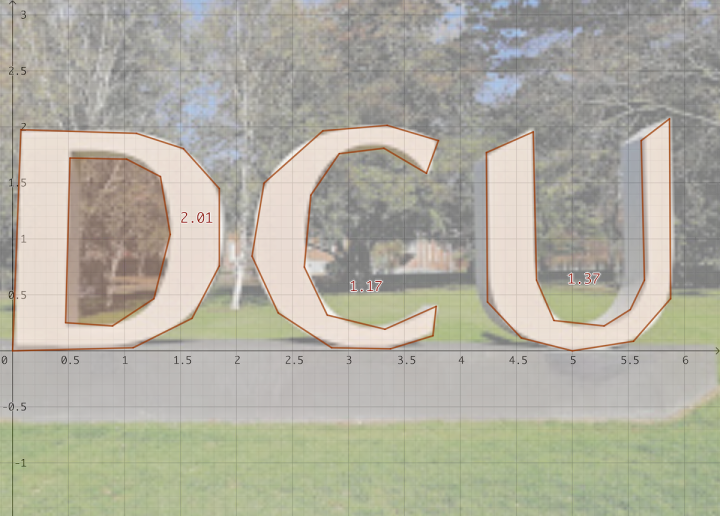
You have to estimate the average width of the letters and their lengths. For example, C is a 2/3 portion of a circle of diameter 2 m and average with 30 cm. So is has a surface of 1.2 m². The modelling of D and U happens equally. Totally the sculpture has a surface of 4.5 m². The depth of the stone is 50 cm, which leads to a total volume of 2.25 m³. The density of the stone being 2.4 (that’s given in the first hint), the total weight of the sculpture is around 5400 kg. The estimation of the surface being tricky, I actually checked again by taking a picture from a distance and estimating numerically the total surface with the help of my computer. 

Estimation of the sculptures` surface.

What´s the didactic aim of the task?

Clearly, I want here to get first the students to have a rough estimation of the degree of magnitude, is it around hundreds of kg, a few tons or tens of tons. I give a broad « orange » zone between 3000 and 7500 kg for those trying to figure out by simply bracing their arms around the sculpture to get a sense of the volume, which I find fair enough for an answer. But then, trying to model each letter as simpler geometric shapes is really the main focus of this task. It can not be done exactly, the average width of each letter is a matter of debate, which is good. The « green » zone might be a little bit too tight (between 5000 and 6000) which is only a 20% width around the expert estimation, but the depth is without any doubt 1/2 meter so the uncertainty really is on the surface estimation.

Why do you use MathCityMap?

I love taking the pretext of a MathCityMap trail in order to stroll around on a campus or in a park, appreciating the scenery from this very specific perspective of looking around for objects that tickle my mathematical inclination, keeping open the scientific eye in me.

Task of the Week: The green ear

Today´s task of the week is located in Lüneburg, Germany, where the teacher trainee Jennifer Oppermann created the task “The green ear”. She gave us an interview about this task, mathematic modelling and the MathCityMap project. What´s the topic of the task? The question is, how tall the human being would be, the green ear […]

Today´s task of the week is located in Lüneburg, Germany, where the teacher trainee Jennifer Oppermann created the task “The green ear”. She gave us an interview about this task, mathematic modelling and the MathCityMap project.

What´s the topic of the task?

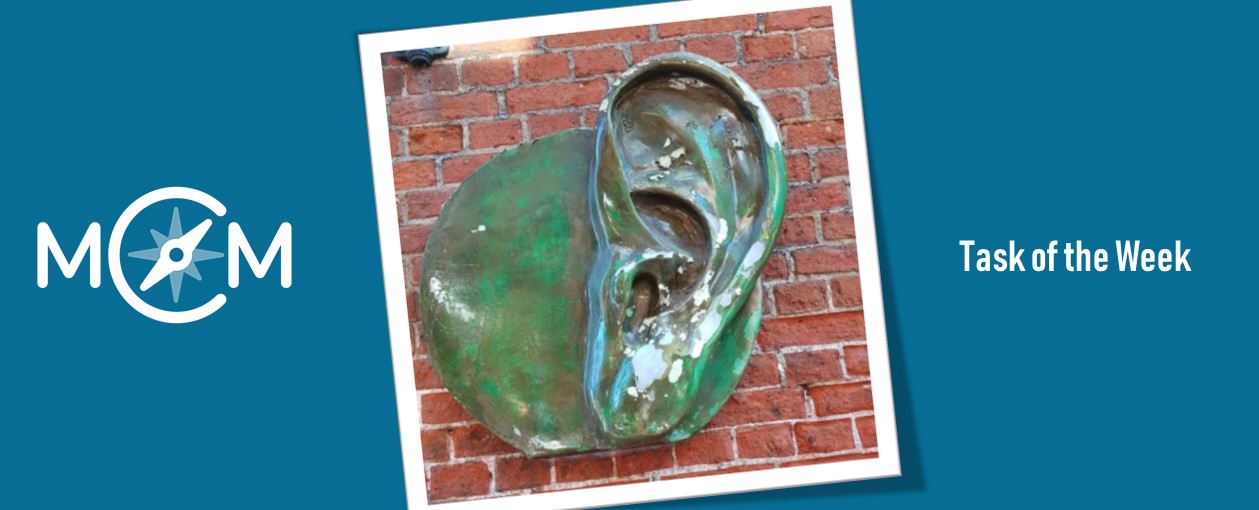
The question is, how tall the human being would be, the green ear belongs to. To solve the task students first have to measure the sculpture of the green ear, followed by measuring an ear of a student. In addition, the body size of this students should be identified.

Afterwards the quotient of the length of the green ear and the students´ ear is multiplicated with the body height of the student. Thereby the size of the human being, to whom the green ear would belong, can be estimated.

What´s the didactic aim of the task?

While working on the task, students should improve their competences in mathematic modelling. Modelling means to link the reality and the mathematic and to solve a given problem through a mathematic calculation. Thus, MathCityMap is a helpful tool to observe the connection between environment and mathematics and to exert mathematical strategies.

How do you use MathCityMap?

To discover our near environment out of a mathematical perspective, we created a math trail through the Hanseatic town of Lüneburg. The MathCityMap project enables mathematic interested people to solve our tasks around Lüneburg and to increase their mathematical competences.

Task of the week: Volume of the bottle

The task of the week is back! Today we present you a task, which was developed during a teacher training at the Georg-Büchner-Gymnasium in Bad Vilbel near Frankfurt. Next to the schoolyard we found this interesting sculpture of a water bottle. Immediately we wanted to ascertain, how many litres of water the bottle would contain. […]

The task of the week is back! Today we present you a task, which was developed during a teacher training at the Georg-Büchner-Gymnasium in Bad Vilbel near Frankfurt.

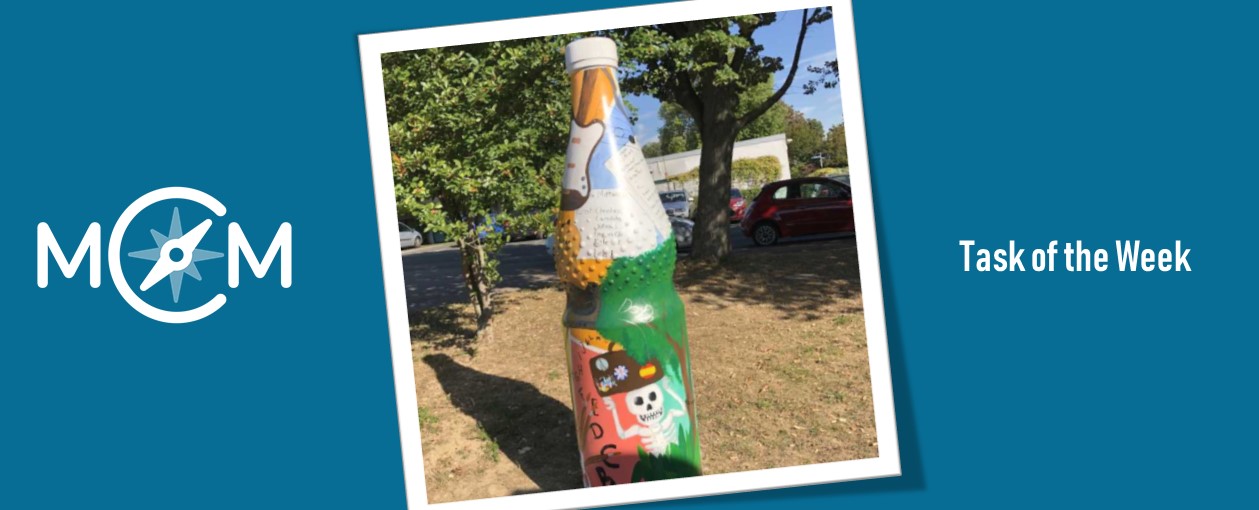
Next to the schoolyard we found this interesting sculpture of a water bottle. Immediately we wanted to ascertain, how many litres of water the bottle would contain. For the task “Volume of the bottle” we assume that the artwork has a wall thickness of 3 cm.

How the volume of the bottle can be ascertained?

For the modelling we divide the artwork in a frustum of a cone and a circular cylinder. We look on the object as compounded solid.

What´s the aim of the task?

The complexity of the task is to find a useful mathematic model for the object, which is a fitting transfer of the reality and is calculable with a manageable time exposure all at once. To solve the problem, you have to find a compromise between mathematical precision and practicability. Hence the task is a good example for a lot of modelling problems.