Task of the Week: The Climbing Blocks of the Mennea Park

In Turin, Italy, we find our new task of the week. Here the teacher Michela Viale created the task “I blocchi da arrampicata del Parco Mennea” (engl.: “The climbing blocks of the Mennea Park”), in which the visible surface of stapled dodecahedrons should be calculated. Michela, how did you discover the MathCityMap project? I got […]

Task of the Week

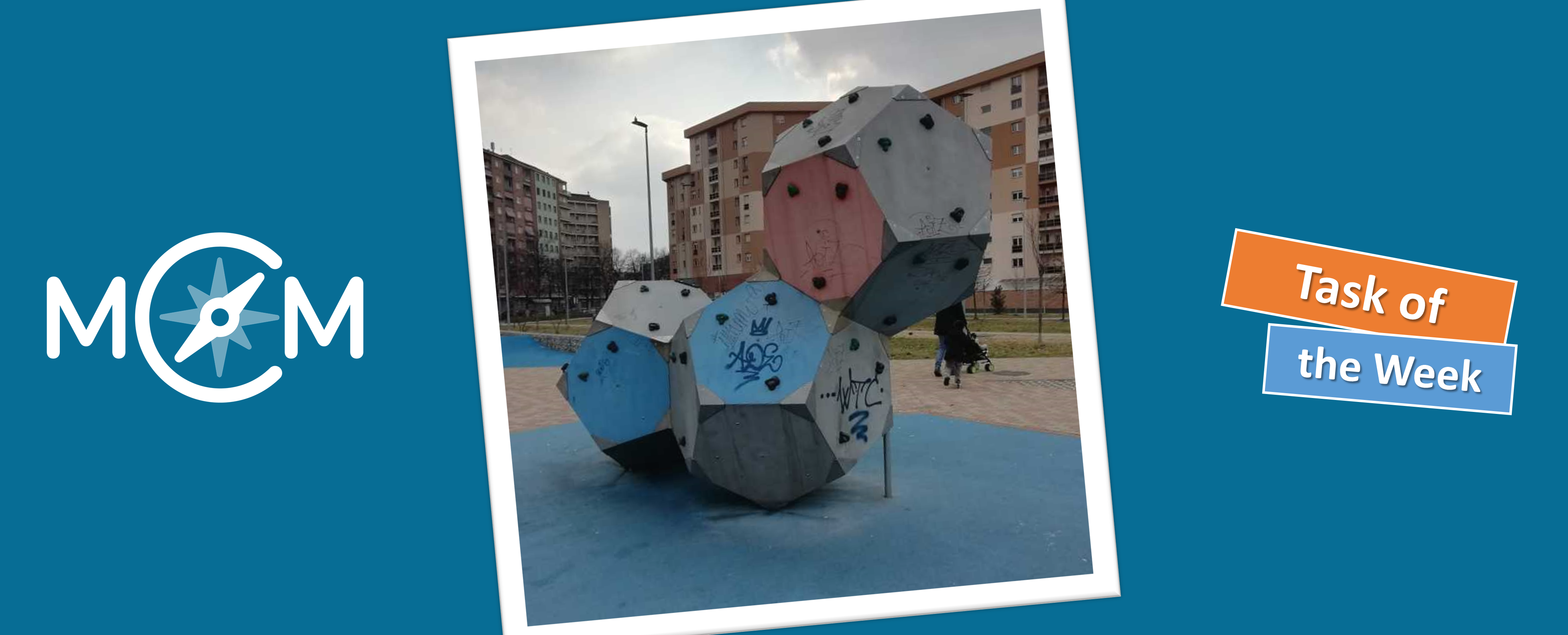
In Turin, Italy, we find our new task of the week. Here the teacher Michela Viale created the task “I blocchi da arrampicata del Parco Mennea” (engl.: “The climbing blocks of the Mennea Park”), in which the visible surface of stapled dodecahedrons should be calculated.

Michela, how did you discover the MathCityMap project?

I got in contact with MCM four years ago, when I was attending a math online course at the university of Torino, Math Department, where I had to create my first MathCityMap task. By participating another MOOC in the spring of 2020, I created my own math trail on MCM.

I am a teacher at middle school (from 11 to 14 years old) and I love to create “real problems” for my students. By using MCM I can organize outdoor mathematical problem solving for my students.

Describe your task. How can it be solved?

My task is placed in a park in Turin (Parco P. P. Mennea). It is a climbing block for children made up of three dodecahedra. Since the blocks are stapled on top of each other, they have some common sides, which are therefore not visible. I ask to children to calculate the area of the visible sides (the surface they could paint). They have to recognize the dodecahedron, count the number of the sides they could paint, calculate the area of one side (which is a regular pentagon). 

What didactic goals do you pursue with the task?

I want to stimulate different didactic aims: recognize solids and plane figures around us, measure them, calculate their surface. In general, I think MCM is very useful to improve Math competences. I’ll create a new math trail during my holidays in Sardinia in August. 
Task of the Week: The Solar Pyramid

Our new Task of the Week is located in Spanish capital Madrid. There, Juan Martinez created the task “Puerta N.O. Parque Juan Carlos I (Pirámide Solar)” [engl.: Entrance to the park Juan Carlos I (Solar Pyramid)]. The task author Juan Martinez is a member of the Spanish maths education association FESPM, which is one of […]

Task of the Week

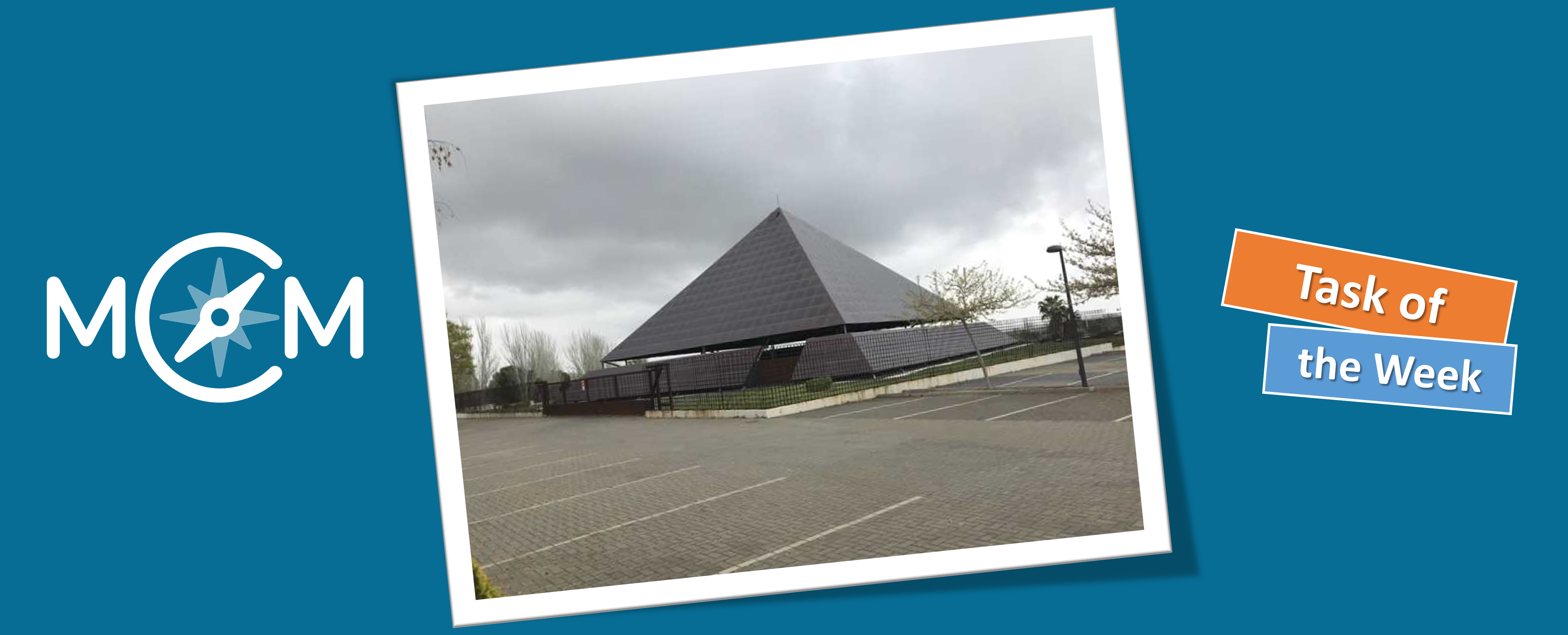
Our new Task of the Week is located in Spanish capital Madrid. There, Juan Martinez created the task “Puerta N.O. Parque Juan Carlos I (Pirámide Solar)” [engl.: Entrance to the park Juan Carlos I (Solar Pyramid)].

The task author Juan Martinez is a member of the Spanish maths education association FESPM, which is one of our project partners in out Erasmus+ projects MoMaTrE and MaSCE³. Both aim to the further development of the MathCityMap system in order to show students the “hidden” mathematics in their own environment.

The task formulation is as follows: Entering the Juan Carlos I Park, through this door we observe on the left a Solar Pyramid. What is the total area of the roof, using one square solar panel as a unit? The pyramid has four triangular sides of equal size. We count 25 whole solar panels on the base side and 15 vertically stacked panels. Taking the cut panels into account, we can calculate that the sides of the pyramid are composed of approximately 830 solar cells.

This task is to approximate the lateral area of a pyramid using a non-standard surface unit. Since the object is quite large, the students should use the triangular area formula to calculate the number of solar collectors und recognize this procedure as an effective counting method.

Task of the week: Old City Hall of Michelstadt

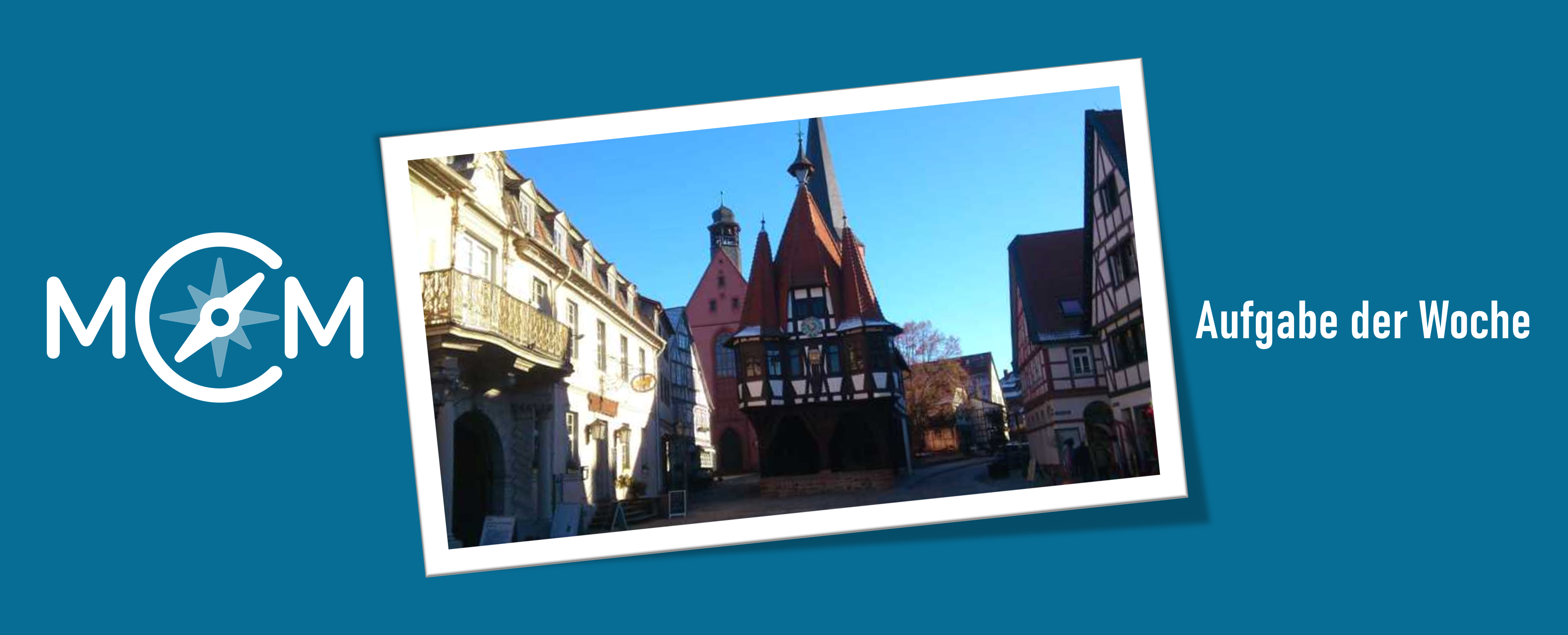
Our new task of the week takes us to Michelstadt in the beautiful Odenwald, Germany. Here math teacher Alexander Strache created the task “Altes Michelstädter Rathaus” (engl.: “Old City Hall of Michelstadt”). In the interview he talks about his experiences with MathCityMap. How did you get to know MathCityMap project? How do you use MCM? […]

Task of the Week

Our new task of the week takes us to Michelstadt in the beautiful Odenwald, Germany. Here math teacher Alexander Strache created the task “Altes Michelstädter Rathaus” (engl.: “Old City Hall of Michelstadt”). In the interview he talks about his experiences with MathCityMap.

How did you get to know MathCityMap project? How do you use MCM?

I came across MCM during my studies at the Goethe University Frankfurt. At first through flyers and “advertising” for it in a lecture, then through attending a seminar on it. At the university I also created my first two assignments for MCM. At the moment I am a teacher in the preparatory service and start to build the first math trail for my school.

Describe your task. How can it be solved?

The task is to estimate the area of the roof of the historical Michelstadt town hall as good as possible. On the one hand, many sizes cannot be measured directly, because the roof hangs far above the heads of the students, on the other hand, the dimensions of the ground plan can be walked/measured and other sizes can be estimated well (advanced students can even determine certain vertical distances quite well using a ray set figure). The comparison with neighbouring buildings and counting the floors can be helpful for a rough approximation. For the creation of the sample solution I worked with a craft sheet and looked at the respective surfaces as exactly as possible – on site working with triangles and rectangles is fully sufficient.

What didactic goals do you pursue with this task?

On the one hand, it is about training an eye for simple geometric figures in architecture and, if necessary, to abstract them to even simpler ones: the surface area of many trapezoids, but also general polygons can be approximated by parallelograms or rectangles. Of course, many simplifications have to be made for the small-scale roof surface, but here the mathematical modelling is trained: What can I neglect and simplify without distorting the overall result too much? It is a matter of cleverly estimating non-measurable quantities by “educated guesses”: If I know that the depth of the building is about 10m, how high could the roof be? And of course, as always by using MCM, interdisciplinary skills such as teamwork are trained.

Further comments on MCM?

I think it’s great that a digital tool has been developed here that doesn’t lead to children sitting in front of the screen longer and longer, but that exercise, fresh air, training in local knowledge and an eye for mathematical phenomena in the “real world” play a major role. Furthermore, the competence of modelling is in the foreground, which is very important for me. Even if the development of a good task takes some time and work, it can be used again and again. MCM is therefore ideal for a student council that develops tasks cooperatively.

Task of the Week: Majestic Stones

Dörthe Ludwig created in Dresden the task “Majestätische Steine” (engl.: “Majestic Stones”) which we now choose as our new MathCityMap Task of the Week. In the interview, Dörthe Ludwig explaines how she uses MCM to foster her daughter’s mathematical interest. How did you discover the MathCityMap project? How do you use MCM and why? I […]

Task of the Week

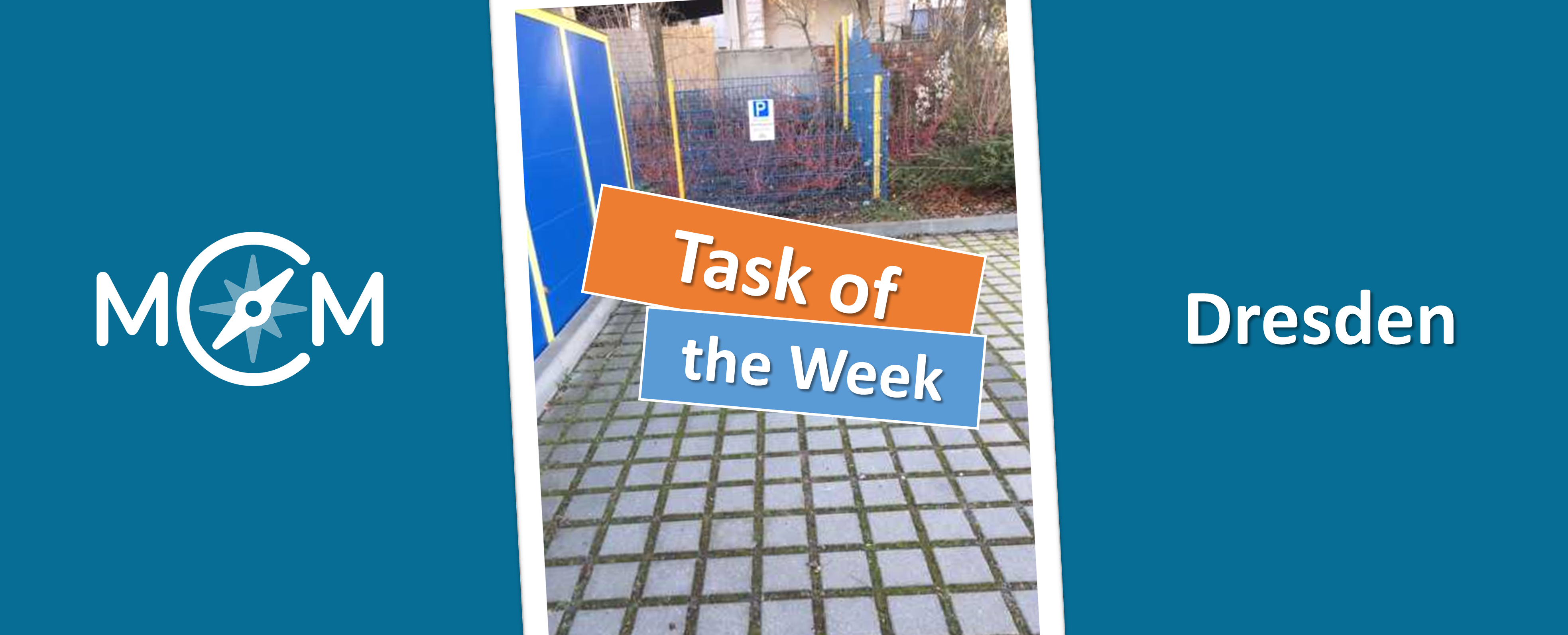
Dörthe Ludwig created in Dresden the task “Majestätische Steine” (engl.: “Majestic Stones”) which we now choose as our new MathCityMap Task of the Week. In the interview, Dörthe Ludwig explaines how she uses MCM to foster her daughter’s mathematical interest.

How did you discover the MathCityMap project? How do you use MCM and why?

I am a teacher at a secondary school and attend a 4-semester extra-occupational training course at the TU Dresden. In a didactics seminar we were introduced to the MCM project in a lecture.

Since my daughter (3rd grade) was not so interested in a maths at this time, we searched together for tasks that can be found in our own environment. Now we want to create a route that she can solve together with her friends (and as many others as possible). She is already looking forward to it!

Please describe your task. How can it be solved?

The task is to skilfully determine the number of cobblestones on a certain parking lot at the primary school. The stones are placed in such a way that it results in a simple multiplication task, but it requires multiplication beyond the small 1×1. So you can simply calculate the number, or you can break the task down into subtasks that you can calculate in your head. In this case, one must not forget to add the partial results.

What didactic goals do you aim for with the task?

To be honest, my main didactic goal was to show my daughter that mathematics can be fun even if you don’t see the solution directly, but have to make a little effort to do so. It seems to have been successful! Of course I hope that many more children will enjoy solving the problem and will be proud of themselves in the end!

Further comments on MCM?

I am enthusiastic and I will try to create many MCM tasks in Dresden. I would also like to take my students out into the fresh air and create some tasks around our school in the future.

Task of the Week: Windows

Our new task of the week is in the Grand Duchy of Luxembourg! In Schifflange, Yves Kreis, senior lecturer at the University of Luxembourg, has created the task “Windows“. In the following interview he reports about the use of MathCityMap for his university teaching. Hello Yves, you use MathCityMap for your teaching at the University […]

Task of the Week

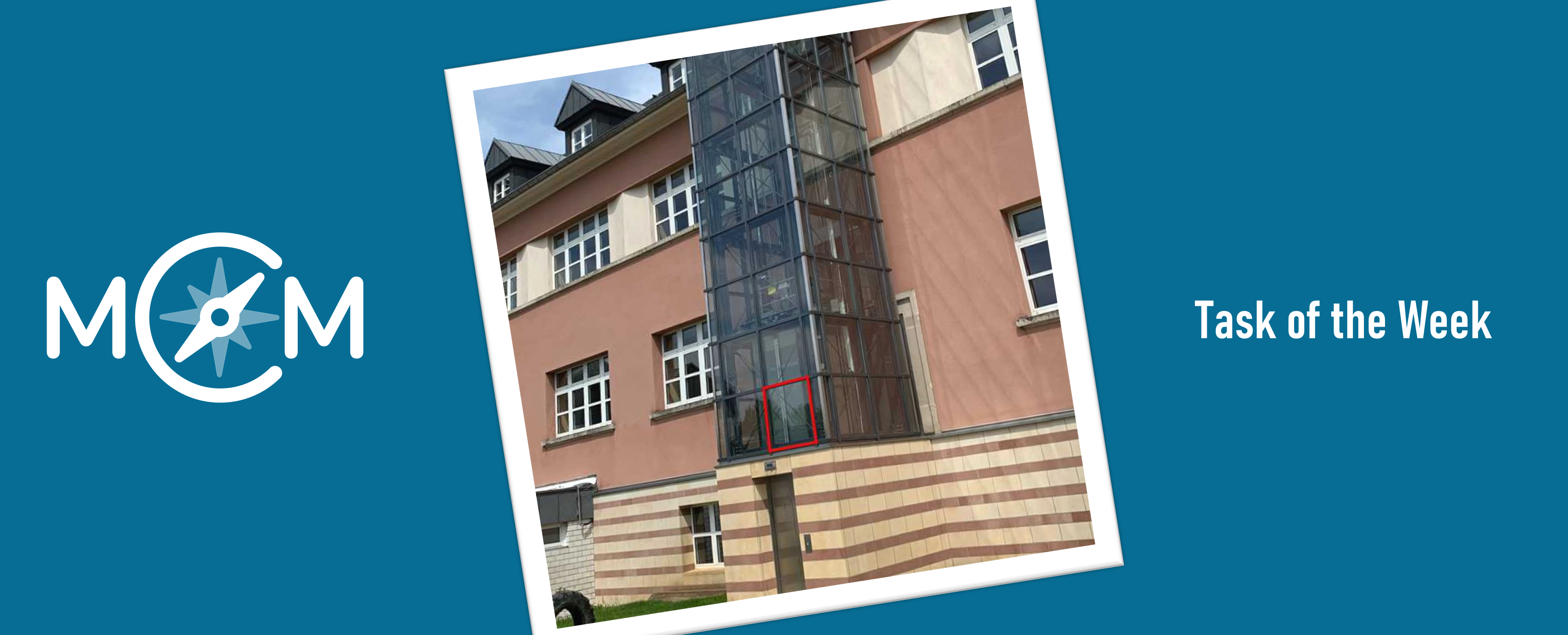
Our new task of the week is in the Grand Duchy of Luxembourg! In Schifflange, Yves Kreis, senior lecturer at the University of Luxembourg, has created the task “Windows“. In the following interview he reports about the use of MathCityMap for his university teaching.

Hello Yves, you use MathCityMap for your teaching at the University of Luxembourg. How does it work exactly?

MathCityMap was presented by Gregor Milicic from the MCM team Frankfurt at the conference “Pedagogical Innovations in STEAM Education Conference” in Linz in January. My colleague Ben Haas and I found the project directly interesting. When we were forced to change our evaluation because of the COVID-19 pandemic, we decided to work out an MCM trail in groups of 2-3 students with subsequent self-evaluation and peer-review of 3 trails from other students.

You have also created some sample tasks . Please describe your task “Window”. How can it be solved? What is the aim of this task?

The task is to determine the number of square windows of a glass lift tower. On one side there are 2 rows of 12 windows each. Only 3 sides are made of glass; the fourth side is the school building. According to this there are 3 ⋅ 2 ⋅ 12 = 72 square windows. The task can be solved by all pupils from class 3 on. The aim is for the children to recognise the patterns and use multiplicative structures instead of simply counting all the windows.

Do you have any further comments on MCM?

MCM has managed to transfer an old idea (mathematical trails) into today’s digital age. A connection to AR (e.g. GeoGebra 3D Calculator) would be very useful from my experience, as many students have planned such tasks.

More information about the use of MathCityMap in Luxembourg:

Interview with Lorenzo Salucci, the 5,000 MathCityMap users & students at the University of Luxembourg

Task of the Week: The scooping ‘Dümpfelschöpfer’

The current task of the week is located in Lichtenfels, Germany. In this Franconian town the teacher Jörg Hartmann created the task “Der schöpfende Dümpfelschöpfer“ [engl. “The scooping ‘Dümpfelschöpfer’”] and answered several questions about it. How did you get in contact with the MathCityMap project? I first discovered the MathCityMap idea through a teacher training […]

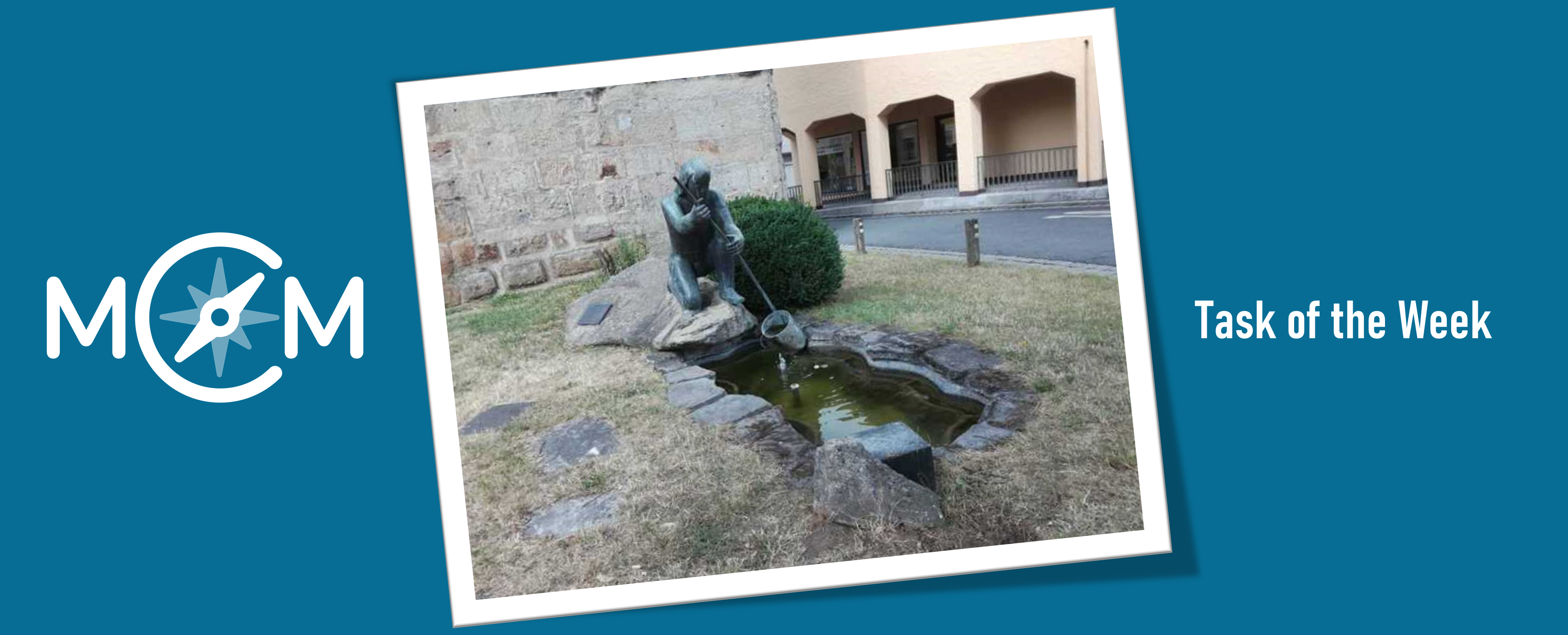
The current task of the week is located in Lichtenfels, Germany. In this Franconian town the teacher Jörg Hartmann created the task “Der schöpfende Dümpfelschöpfer“ [engl. “The scooping ‘Dümpfelschöpfer’”] and answered several questions about it.

How did you get in contact with the MathCityMap project?

I first discovered the MathCityMap idea through a teacher training by Matthias Ludwig, head of the MCM team Frankfurt. During a project week at my school, the Meranier-Gymnasium in Lichtenfels, I offered a course on MCM trails.

Supported by six students of the nineth to the eleventh grade I created the math trail “Bergauf und Bergab, über Stock und Stein in Lichtenfels” [engl. “Uphill and downhill, over rough and smooth in Lichtenfels”], which contains the tasks “Der schöpfende Dümpfelschöpfer“. Subsequently I worked several times with different classes on the trail. A preparation of 20 minutes is suitable for this; the pupils then run the trail for two or three school lessons. The joy of the pupils is enormous, while the pupils experience mathematics in the open air – and the pupils learn an amazing amount.

Please describe your task. How can it be solved?

The famous sculpture in Lichtenfels, the so-called “Dümpfelschöpfer”, represent a man scooping water from an irregularly shaped pool. In the task I ask how often the man have to scope until the pool is empty. To solve the task, the students have to divide the problem into smaller subtasks, e.g. what the volume of the pool is or how units can be converted.

Which didactic goals do you want to promote?

I would like to encourage students which work on the math trail to perceive their environment from a mathematical perspective as well as to recognize the connection of school math and the real world. They might ask themselves which mathematical object has a similar shape to the bucket and how to convert a volume in m³ in litres.

Furthermore, I want students to do mental arithmetic and make rough estimation. By working on this task, they should realise how useful rough calculation is in everyday life.

Do you have any further commentary of MathCityMap?

I am enthusiastic about the idea of outdoor mathematics, and my students really enjoy to run a math trail. A lot of mathematical creativity is required to create a math trail. To be honest, at school the time to foster students’ mathematical creativity is limited – unfortunately I think the creation of a trail together with students is only possible during a project week.

Overall, the MathCityMap project is great! I really hope that some other users create trails around Lichtenfels, because I would definitely enjoy working on a “foreign” trail to get new ideas for math trail tasks.

Task of the Week: Les nombres sur Castella

The task of the week is back! After the Corona contact restrictions have been eased in most countries, we are looking forward to start the new outdoor mathematics season. Summer is MathCityMap time! And so, we eagerly await many new MathCityMap tasks.   The current Task of the Week is located in the Pyrenean village […]

Task of the Week

The task of the week is back! After the Corona contact restrictions have been eased in most countries, we are looking forward to start the new outdoor mathematics season. Summer is MathCityMap time! And so, we eagerly await many new MathCityMap tasks.


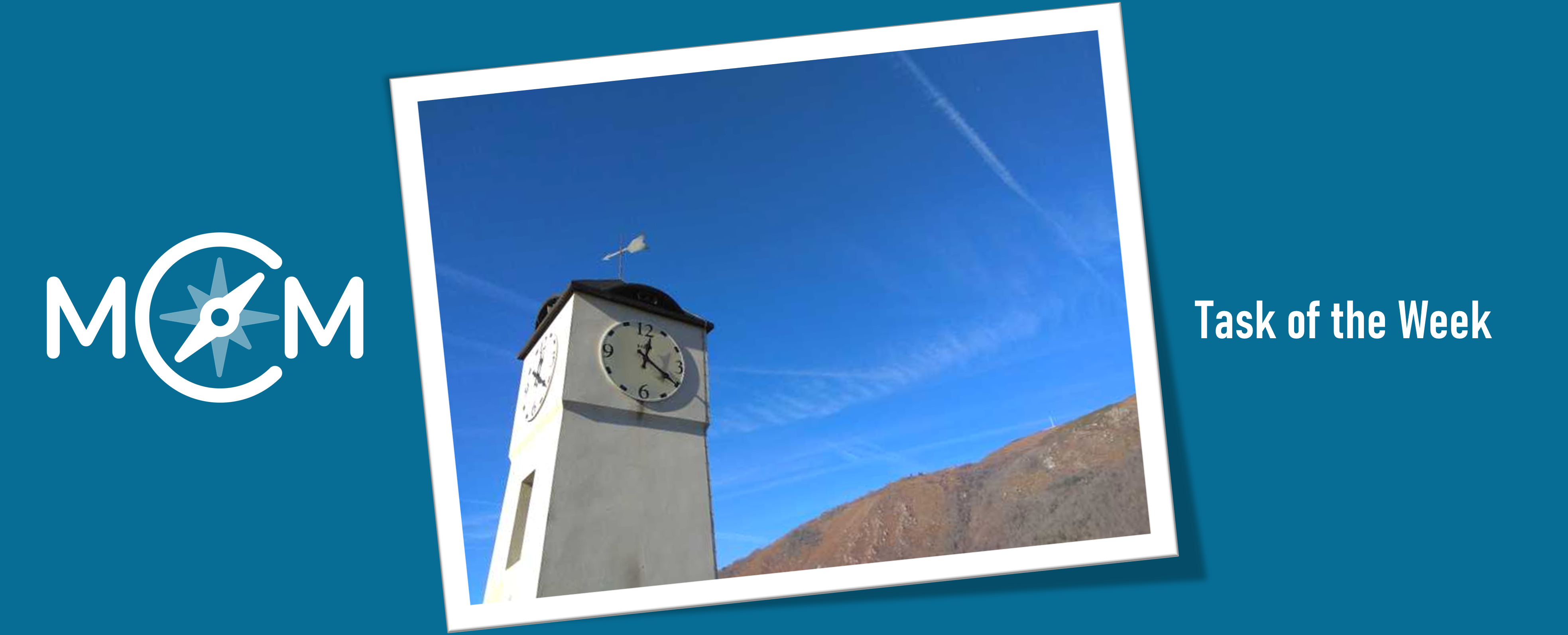
The current Task of the Week is located in the Pyrenean village Arignac in the south of France, where the math teacher Sonja Rembert has created the task “Les nombres sur Castella” [Numbers on the tower].

How did you get to know MathCityMap?

I discovered the wonderful MathCityMap project through a publication on APMEP, a French website for math teachers (click here to see the article about MathCityMap on APMEP). In my teaching, I try to use approaches that are as interesting and varied as possible. Therefore, I was immediately enthusiastic about the Mathtrail idea!

In the first math trail I created, I want to lead the students out of the classroom and get them to get to know their surroundings or our village from a mathematical perspective.

Please describe your task. How could you solve it?

I have created the task “Les nombres sur Castella” in the small village Arignac in the south of France. The task is about an ordinary tower, as you often find in this region: A Castella. My 8-year-old pupils are asked to answer the following question: “Find all the numbers that can be seen on the tower and add them up! So, the goal is to add up all the numbers you can find on the tower. This can be tricky because there are numbers on a clock and there is a clock on each side of the tower. You can also read other numbers on two information boards on the tower.

Which didactic goals do you want to promote with this task?

The children should take a closer look at the familiar tower and recognise that they can find numbers everywhere, even “in real life”. In our daily life we are surrounded by numbers!

Do you have any further comments on MathCityMap?

I think the MathCityMap project is very useful to motivate students for math lessons! Therefore, I will create more math trails soon. Thank you very much for developing the great MathCityMap platform!

Task of the Week: A location for the statue

Our current task of the week is located in the German Hanseatic city Lübeck. Yvonne Kaiser created the GPS task „Ein Platz für die Statue – Umkreismittelpunkt des Dreiecks“ [„A location for the statue – circumcentre of a triangle”]. In the following she answers us several questions about her task and MathCityMap. Information about the […]

Task of the Week

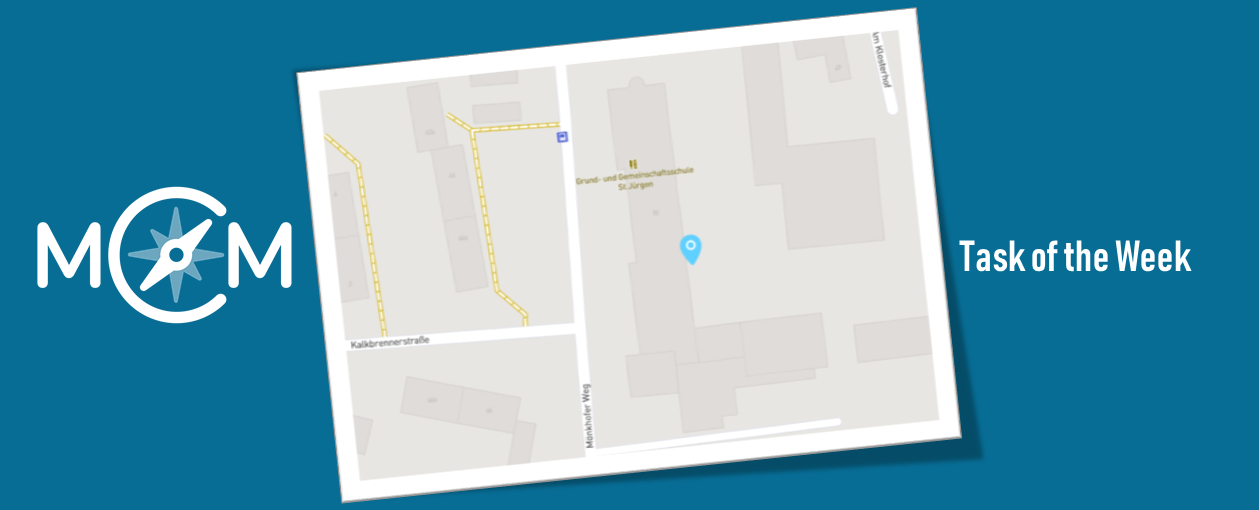
Our current task of the week is located in the German Hanseatic city Lübeck. Yvonne Kaiser created the GPS task „Ein Platz für die Statue – Umkreismittelpunkt des Dreiecks“ [„A location for the statue – circumcentre of a triangle”]. In the following she answers us several questions about her task and MathCityMap. Information about the task type GPS task, which can be easily created by using the Task Wizard, can be found here.

How do you get in contact with MathCityMap?

At the moment, I participate in a further training as a mathematics teacher on secondary level. During the training, we should create a MathCityMap math trail about geometric objects.

Please describe your task. Where is it placed? What´s the topic of the task?

The task formulation is: The statue in front of the building in the Kalkbrenner street should be placed on the school yard, so that the statue has the equal distance to our three school buildings. Find the point, which has the same distance to the three marked points.

To solve this task, the students firstly have to walk to the three marked points. They recognize that those three points are the corner points of a triangle. By using tape measures and protractors the students can determine at least two perpendicular bisectors. The intersection of those two lines is the circumcentre of a triangle, which is the quested point.

Which didactic aims do you want to stimulate through this task?

The aim of the task is to practice the geometric construction of perpendicular bisectors not only on a sheet of paper in the classroom but outdoors on the school yard. As the building behind the statue will be teared down prospectively, the question raises, where the statue will be placed afterwards. Thus, the story in the task formulation awakes further motivation.

Do you have any other commentary on MathCityMap?

Until now, I’ve never used MathCityMap in class. Therefore, I’m really looking forward to try it out and to observe, how students will work on this problem.

Task of the Week: El volumen KIO

Our new Task of the Week was created by Angelica Benito Sualdea and Alvaro Benito Nolla de Celis in Madrid. In the following they will answer us some questions about their task “El volumen KIO” [engl. volume of one KIO tower]. How do you get in contact with MathCityMap? We’ve been interested in Math Trails […]

Task of the Week

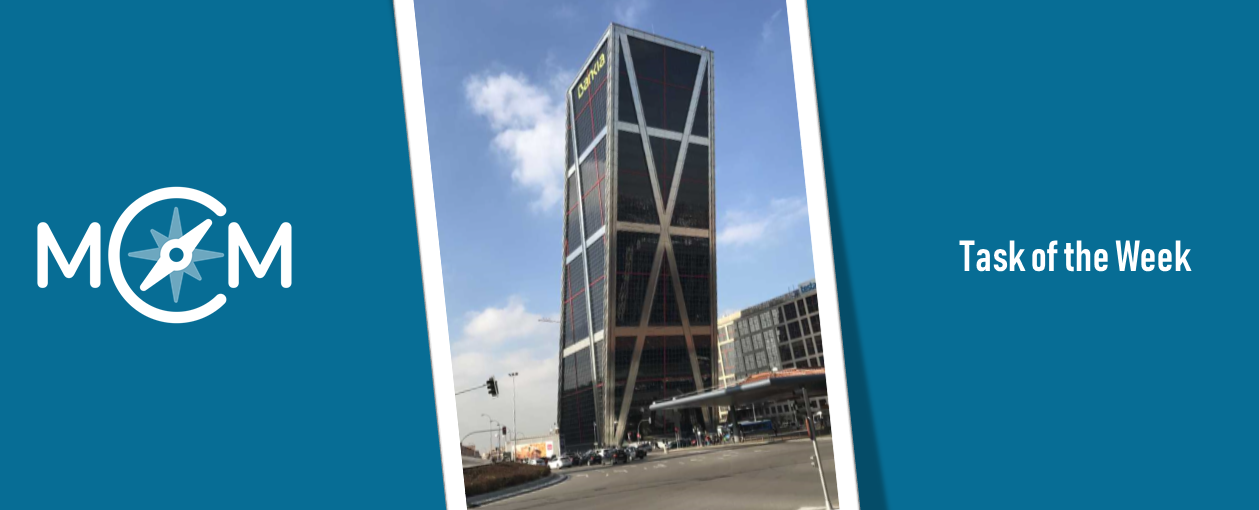
Our new Task of the Week was created by Angelica Benito Sualdea and Alvaro Benito Nolla de Celis in Madrid. In the following they will answer us some questions about their task “El volumen KIO” [engl. volume of one KIO tower].

How do you get in contact with MathCityMap?

We’ve been interested in Math Trails as an educational tool for the last recent years, and we discover MathCityMap during a talk in a conference. We really liked the idea and we immediately started to think in uploading some of our trails we had already created into the platform. It took us some time, but we finally did!

Please describe your task. Where is it placed? What´s the topic of the task?

The task is placed in a characteristic square in the north of Madrid. The square is dominated by two twin towers (the Puerta de Europa Towers, commonly known as the KIO Towers) which are oblique prisms bending one to each other with an angle of 14 degrees of inclination. Since 1996, they symbolise a picturesque “entrance” to the city. From a close look it realised that the towers are surrounded by a rectangular lattice, which divides each tower in a web of black aluminium windows.

Our task asks after the total volume of one of the KIO towers. It provides information about the dimensions of one of the windows: 1.20m x 1.34m. Since its volume is the same as the volume of a straight tower with the same base, to solve the task it is only needed to calculate the number of windows covering the base and the number of windows covering the height of the tower. By counting carefully, it can be checked that there are 30 windows along the base of the tower and 86 from the ground to the top, which implies that

Vol(KIO Tower) = A*h = (30*1.20)^2*(86*1.34) = 149.351 m^3

Which didactic aims do you want to stimulate through this task?

We would like to stimulate student’s ability of solving a complex problem (in this case, calculating the volume of a skyscraper) by just knowing the information of a small element of it (the dimensions of a window of the tower). We find very useful to teach that reducing problems to simpler ones is a powerful mathematical tool. Also, since the tower is an oblique prism, it’s volume is the same as the corresponding right prism, and this task is a stimulating real life example.

Do you have any other commentary on MathCityMap?

We love the app! we will continue creating trails and encourage our students to experience and design new trails.

Task of the Week: Fountain

Our new Task of the Week is located in Slovakia. In the town Nové Zámky, Aneta Vadkerti created the task “Fountain” and the math trail “Learn something new”. How do you get in contact with MathCityMap? A few weeks ago, a colleague of mine told me about this amazing mathematics application, which I could use […]

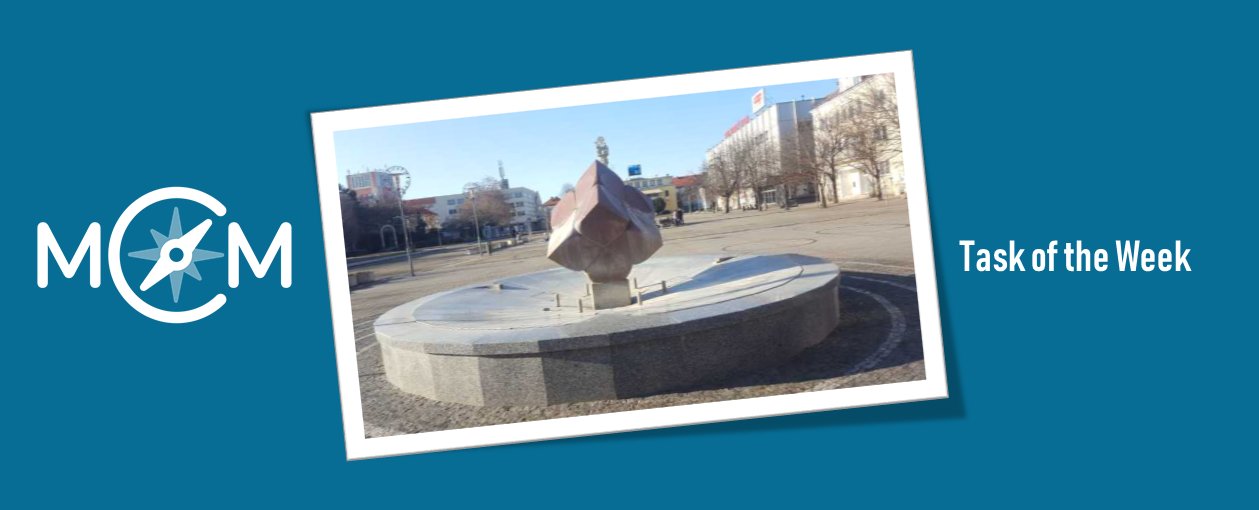
Our new Task of the Week is located in Slovakia. In the town Nové Zámky, Aneta Vadkerti created the task “Fountain” and the math trail “Learn something new”.

How do you get in contact with MathCityMap?

A few weeks ago, a colleague of mine told me about this amazing mathematics application, which I could use while teaching. Veronika Bockova, who studies Mathematics in a nearby town, helped me to get familiar with it. When I later used it with my students, they were so excited that it motivated me a lot and I even tried to make my own trail.

Please describe your task.

My task “Fountain” is placed in the city centre, in the pedestrian zone in Nové Zámky, in Slovakia. The question is to figure out the radius of the fountain. As there is usually water in it, you can not just measure the radius. You have to measure the circumference of the fountain. And as the fountain is in a circle shape, you can find out length of the radius by using the formula C = 2πr. To calculate the radius, we use r = C/2π. 

Which didactic aims do you want to stimulate through this task?

This is a kind of procedural task, which can provide students with a good practise of procedures. I focused on the knowledge students already possess. I also intended to stimulate logic thinking and problem solving through experiencing learning in a real-life situation – not only on theoretical, but on practical level, too.

Do you have any other commentary on MathCityMap?

Me and my students love the application MathCityMap. Students are outside, they are moving, breathing fresh air.  There is a lot of group work, brainstorming, they help each other. They learn new interesting facts about the town and its history. And furthermore, they realise the big meaning of mathematics in life.