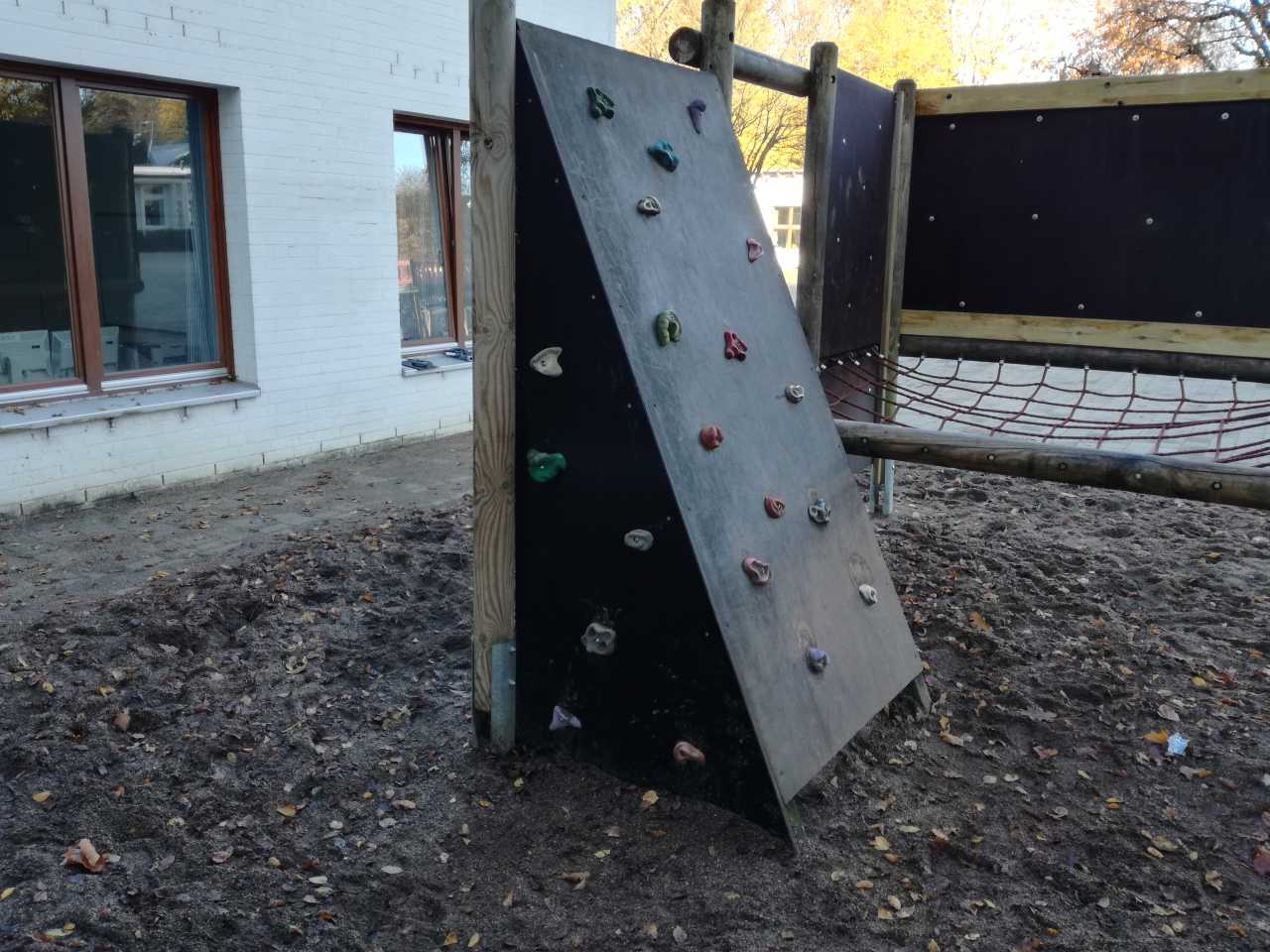
Today’s “Task of the Week” leads to Hamburg, more precisely to the school Am Heidpark. Here, one can find the trail “Am Heidpark” which is a good example to show that already a schoolyard can be made for a MathCityMap trail. The selected “Task of the Week” is called “Climbing Wall” with task number 668.


Task: Climbing Wall

Determine the slope of the climbing wall in percent.

The task enables a suitable embedding of the topic slope of linear functions. The slope of the climbing wall can be determined by recourse of the gradient triangle. In the coordinate system, the slope of a linear function can be calculated with help of two points on it. It is necessary to determine the difference of the y-coordinates (dy) and the difference of the x-coordinates (dx) and divide them afterwards. Corresponding in the real context, it is necessary to measure the height difference (dy) as well as the difference in length (vertical; dx). Afterwards, the slope can be calculated with help of a division and the conversion into percent. The task can be used from grade 8 and supports a basic understanding of the slope of a linear function and its determination with help of a gradient triangle. The task is especially suitable in the beginning of the topic as it already “predefines” a right-angled gradient triangle. Further tasks could for example involve the slope of a stair handrail. The task is a connection of algebra and geometry and can be related to the branches measuring and functional correlation.
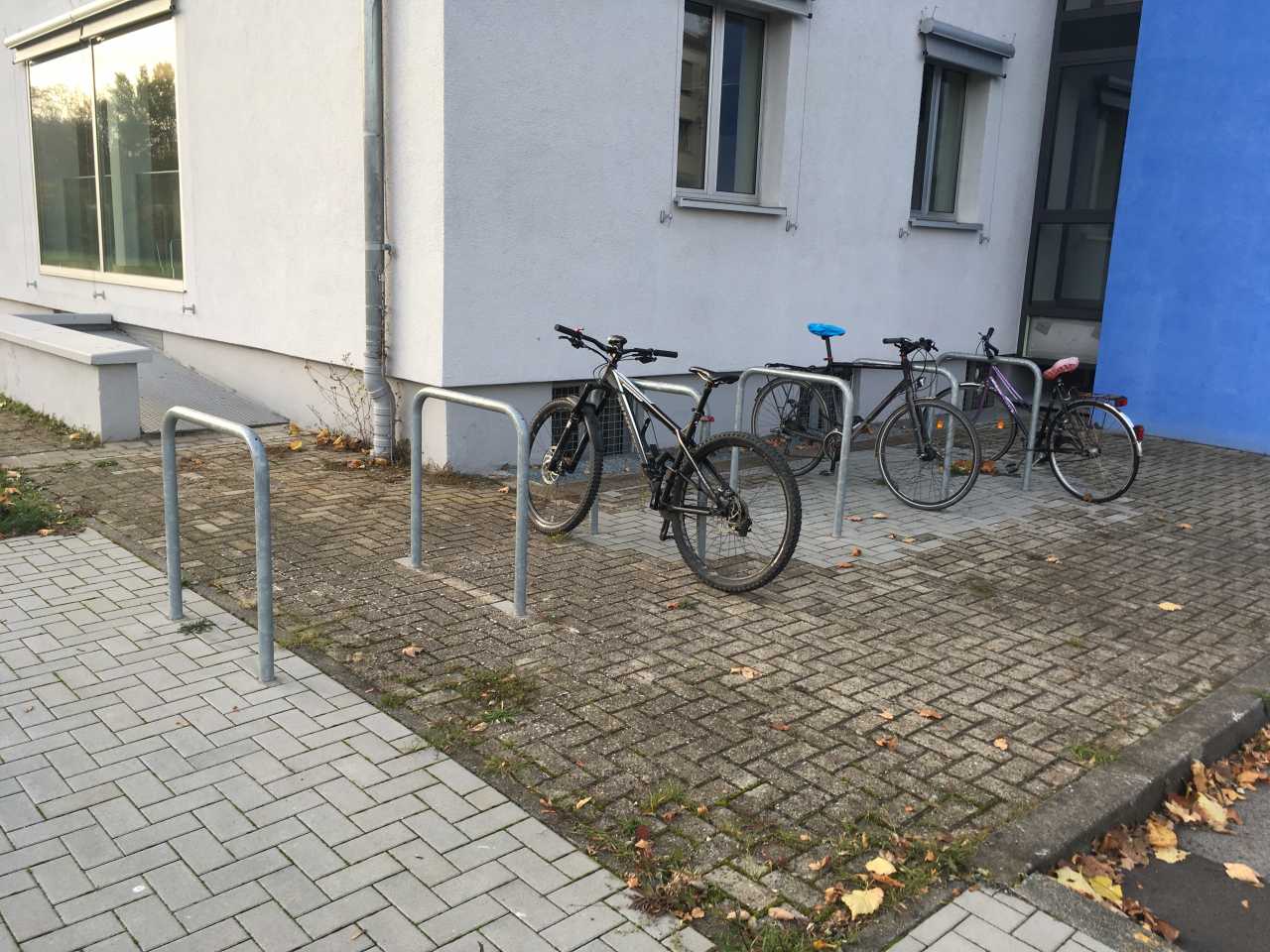
 

In this week, the focus of the “Task of the Week” is on a stochastic problem. The task is called “Permutation at the Bicycle Stand” and is included in the trail “Hubland Nord” located in Würzburg. The task number is 680.


Task: Permutation at the Bicycle Stand

Four bicycles should be locked at the bicycle stands. The bicycles can be locked on the left or on the right side of each stand. How many possibilities exist to lock four bicycles at the stands? You do not have to distinguish whether the bikes are locked “forwards” or “backwards”. You can assume that all stands are free.


In this task, it is necessary to determine the number of possibilities to lock four bicycles at the bicycle stands. Altogether, there are eight stands and therefore 16 possible spaces. On the picture, not all spaces can be seen in order to guarantee the criterion of the students presence (the task can only be solved at this location). For the first bike, there exist 16 possibilities to lock it. As this space is full afterwards, the number of possibilities to lock the second bike is 15. Analogous, the possibilities for bikes three and four amount 14 and 13. This combinatorial problem is a situation where repetition is not allowed and order matters. With help of the possibilities’ product, one can calculate the total number of possibilities.

This task enables a suitable embedding of a combinatorial problem into the reality. It belongs to probability calculus and can be used from grade 8 with first combinatorial considerations. Further, it can be especially used in stochastics in grade 12/13 as a repetition of basic combinatorial considerations. Moreover, the task can be transferred easily to similar situations (e.g. parking spaces).

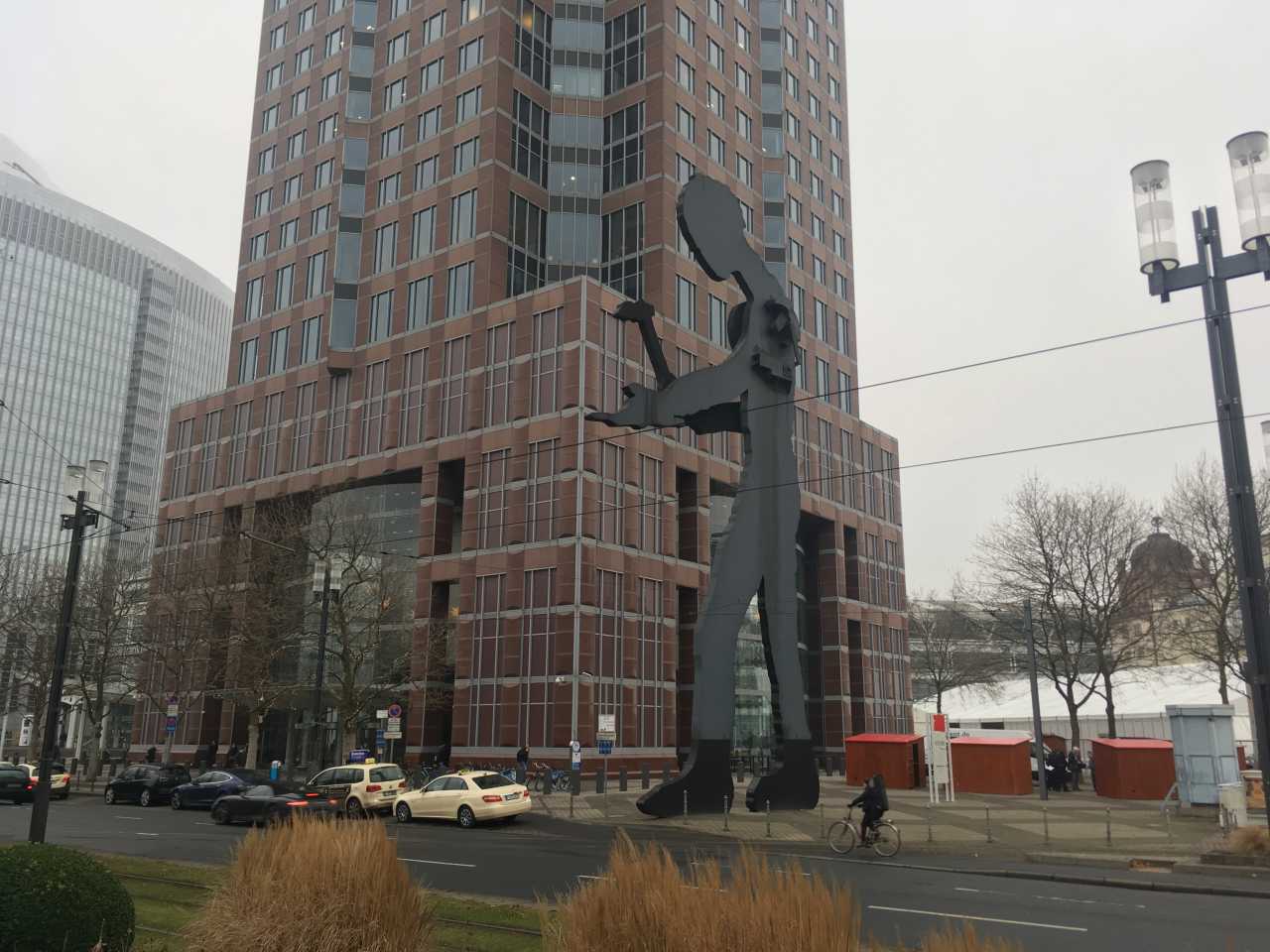
Today’s “Task of the Week”  focuses on the “Hammering Man”, a symbol of Frankfurt’s fair. The “Hammering Man” comes to one’s attention through his continuous hammering motion. The task is part of the “Weihnachtstrail” with task number 784.

__

Task: Hammering Man

The “Hammering Man” hammers continuously. How many hammer blows does the “Hammering Man” carry out in the month December?

__

To solve this problem, it is necessary to observe the motion of the “Hammering Man” and measure the duration of a blow (in seconds). This can be done through measuring the time for 10 cycles. Afterwards, the number of seconds for one day and for the month December should be determined. With help of a division, the number of hammer blows can be calculated for the month December.

In this task, the main part is to determine the frequence of a periodic motion through measuring. Therefore, the task can be seen as an examplary task which can be adapted to further locations where things move periodically. The focus is especially on the time units second, day and month, as well as their conversion. Further, the arithmetic operations multiplication and division are included. Therefore, the task is in connection with school mathematics and can be used from grade 4.

The task is very suitable, because it requires the presence and activity (measuring of the duration of a blow) of the pupils. Further, it is a realistic problem, which can be solved without special aid. The task offers the possibility to differentiate as the pupils can ask for help if needed. The sample answers can be found with the task in the portal.

From now on, a selected task from the MathCityMap portal will be presented weekly. These tasks will be collected under the category “Task of the Week” and illustrate the diverse mathematic and realistic usages of the MathCityMap project.

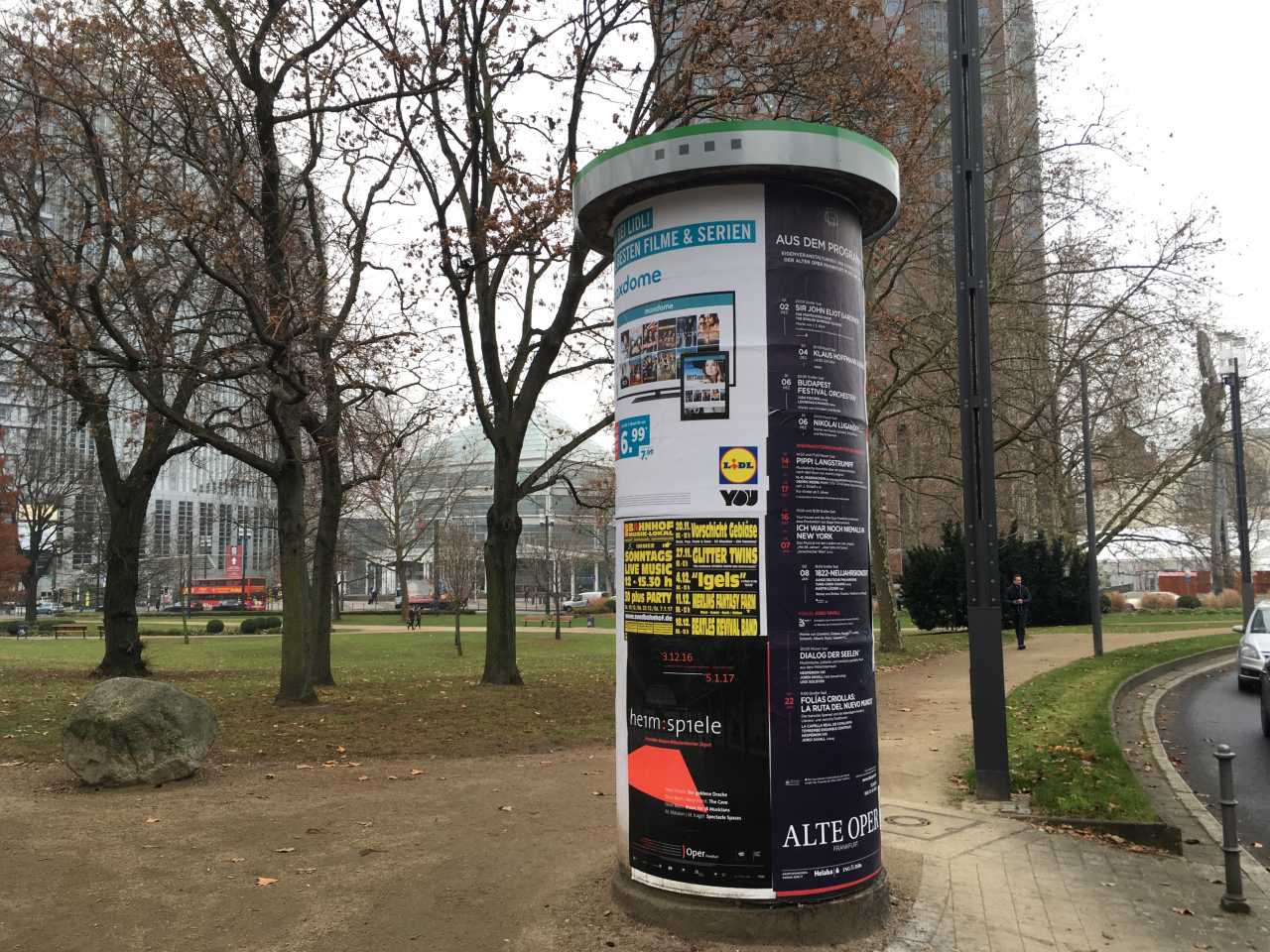
In this week, the focus is on the mathematic use of the advertisement pillar, exemplary included in the “Weihnachtstrail” in Frankfurt with task number 783.


Task: Advertisement Pillar

How many DIN A0  posters (84,1 cm x 116,9 cm) can be placed in portrait orientation and without overlapping?


To solve this task, it is necessary to measure the number of posters which can be placed in height and length. To do so, the perimeter and the height of the advertisement pillar have to be measured. Afterwards, the task can be solved with a multiplication. The task belongs to geometry, especially to the branches “space and shape” and “measuring” and can be used from grade 5. As it is asked for the number of posters, the solution must be a natural number.

This task is particularly suitable in terms of the MathCityMap concept as advertisement pillars exist in every city. Therefore, the task can be adapted easily and quickly to other surroundings which is underlined through the fact that similar tasks can be found in other trails as well. This task is an effective activity to do outdoor mathematics.