Trail of the month: Mathematics outdoors

We are once again in a European capital for the “visit” of the Trail of the Month September. The trail “Mathematics outdoors” is located in a city that bears the same name as the state, Luxembourg. This mathematical walk was created by Claude Reuter as part of the initiative “Mir gi raus” of the SCRIPT, […]

We are once again in a European capital for the “visit” of the Trail of the Month September. The trail “Mathematics outdoors” is located in a city that bears the same name as the state, Luxembourg. This mathematical walk was created by Claude Reuter as part of the initiative “Mir gi raus” of the SCRIPT, a coordination center for educational and technological research and innovation.

The trail consists of a total of 11 tasks covering a wide range of topics such as geometry, stochastics and arithmetic and is located in the central district of Clausen directly on the Alzette River. The trail is available in the MCM app under the code 4710757 and in the MathCityMap web portal here.

Claude Reuter describes his experience and work with MathCityMap in the following interview. Enjoy reading!


How did you come across the MathCityMap project?

I came across MathCityMap while researching on the internet about applications that help in creating GPS-based trails.


Please describe your trail?

The MathTrail is intended as an example trail. It is designed to show teachers how mathematics can be experienced in a playful way using simple means in the immediate environment of the school (in this case the schoolyard). Mathematics is everywhere and should therefore not only be dealt with in the classroom.


How do you use MCM and why?

MCM is designed to help people experience mathematics. Although mathematics is an exact science, we often work with estimates in everyday life. With MCM, mathematical content can be connected to the real context.


Describe your favorite task on the trail. How can it be solved?

My favorite task from the trail is the task to determine the flow velocity of the Alzette River. In this task, the focus is not on the result, but on the process. The result cannot be determined unambiguously. To solve the task, students must come up with possible procedures on their own and then check them for feasibility.


Trail of the month: Traufgängerle witch kitchen in Albstadt

In August, the Trail of the Month comes from Albstadt, a city in the south of the German state of Baden-Württemberg. In a joint project, the Zollernalbkreis District Media Center and the Baden-Württemberg State Media Center created the “Traufgängerle Hexenküche (witch kitchen) in Albstadt” mathtrail here, which can be accessed with the MCM app under […]

In August, the Trail of the Month comes from Albstadt, a city in the south of the German state of Baden-Württemberg. In a joint project, the Zollernalbkreis District Media Center and the Baden-Württemberg State Media Center created the “Traufgängerle Hexenküche (witch kitchen) in Albstadt” mathtrail here, which can be accessed with the MCM app under the code 459518 and is available on the MathCityMap web portal here.

The trail consists of a total of twelve tasks that are designed to cover all content-related competencies that need to be acquired in elementary school. While working on the tasks, you can experience one of the many special hiking trails around Albstadt, which gives this trail a very special atmosphere.

Silke Schick, educational associate at the State Media Center Baden-Württemberg and co-creator of the trail, gives us a short interview below about the creation of the trail and her work with MathCityMap. Enjoy reading!


How did you come across the MathCityMap project?

During a brainstorming session for the Media Competence Days of the district media centers and the Baden-Württemberg State Media Center in June of this year, we stumbled across MathCityMap and then connected it with the premium hiking trails in the city of Albstadt.
Since math teachers are on the team, the idea came up for the students to design a trail during the time of the media literacy days that would invite them outside, while also creating an area for teachers to use for long-term math field trips. In the course of this, we developed a training for teachers to introduce the portal.


Where is your trail located? What is special about your trail?

As a media center association, it is particularly important to us that the trail can be used by as many people of all ages as possible. Thus, we have chosen a trail that is located along a well-known hiking trail especially for children. This trail leads through a wooded area past a game preserve, there is a “witch’s kitchen” to discover and at the end it leads to an observation tower of a medieval castle. This trail can be used by families with children, grandparents with their grandchildren as well as school classes of elementary school or orientation school as an excursion destination and mathematical journey of discovery.


How do you use MCM and why?

The trail was a pilot project that will lead to us making similar project trails available throughout Baden-Württemberg. Starting in the upcoming 2022/2023 school year, advisors at district media centers will train local teachers on how to use MCM for their own schoolyard or city. A great option for doing math together outdoors.


Describe your favorite task on the trail. How can it be solved?

There are two favorites in the team:
In the “Albstadt Town Musicians” task, you have to find all the wooden animals in the forest, measure them and add up their height. As a team, you have to agree on where and how to measure.
The second favorite is the “Tower” station. The task is to count steps. We had three generations with us when we created it and ended up with three different solutions. The challenge was for everyone to find an optimal counting strategy on the way up and to keep it up. Fitness training was included.


Generic Tasks: GPS Tasks

The last article on Generic Tasks deals with the most unusual category in the Task Wizard, GPS tasks. These tasks can be created by the wizard in a very short time and can be easily implemented on any larger area and can therefore be integrated into any trail as needed. The first article on Generic […]

The last article on Generic Tasks deals with the most unusual category in the Task Wizard, GPS tasks. These tasks can be created by the wizard in a very short time and can be easily implemented on any larger area and can therefore be integrated into any trail as needed. The first article on Generic Tasks, which also tells you how to get to the Task Wizard and what Generic Tasks are, can be found here.

In the category of GPS tasks we are not bound to specific objects, which has to do with the approach of the tasks. For example, one possible task is:

“Walk a line AB which is 50 meters long.”

To create the task, you only need to define a place where the task is to be performed. The person performing the task then uses a GPS function in the app to set two points while walking that are 50 meters apart. The route can be either directional, i.e. running in a certain cardinal direction, or non-directional.


Other possible tasks are, for example, tracing a square or an isosceles triangle. In addition, as seen in the first image of this article, you can ask for points that are equidistant from two or three points previously determined in the app, such as the sculptures.

We hope that with this series of articles on Generic Tasks we were able to introduce you to our Task Wizard and its possibilities to simplify the process of creating tasks. Have fun trying it out!


Trail of the month: Bern’s Old Town

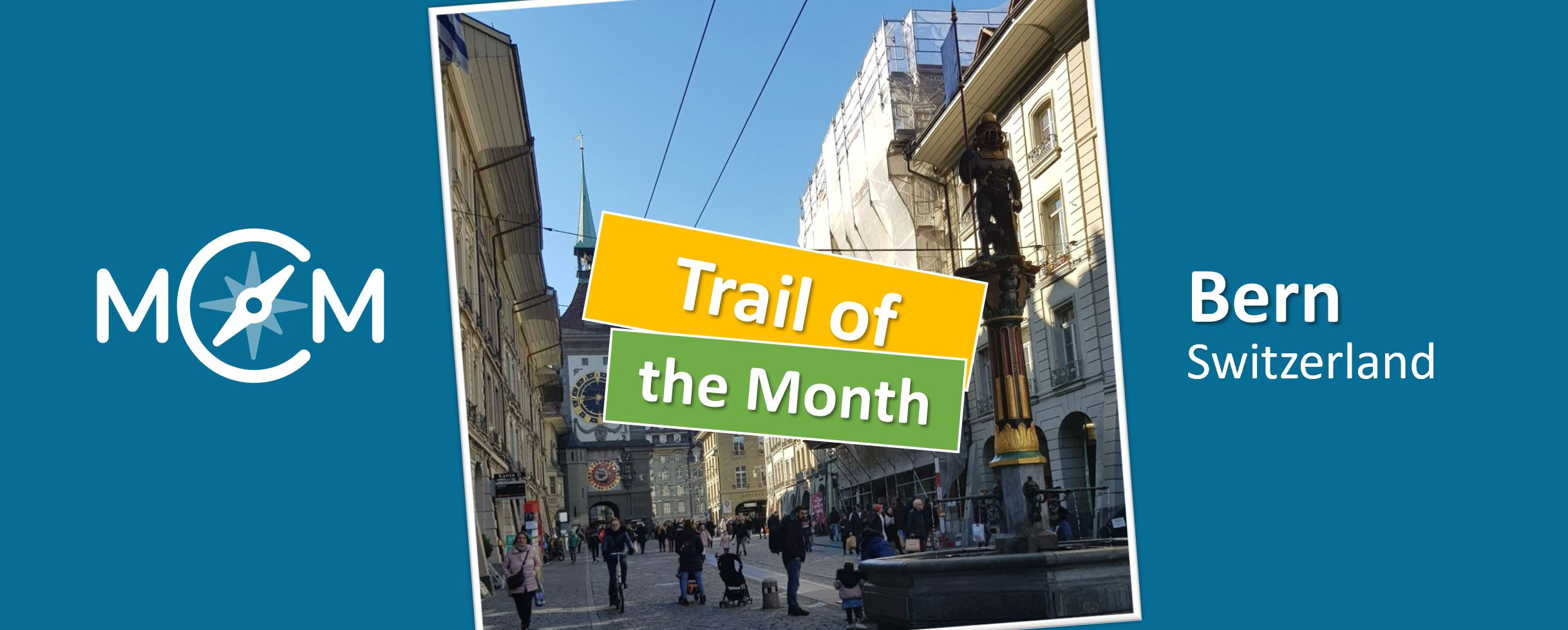
The Trail of the Month July invites us to a mathematical walk through another European capital. This time we are in the beautiful city of Bern, Switzerland. The Trail of the Month was created by Damaris Burri as part of her master’s thesis at the PH Bern at the Institute for Secondary Level 1 and […]

The Trail of the Month July invites us to a mathematical walk through another European capital. This time we are in the beautiful city of Bern, Switzerland. The Trail of the Month was created by Damaris Burri as part of her master’s thesis at the PH Bern at the Institute for Secondary Level 1 and is available in the MCM app under the code 678321 and in the MathCityMap web portal here.

Running through the historic old town of Bern, the trail consists of a total of 12 tasks, some of which can be extended with sub-tasks. In terms of content, the tasks deal with topics from grades 7 to 9 (in Switzerland, the so-called third cycle), i.e. with areas and volume calculations, as well as gradients and units of measurement.

In the following interview Damaris Burri describes her experience with MathCityMap so far and gives additional background information about the trail:


How did you come across the MathCityMap project?

I came across the MathCityMap project during a mathematics didactics seminar at the PHBern. At the end of such a seminar, the lecturer introduced us in a few words to some links to websites that could be useful for teaching mathematics. One of these links led to the MathCityMap website. Looking for a topic for my master thesis, I remembered these links and explored MathCityMap and the world of mathtrails for the first time. I was thrilled and had found an exciting topic for my master thesis.


Where is your trail located? What is special about your trail?

Bern’s Old Town is a UNESCO World Heritage Site and forms the historic core of the Swiss federal city of Bern. The Mathtrail “Berner Altstadt” invites you on a mathematical tour of the city. With its total of twelve tasks, the trail leads past many sights, such as the Kindlifresserbrunnen, the Bern City Hall, the Bear Park, the Bern Cathedral and the Zytgloggen Tower. At each task, students can expect a mathematical problem based on 7th and 8th grade basic geometry knowledge, as well as background information about the object. The goal of the trail is to show the young people that mathematics can not only be done in the classroom, but that objects from everyday life are also suitable for calculating. Furthermore, the Mathtrail should be fun and a positive experience for the whole class.


How do you use MCM and why?

I developed the trail as part of my master’s thesis specifically as an extracurricular learning space for mathematics lessons in cycle 3 (secondary level 1), which can be used freely over the three school years (7th to 9th grade). In Switzerland, students in the upper grades (7th – 9th grade) are increasingly taught in mixed-level groups. My Trail takes the resulting heterogeneity into account with tiered clues and subtasks. Each task has at least two tiered hints that help the youngsters understand the task and find a possible solution path. They also point out possible stumbling blocks. In the case of tasks that exceed the subject matter of the 7th grade, the tasks were divided into several sub-tasks. These guide the young people step by step to the solution.

In order to be able to solve the tasks of the Mathtrails “Berner Altstadt”, each participating group (consisting of 3 -4 students) must be equipped with a smartphone, a set square, a double meter and a calculator.


Describe your favorite task on the trail. How can it be solved?

My favorite task is the task at the Zytglogge (time bell tower). The Zytglogge is one of the landmarks of Bern’s old town and was the first western gate before the city was expanded in the 13th and 14th centuries. The tower with its mechanical music box fascinated me already as a child. Every hour on the hour, the music box starts to play and the dancing bear train, the jester and the screaming rooster come to life.

The “Zytglogge” task refers to the doorway, where on one of the walls hang seven historical length measures that used to be used in the markets of Bern. In this task, the students have to indicate the length of the doorway to the length measure “Swiss foot”. To complete the task, learners must know and understand the principle of converting length measures. The students can determine the length of a Swiss foot both by measuring it or by observing it closely, because the length of 3/10 meter is engraved. To solve the task, they must also measure the length of the doorway and then convert the length obtained into “Swiss feet”.


Another partner school in Portugal!

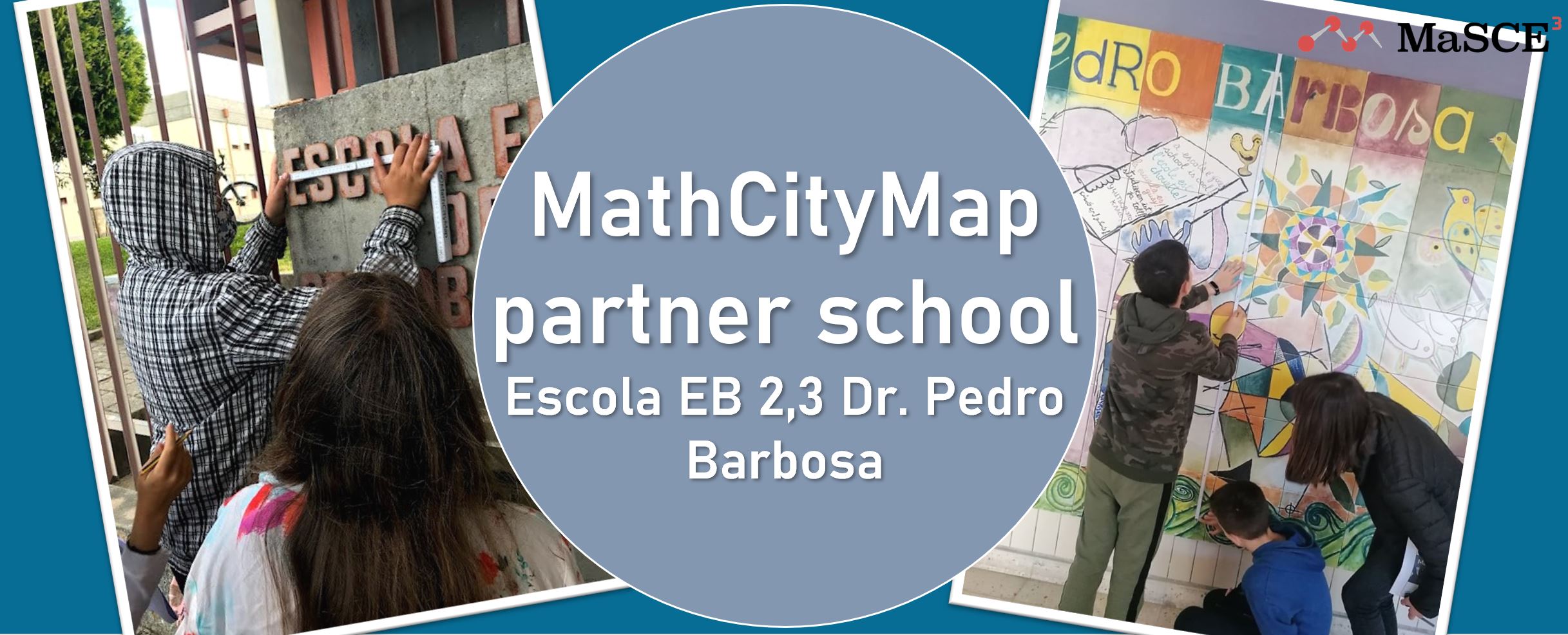
A fantastic part of MathCityMap is our constantly growing international community. In this we now welcome the already fourth MCM partner school in Portugal, the “Escola EB 2,3 Dr. Pedro Barbosa” in Viano do Castelo. The successful application process was accompanied by two pre-service math teachers, Ana Meira and Liliana Francisco, who reported on it […]

A fantastic part of MathCityMap is our constantly growing international community. In this we now welcome the already fourth MCM partner school in Portugal, the “Escola EB 2,3 Dr. Pedro Barbosa” in Viano do Castelo.

The successful application process was accompanied by two pre-service math teachers, Ana Meira and Liliana Francisco, who reported on it as follows:

“Our first experience with MathCityMap was as students during our master’s program. We were so positively impressed by the app that we decided to create mobile Math Trails with our own students, two 6th grade classes. To apply the content taught in class, we created a trail about rational numbers (trail code: 099594) and another about symmetries (trail code: 145301).

Both groups reacted extremely well and enjoyed the opportunity to get outside, exploring the mathematics that surrounds them. The technology was an extra motivation, especially the gamification feature of the app and the possibility of accessing immediate feedback on their answers. The contents taught in the classroom acquired new meaning as the students could see the applicability in real context.

The package with the official partner school plaque and the MCM measuring instruments is already on its way to Portugal and we are very much looking forward to receiving more applications from all over the world.

All further information about the partner school program and the requirements for the application can be found in the article about the first MCM partner school as well as on the homepage of our project MaSCE³.


Trail of the month: Bruneck a little different.

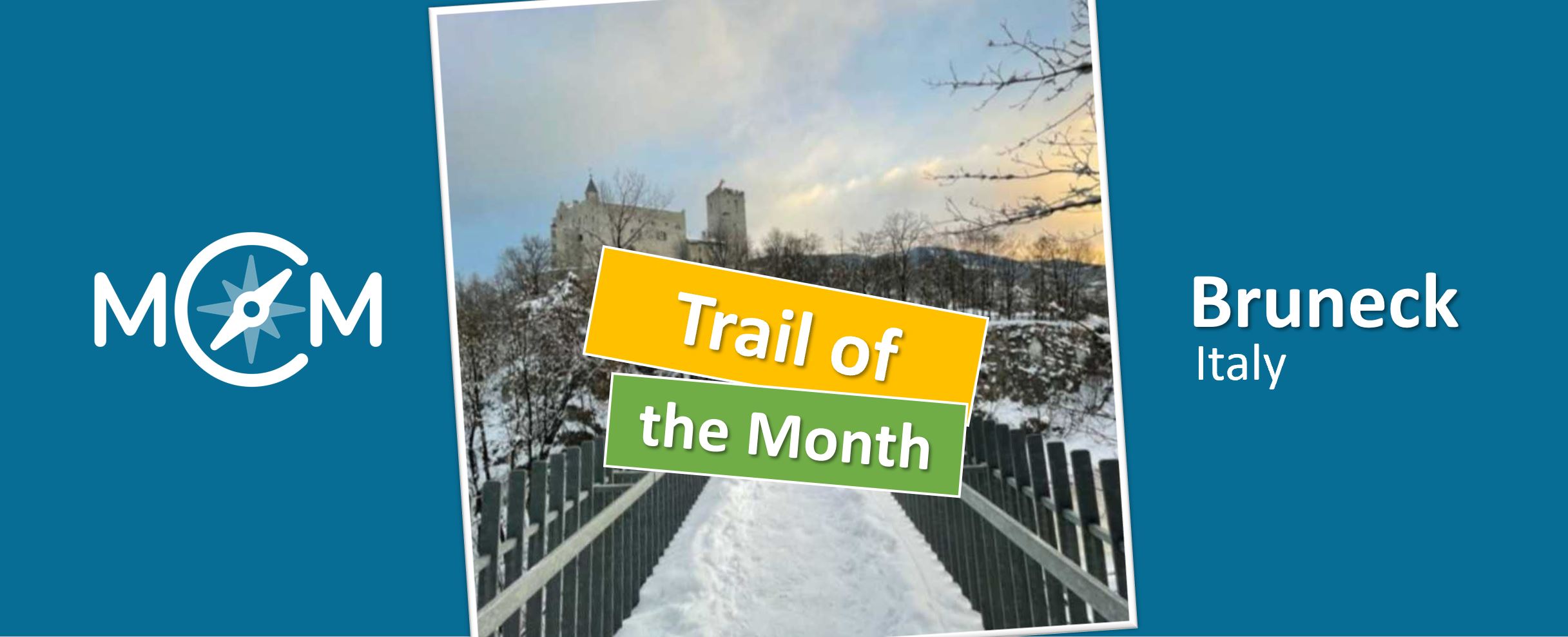
The Trail of the Month of June comes from the small medieval town of Bruneck in the region of South Tyrol in northern Italy. Here, Melanie Forer and her third-grade students created the trail “Bruneck einmal anders” (Brunico a little different), which can be accessed with the MCM app under the code 353905 and is […]

The Trail of the Month of June comes from the small medieval town of Bruneck in the region of South Tyrol in northern Italy. Here, Melanie Forer and her third-grade students created the trail “Bruneck einmal anders” (Brunico a little different), which can be accessed with the MCM app under the code 353905 and is available on the MathCityMap web portal here.

The trail consists of a total of six tasks that mostly revolve around the topics of areas and volume calculation of basic and composite objects and areas. In addition, of course, you have the pleasure of getting to know Bruneck from a completely different perspective, while at the same time visiting sights such as the castle of Bruneck.


An interview about the creation of the trail and her experiences with MathCityMap is given by Melanie Forer below:


How did you come across the MathCityMap project?

I got to know MathCityMap in the context of the further training ” Mathematical Trails” of the Pedagogical Department in South Tyrol. Using the example of the project “matematica in città” in Bolzano, we interested teachers were invited to observe the environment with a mathematical eye and then familiarize ourselves with the app MathCityMap. The possibility to formulate and solve mathematical questions at extracurricular learning sites appealed to me very much, so I also brought this idea to my class, where it immediately received a lot of approval.


Where is your trail located? What is special about your trail?

The small medieval town of Bruneck in South Tyrol, Italy impresses with its castle and the famous town alley. In 1741, the Ursuline Order settled in Brunico and in the following years the Ursuline Sisters built a church, convent, boarding school and school. Pupils of this equated secondary school have created the mathtrail “Bruneck einmal anders”, which is described as follows:

Starting from the school entrance at the Ursuline Church, the route goes through the eponymous Ursuline Gate via the historic Stadtgasse up to the Upper Town. From there it continues up to Bruneck Castle and across the suspension bridge to Hermann-Staudacher-Platz. Afterwards the trail goes back to the Schlossberg, down to the Rainkirche and over the trench to the Hintergasse. With the trail it is possible to get a new perspective on the sights of Bruneck by putting otherwise inconspicuous, everyday, geometric figures and bodies in the center of attention.


How do you use MCM and why?

I use MathCityMap to offer very practical, modern mathematics lessons that are close to the students’ lives. Through new digital media, such as MathCityMap, the student world can become a place of learning and a new approach to mathematics can be created. The mathematical perspective no longer remains only in the classroom, but is increasingly applied in the playground, on the way to school or in leisure time.

This school year, I will again be working with a small group of students to collect new tasks and take on the mathematical challenge.


Describe your favorite task on the trail. How can it be solved?

My favorite task is the “bridge at the castle”. With a bit of a thrill, but of course with maximum safety, you can enjoy a wonderful view of Bruneck Castle. The task is to measure the area of the fence and calculate the cost of redesigning it. The special thing here is the varied approach to determining the length, with measuring and counting with meter tape folding rule or other aids such as thread, step length, etc.. To be able to solve the task, basic knowledge of calculating the area of rectangles and an understanding of direct proportionality is needed.


The first MCM partner schools of Slovakia

Also from Slovakia the first schools are joining the partner school program of MathCityMap. We are very happy to welcome “ZŠ s MŠ Lipovce” and “Základná škola Revúca” as the new and fifth / sixth partner school, which successfully passed the application process. The process at ZŠ s MŠ Lipovce was initiated by Sylvia Smolková, […]

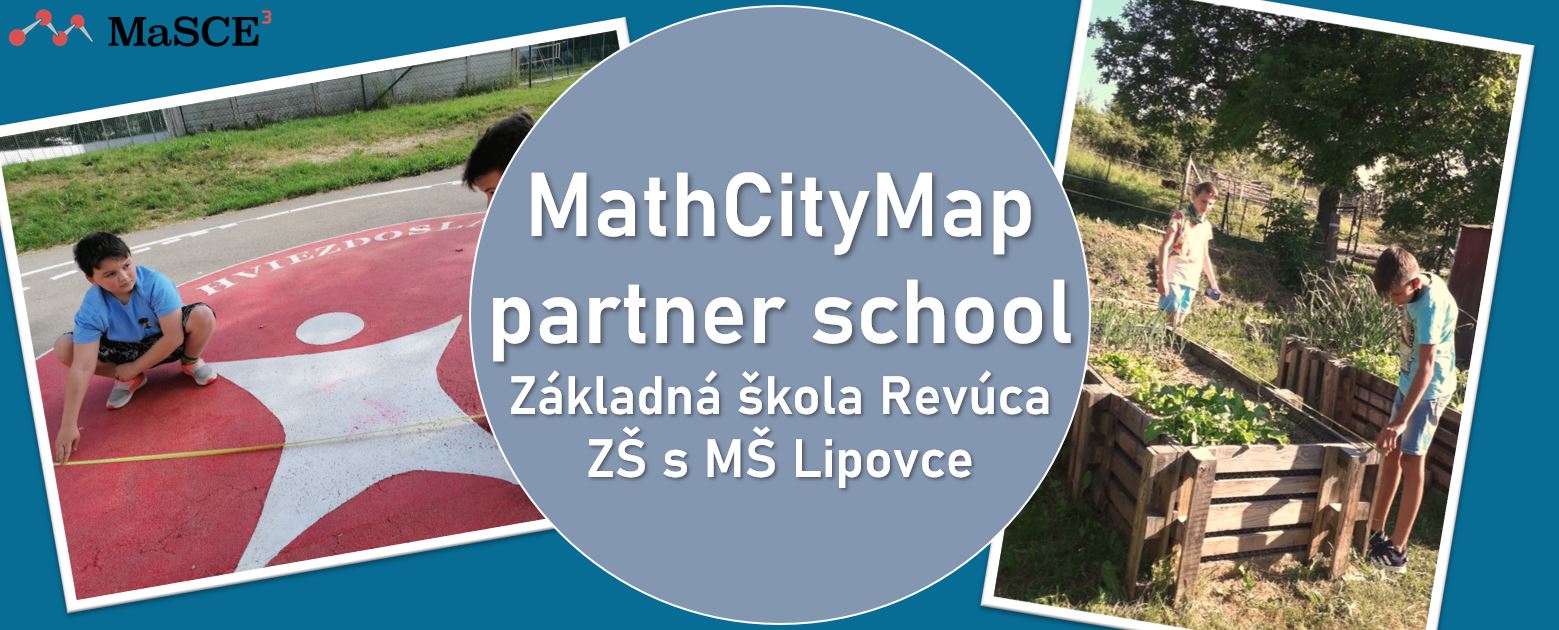
Also from Slovakia the first schools are joining the partner school program of MathCityMap. We are very happy to welcome “ZŠ s MŠ Lipovce” and “Základná škola Revúca” as the new and fifth / sixth partner school, which successfully passed the application process.

The process at ZŠ s MŠ Lipovce was initiated by Sylvia Smolková, a dedicated mathematics teacher at the school, which has a kindergarten, primary and secondary school.
Four trails were created for grades 5 (075303), 7 (025383), 8 (675400) and 9 (565437), which lead the school’s students across Lipovce and let them discover the community in a new way. Trying out the trails with the classes was a lot of fun for all involved and especially the experience of doing mathematics outside was a great motivational factor, as Sylvia Smolková told us.

At Základná škola in Revúca, the application was submitted by Michaela Štefko, who described her experience with MCM as follows:

“I work at the primary school in Hviezdoslavova street in Revúca. Our students are always open-minded to new and interesting forms of learning. As soon as we came across the application and the portal Mathcitymap, we immediately decided to use it in our lessons. So far, we have created two trails in the area of our school for the 5th and 6th grade. We are currently working on another one for the 7th grade. My colleague and I have recently started to design a mathematical walk in our town. We would like to present the monuments and significant places in our district town. Our students have already passed both routes, they were all excited, they formed groups very quickly and worked nicely on every single task. They even suggested that they take part in creating other tasks. We want to improve students´ reading comprehension, teamwork and also communication skills. Additionally, we see a great benefit in the fact that students, whose favourite school subject is not mathematics, took part in solving mathematical problems.”

The packages with the measuring tools and the official partner school plaque are already on their way to the schools and, as always, we are very much looking forward to receiving further applications from all over the world.

All further information about the partner school program and the prerequisites for the application can be found in the article about the first MCM partner school as well as on the homepage of our project MaSCE³.


Trail of the month: Helsinki Tour

Through the Trail of the Month of May, we get to know a European capital from a slightly different angle. We’re talking about Finland’s largest city, Helsinki, where Nina Salminen, a local mathematics, chemistry and physics teacher, created the Helsinki Tour trail, which is available in the MCM app by using the code 129638 and […]

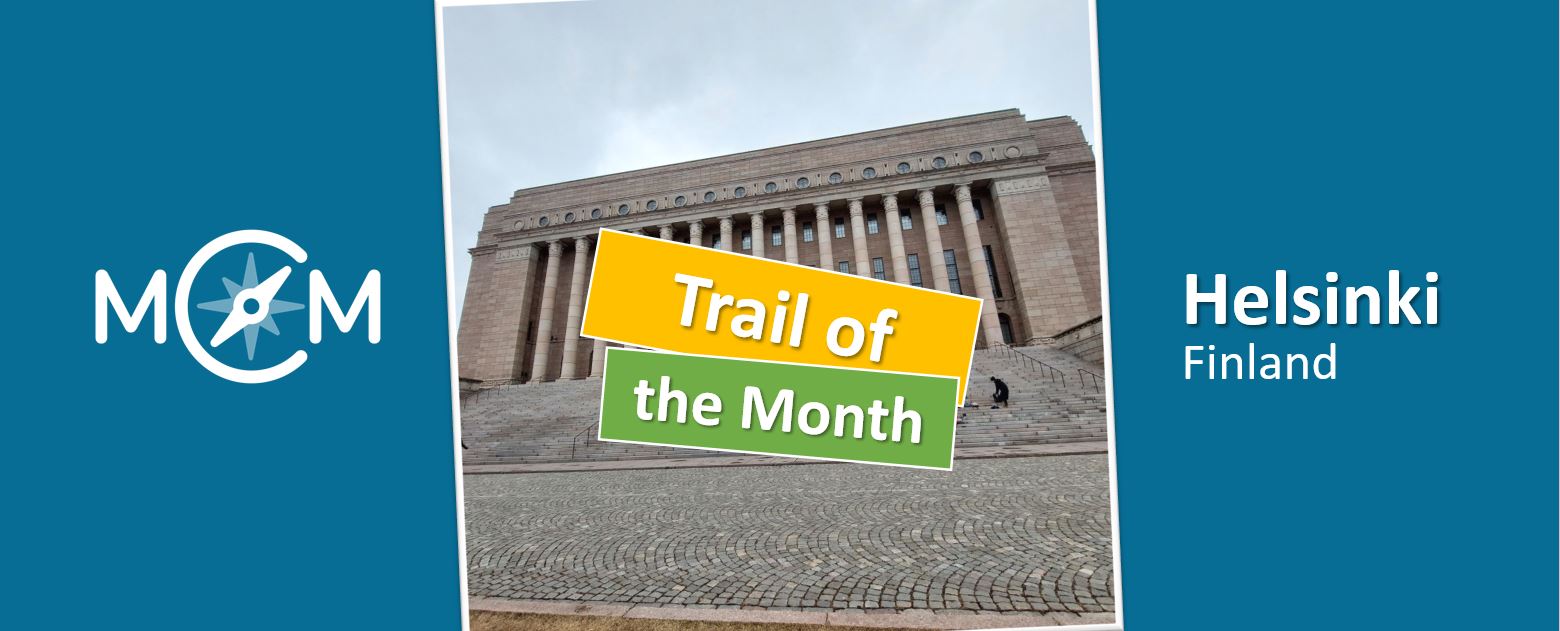
Through the Trail of the Month of May, we get to know a European capital from a slightly different angle. We’re talking about Finland’s largest city, Helsinki, where Nina Salminen, a local mathematics, chemistry and physics teacher, created the Helsinki Tour trail, which is available in the MCM app by using the code 129638 and on the MathCityMap web portal here.

On this extensive mathematical walking trail we get to know the city and its sights in connection with six mathematical tasks based on intermediate level topics. Starting at the Sibelius Monument, the trail covers a total distance of 2.9 km, passing the Olympic Stadium, the Parliament Building and the famous Temppeliaukio Church, which was carved directly into a rock.

In a short interview Nina Salminen tells us how she got to know MathCityMap and gives us some background information about her trail:


How did you come across the MathCityMap project?

My Italian colleague Giovanna Zito from Brindisi asked me to join an Erasmus+ project, where a MathCityMap trail is being planned with students in each of the five countries participating in the project. I found out about the MathCityMap project and made one trail with my students near our school, Munkkiniemi School. This spring we went further and planned two trails in the center of Helsinki.


Please describe your Mathtrail.

Along the trail you will see points of interest in Helsinki and at the same time solve short math problems. For each task, you will get to know one of Helsinki’s attractions. Thus, the route also serves as a tourist tour in our capital. Math problems are suitable not only for students but also for anyone who wants to recall the basics of mathematics or enjoy problem solving.


How do you use MCM and why?

MCM trail brings good variation for math lessons. A trip outside breaks up the monotony of the school day. Showing math in different contexts is also a good way to reach students who, for one reason or another, don’t like math and don’t think they’re good at it.

We can also get around the trails on theme days or when there are foreign guests at our school. The trail makes it easy to introduce our hometown. The Finnish mobility of the Erasmus+ project will take place in May and all 50 students from five different countries will take the MCM trail.


Describe your favorite task of the trail. How can it be solved and what can students learn from it?

My students have come up with ideas for the tasks and were so excited about planning them that I consider everyone a favorite. The tasks differ from each other and many of them require knowledge of geometry. In addition to connect math with real life, students get to know their hometown. They also learn to work together as a group when solving tasks and navigating from one task to another.

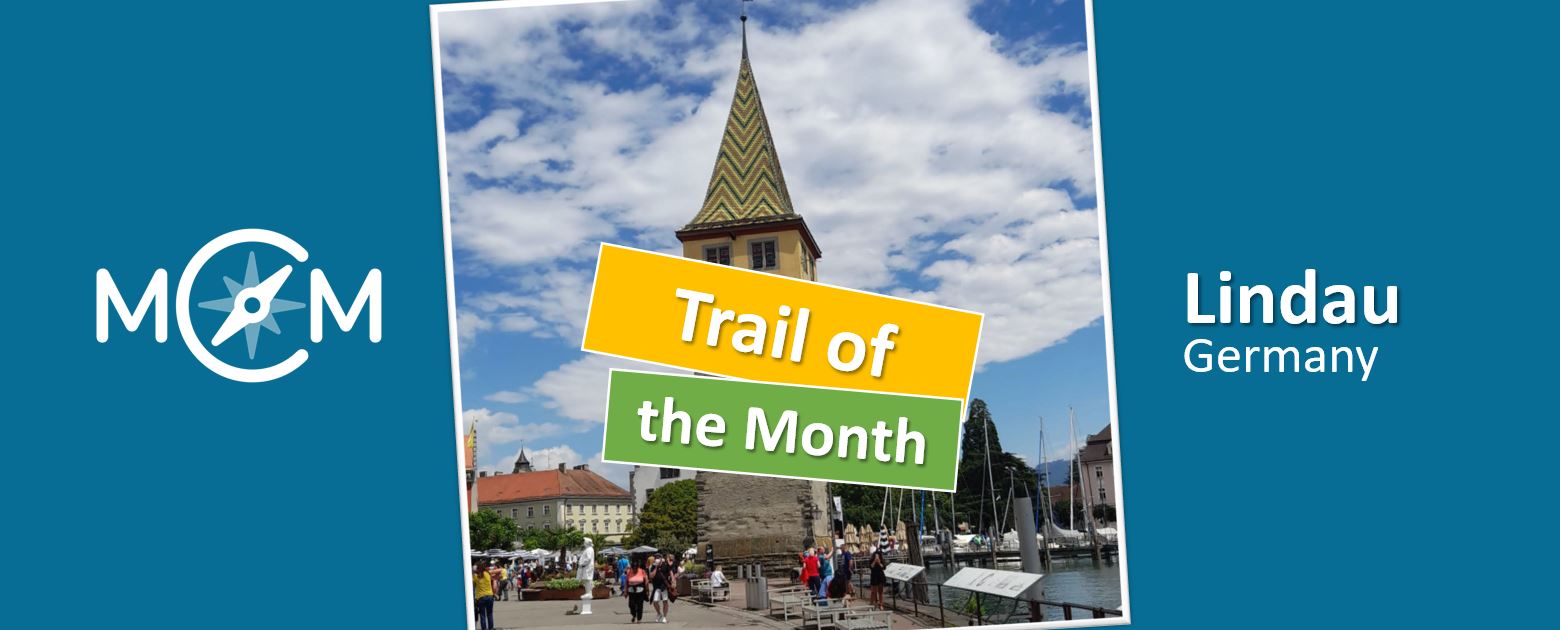
Trail of the month: Lindau Island MathTrail

The Trail of the Month for April was created at a picturesque location on Lake Constance, on the island of the city of Lindau in Bavaria. Together with his P-Seminar, a special type of course in the Bavarian gymnasiale Oberstufe, teacher Jan Neuendorf created the “Lindau Island Mathtrail” (Lindauer Insel Mathtrail), which is available in […]

GeneralTrail of the Month

The Trail of the Month for April was created at a picturesque location on Lake Constance, on the island of the city of Lindau in Bavaria. Together with his P-Seminar, a special type of course in the Bavarian gymnasiale Oberstufe, teacher Jan Neuendorf created the “Lindau Island Mathtrail” (Lindauer Insel Mathtrail), which is available in the MCM app under the code 376526 and in the MathCityMap web portal here.

Along the harbor and through lindau’s old town, the trail winds its way across the entire island and integrates various sights of the city, making it very interesting not only mathematically, but also architecturally and historically. The trail contains a total of ten tasks that focus in particular on the content of the eighth and ninth grades.


An interview about the background of the trail is given by Jan Neuendorf in the following interview:


How did you come across the MathCityMap project?

I first heard about the project from colleagues who had spoken about it in various training courses. Afterwards, I found out more about the MathCityMap project on the Internet. This gave me the idea to offer a P-seminar in mathematics, which had the goal to develop a Math-Trail on the island of Lindau and to make it accessible to interested people via the MathCityMap-App. The P-Seminar is a special feature of the gymnasiale Oberstufe in Bavaria. It supports students in their study and career orientation and focuses on the planning and implementation of a subject-related project.


Where is your trail located? What is special about your trail?

The trail is located on the island of Lindau in Lake Constance. With its historic old town, narrow streets, medieval buildings and picturesque harbor with lighthouse, lion and mountain view, the island provides a unique backdrop for the elaborate math trail. Therefore, it was also an exciting challenge to discover and develop suitable mathematical tasks on objects on the island. Thus, the trail combines sightseeing with math activities, which is an exciting combination.


How do you use MCM and why?

So far, MCM has served as a guiding idea for the P-Seminar in mathematics. The goal of the participating students was to plan and implement a math trail on the island of Lindau. In the future, the trail will be used in grades 9 and 10 as a subject outside the classroom or as part of our project week. It is certainly also desirable that other schools in the Lindau area will use the trail for classroom excursions and class action days.


Describe your favorite task on the trail. How can it be solved?

My favorite task of the trail is the task to the Mangturm (Mangtower) at the Lindau harbor. On the one hand, the task is to be solved directly at the harbor in the heart of Lindau, which gives the task an exposed place within the trail. On the other hand, it is a suitable task from the field of geometry, in which mathematics is applied in practice and in which geometry as the science of measurement can be understood in its most original form.
The task is solved with the ray theorem. The fascinating thing is that this theorem can be used to determine lengths that are difficult or impossible to measure.
If you form the 2m long meter stick into an isosceles, right-angled triangle and place it on the harbor railing in such a way that you can aim at the top of the tower via the tip of the leg of the meter stick that is far from your eye, you are not far from the solution. After you have measured the horizontal distance of your location to the Mangturm with the help of the railing elements, you add the height of the railing to this quantity and thus obtain the height of the tower.


A mathematical culture trail

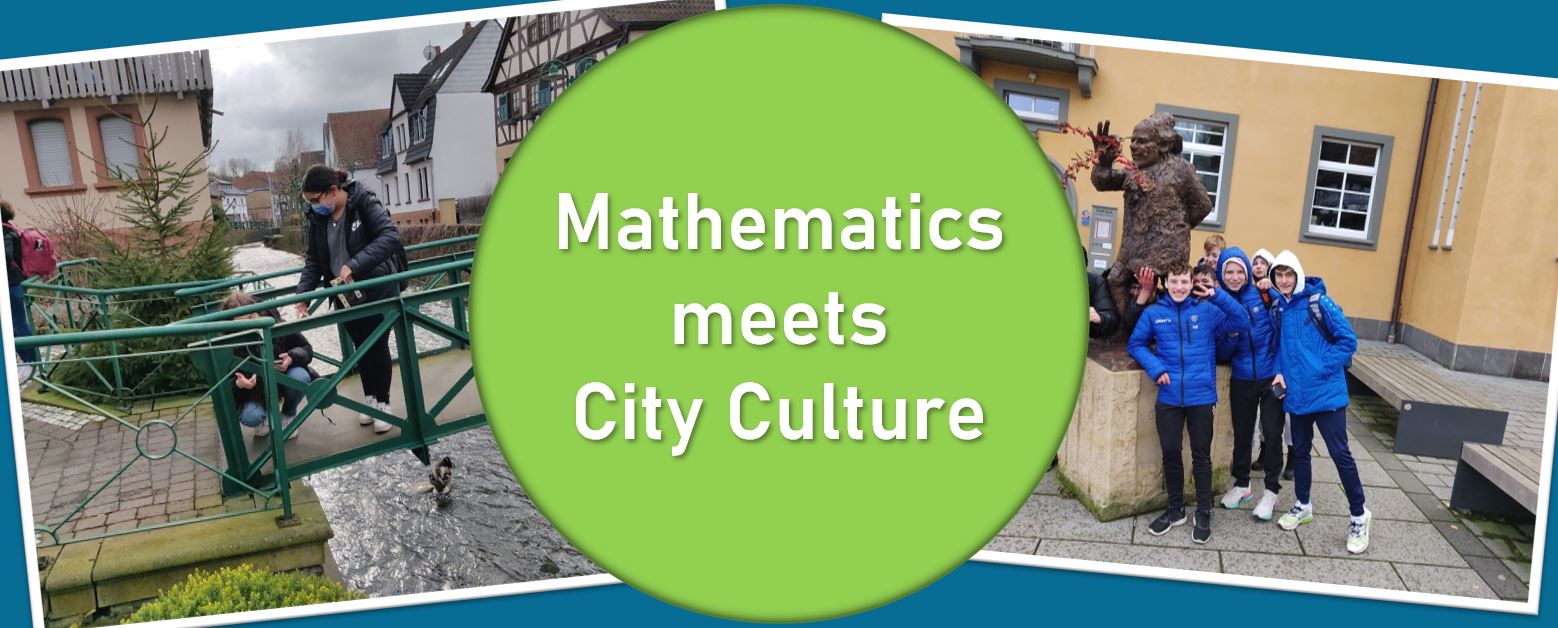
In this article we present a very interesting development in Ober-Ramstadt, a city in the south of the German state of Hesse. There, Daniel Reckhard, a student teacher at the Georg-Christoph-Lichtenberg-Schule, has developed a special kind of math trail with MathCityMap. The aim of the so-called mathematical culture trail is to combine the culture of […]

In this article we present a very interesting development in Ober-Ramstadt, a city in the south of the German state of Hesse. There, Daniel Reckhard, a student teacher at the Georg-Christoph-Lichtenberg-Schule, has developed a special kind of math trail with MathCityMap. The aim of the so-called mathematical culture trail is to combine the culture of the city with interesting and creative mathematical discovery opportunities and thus to gain a new perspective on mathematics. Further information about the trail can be found on the website of the city of Ober-Ramstadt and an interview about the background of the mathematical culture trail with the creator can be read below.
 

How did the idea for combining the topics of mathematics and culture come to life?

Mathematics is one thing above all: an art. Very eloquently and with the necessary leisure Paul Lockhart describes this in “A Mathematician’s Lament: How School Cheats Us Out of Our Most Fascinating and Imaginative Art Form”. An abridged version is freely available as a PDF on the Internet and is absolutely worth reading.

Math as art is meant to be very inclusive, that math is so amazingly suited to describing our universe is one aspect of it. My favorite subjects are the STEM sciences and within mathematics my favorite is statistics. In statistics, too, you are not at home until you have filled its concepts with experience and thus brought them to life, whereupon you can create. So also in statistics aesthetics in the literal sense (aisthesis as “sensual cognition”) is central.

The typical school mathematics could hardly be more opposite. I am forced to cram through a crowded curriculum, necessarily superficial and hasty. I have to drill students on exam math and fill them with mindless arithmetic, dry formulas, and meaningless concepts. So my pubescent students came back to class from distance learning and already the “mathematics competition” of the state of Hesse loomed on the horizon, a de facto comparative test in which an immense range of topics is asked. And this (thoroughly international) rigidity of the curriculum is commonly thought to be the true face of mathematics. No wonder, there is no time for real understanding.

The central reason for the connection, then, is as a resolute antithesis of instruction characterized by control. A second reason is that mathematics is in any case inseparable from our culture as a part of it. For example, I had attended the lecture “Mathematics in Context” by Prof. Burkhard Kümmerer and had enjoyed studying the genesis of mathematics.


Why did you choose MathCityMap to implement the idea?

The idea came from the supervisor of my educational thesis, Steffen Burk. I had the idea of laying a geocache, and he thought there was something better because it was tailored to schools. My second subject is computer science, I like to work my way into new techniques. And here I also found it exciting to see how I can implement my ideas in a very closed learning environment. For example, how do I represent imagination, how do I enable mathematics to unfold?

Because the core principle behind MathCityMap is the same as with the Skinner Box: learners interact with a machine, but outside, i.e. on real objects. And of course, Prof. Ludwig does not intend MathCityMap to replace teaching, but recommends it for certain scenarios, especially as a deepening of the application of already learned concepts. So a real encounter of the learners with something fundamentally new was a challenge. I hope that I succeeded well. In any case, my students had a lot of fun, as did my colleagues who had previously tested the trail.

What I and the students really liked was going out into the world. It naturally led to cooperation with the city administration and to opening up the trail to the general public. That’s another aspect of cultural school: connecting the school community with the communities that surround it. That also enlivens the math. What I also really liked is that the user-friendliness allows students to create tasks. This allows them to be immediately creative.

For example, I could also imagine implementing open-ended task formats: for example, “How should (mathematical object) be designed?” The students use the funnel principle to make assumptions or choose suitable real objects, and their closed MathCityMap task thus represents a solution to the open task.


What is there to discover and learn on the trail?

The goal of this trail is to show the cultural and aesthetic side of mathematics, its diversity, hidden patterns, symmetries, but also how mathematical cultural techniques shape our world. Compared to other trails, the tasks are deliberately kept quite easy. After testing, I have adapted the tasks and aids so that many students can solve the tasks well. As with the Computer Science Beaver, the trail is intended to enable students to gain a positive experience with mathematics without a great deal of prior knowledge, which creates a desire for more.

At my favorite station, students discover what numbers (for example, their favorite number) really look like because, for example, “4” or “four” are just names for a number, they are not the number itself. I implemented this via a geogebra activity. At another station, they learn why scaffolds always contain triangles, as they recreate them and thus “grasp” math in the literal sense. The material for this is on file at the school. Those outside the school can borrow the material from the town hall with a deposit of 10€.

At yet another station, they stretch a twelve-knot cord and have to understand how many stone slabs are spanned, thus discovering the decomposition principle and thus the decisive basic idea for the area of any polygon. One station (appropriately enough, the library) activates the imagination and asks what would be created if one were to think of the mirrored object in addition to the given object (a decorative window).

And quite incidentally, something about cultural history is told, for example, why a stream leads to a mill wheel. I found it impressive to calculate with which enormous force this wheel is turned. Finally, the students are taken to hidden cultural sites, for example, our small town has its own museum, which many people are not aware of.