



In this year’s autumn, numerous tasks were created in Wilhelmsburg, district of Hamburg. The tasks are very convincing – especially in the context of the MCM concept – through their interdisciplinary and thematic diversity, which we would like to illustrate exemplary in our current Task of the Week.


Task: Red area (task number: 1964)

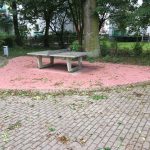
Determine the red area on which the ping-pong table stands. Give the result in m².


It quickly becomes clear that the entire area can not be approximated by a single geometrical object, or that this is only possible with significant losses in accuracy. It is therefore appropriate to divide the area searched into disjoint subspaces, which can be calculated using formulas. This is best done using a drawing. A particular challenge are the curved edges, where estimations and approximations are necessary. According to measurements and calculations, the total area is obtained by adding the area contents of all partial surfaces.

The area can be described using rectangles and triangles. In addition, the principle of the decomposition and additivity of surface content is necessary for solving the problem. The task can be used from class 7 onwards.

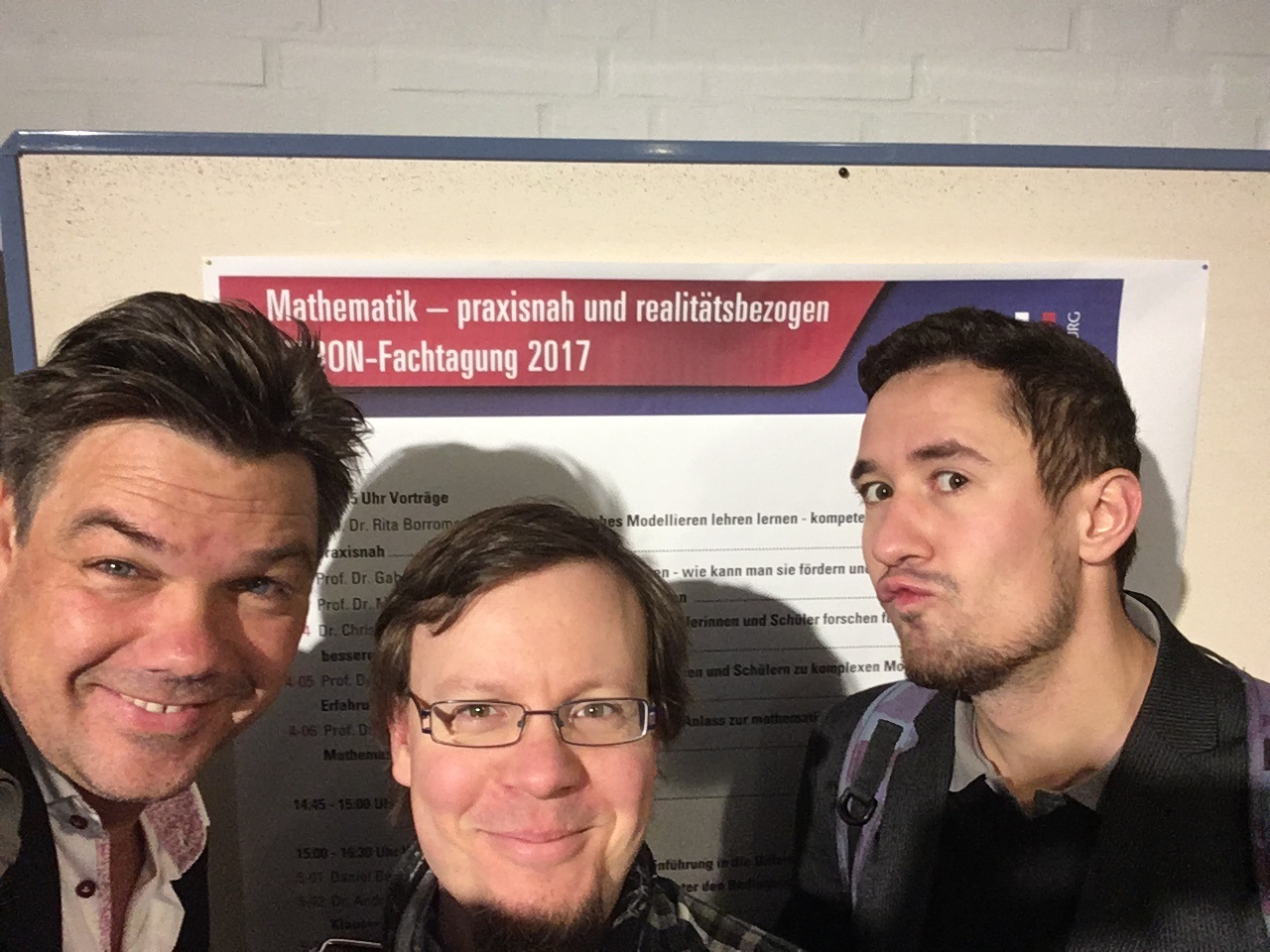
Joerg Zender, Iwan Gurjanow and Matthias Ludwig presented MCM in theory and practice on Friday, 17.11.2017 at the ISTRON conference at the Landesinstitut in Hamburg. The lecutre by Matthias Ludwig was very well attended with more than 120 listeners and led into the world of outdoor mathematics. He combined traditional methods such as measuring with the measuring table and the scientific and technological approach of MCM. In the fully booked workshop, Iwan Gurjanow and Joerg Zender presented MCM in practice. First, the participants got the chance to complete some tasks of the prepared trails and created their own tasks and a trail in the MCM portal afterwards. The success of the training was also made possible through the very good technical equipment and support provided by the Landesinstitut Hamburg.  

Hamburg was fun again and we are looking forwards to coming back!

In regards to the Hamburger Stiftungstage 2017, numerous MCM tasks were created on demand of the Stiftung Rechnen in the district Wilhelmsburg and combined into varied trails for families and school classes of grades 3 to 9. As part of the opening of the trails, the tasks were tested by Hamburg’s pupils as well as press representatives, and Iwan Gurjanow was able to present the MCM concept to the participants on site.

(c) Stiftung Rechnen

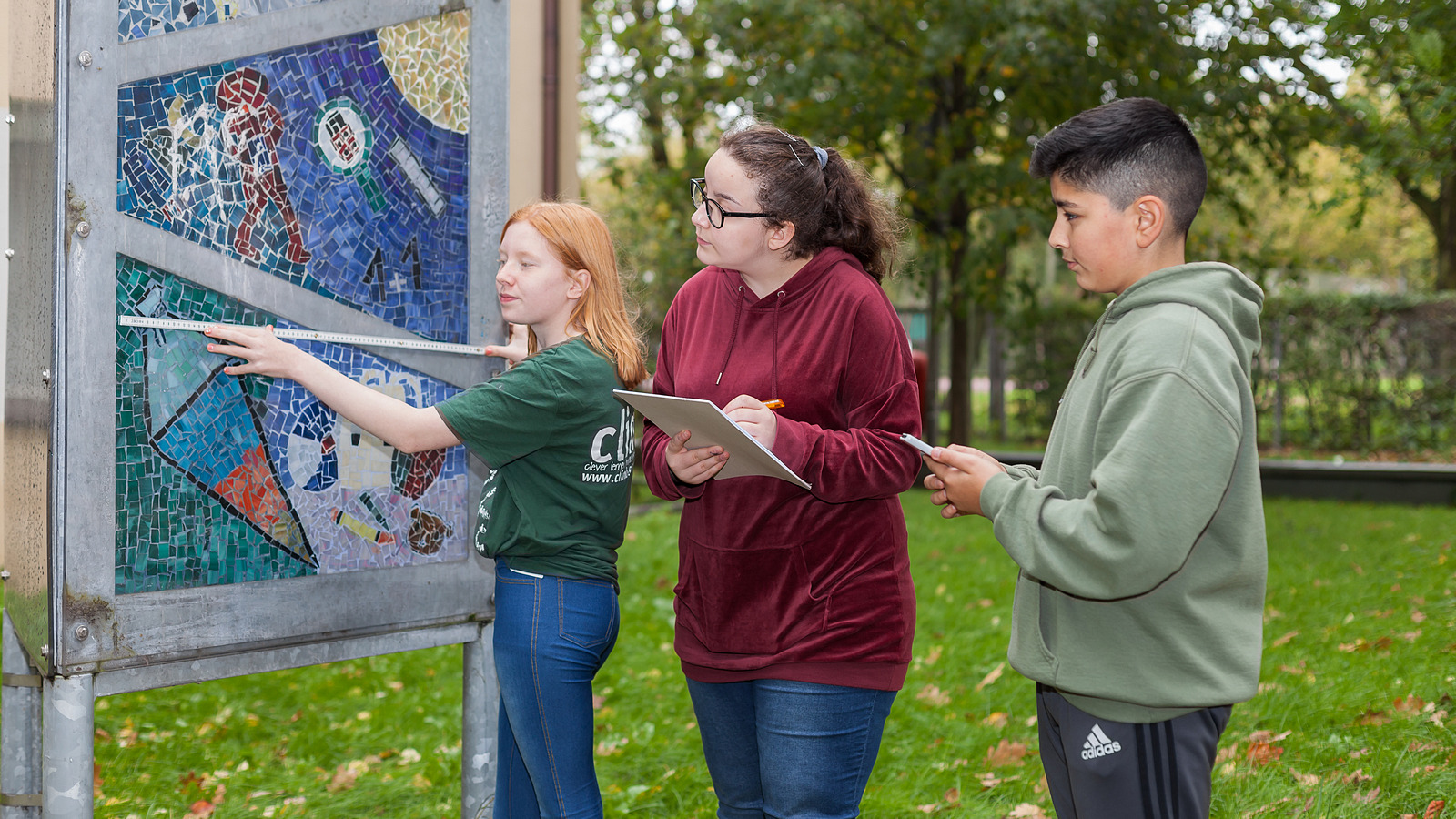
On the next picture you can see a group of students, which solves the task School Cone.

(c) Stiftung Rechnen

The resonance in the press, e.g. in the Hamburger Abendblatt as well as in the regional editions of the Bild und SAT 1, is consistently positive and makes clear: MCM convinces teachers and students through authentic tasks, the use of modern media and the practicability of “outdoor mathematics”.

We are thankful for the very positive feedback and hope that fun and curiosity on MCM will be awakened by many users through the continuation of the trails .

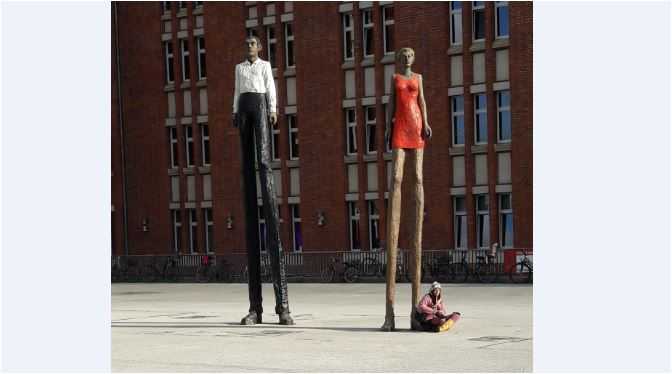
This week we would like to present the task “On a big Foot”. It is located close to the main railway station in Hamburg and is part of the trail “In and around St. Georg”.


Task: On large feet (task number: 647)

These figures are created by the contemporary German sculptor Stephan Balkenhol. I would like to know from you: What shoe size does the man have? For shoe sizes, there are four common systems worldwide. In Germany, European shoe sizes are the usual measure. They are based on the so-called “Parisian Stitch”. The stitch is a length measure with which a shoemaker specifies the length of a stitch and thus also the shoe size of the complete shoe. A French stitch or Parisian stitch is ⅔ centimeters long. The shoe last is a piece of wood, plastic or metal which is modeled on the shape of a foot and used to build a shoe. Since the feet should have some space, the length of the shoe last corresponds approximately to the foot length + 15 mm.


For the task, the pupils first measure the length of the man’s shoe and calculate the length in “stitches” so that the European shoe size can be specified. A major component of the task is the measurement and conversion of quantities. In doing so, the unity of the stitch, which should be unknown to most students, is used. It can be used from class 6 onwards. In addition, the first proportional basic ideas can be formulated for the conversion and could be a suitable transition to the proportionality and the rule of three.

The task was created by Dunja Rohenroth. She has already been able to test this task with her students and sees in this task the special advantage that the result cannot be solved by means of an internet search. The aspects of the presence and activity of the pupils are thus particularly emphasized.