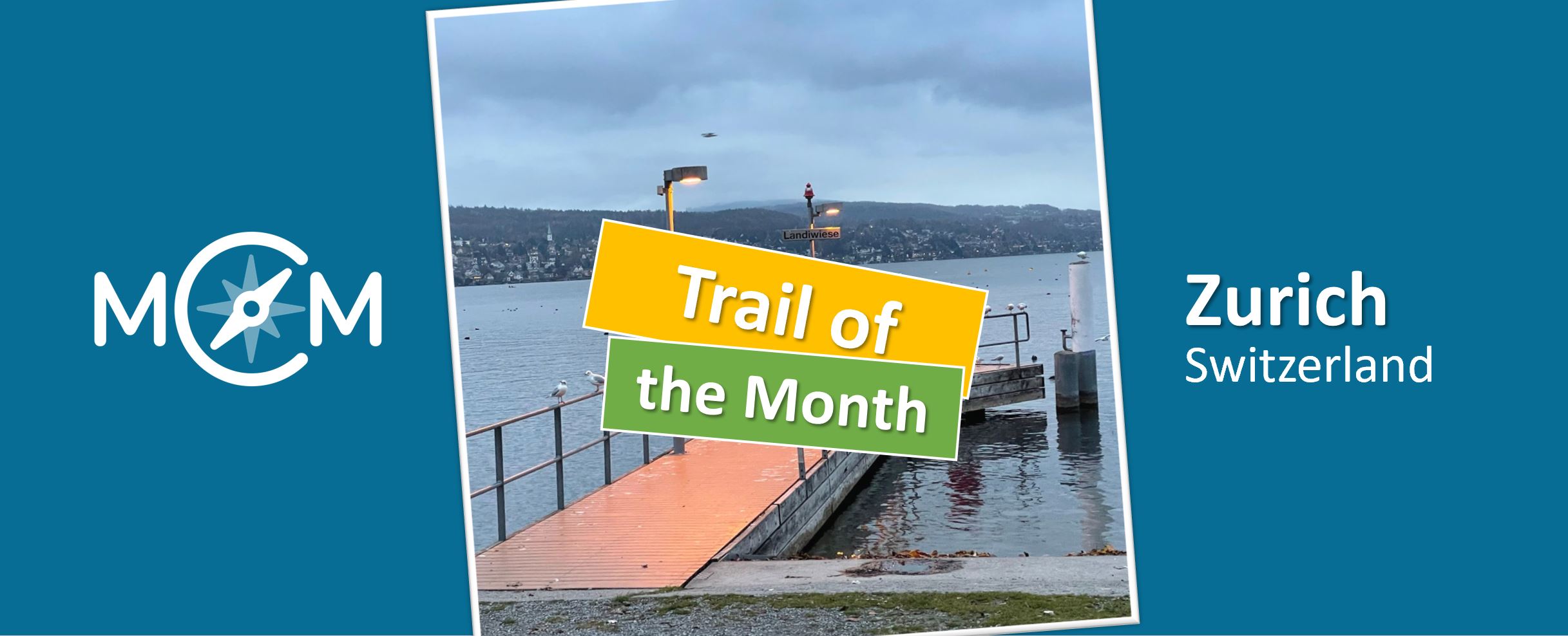
Trail of the Month: Counting, measuring, calculating and estimating between Sechseläutenplatz and the city border

The term mathematical walk could hardly be more apt than for the trail of the month March. This one comes from the largest city in Switzerland, Zurich. Here, Roland Wiss, a member of the school management and executive board of LIPSCHULE Zurich, has created the trail “Counting, measuring, calculating and estimating between Sechseläutenplatz and the […]

GeneralTrail of the Month

The term mathematical walk could hardly be more apt than for the trail of the month March. This one comes from the largest city in Switzerland, Zurich. Here, Roland Wiss, a member of the school management and executive board of LIPSCHULE Zurich, has created the trail “Counting, measuring, calculating and estimating between Sechseläutenplatz and the city border” (Zählen, Messen, Berechnen und Schätzen zwischen Sechseläutenplatz und der Stadtgrenze), which can be accessed in the MCM app under the code 257781 and is available on the MathCityMap web portal here.

The trail stretches over a total length of 2.8 km and, as the title suggests, leads from the centrally located Sechsläuteplatz along a walking path alongside Lake Zurich to the city border. A total of twelve interesting mathematical tasks with a wide variety of content can be found along the route, which not only offers a chance to marvel at the beautiful nature surrounding the city of Zurich. What most of them have in common, however, is that there seems to be too little data to solve them.

Roland Wiss explains among other things the concept of the trail in more detail in the following interview:


How did you come across the MathCityMap project?

I am always interested in different ways to show my students the beauty and excitement of mathematics. This includes mathematical problems from everyday life and especially outside the classroom. For this reason, I regularly search the internet for exciting math projects. In doing so, I came across the MathCityMap project, which immediately appealed to me.


Where is your trail located? What is special about your trail?

I walk every morning in Zurich from Stadelhofen station to Lipschule and since I am a big fan of Fermi questions, I had the idea to design this trail along my way to work. I call a Fermi question an estimation about a problem, where the students seem to have no or insufficiently accurate data at a first superficial glance. However, when their explorer and detective eyes are awakened, students notice that they can decompose the question into several sub-problems for which they can find exact or approximate solutions. Combining and completing the partial results, they arrive at an overall result that is very close to the actual value. My students like to deal with Fermi questions and they learn a lot. So it was obvious for me to create a trail on the topic “Counting, Measuring, Calculating and Estimating”. Since the Lipschule is a comprehensive school with different age groups, I wanted to create a trail that contains tasks for many age groups. In addition, there is the wonderful location at the lake and the possibility to extend the trail to a day trip with (at least in summer) a swim in Lake Zurich.


How do you use MCM and why?

We regularly have a mathematics project week. One workshop of this week is called “Mathematics outside” and has the following content: “Mathematics is everywhere. We explore the surroundings from Sechseläutenplatz to Lipschule with a mathematical eye”. The MathCityMap app is perfect for this. I especially like the fact that the students are outside thanks to the app and solve many tasks in teamwork. They are also actively involved and have to solve the tasks and problems using appropriate tools. The students learn not only mathematics, but also teamwork and the use of clever solution and organization strategies.


Describe your favorite task on the trail. How can it be solved?

My favorite task is called “Area of a hexagon” because it can be solved in different ways and by different ages. On the one hand, the older students can use the area formula for the hexagon 3*√3*s*s/2 and count the paving stones along the sides to determine the number. On the other side, there are hexagons of equal area in the square, which are filled with paving stones. Younger students, who do not yet know the area formula, can determine the number in a clever way by counting and estimating. Since the hexagons filled with pavers all have similar patterns, the students can also think about the method the paving contractor used to lay out the pavers. It is therefore a place and a task that can stimulate a variety of thinking processes.
The new trail world record goes to…

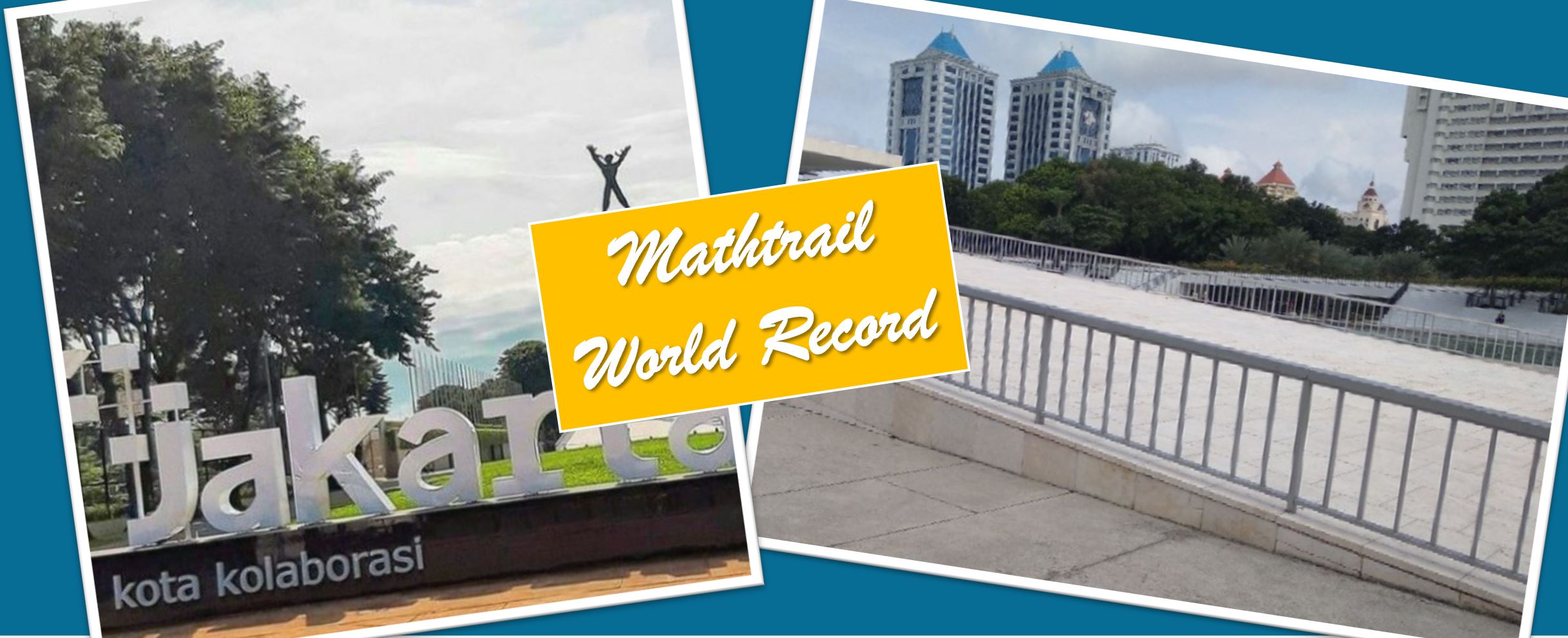
After almost two years, the time has finally come. A new Mathtrail takes the title of the most downloaded trail in the world! The previous record holder, the trail MCM@home (Ffm a. M.) by Matthias Ludwig with 477 app downloads, has now been replaced by a great trail from Jakarta in Indonesia. The trail Banteng […]

After almost two years, the time has finally come. A new Mathtrail takes the title of the most downloaded trail in the world! The previous record holder, the trail MCM@home (Ffm a. M.) by Matthias Ludwig with 477 app downloads, has now been replaced by a great trail from Jakarta in Indonesia.

The trail Banteng Berhitung was created by Yunas Chandra and has already been downloaded 569 times in the MCM app since its release on 09.12.2021.

Congratulations to the new record holder and we are curious when we will set a new record.

A short interview with the creator of the Mathtrail follows now in this article. Have fun reading!


How did you come across the MathCityMap project?

To be honest, I never guessed that my Mathtrail will be downloaded that many times. It’s a pleasure for me. This Mathtrail probably is the output from “Bimtek Penguatan Keterampilan Numerasi Guru Dikdas melalui Math City Map” which was held by Ministry of Education. It was a teacher training at which all the participants had to go outdoors to create a task and trail and “Banteng Berhitung” is my trail which consist of tasks of myself and other participants. So, I thought this reward must be declared for all the participants in that “Bimtek” especially who made the tasks that I used in my trail.


Please describe your Mathtrail.

“Lapangan Banteng“ is a historic square located in a historic area formerly known as Weltevreden. Formerly students could learn history and enjoy the beauty of “Lapangan Banteng” and now they can also learn about numeracy. Students can apply their math knowledge in real life so they can maintain and improve their numeracy skill.

How do you use MCM and why?

I really love to use this app, it can help us as teachers to make more interesting learning settings included in an outdoor activity. So far, students rarely use their math skills in their life problems. With MathCityMap they can learn how to apply them and they deepen their knowledge about math.


Describe your favorite task of the trail. How can it be solved and what can students learn from it?

“The City of Collaboration” is my favourite task. It needs numeracy skill to solve this, because if students don’t have it they will never get the answer. Its very simple to answer but people can easily type in the wrong answer too. They have to determine the area to be installed ceramics in and then divided it by the size of ceramics that is supposed to be use.

100 Trails in Slovakia

Great news from Slovakia! 100 math trails with MathCityMap have now been published there. The trails were created mainly by teachers of mathematics didactics, PhD students and student teachers at Constantine the Philosopher University in Nitra. In addition, MathCityMap has a strong community within primary teachers in Slovakia. The 100th public trail in Slovakia was […]

Great news from Slovakia! 100 math trails with MathCityMap have now been published there. The trails were created mainly by teachers of mathematics didactics, PhD students and student teachers at Constantine the Philosopher University in Nitra. In addition, MathCityMap has a strong community within primary teachers in Slovakia.

The 100th public trail in Slovakia was created in the small town of Želiezovce by Réka Veszprémiová. The trail entitled “Matematická prechádzka v Schubert parku v Želiezovciach” (Mathematical Trail in Schubert Park in Želiezovciach) consists of five tasks, is created for the 6th grade and covers a wide variety of topics, such as calculating the area of rectangles or finding the greatest common divisor.

Keep up the good work Slovakia!

Trail of the month: Math Trail di Fort Rotterdam Macassar

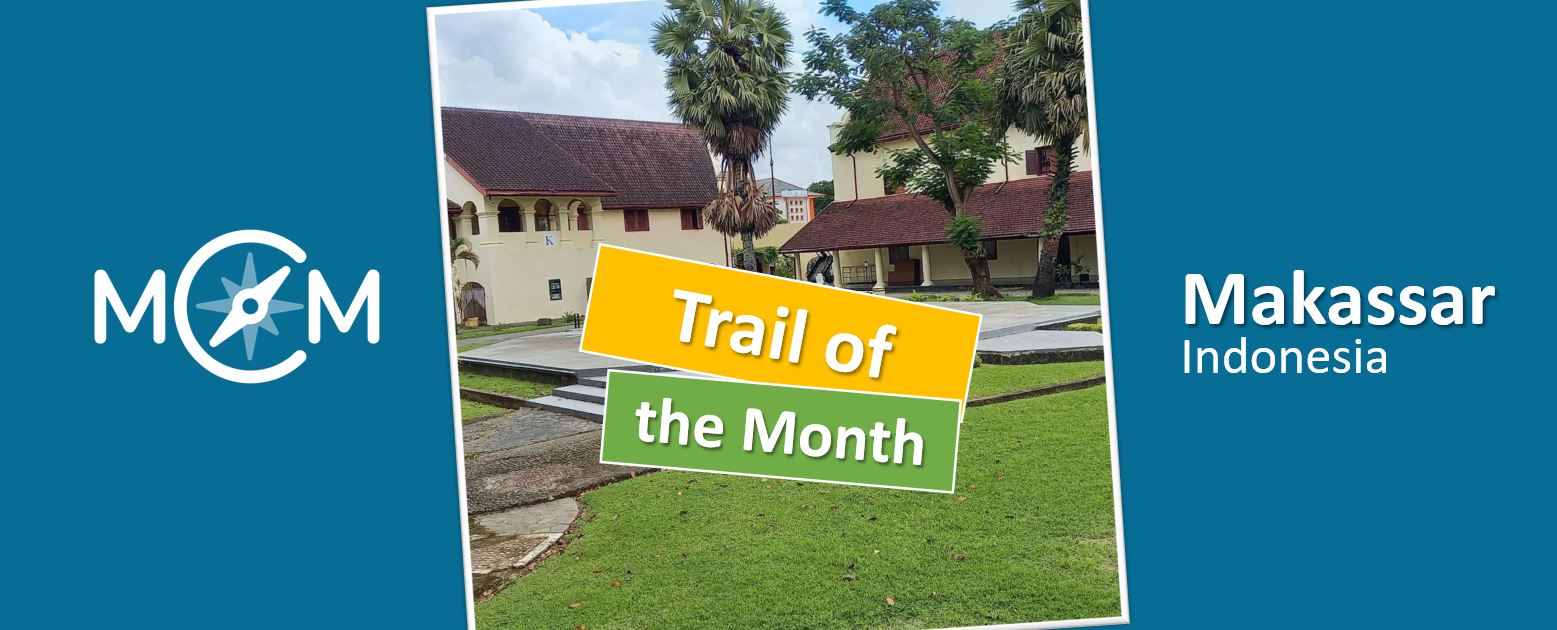
The Mathtrail of the month February comes from Indonesia, more precisely from the city of Makassar on the island of Sulawesi. Here, teacher Jamaluddin Tahuddin created the trail “Math Trail di Fort Rotterdam Makassar” a special math trail that leads through the historic fort of the city of Makassar with a total of six tasks. […]

GeneralTrail of the Month

The Mathtrail of the month February comes from Indonesia, more precisely from the city of Makassar on the island of Sulawesi. Here, teacher Jamaluddin Tahuddin created the trail “Math Trail di Fort Rotterdam Makassar” a special math trail that leads through the historic fort of the city of Makassar with a total of six tasks. The trail can be accessed on the web portal and in the app under the code 157539.

You can find a short interview with the creator of the trail below. Have fun reading it!


How did you come across the MathCityMap project?

Every year, students go on a study tour in Fort Rotterdam. They work on a project assignment to make a report given by the Indonesian teacher. After attending training on how to strengthen numeracy skills through the MathCityMap application, I was interested in making a Math Trail in Fort Rotterdam. In addition to doing historical tours, students will also be able to do numeracy activities at Fort Rotterdam. Thus, this activity can involve many subjects, including Mathematics, Indonesian, English, History, and Science.


Please describe your Mathtrail.

Fort Rotterdam is one of the historical places in the city of Makassar. Everyone including students in Makassar know this place. So far, they have only seen Fort Rotterdam from a historical perspective. But now they will also be able to look at Fort Rotterdam from a numeracy point of view. Inside the fort, I’ve selected several objects that can serve as numeric contexts. So that people who visit Fort Rotterdam will not only do historical tours, but can also do numeracy tours.


How do you use MCM and why?

Students can use the MathCityMap application for activities to practice numeracy skills outside the classroom.
Students are organized into several groups and each group consists of 3-4 students. Each group only needs 1 smartphone so that all students can be involved even though not all have smartphones. The slow speed internet connection is also not a problem because every math trail that students will complete can be downloaded first so that it can be used offline. Teachers can also know how students solve each of the numeracy problems through a worksheet which can be downloaded through the MCM application.


Describe your favorite task of the trail. How can it be solved?

My favorite trail task is Gerbang Gereja on the Math Trail in Fort Rotterdam City of Makassar. In addition to its unique shape, at the Church Gate students can also learn from the context of numeracy. In this task, students will calculate the maximum height of a box car that will carry cultural heritage objects into the building, the car has a width of 167 cm. To solve this problem, students must know the relationship between the radius of the circle, the slope, and the distance of the circle from the center of the circle.
Where the width of the box car is the minimum segment length and the distance from the center of the circle is the maximum height of the box car. So, to solve it, students must measure the width of the gate which is the diameter of the semicircular gate first.

Trail of the month: Mathtrail at the Zeppelin grandstand

The Trail of the Month January comes from the second largest city in the German state of Bavaria. Frederic Fell, a student of secondary school teaching, created the trail “Mathe-Rundweg an der Zeppelintribüne” in Nuremberg, which can be accessed in the MCM app under the code 273993. It is available in the web portal here. […]

Trail of the Month

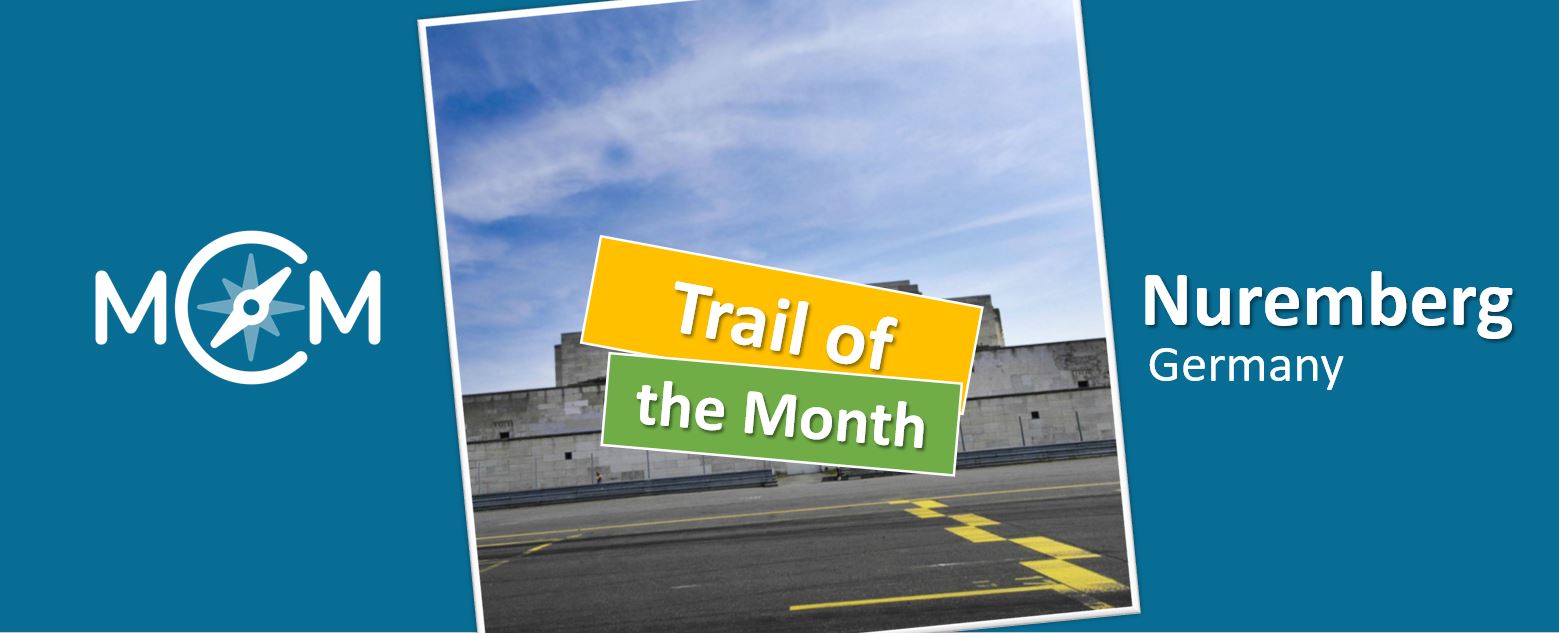
The Trail of the Month January comes from the second largest city in the German state of Bavaria. Frederic Fell, a student of secondary school teaching, created the trail “Mathe-Rundweg an der Zeppelintribüne” in Nuremberg, which can be accessed in the MCM app under the code 273993. It is available in the web portal here.

The trail, which consists of a total of nine tasks, was created in the direct vicinity of the Nuremberg stadium, the home of 1. FC Nuremberg (Der Club), partly on the former Nazi Party Rally Grounds. In addition to the mathematics tasks, you can also explore historical topics.


Here you can find a short interview with Frederic Fell:

How did you come across the MathCityMap project? How do you use MCM and why?

I am studying to become a secondary school teacher with the subject combination mathematics / physics at the Friedrich-Alexander-Universität Erlangen-Nürnberg. I am currently writing my admission thesis (similar to a bachelor thesis, but for student teachers) in the didactics of mathematics. My supervisor Stephanie Gleich offered the topic “MathCityMap” and I was immediately interested. This admission thesis is, among other things, about extracurricular learning places, but also about modeling. The practical part of the work is my trail.


Where is your trail located? What is special about your trail?

My trail is located in Nuremberg on the former Reichsparteitagsgelände, which was used as a place for propaganda during Nazi times. Today the area is used in many different ways, as a recreation area, as a DTM race track or as a venue for the “Rock im Park” festival.
The special thing about the trail is that the relics from the Nazi era are used for better purposes, like a math trail. Of course the Reichsparteitagsgelände is a place of history, but I think it’s great how you can also learn something about math in such a place. The trail is set for ninth grade students at the Realschule. My intention is that the trail can be used as a field trip at the end of ninth grade. So we hike, do a little math and afterwards we can have a picnic at the Dutzendteich.


Briefly describe one of your tasks. How can it be solved?

I would like to describe the task “Rainbow” in more detail. 8 pillars were painted on the grandstand. You have to determine the painted area. One pillar is too big to measure. With the help of the picture you can see that 4 rectangular plates were painted on each pillar. The area of a rectangular plate can be determined. This must be taken times 4 to determine the area of a pillar and this in turn times 8 to calculate the total area. This task is varied and requires a bit of “thinking around corners”. The photographer has provided me with the rights for the pictures used in this task.


Do you have any other comments about MCM?

MCM is a really great project and I’m glad I was able to work with it as part of my graduate thesis. When I’m a trained teacher, I’ll definitely incorporate math trails like this into my teaching.

Trail of the month: Olomouc centrum (jednodušší)

The trail of the month December comes from the Czech Republic. Adéla Pantělejevová created the trail named “Olomouc centrum (jednodušší)” in the city center of Olomouc, the sixth largest city in the Czech Republic in the east of the country, while working on her thesis at Palacký University Olomouc. The trail can be accessed via […]

Trail of the Month

The trail of the month December comes from the Czech Republic. Adéla Pantělejevová created the trail named “Olomouc centrum (jednodušší)” in the city center of Olomouc, the sixth largest city in the Czech Republic in the east of the country, while working on her thesis at Palacký University Olomouc. The trail can be accessed via the MCM app using the code 795612. It is available on the web portal here.

In total there are seven tasks, designed directly on the prominent buildings of the old town. So while walking the trail, you also get to know the most beautiful sides of Olomouc. You will find a short interview with Adéla on the trail and her experiences with MathCityMap below. Enjoy reading!


How did you come across the MathCityMap project?

Once our wonderful teacher Dr. Lenka Juklová arranged a lecture by Dr. Soňa Čeretková, which was about MCM (Soňa Čeretková is working on the MCM project in Slovakia) and I became very interested in this topic. During the lecture we had a chance to do a mathtrail around the faculty and I thought it would make a great topic for my thesis, since it had not been done in the Czech Republic yet. Dr. Juklová even suggested this topic to me so I am currently working on it under the supervision of Dr. Patrik Peška at the Palacký University Olomouc.


Please describe your Mathtrail.

This particular trail is designed mainly for primary school children. It was created as part of my thesis. Most of the existing trails are designed for high schoolers, however, I wanted to create a trail for younger learners too. It is very playful, fun, and intends to show how math can be connected to other school subjects and be found anywhere, in this case in the Upper Square in Olomouc. Although my studies are focused mainly on high school mathematics, I tutor also younger children and since several of them live around the center of Olmouc I wanted them to enjoy maths through MathCityMap aswell. I also implemented the pirate theme in my lessons, which should make the whole trail more interesting for children.


How do you use MCM and why?

My goal is to show teachers how to make mathematics interesting and fun, how to use the modern technology which is available for us, and moreover to show students that mobile phones and the internet don’t have to be used only for playing games or buying clothes online, but that they can be also helpful for looking up information, educating themselves, etc.. Furthermore, I recommended these trails to my friends and classmates, who are mostly secondary school teachers and high school teachers. Some of them had already started using it in their classes or it served them as a template for creating their own trails. One of my friends is now using MCM even in his physics classes.

My friend and I are currently trying to collect some task ideas for creating a template, which could be used in a lot of different places. What we have prepared so far can be soon used in other cities. I’m very much looking forward to it.


Describe your favorite task of the trail. How can it be solved and what can students learn from it?

My favourite task of this trail is definitely “Orloj”. It is a task with several sub-tasks, in which you have to understand the meaning of each dial and determine the number and type of different ornaments.. Students get to practice hours, days, weeks, months of the year, zodiac signs, as well as orientation and location, basic arithmetic along with characters and occupations. This task is not just about mathematics, rather it also tests general knowledge of third grade students. In the task students have to choose their answers from a list of options, add numbers and names to blank spaces, etc.. So it is not like other tasks where their answers have to fall within a certain interval.

Trail of the month: Tracing circles and bodies in Hanover

  November’s Trail of the Month comes from the capital of the German state of Lower Saxony. The trainee teacher Franziska Hormann created the trail “Circles and bodies on the trail in Hanover”, which can be accessed in the MCM app under the code 386349. It is available in the web portal here. On this mathtrail […]

Trail of the Month


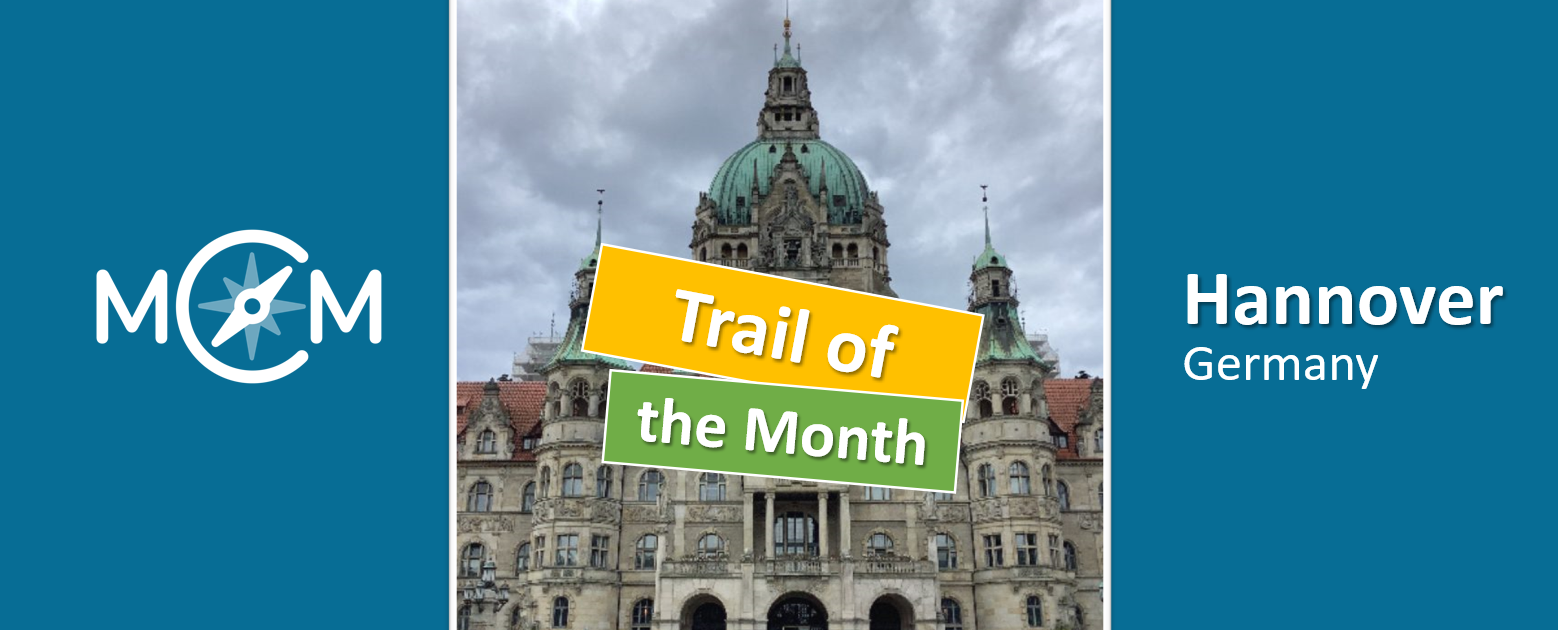
November’s Trail of the Month comes from the capital of the German state of Lower Saxony. The trainee teacher Franziska Hormann created the trail “Circles and bodies on the trail in Hanover”, which can be accessed in the MCM app under the code 386349. It is available in the web portal here.

On this mathtrail you will find a total of nine tasks implemented on the buildings and artistic sculptures of Hanover’s city center.


How did you come across the MathCityMap project?

As a former student at Goethe University, I was already able to get to know MCM during my studies in the module Upper School Didactics, where I also designed my first tasks. In Frankfurt, the app is widely used, so I was surprised that in Hanover, where I am currently completing my traineeship, there are only a few MCM trails and the project was hardly known among teachers or at our study seminar. However, my interest in sharing and spreading it in my home region was correspondingly great, especially since the beautiful old town of Hanover offers ample opportunities to apply mathematics…


Please describe your Mathtrail.

The Mathtrail is specially designed for the topic of circle and solid calculation, which is taught in the 10th grade in Lower Saxony. On a circular route through the old town past well-known places such as the New Town Hall, the Market Hall and Church or the Ballhof, students can apply their knowledge of the circumference and area of circles, surface area and volume of cylinders and spheres and test it on authentic problems.
The trail is particularly suitable at the end of the unit, when all the formulas are already known and the constructed tasks from the textbook have had their day. I myself tried it out as part of a project day with a 10th grade class, and since the topic is usually taught at the end of the school year in Lower Saxony, such a project day before the vacations is particularly worthwhile, on the one hand to do mathematics in the world around us at an extracurricular learning site, and on the other hand to offer an alternative to the annual movie watching in the last few weeks.


How do you use MCM and why?

Since I am still at the beginning of my professional life, I have so far only used MCM for this specific trail in the said 10th grade. In my opinion, MCM is especially (but not only) suitable for geometry topics, in which I will gladly use it again in other grades. On the one hand, as a teacher myself, it is a pleasure to design the tasks and to rediscover old familiar things with a different view. In addition, the possibility of publishing the paths means that other teachers can also benefit from the efforts. On the other hand, I feel it is important to experience mathematics in real-life contexts that are as authentic as possible, to become active myself and to have to puzzle. MCM can make all this possible with well-set tasks, where the groups have to coordinate and find heuristic strategies for calculating solutions together, which also promotes their ability to work in a team.
Last but not least, out-of-school learning venues are rare in the subject of mathematics. MCM makes it possible, regardless of the proximity to facilities such as the Mathematikum in Giessen, etc., to design an extracurricular learning venue that can be adapted to one’s own lessons with manageable effort and thus make mathematics experienceable in a different way.


Describe your favorite task of the trail. How can it be solved?

I believe that all tasks have their charm and sometimes require less and sometimes more modeling competence. I like the starting task of the trail with the Hase fountain, for example, because in the beautiful brick backdrop between the Old Town Hall and the Market Church, you first have to perceive this historic structure simplified as a cylinder and then come to the determination of the water volume via various paths, the circumference of the basin or the partly estimated radius, whereby the correct unit must not be neglected at the end. In this task you also have to have the courage to hold the folding rule properly in the water for once.
I like tasks where the solution is not immediately obvious and where you have to fiddle a bit without increasing frustration. That’s why the solution interval should not be too small, which I learned myself during the test.

Article on MathCityMap in Stuttgart’s Newpaper

Already in the last week, we reported on the opening of the MATHE.ENTDECKER trails around Stuttgart’s stock exchange. We are happy that the event was also reported in the Stuttgarter Zeitung at the 20.04.2018 and would like to share this article with you: High school students on the math path School students use a smartphone […]

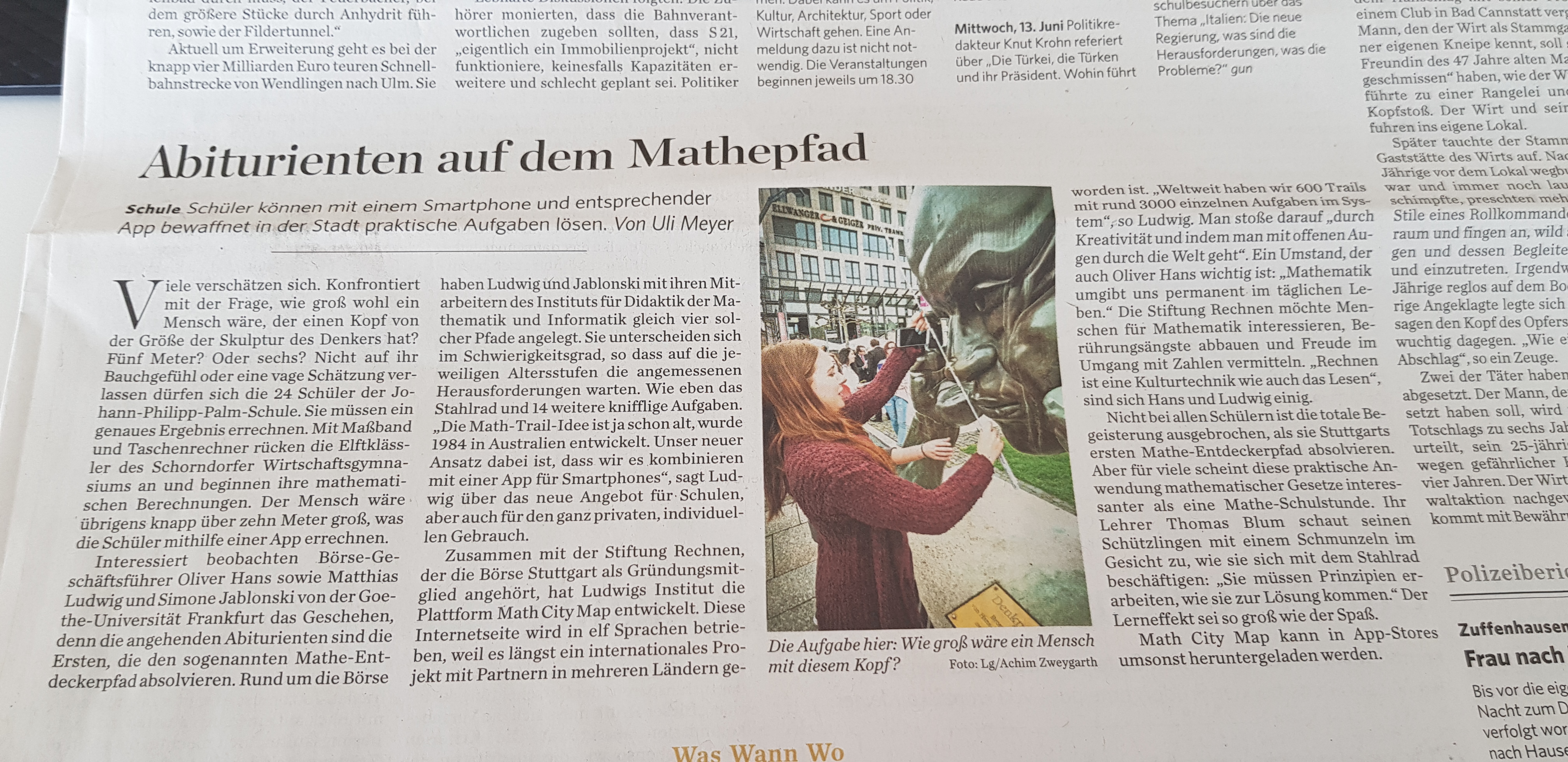
Already in the last week, we reported on the opening of the MATHE.ENTDECKER trails around Stuttgart’s stock exchange. We are happy that the event was also reported in the Stuttgarter Zeitung at the 20.04.2018 and would like to share this article with you:

High school students on the math path

School students use a smartphone and corresponding app to solve practical tasks. Uli Meyer

Many people are wrong being confronted with the question of how big a person would be with a head the size of the sculpture of the thinker. Five meters? Or six? 24 students of Johann Philipp Palm School cannot rely on their feeling or a vague estimate. They have to calculate an exact result. The 11th graders of the Schorndorfer Wirtschaftsgymnasium start with measuring tape and calculator and begin their mathematical calculations. Incidentally, the human would be just over ten meters tall, which the students calculate with help of the app. Managing Director of Stuttgart’s stock exchange, Oliver Hans, and Matthias Ludwig and Simone Jablonski from the Goethe University Frankfurt watch the happenings, because the aspiring high school students are the first to complete the so-called math discovery trail. Around the stock exchange, Ludwig and Jablonski and their staff of the Institute for Didactics of Mathematics and Computer Science have created four such trails. They vary in difficulty and challenge different ages, like the steel wheel and 14 other tricky tasks. “The Math Trail idea is already old and was developed in 1984 in Australia. Our new approach is that we combine it with an app for smartphones, “says Ludwig about the new offer for schools, but also for the very private, individual use.

Together with Stiftung Rechnen, where Stuttgart’s stock exchange is a founding member, Ludwig’s institute has developed the MathCityMap platform. This website is translated in eleven languages, ​because it has become an international project with partners in several countries. “Worldwide, we have 600 trails with around 3000 individual tasks in the system,” says Ludwig. One encounters it “through creativity and through the world with eyes open”. A circumstance that is also important to Oliver Hans: “Mathematics surrounds us permanently in our daily lives.” Stiftung Rechen would like to interest people in mathematics, to reduce fear of contact and to convey joy in dealing with numbers. “Arithmetic is a cultural technique as well as reading”, Hans and Ludwig agree. Not all students were enthusiastic when they completed Stuttgart’s first math discovery trail. But for many, this practical application of mathematical tasks seems more interesting than a math lesson. Their teacher, Thomas Blum, watches his students with a smile on their faces as they study the steel wheel: “They must work out principles as to how they can come to a solution.” The learning effect is as great as the fun.

MathCityMap can be downloaded for free in App Stores.

MCM in Kappeln – a great success

Even in the summer holidays, MathCityMap is demanded. At the “Mathe Magie” exhibition in Kappeln, Iwan Gurjanow and Matthias Ludwig created various Mathtrails especially for the city of Kappeln. One can choose between the family trail and trails for different grades. Rebecca Nordmann from “Schleiboten” wrote a wonderful text about the Mathtrail which expresses the […]

General

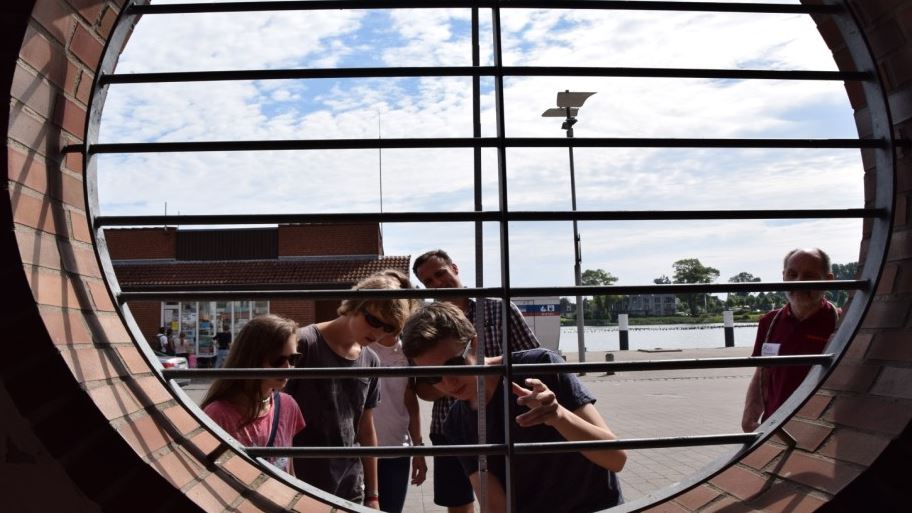
Even in the summer holidays, MathCityMap is demanded. At the “Mathe Magie” exhibition in Kappeln, Iwan Gurjanow and Matthias Ludwig created various Mathtrails especially for the city of Kappeln. One can choose between the family trail and trails for different grades.

Rebecca Nordmann from “Schleiboten” wrote a wonderful text about the Mathtrail which expresses the mood in solving the tasks and which we want to share with you. We further want to thank for the photo taken by Rebecca Nordmann.

MathCityMap at the ICTMT 13 in Lyon

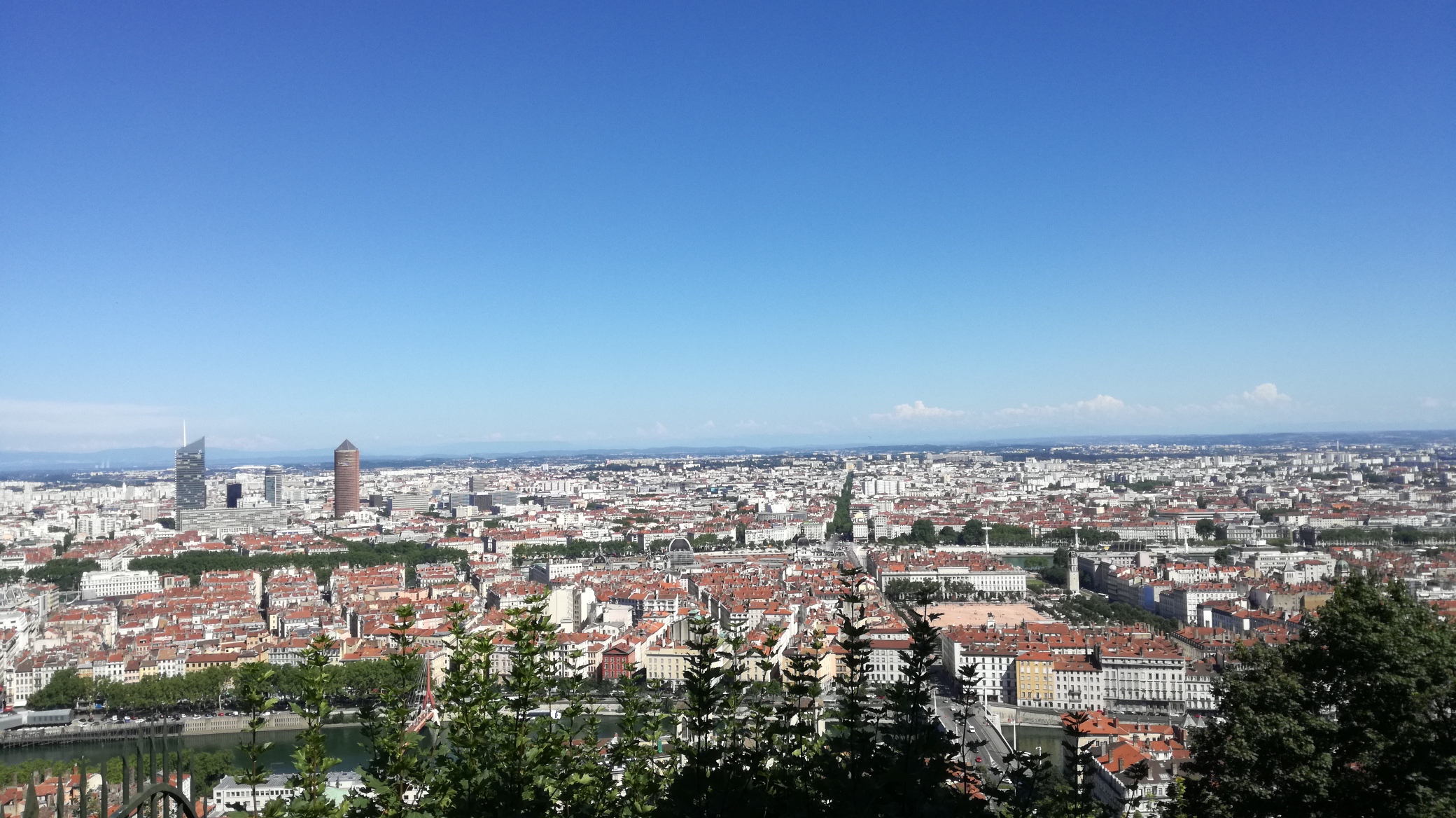
The MathCityMap project was presented at the ICTMT conference in Lyon (3 – 6 July 2017) by Iwan Gurjanow. The focus of the performance was on the MCM app and the different gamification modes (correct-false feedback, points, leaderboard) related to the intrinsic motivation. Further, the first results of the study conducted in June were presented. […]

Events

The MathCityMap project was presented at the ICTMT conference in Lyon (3 – 6 July 2017) by Iwan Gurjanow. The focus of the performance was on the MCM app and the different gamification modes (correct-false feedback, points, leaderboard) related to the intrinsic motivation. Further, the first results of the study conducted in June were presented. More on this topic will soon be available in the publications section.  

Mathtrail on the terrain of the ENS (École normal supérieure de Lyon)

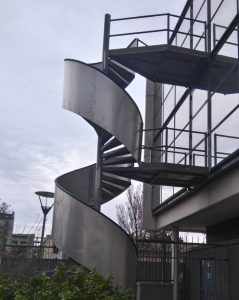
In addition to the presentation there was also a Mathtrail in the garden of the ENS (meeting place) created by Prof. Dr. Christian Mercat (l’Université Claude Bernard Lyon 1). At the conference, the participants were given the opportunity to solve the Mathtrail exercises on their own. The best solutions were awarded a prize. Many participants tested the app with best weather and discussed about the tasks, which can often be solved in different ways. One example is the staircase shown below, in which the area of ​​the edge of the staircase was determined.

It was a successful conference and we are already looking forward to the next one: ICTMA in Cape Town (South Africa)!