Adrian Schrock, math teacher at the Weibelfeldschule in Dreieich (Germany), has created our new Trail of the Month. The tasks of the math trail aim at the topics Theorem of Pythagoras and the Intercept Theorem. By this example we want to show how you can create so-called theme-based math trails with close curricular links. In this interview Adrian Schrock talks about his experiences with MathCityMap.

How do you use MCM and why? What is special about your trail?

I currently use the trail „Unseren Schulhof mit Mathe entdecken“ (engl.: “Discovering our schoolyard by doing maths”) in my 9th grade in the subject area “Pythagorean theorem” and ” Intercept theorems” and would like to increase the motivation for problem solving in class.

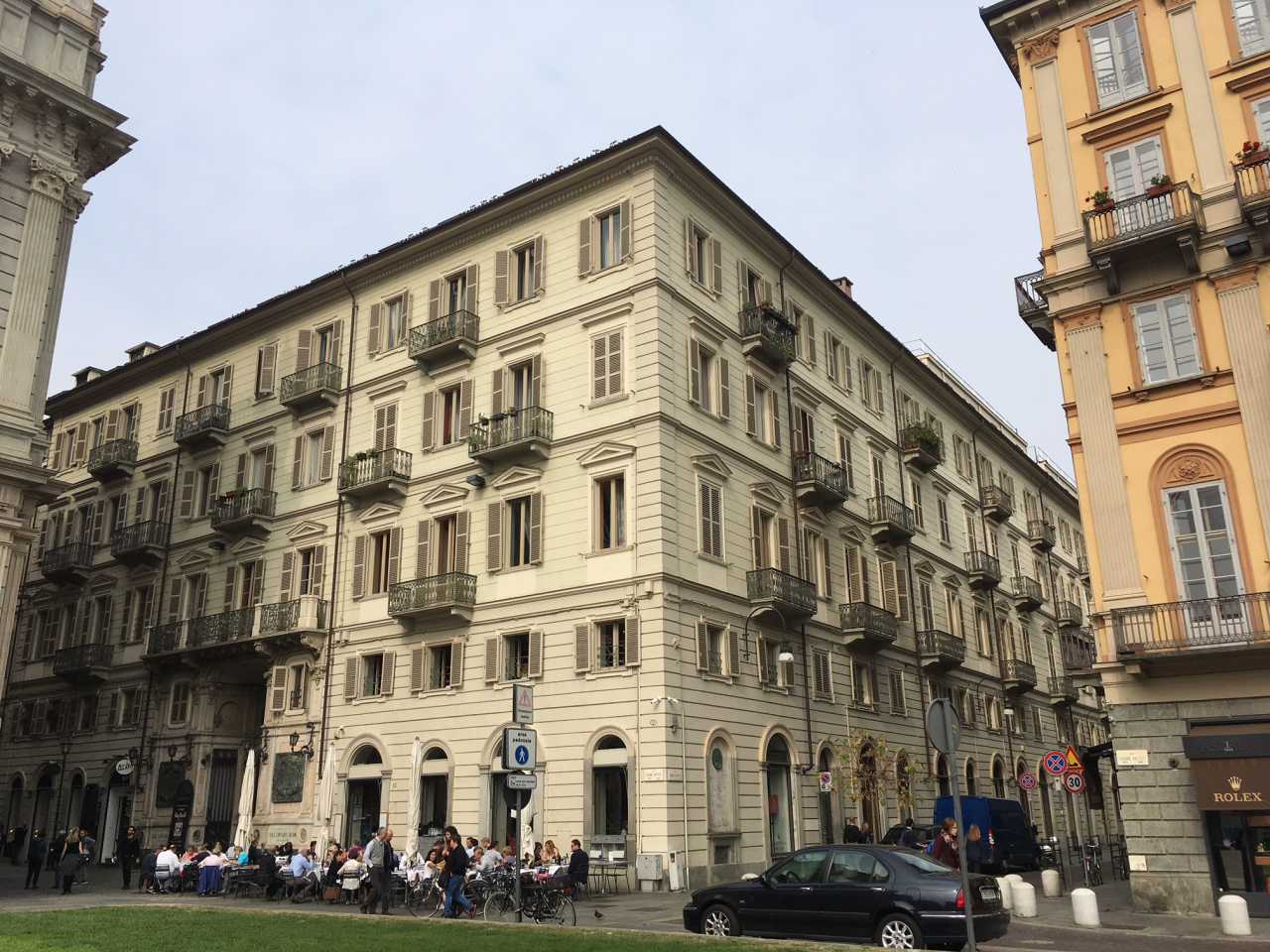
What is special about my trail is that all the tasks are in the schoolyard and combine the topics “Pythagorean theorem” and “Intercept theorems”. Not only inaccessible variables like the height of the school building can be calculated, but also by reversing the theorems both the 90° angle and the parallelism can be checked using objects in the schoolyard.

The first task is explicitly intended as an introduction to working with the Mathtrail and should be carried out in small groups in the classroom. I have already tested this successfully in class and had the advantage that the SuS first get to know the app and possible questions can be clarified directly in the plenum.

In order to increase the relevance of the tasks, a short story is formulated in my descriptions “About the object”, which shows why the question could be interesting. For example: “Between the columns a screen for a stage set can be hung up. A teacher wants to know for a performance of the Performing Play in an open-air theatre whether the screens are parallel to each other”. The stories are, of course, made up, but may answer the question of the students “Why would you want to know that?”.

What didactic goals do you pursue?

On the one hand, the trail aims to specifically promote motivation for problem solving in the 9th grade. On the other hand, by focusing on the selected topics, the trail has the additional purpose of being able to apply the teaching content to real objects and thus deepen the knowledge. The advantage of this is that it is clear from the starting situation of the SuS that previous knowledge is required for the trail. A disadvantage is, of course, that if you work on other class levels, your motivation might be lower, because you don’t see any connection to your current lessons.

Further remarks about MCM?

Small wish to the MCM team… the Task Wizard lacks task types to determine heights or to check for example parallelism or something similar to my trail. Maybe you could add some more topics here.

I find the structure of the website and especially the feedback to the created tasks very good – thanks a lot to the MCM team!
At the beginning of the month, Iwan Gurjanow presented the MathCityMap project in Sweden at the PME conference. Of course, around the location, different tasks were created as our current Task of the Week.


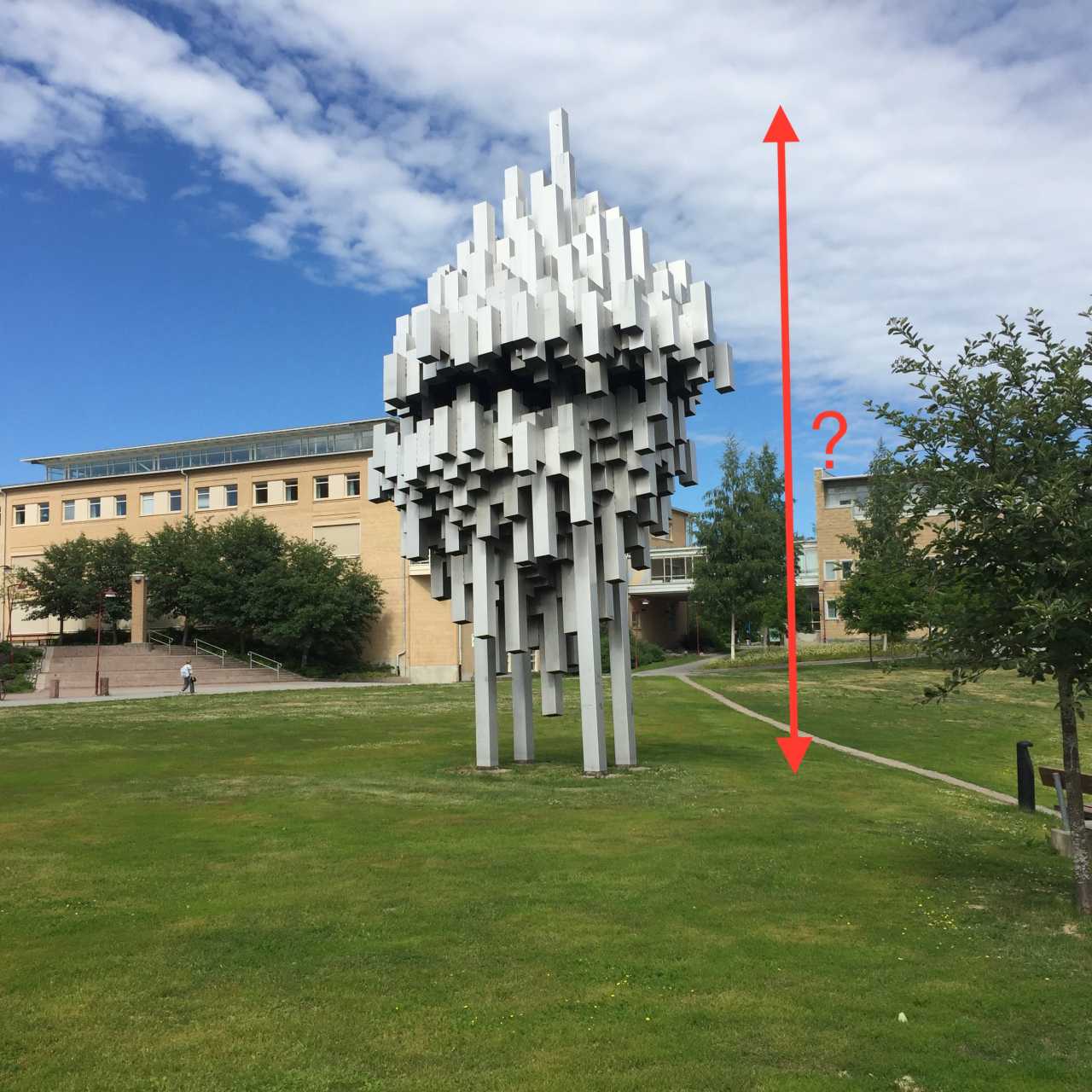
Task: Height of the Statue (Task Number: 4303)

How high is this statue? Give the result in meters.


The task can be solved via different approaches. On the one hand, it is possible to estimate how often a person with a known height fits into the heigth of the statue.

A more elaborated approach is the application of the intercept theorem, which is shown in the hint picutre. One can use the folding ruler as object of reference.


Today we would like to introduce you to our generic tasks concerning the height of buildings. This topic offers the opportunity to do math for different grades.

The height of buildings can already be determined with grade 5 students if regularities and patterns are identified: https://mathcitymap.eu/en/portal-en/?show=task&id=2045

These may e.g. be bricks, glass panes or plates, of which one or more can be measured to determine the total height by means of the total number.

Such a question thus trains the mathematical view on regularities and patterns in the environment.

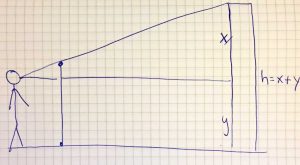
The difficulty of the task increases as soon as the building has no regularities. The height can then be determined with the help of the intercept theorems.

https://mathcitymap.eu/en/portal-en/?show=task&id=3171

There are various possible solutions for this, for example using the sun’s position in suitable weather conditions, using smaller objects (such as lanterns) or using the folding rule. In this case, it is particularly helpful to make a preliminary sketch of the situation in order to facilitate the application of the intercept theorems.

Important in both cases is a marking in the task or image, which makes it clear to what point the height should be determined, for example, if you want to ignore a front building.

The document Height of Buildings contains our detailed description of both types of tasks.

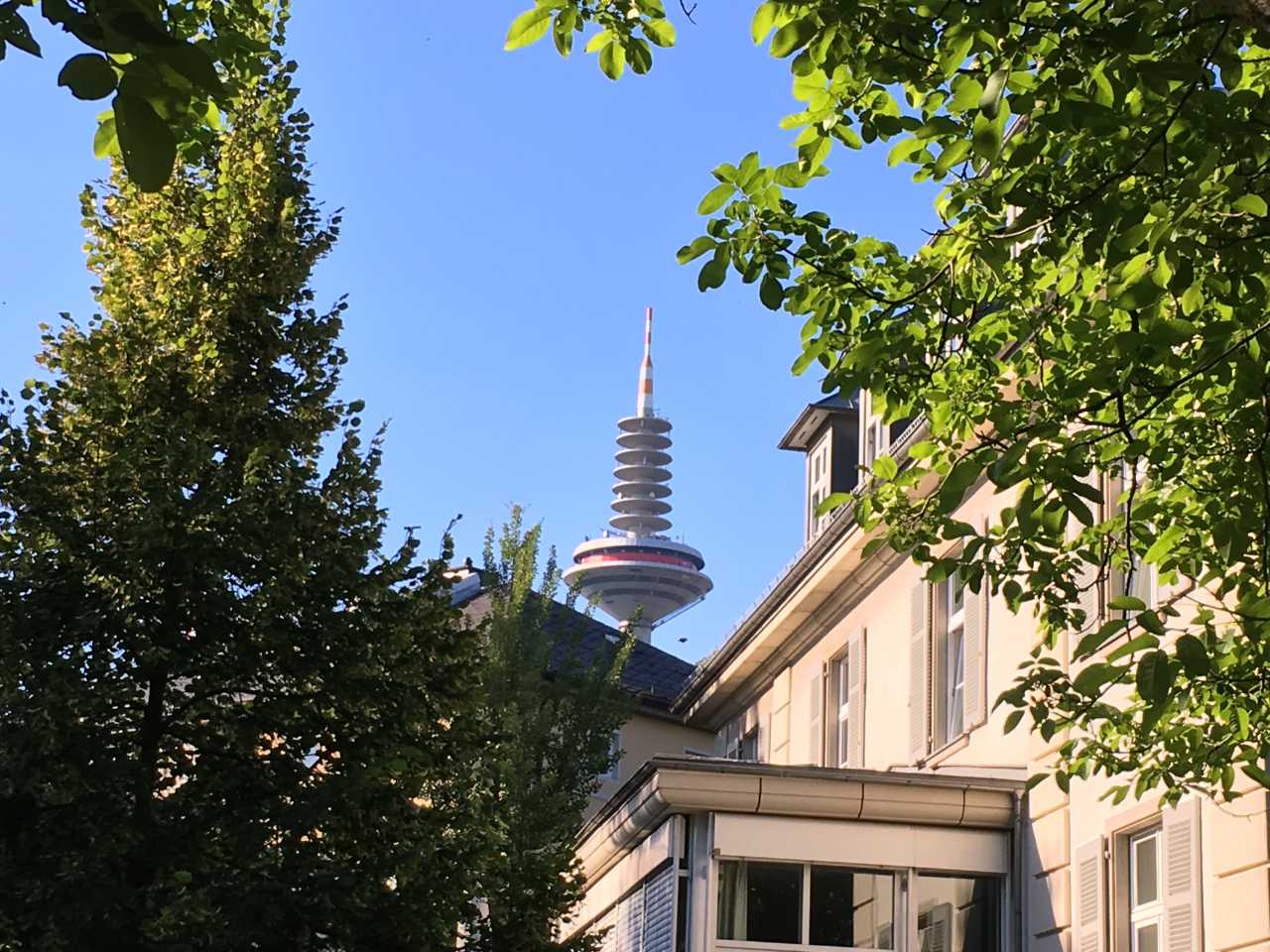
The current Task of the Week deals with one of the many landmarks of Frankfurt: the Europe tower, also known as “asparagus”. The related task is to estimate the own distance to the tower using the intercept theorems.


Task: Europe Tower (task number: 1595)

Determine the distance from your location to the Europe Tower. Give the result in meters. Info: the pulpit has a diameter of 59 m.


The first challenge is to find a suitable solution. With the aid of the intercept theorems, the task can be solved with the use of one’s own body. The arm and thumbs are streched so that the pulpit of the tower is covered with one eye opened. Afterwards the distance to the tower can be calculated with help of the thumb width and the arm length or distance from thumb to eye.

The task is a successful example of “outdoor mathematics” by using the theoretical formulas (here: intercept theorems) in an authentic application in the environment. To solve the problem, the students need knowledge about the intercept theorems. The task can thus be assigned to geometry and can be solved from class 9 onwards.

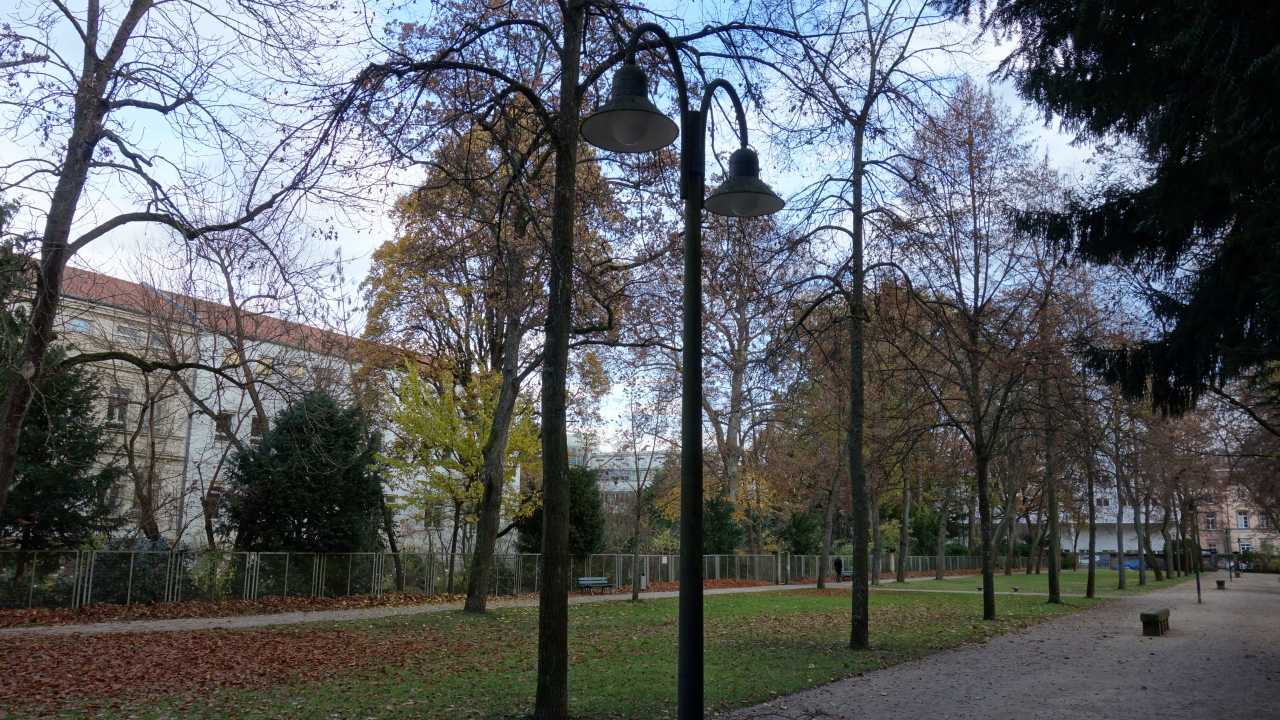
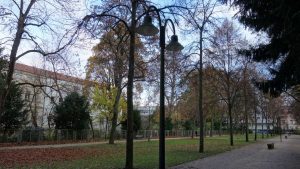
This week the “Task of the Week” focuses on a typical application of the intercept theorems. In particular, it is about the height determination of objects using the interception theorems. This task type can be transferred to many different objects and can therefore be found in further MathCityMap trails. The here described example is about the height determination of the lanterns in the garden of Erlangen’s castle.


Task: Illumination of the Castle Garden (task number: 709)

Determine the height of the two-armed lamps in the castle garden in the unit cm.


To solve the problem, the second intercept theorem is required. For this purpose, the pupils position themselves a few meters away from the object and fix the object. The intercept theorem can then be applied using the measuring stick. For this, the eye height as well as the distance to the object must be measured. With the arm outstretched, the measuring stick is held so that its tip coincides with the upper end of the lantern. The length of the arm and the scale length, which corresponds to the height of the lantern from the height of the eye, lead to the height of the lantern.

This is a problem-solving situation in which initially missing values have to be determined by a suitable initial situation. The application of the interception theorem can in this case be facilitated through the preparation of a sketch. The task is particularly suited to show students the practical application of the interception theorem and to give a meaningful content to the calculus.