Task of the Week: Fountain

Our new Task of the Week is located in Slovakia. In the town Nové Zámky, Aneta Vadkerti created the task “Fountain” and the math trail “Learn something new”. How do you get in contact with MathCityMap? A few weeks ago, a colleague of mine told me about this amazing mathematics application, which I could use […]

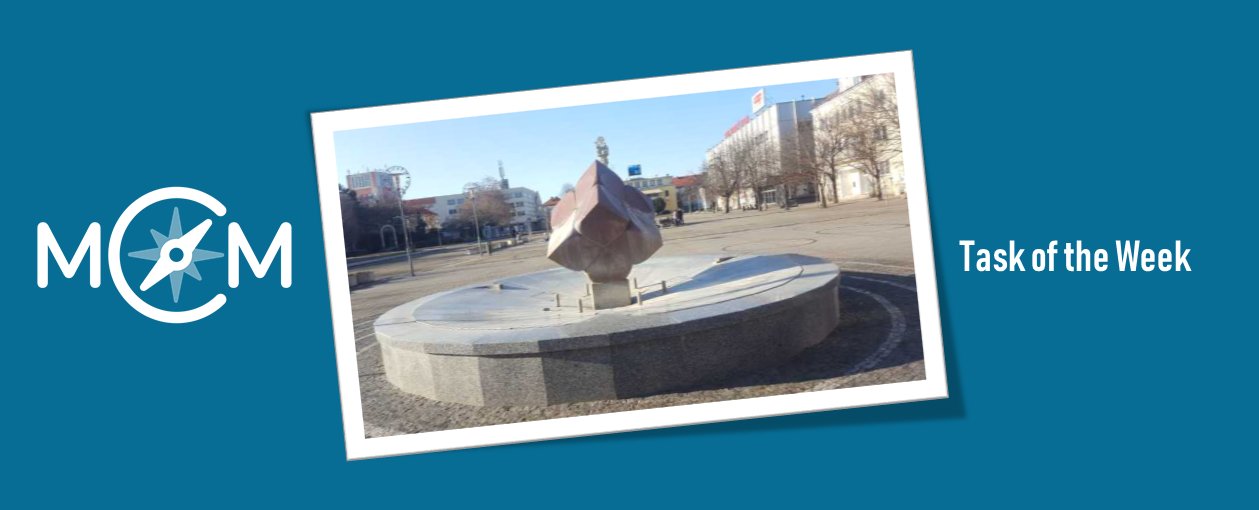
Our new Task of the Week is located in Slovakia. In the town Nové Zámky, Aneta Vadkerti created the task “Fountain” and the math trail “Learn something new”.

How do you get in contact with MathCityMap?

A few weeks ago, a colleague of mine told me about this amazing mathematics application, which I could use while teaching. Veronika Bockova, who studies Mathematics in a nearby town, helped me to get familiar with it. When I later used it with my students, they were so excited that it motivated me a lot and I even tried to make my own trail.

Please describe your task.

My task “Fountain” is placed in the city centre, in the pedestrian zone in Nové Zámky, in Slovakia. The question is to figure out the radius of the fountain. As there is usually water in it, you can not just measure the radius. You have to measure the circumference of the fountain. And as the fountain is in a circle shape, you can find out length of the radius by using the formula C = 2πr. To calculate the radius, we use r = C/2π. 

Which didactic aims do you want to stimulate through this task?

This is a kind of procedural task, which can provide students with a good practise of procedures. I focused on the knowledge students already possess. I also intended to stimulate logic thinking and problem solving through experiencing learning in a real-life situation – not only on theoretical, but on practical level, too.

Do you have any other commentary on MathCityMap?

Me and my students love the application MathCityMap. Students are outside, they are moving, breathing fresh air.  There is a lot of group work, brainstorming, they help each other. They learn new interesting facts about the town and its history. And furthermore, they realise the big meaning of mathematics in life.
Task of the Week: Old Oak Tree

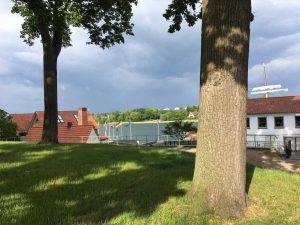
How can the age of a tree be approached using mathematics? This question addresses the current Task of the Week. It is placed in this form in Kappeln, but can be easily and quickly transferred to other places. Task: Old Oak Tree (issue number: 1473) How old is this oak tree? It is known that […]

Task of the Week

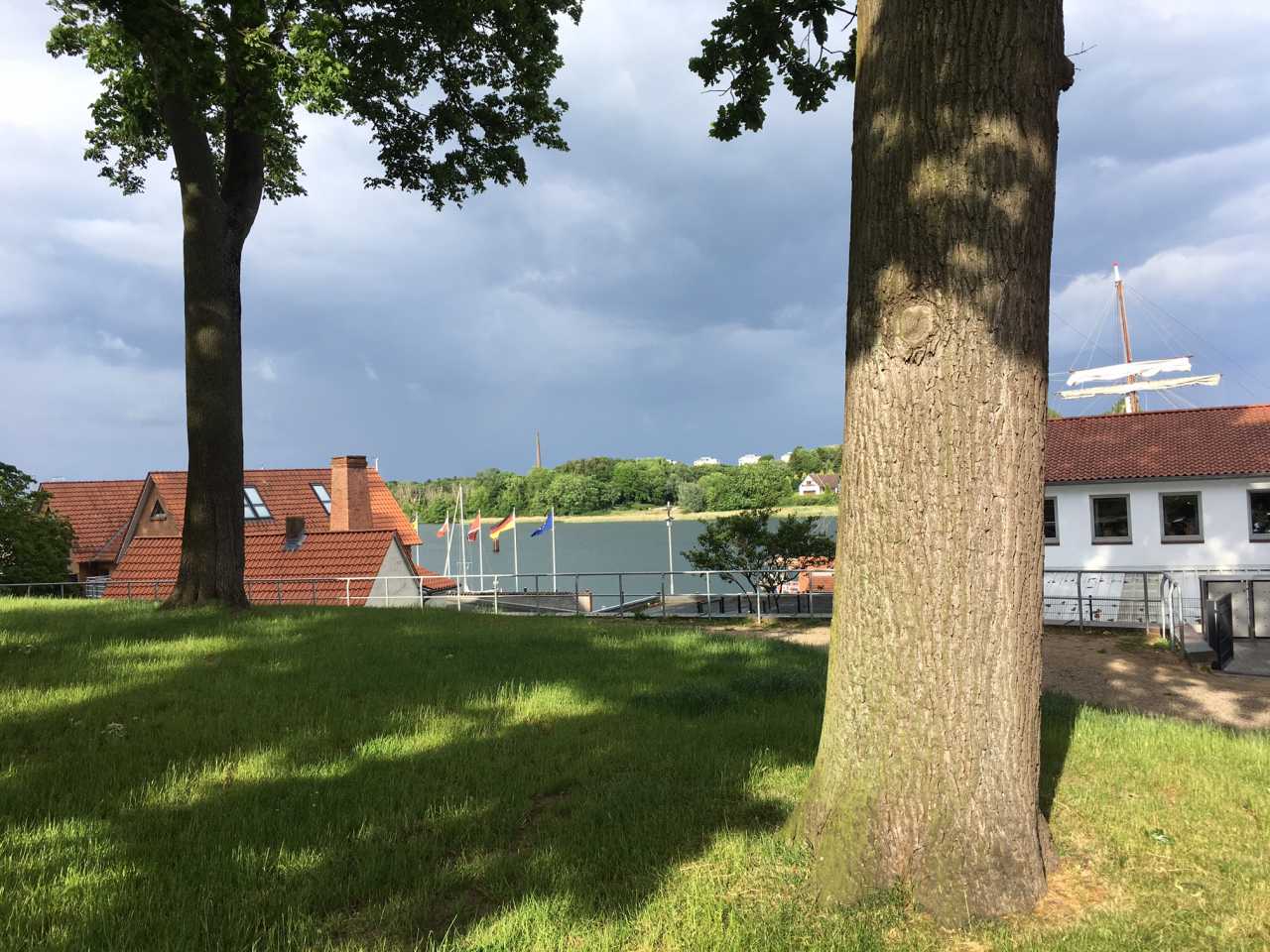
How can the age of a tree be approached using mathematics? This question addresses the current Task of the Week. It is placed in this form in Kappeln, but can be easily and quickly transferred to other places.


Task: Old Oak Tree (issue number: 1473)

How old is this oak tree? It is known that an oak with a diameter (in breast height) of 50 cm is about 110 years old.


In order to solve the problem, it is assumed that the growth of the oak is linear. This means that the average growth per year can be determined using the information in the text. Subsequently, the circumference in the height of the chest is measured and the diameter is determined by means of the relationship between the circumference and the diameter of a circle. This then leads to the age of the tree.

On the one hand, the problem can be classified in the geometric topic of the circle and, on the other hand, proportionality. If the relationship between the diameter and the circumference is already discussed at this time, the task can be used from class 6 onwards.

Task of the Week: Cylinder on the Rhine

The present task of the week is about geometric figures. In the task “Cylinder on the Rhine”, located in Cologne, the aim is to determine the radius of a cylinder by means of measurements or the relationship between radius and circumference of a circle. Task: Cylinder on the Rhine (task number: 1183) Determine the radius of […]

Task of the Week

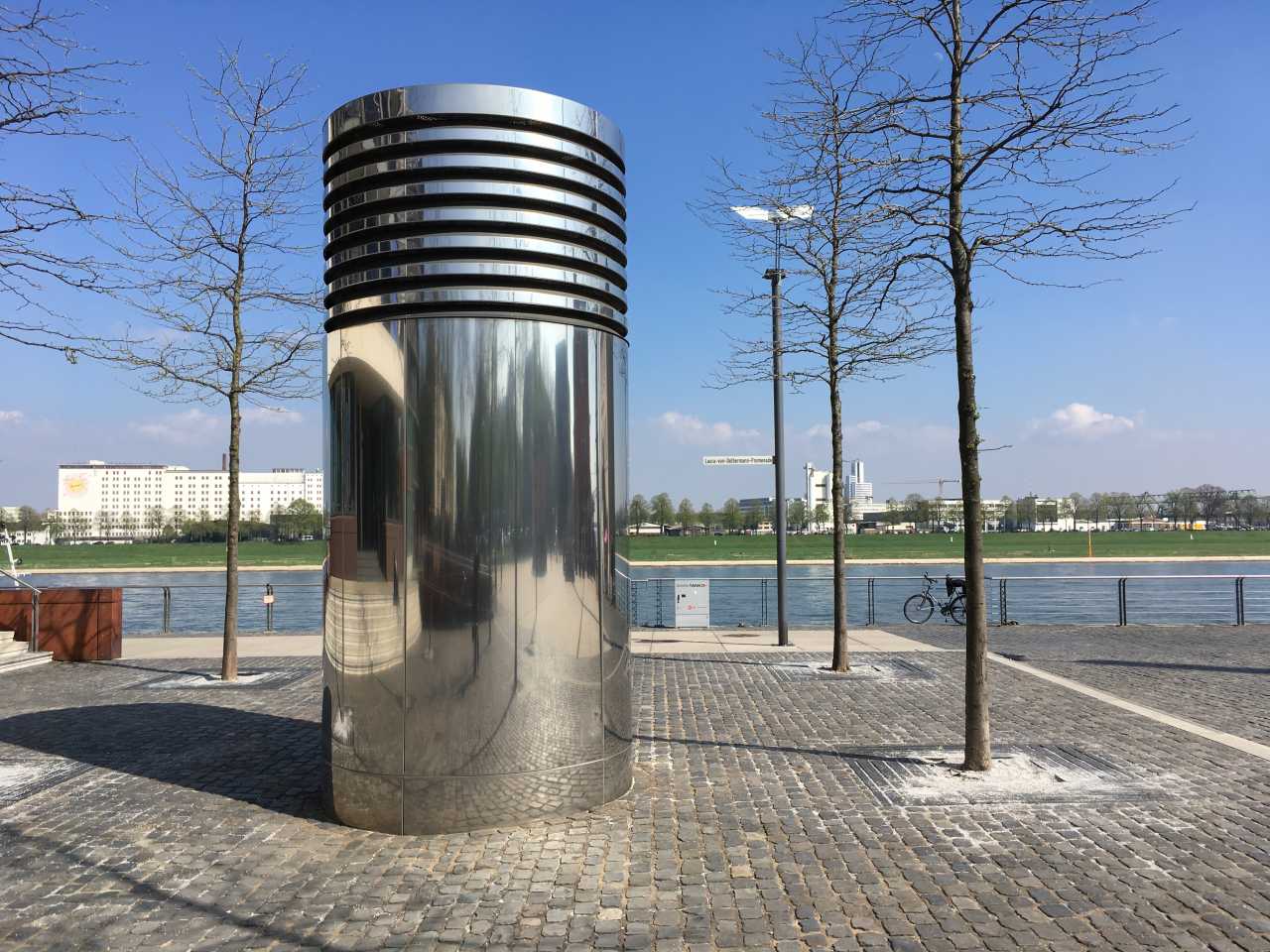
The present task of the week is about geometric figures. In the task “Cylinder on the Rhine”, located in Cologne, the aim is to determine the radius of a cylinder by means of measurements or the relationship between radius and circumference of a circle.


Task: Cylinder on the Rhine (task number: 1183)

Determine the radius of the cylinder. Give the result in m.


The task can be solved in different ways. One possibility is to use the relationship between the circumference of the circle and the diameter or radius. The result is then obtained by measuring the circumference. Alternatively, the radius can be determined by means of the inch post and suitable application (here the right angle plays a role). The task can therefore be classified into the topic circle, in particular the formula for the calculation of the circumference. The task shows that mathematical tasks can often be solved in various ways without calculation. Although the task does not require any profound knowledge of the cylinder (apart from the fact that the base is circular), it can be precisely in this aspect, and a connection of planar and spatial geometry can be made clear.

It can be used starting from class 9.