Task of the Week: Shaft Cover

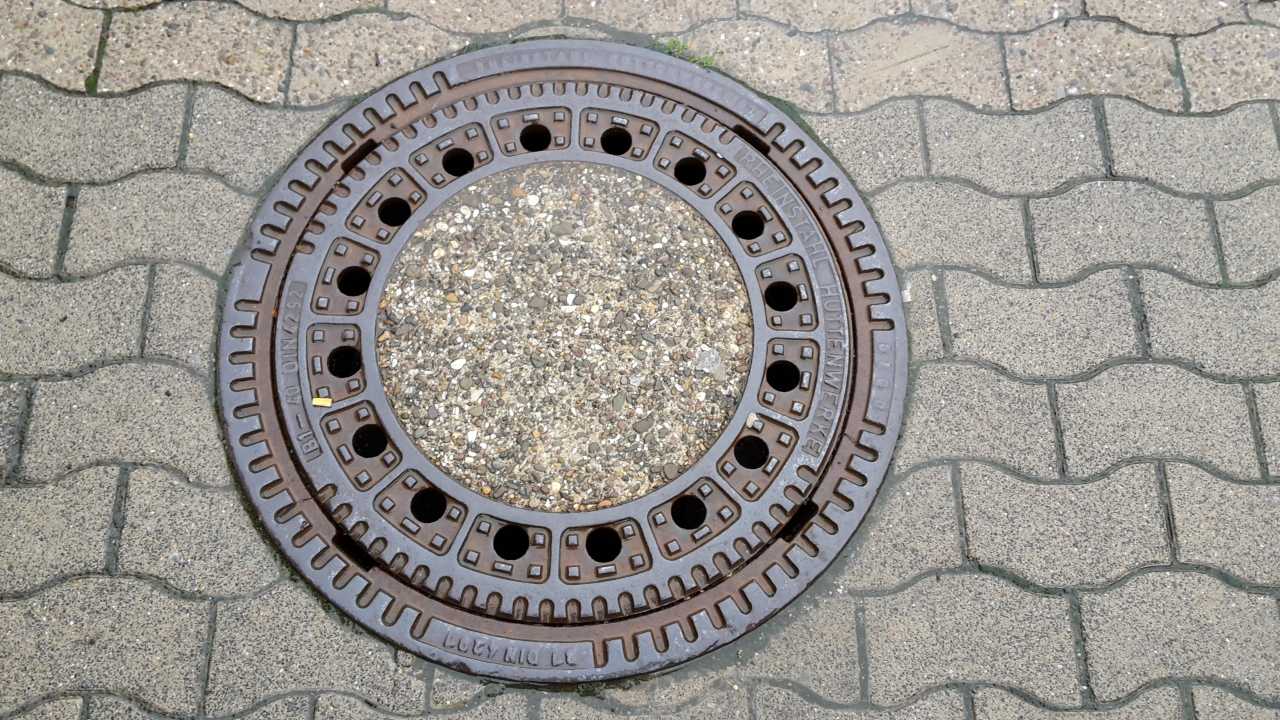
The current Task of the Week is about an everyday object, which is suitable for various tasks around the circle and can be used due to its frequent occurrence in almost every trail. More specifically, it is about the shaft cover of a canal and its dimensions and weight. Task: Shaft Cover (task number: 1804) […]

The current Task of the Week is about an everyday object, which is suitable for various tasks around the circle and can be used due to its frequent occurrence in almost every trail. More specifically, it is about the shaft cover of a canal and its dimensions and weight.


Task: Shaft Cover (task number: 1804)

In the center of the shaft cover, concrete is given. 12 liters of concrete are used per lid. What is the height of the concrete cylinder? Give the result rounded to one decimal place in cm.

To solve the problem, it is first necessary to recognize that the volume of the center of the shaft cover is given. In addition, the shaft cover has to be recognized as a cylinder apart from minor inaccuracies. Using the formula for the volume of a cylinder and the measured radius, the students can identify the required height. In general, the modeling competence and handling of mathematical objects in reality is trained. In addition, the flexible handling of formulas and the choice of suitable units play an important role in order to solve the problem. The problem can be grouped into the complex circle and cylinder and thus plays a role in geometric questions. The task can be used from class 9 onwards.
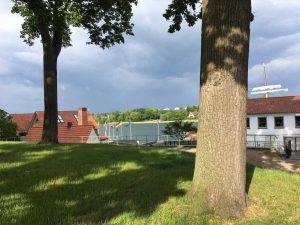
Task of the Week: Old Oak Tree

How can the age of a tree be approached using mathematics? This question addresses the current Task of the Week. It is placed in this form in Kappeln, but can be easily and quickly transferred to other places. Task: Old Oak Tree (issue number: 1473) How old is this oak tree? It is known that […]

Task of the Week

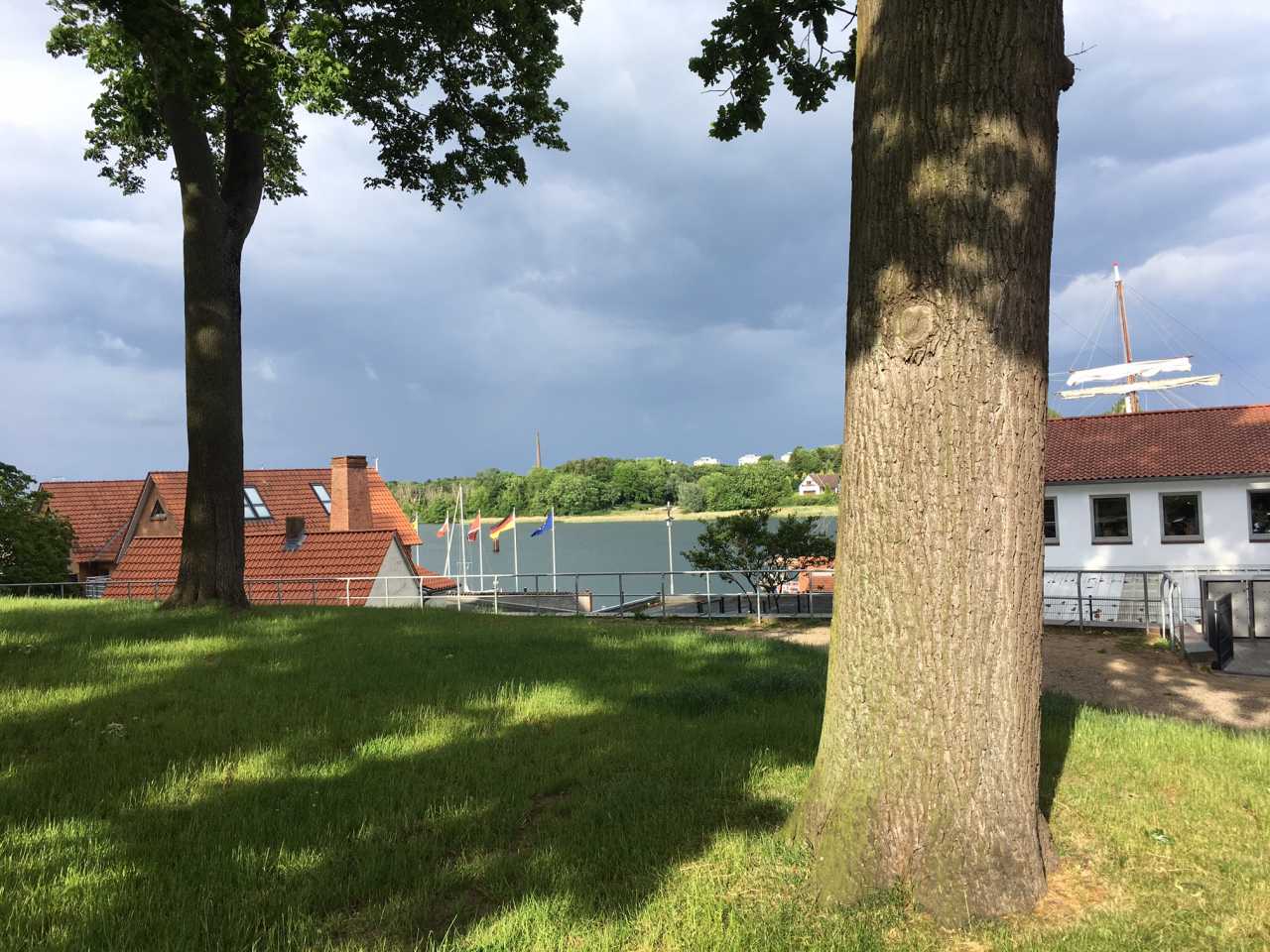
How can the age of a tree be approached using mathematics? This question addresses the current Task of the Week. It is placed in this form in Kappeln, but can be easily and quickly transferred to other places.


Task: Old Oak Tree (issue number: 1473)

How old is this oak tree? It is known that an oak with a diameter (in breast height) of 50 cm is about 110 years old.


In order to solve the problem, it is assumed that the growth of the oak is linear. This means that the average growth per year can be determined using the information in the text. Subsequently, the circumference in the height of the chest is measured and the diameter is determined by means of the relationship between the circumference and the diameter of a circle. This then leads to the age of the tree.

On the one hand, the problem can be classified in the geometric topic of the circle and, on the other hand, proportionality. If the relationship between the diameter and the circumference is already discussed at this time, the task can be used from class 6 onwards.

Task of the Week: Passage prohibited

The current “Task of the Week” shows that many geometrical questions can be found in different traffic signs. This concerns the circular “passage prohibited” sign and, in particular, the question of the ratio of red and white surfaces. Task: Passage prohibited (task number: 1102) How many percent of the area of ​​the “passage prohibited” sign is red? […]

Task of the Week

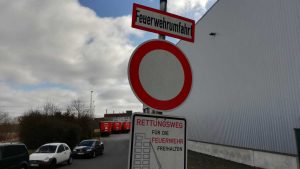
The current “Task of the Week” shows that many geometrical questions can be found in different traffic signs. This concerns the circular “passage prohibited” sign and, in particular, the question of the ratio of red and white surfaces.


Task: Passage prohibited (task number: 1102)

How many percent of the area of ​​the “passage prohibited” sign is red?


For the calculation, the pupils have to use their knowledge about the area of ​​the circle. In addition, it must be noted that the shield is not only white on the inside, but has a white edge as well, which must be considered for an exact calculation. The pupils measure the different radii, calculate the total area and the area of ​​the two white surfaces. By means of subtraction the surface content of the red ring is obtained. In the last step, the percentage of the red area has to be calculated.

The task can be classified in the area of ​​geometry, more specifically in circles and area contents, and is releasable from class 7 onwards. Other traffic signs can be integrated in a similar way into geometric questions, such as the “entrance prohibited” sign on a one-way street. In particular, the different flat figures on street signs (circle, triangle, rectangle, octagon) motivate different tasks.

Task of the Week: Cylinder on the Rhine

The present task of the week is about geometric figures. In the task “Cylinder on the Rhine”, located in Cologne, the aim is to determine the radius of a cylinder by means of measurements or the relationship between radius and circumference of a circle. Task: Cylinder on the Rhine (task number: 1183) Determine the radius of […]

Task of the Week

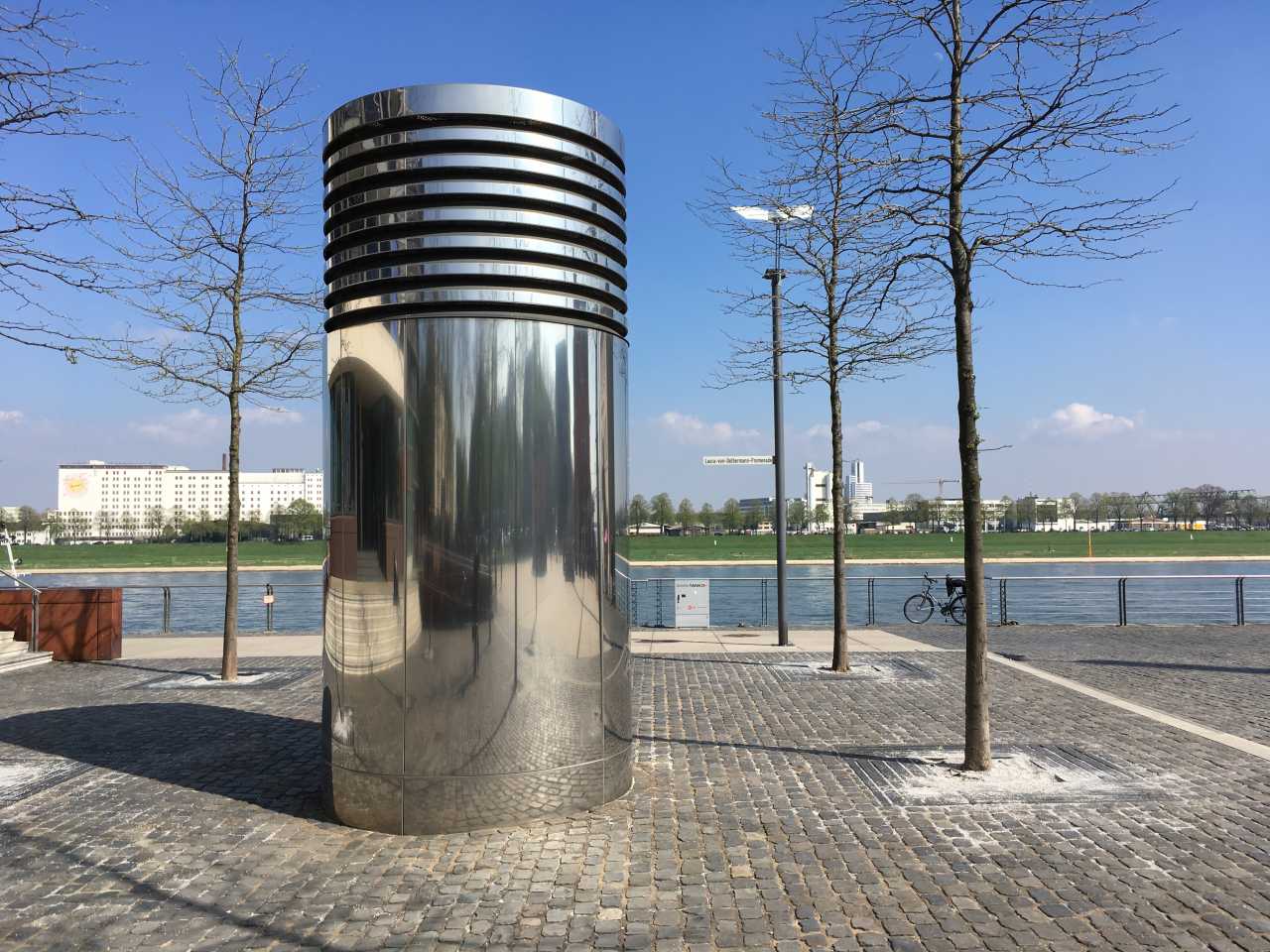
The present task of the week is about geometric figures. In the task “Cylinder on the Rhine”, located in Cologne, the aim is to determine the radius of a cylinder by means of measurements or the relationship between radius and circumference of a circle.


Task: Cylinder on the Rhine (task number: 1183)

Determine the radius of the cylinder. Give the result in m.


The task can be solved in different ways. One possibility is to use the relationship between the circumference of the circle and the diameter or radius. The result is then obtained by measuring the circumference. Alternatively, the radius can be determined by means of the inch post and suitable application (here the right angle plays a role). The task can therefore be classified into the topic circle, in particular the formula for the calculation of the circumference. The task shows that mathematical tasks can often be solved in various ways without calculation. Although the task does not require any profound knowledge of the cylinder (apart from the fact that the base is circular), it can be precisely in this aspect, and a connection of planar and spatial geometry can be made clear.

It can be used starting from class 9.

Task of the Week: Serpent Surface

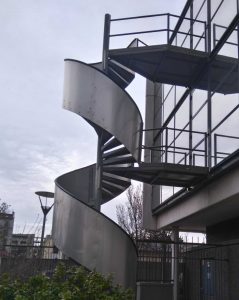
Today’s “Task of the Week” leads to Lyon, France, included in the trail “IFE”. It deals with an area calculation of a particular kind and shows in an exciting way which varied mathematical ideas are in everyday objects.  Task: Serpent Surface (task number: 1129) The metal railing of the fire stairs is in the form of a […]

Task of the Week

Today’s “Task of the Week” leads to Lyon, France, included in the trail “IFE”. It deals with an area calculation of a particular kind and shows in an exciting way which varied mathematical ideas are in everyday objects.


 Task: Serpent Surface (task number: 1129)

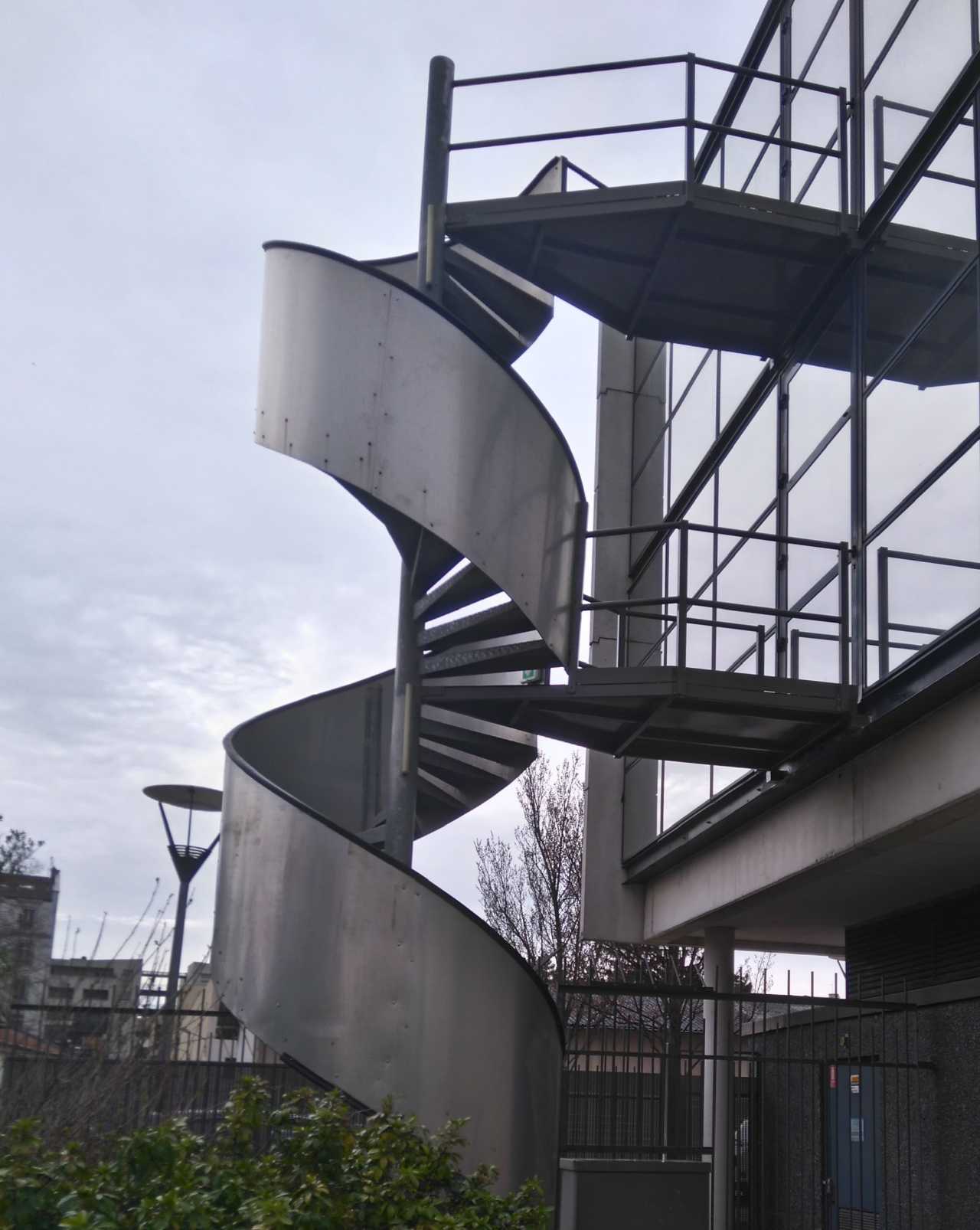
The metal railing of the fire stairs is in the form of a serpent line. Calculate the surface area in m².


 Before the students can begin to solve the problem, preliminary considerations are necessary, e.g. whether the slope of the railing is relevant or which formulas can be used to determine the length of the railing. The pupils should recognize the course of the serpent line as circular. In the case of two rotations of the staircase, the length of the railing corresponds to the double circumference of the circle with the step length as radius. With help of the circumference and height of the railing, the surface area of ​​the serpent surface can be determined.

This is a geometric problem which combines the subcategories “space and form” and “measuring” by recognizing geometric structures in the environment as well as measuring the sizes and using them for calculations. The task is assigned in particular to the theme “circle” and can thus be used with treatment of the formula for the circle circumference from class 8 onwards.

In addition, the task shows that many objects can motivate a wide range of questions. Besides the question of the surface area, it would for example be possible to calculate the slope of the railing.