Task of the Week: Serpent Surface

Today’s “Task of the Week” leads to Lyon, France, included in the trail “IFE”. It deals with an area calculation of a particular kind and shows in an exciting way which varied mathematical ideas are in everyday objects.  Task: Serpent Surface (task number: 1129) The metal railing of the fire stairs is in the form of a […]

Task of the Week

Today’s “Task of the Week” leads to Lyon, France, included in the trail “IFE”. It deals with an area calculation of a particular kind and shows in an exciting way which varied mathematical ideas are in everyday objects.


 Task: Serpent Surface (task number: 1129)

The metal railing of the fire stairs is in the form of a serpent line. Calculate the surface area in m².
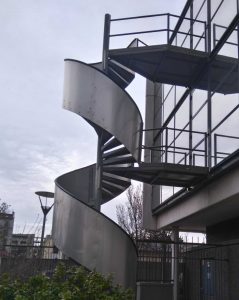

 Before the students can begin to solve the problem, preliminary considerations are necessary, e.g. whether the slope of the railing is relevant or which formulas can be used to determine the length of the railing. The pupils should recognize the course of the serpent line as circular. In the case of two rotations of the staircase, the length of the railing corresponds to the double circumference of the circle with the step length as radius. With help of the circumference and height of the railing, the surface area of ​​the serpent surface can be determined.

This is a geometric problem which combines the subcategories “space and form” and “measuring” by recognizing geometric structures in the environment as well as measuring the sizes and using them for calculations. The task is assigned in particular to the theme “circle” and can thus be used with treatment of the formula for the circle circumference from class 8 onwards.

In addition, the task shows that many objects can motivate a wide range of questions. Besides the question of the surface area, it would for example be possible to calculate the slope of the railing.
Task of the Week: Illumination of the Castle Garden

This week the “Task of the Week” focuses on a typical application of the intercept theorems. In particular, it is about the height determination of objects using the interception theorems. This task type can be transferred to many different objects and can therefore be found in further MathCityMap trails. The here described example is about […]

Task of the Week

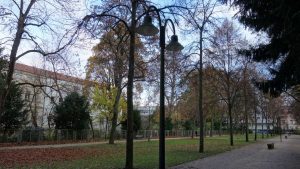
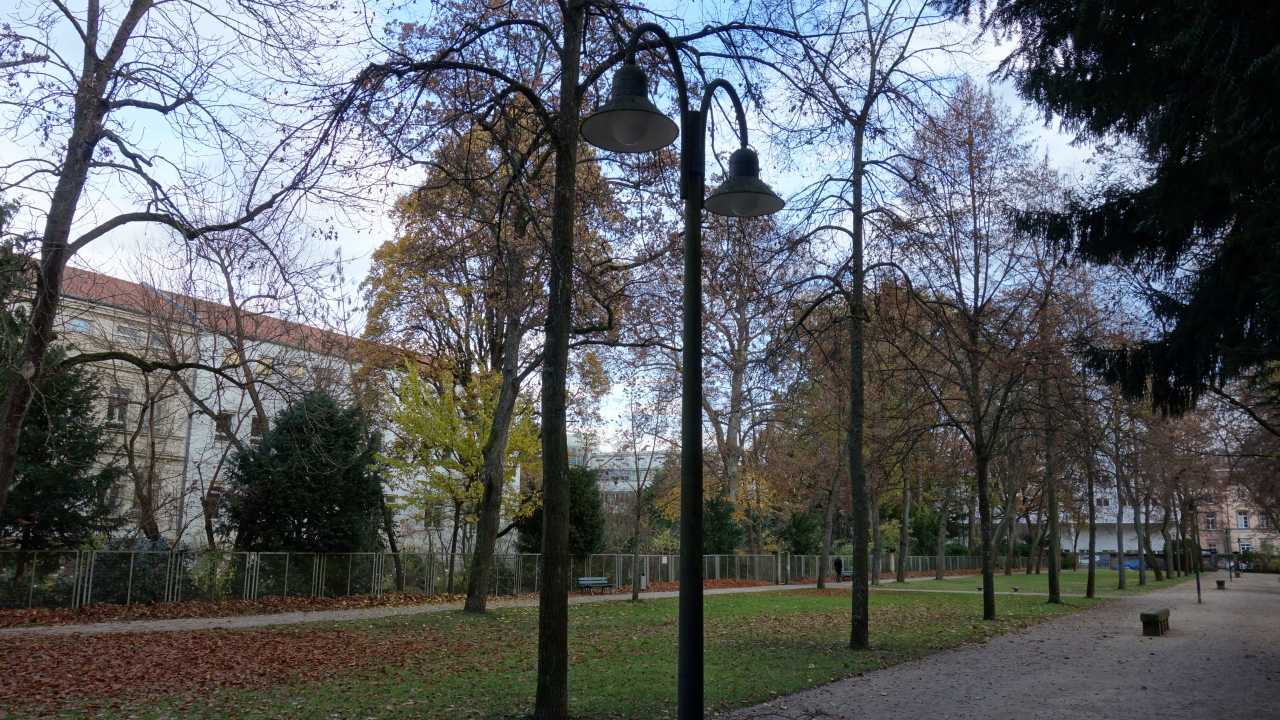
This week the “Task of the Week” focuses on a typical application of the intercept theorems. In particular, it is about the height determination of objects using the interception theorems. This task type can be transferred to many different objects and can therefore be found in further MathCityMap trails. The here described example is about the height determination of the lanterns in the garden of Erlangen’s castle.


Task: Illumination of the Castle Garden (task number: 709)

Determine the height of the two-armed lamps in the castle garden in the unit cm.


To solve the problem, the second intercept theorem is required. For this purpose, the pupils position themselves a few meters away from the object and fix the object. The intercept theorem can then be applied using the measuring stick. For this, the eye height as well as the distance to the object must be measured. With the arm outstretched, the measuring stick is held so that its tip coincides with the upper end of the lantern. The length of the arm and the scale length, which corresponds to the height of the lantern from the height of the eye, lead to the height of the lantern.

This is a problem-solving situation in which initially missing values have to be determined by a suitable initial situation. The application of the interception theorem can in this case be facilitated through the preparation of a sketch. The task is particularly suited to show students the practical application of the interception theorem and to give a meaningful content to the calculus.

Task of the Week: Weight of the Quai 43

The current “Task of the Week” from the trail “La Doua” in Lyon, France, shows that the MathCityMap project is already implemented internationally. Originally, the task is in French and will be translated for the Analysis. Task: Weight of the Quai 43 (Task Number: 855) The building “Quai 43” has the shape of an ocean […]

Task of the Week

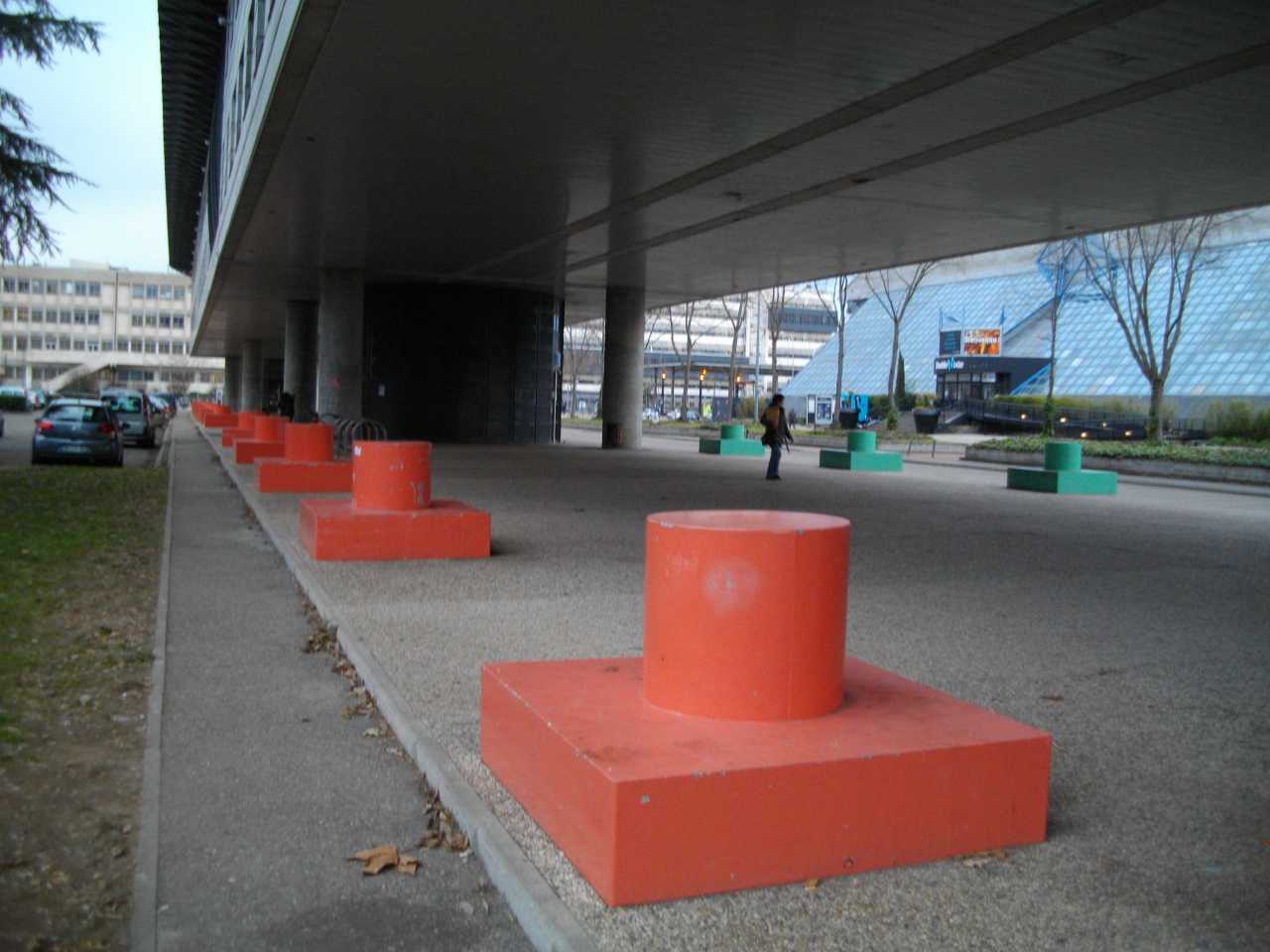
The current “Task of the Week” from the trail “La Doua” in Lyon, France, shows that the MathCityMap project is already implemented internationally. Originally, the task is in French and will be translated for the Analysis.


Task: Weight of the Quai 43 (Task Number: 855)

The building “Quai 43” has the shape of an ocean liner, which is built on ten concrete columns. Determine the weight of the building in tons (reinforced concrete weights 2.5t/m³).


To approximate the weight, it is necessary to calculate the volumes of the individual walls and floor slabs. To do so, the length and width of the building are determined through measuring. Afterwards, the area and the perimeter of the building (idealized as a rectangle) can be calculated. The building includes two floors and therefore the area can be counted three times. To determine the volume of the walls and floor slabs, it is further necessary to determine the height of the building and the thickness of a wall/floor slab. Afterwards, the students can calculate the different volumes through the formula of a cuboid. With help of a multiplication with the density, the approximate weight of the building can be found.

This task is a geometric and architectural problem which includes measuring of lengths as well as determining of field volumes. Especially modelling is in the center as the form of the building is approximated to a cuboid. Afterwards, the students have to consider which walls and floor slabs are relevant for the building’s weight. The task can be used from grade 7, especially in the context of cuboids and compound fields.

This task is only one of many examples which show that the MathCityMap project is an international project which stands out due to its universal use at several locations.

Task of the Week: Advertisement Pillar

From now on, a selected task from the MathCityMap portal will be presented weekly. These tasks will be collected under the category “Task of the Week” and illustrate the diverse mathematic and realistic usages of the MathCityMap project. In this week, the focus is on the mathematic use of the advertisement pillar, exemplary included in […]

Task of the Week

From now on, a selected task from the MathCityMap portal will be presented weekly. These tasks will be collected under the category “Task of the Week” and illustrate the diverse mathematic and realistic usages of the MathCityMap project.

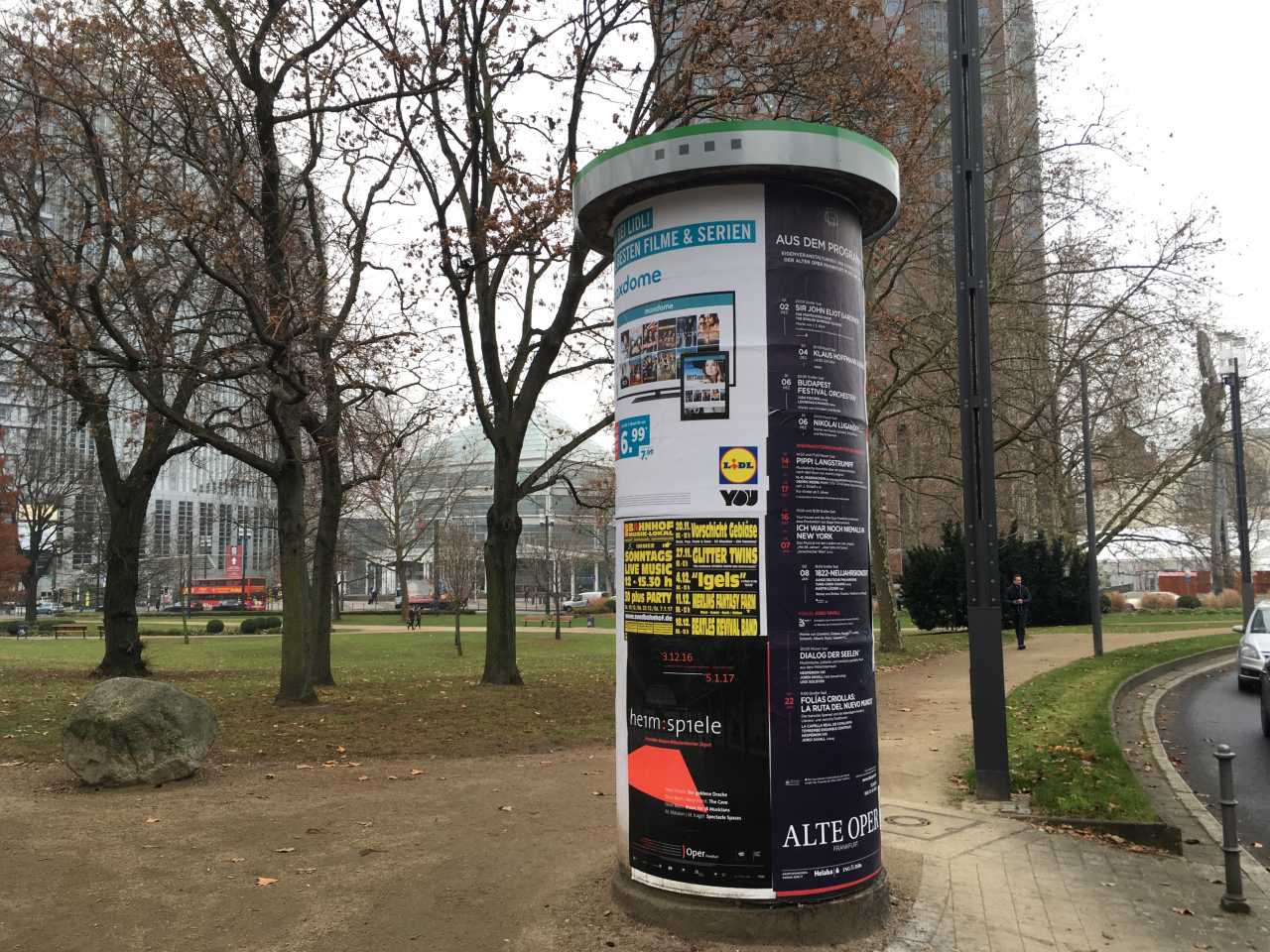
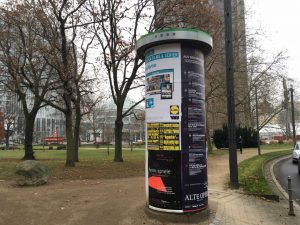
In this week, the focus is on the mathematic use of the advertisement pillar, exemplary included in the “Weihnachtstrail” in Frankfurt with task number 783.


Task: Advertisement Pillar

How many DIN A0  posters (84,1 cm x 116,9 cm) can be placed in portrait orientation and without overlapping?


To solve this task, it is necessary to measure the number of posters which can be placed in height and length. To do so, the perimeter and the height of the advertisement pillar have to be measured. Afterwards, the task can be solved with a multiplication. The task belongs to geometry, especially to the branches “space and shape” and “measuring” and can be used from grade 5. As it is asked for the number of posters, the solution must be a natural number.

This task is particularly suitable in terms of the MathCityMap concept as advertisement pillars exist in every city. Therefore, the task can be adapted easily and quickly to other surroundings which is underlined through the fact that similar tasks can be found in other trails as well. This task is an effective activity to do outdoor mathematics.